Review of Divination with Human Heart Attached by Emily Stoddard

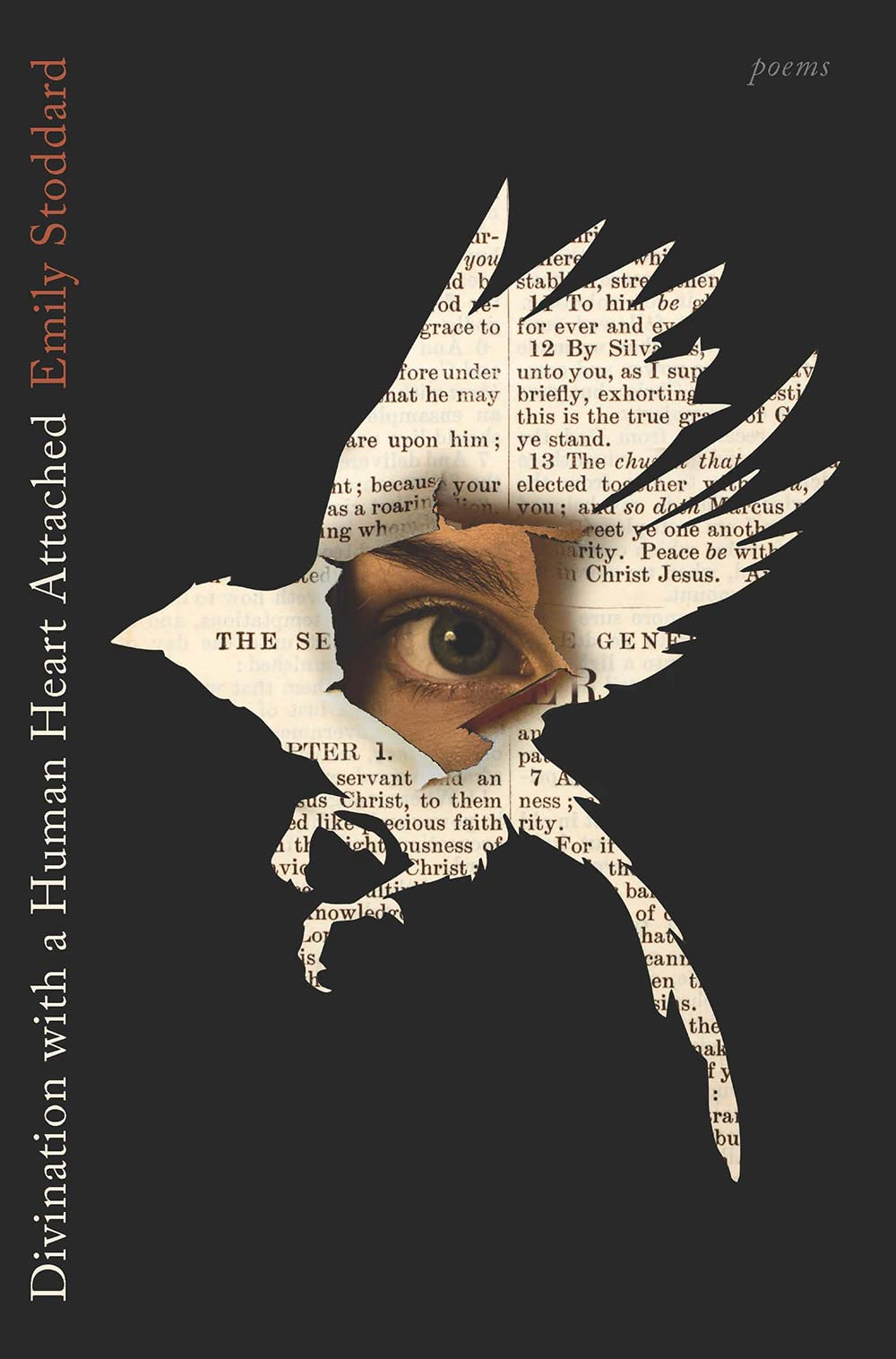
In Emily Stoddard’s debut poetry collection, Divination with a Human Heart Attached, I felt many resonances with my own life, particularly the wrestling with faith and the deep love for plants. The 2023 collection of 36 mostly free verse poems is deep and wide. There is rich religious language that is at times biting critique of institutional corruption and sexism in religious institutions, and at others cleverly reimagined Christian mythology. In other corners of the book, we sit with the author’s deep longing for rest in the Divine and realize that there are green shoots emerging from the scorched earth of our contemporary religious wasteland.

Raised in the Mormon tradition, I consider myself a contemplative catholic these days, but my faith in the Roman Church is anything but certain or confident. Sometimes I feel as alienated from my Catholic parish as I might at a Richard Dawkins talk. But the good earth is big enough for my faith and my doubt. And I am glad about that. And Stoddard’s poetry lends me hope that I am not alone in this.

My heart swelled with sympathy with the very first line of “More & More”: “The trouble is / everything calls to me.” From my desk I can see birds squabbling over my birdfeeder. I have come to love these birds and they are an important part of my work from home ecosystem. There are white-crowned and song sparrows, juncos, chickadees. I am writing a university course on birds in the humanities, and I have been fascinated to learn of the common practice in many cultures, but particularly among the ancient Romans and Greeks of divination using birds. This art is called augury or ornithomancy, and the omens brought by birds appear at key moments in the Iliad and Odyssey. Stoddard’s title references divination that goes inward, but her poems are richly colored with plant and bird life. In one instance, the magpie presents a powerful fusing of the transcendent power of air and flight and the earthy arrival of ground.

In “I Might Have Been a Botanist”, she wrestles with the wonderful knowledge of science and its tendency to reduce the world beyond the recognition of poetry. She writes, “More, I said,  / tell me your name, I said / without the restraint of a scientist,”. As a child, I was fascinated by the natural world, but science and math classes felt anything but earthy. My favorite activity outside was make believe, imagining I was a boy in the wilderness, where I was at home talking to animals. The reductionism of science also repulsed me during my graduate work on forestry, where our frequent trips into the woods seldom invoked words like beauty from the instructors and foresters.

In “Hivemind Elegy (There are Things Coming)”, Stoddard enlists the imagery of that fatal mythical apple to speak of a surging ecological grief that is attending our descent from fossil fuel civilization. She writes, “Migration patterns may soon / become escape routes,”. We all know something is coming. We don’t know how bad it will be. Satan stands before us offering two temptations: embrace technological optimism or give up hope completely. I hear Stoddard facing her anxiety, tapping into her grief, but not making any sweeping claims about where this journey will take her.

In “Inheritance Rosarium”, we trace the contours of a multigenerational shawl knit from the bodies and hearts of a grandmother, a mother and the author. There are references to the mysteries of the rosary, saints, the rib of Adam, crosses and a deep longing for God peppered with the doubts of a strong young woman. The last line punches: “If it’s true, if god is there at all, she kicks us from the inside.” Reclaiming the image of god the mother, who is also being born by us, invokes the mystic wisdom of Meister Eckhart, who believed that each of us was called to give birth to God through our own spiritual fecundity.

In “Petronilla tries to imagine her father’s prayer (I)” Stoddard moves from divine feminine to lesser-known biblical women. The poem gives us a glimpse into the mind of a little know extra-biblical character, Saint Petronila the traditional daughter of Saint Peter. We see through Petronilla’s eyes and wonder at the traditional story of her being disfigured to save her virginity. 

One of the most unique, narrative poems, is “Passion Play” which is a touching portrait of a daughter’s love for her father, and his love for Christ and trees. After considering the damage a Roman whip might do to the skin of a defeated Jesus of Nazareth, she smirks at the strangeness of applying fake blood to her father, as he prepared to carry the cross in the passion play at his Catholic parish. Stoddard’s father had crafted the cross himself from a redwood tree. However, unlike the bellowing cry of sadness from the cross, Stoddard connects with the loneliness of the garden. The garden where Jesus found himself alone with the trees as his companions slept. Most Easter Saturdays, I find myself in a Catholic church witnessing the somber glow of candles. The bishop intones a chant in the dark, lights the bonfire, and then lights a single candle whose light spread outward through the congregation’s huddled candles. More subtle than a passion play, but every year this ritual fire rekindles my own inner flame.

In “Descendants” we find a heartbreakingly relatable wrestle with feeling out of place in an achingly beautiful cosmos. She writes “restless / for the language  /  an ancestor spoke / into the sky / of their god”. Wrestling with a feeling common among settlers of European descent in North America, she writes, “the ladder / of my spine / is lined by shores / that were not ours / to fish”.  It is such a familiar feeling to live in such a vast cosmos, with unlimited data coming to us from satellite images, without a coherent story to tell. And even the ground beneath my feet, in Vancouver, BC did not create me or my ancestors, who were scattered across north America by the frantic boats that left southern England in the 1700s. The pathway forward is far from certain. Divination with Human Heart Attached is a powerful auger of what remains worthy of our attention, even in the dark.  

Litanies of Grief for the Coming Age

Keynote address presented to Facing Ecological Grief at Simon Fraser University, April 29, 2023

I don’t know how you all build community, but planning conferences like this is one of my favorite ways! Planning this conference has been a joy. I am very grateful to Naomi Krogman, Paul Kingsbury, Laurie Anderson, Laurie Wood, Candace Ratelle-Le Roy and Chelsie de Souza for believing in this gathering. I am also grateful to all of you, who trust us enough with your day to come and sit and talk.

But I am not just grateful to you. I need you. We are going to need each other to weather the coming age.  I am not sure if what we are witnessing is a death rattle or a birth pang. Perhaps, both. What I am going to do is outline some perspectives on ecological anxiety and grief. Not as a psychologist but more as a cultural and spiritual activist.

I want to gesture towards an engagement with grief that holds all the wonderful and terrifying tensions that are building in our time. I don’t come to grief as a problem to be solved. A symptom to be alleviated. A neurosis to be alchemized into action by positive thinking.

Rather, I want to suggest that grief is more like an art form. Grief is a skill. I would even say that grief is a companion or a friend.In the arriving age, we need movements and justice and policy and technology. We also need practitioners of what I call Griefcraft: Midwives and storytellers and artists and chaplains. So let’s talk about our time of trouble with no easy answers.

A Litany of Bad News

Source: https://nymag.com/intelligencer/2018/07/climate-change-wildfires-heatwave-media-old-news-end-of-the-world.html

Because I don’t know if you’ve heard, but the world as we know it is ending. There has been a steady litany of troubling news from policy experts and scientists. There has been a litany of pleading for change from the world’s religious leaders, environmentalists and Indigenous communities. Listen to a few of these actual headlines from my newsfeed in recent weeks:

“Temperatures in 2023 could be record breaking with rapidly developing El Niño.”

“We are not the first civilization to collapse, but we will probably be the last.”  

“Living sustainably isn’t just a trend, it’s a necessity.”

“As 1.5 degrees looms, scientists see growing risk of runaway warming, urgent need to slash emissions.”

“Climate diplomacy is failing — but we need it to survive.”

“Catastrophic warming will claim lives without action.” 

“Ocean currents could collapse this century.”

“Oceans littered with 171 trillion pieces of plastic.”

“Record deforestation in Brazil’s Amazon a challenge for incoming president.”

“Extinction crisis puts one million species on the brink.”

“Scientists deliver ‘final warning’ on climate crisis: act now or it’s too late.”

Of course, there is lots of good news peppered in there too! Deforestation rates have slowed, nations are committing to more protected areas, or even that the garbage patch in the Pacific Ocean is enabling novel marine ecologies! But these days the scales seem to be tipped toward the catastrophic. We know there are still several pathways forward. But as the weeks and months pass, fewer and fewer of these pathways exclude a great reckoning with massive ecological, cultural and spiritual losses. This litany of troubling headlines can trigger in me a deep well of anxiety and anticipated grief. But what’s worse is that most of the time the sheer quantity of bad news results in numbness to feeling anything at all. (It also helps that the next frame is usually a tree or a cat or someone falling or a brand-new baby!)  

Generation Dread

So, while there is no longer any uncertainty about the reality of anthropogenic climate change, it is not certain what kind of world our children will inherit. While passing 1.5, 2 or even 3 degrees warming will not be the end of the world full stop; this does not resolve a sense of dread about how bad things are and will continue to get. How much loss will the coming generations have to metabolize? How many species, whose evolutionary lineages span millions of years, will be put to an end? As psychologist and holocaust survivor Viktor Frankl wrote in Man’s Search for Meaning, “at the end of uncertainty comes the uncertainty of the end.”

For me, this uncertainty at the end of the Holocene climate invokes a buzzing anxiety. Ecological Anxiety is typically defined as a state of worry about the future that invokes feelings of sadness, despair, anger, helplessness or hopelessness. Mental health and therapy circles have been talking about climate and ecological anxiety as an impact or symptom of the unfolding crises. This clinical approach tends to revolve around adapting one-on-one therapy models to equip individuals with more tools for coping with their climate-induced emotions. But anxiety is a completely normal response to an unfolding crisis.

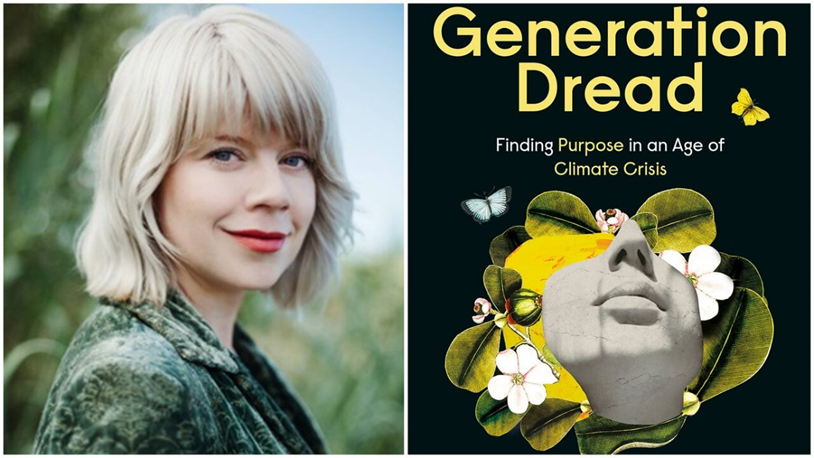
Anxiety is as much a signal being communicated from the heart of the world as it is a complex of subjective emotional responses. So rather than just coping with symptoms, deep attention to all of our feelings is an important part of engaging with anxiety related to the ecological crises. In her book Generation Dread, Britt Wray writes, “Despair and fear are not inherently bad. Hope and optimism are not inherently good…. We must move from an either/or to a both/and model. There is meaning in every emotion.”

There is a powerful practice here which is borrowed from Buddhist mindfulness. Anxiety is not best dealt with by insisting that I think positively or try to just focus on feeling gratitude. As Alain de Botton writes through his School of Life organization: “Peace of mind doesn’t come from hoping for the best; it comes from close attention to the very worst…” 

A common misconception in discussions of climate anxiety and grief is that this is primarily a concern of the privileged, global north. However, psychologist Susan D. Clayton and co-authors which included Britt Wray have shown, young people in the global south self-reported negative emotions related to climate anxiety at a higher rate than those in the global north. Their essay published in the peer reviewed journal Sustainability analyzed the data from a survey of 10,000 young people between the ages of 16-25 from ten different countries.  For young people all over the world, climate anxiety is impacting their ability to function on a daily basis. In Western countries however, self-reported impacts averaged around 45% whereas in the countries from the global south it was closer to 75%.  

Source: https://www.mdpi.com/2071-1050/15/4/3540

These findings reveal the obvious: Those closest to the front lines of these unfolding crises are most impacted by them. This is also the case for the far north. As the research of Ashlee Cunsolo, Dean of Arctic and Subarctic Studies at the Memorial University of Newfoundland shows, Northern and Inuit peoples are on the front lines of ecological anxiety and grief in an ecology that is seeing rates of warming four times higher than the global average. One of Cunsolo’s research partners, an Inuit Elder remarked: “Inuit are people of the sea ice. If there’s no more sea ice, how can we be people of the sea ice?” 

Two Temptations

In a civilization that has perfected the art of either or, the media often presents us with two responses to the unfolding crises. The first is Climate Doomism which believes it is too late for any meaningful action.  The second is a Hyper-Optimism that includes the belief that the more we do the better chance we have of fixing all the world’s troubles.

American writer Roy Scranton, in his book Learning to Die in the Anthropocene writes, “The greatest challenge we face is a philosophical one: understanding that this civilization is already dead. The sooner we confront our situation and realize that there is nothing we can do to save ourselves, the sooner we can get down to the difficult task of adapting, with mortal humility, to our new reality.”

Scranton frames himself as a climate realist, rather than an alarmist or reactionary. In my view he is more motivated by his anti-capitalist politics than a healthy realism about the future of the earth’s climate. Swedish academic and activist Andreas Malm, himself a Marxist scholar, calls Scranton’s book a reification of despair. This means that too often the Doomist view risks becoming a self-fulfilling prophecy that frees its adherents from any responsibility “in the meantime.” 

But there is something else going on here too. Having frequented environmentalist circles and taught in universities in different parts of North America, I worry that a contributing factor to the Doomist mentality is the belief that our species deserves to go extinct. It is imagined that perhaps the earth community would be better off without us.

This intuition is actually a kind of self-hatred that appears among some settlers and progressives.  Some days, I empathize. But I worry that we will not bother building the foundation for a world that we don’t believe our children are worthy to inherit.  

Rather, with scholar Lyla June Johnston, who has Navajo, Cheyenne and European ancestry, I believe that “Human beings are meant to be a gift to the land.” Human extinction would be as tragic as passenger pigeon extinction or monk seal extinction or tiger extinction or orca whale extinction. Human beings emerged from a mesh of ecological brilliance; and there is a place for us in the web of life so long as we can stop techno-industrial civilization from unraveling it completely.

Hyper-Optimism

On the other side of this false choice is what I am calling Hyper-Optimism; which feeds a well-intentioned fix-it mentality. All of us struggle with finding meaningful ways to take action. But this urge is so powerful that we sometimes demand ten ways to take action, before listening to what’s really going on.  Fed on a sugary diet of can-do’s, many activists throw their lives into the work and end up burning out in a few years. In his excellent book Earth Grief, Stephen Harrod Buhner reflects, “Activism is an institution that compulsively seeks to heal the world’s pain rather than feel it.”

Of course, he (and I) are not against action, or activism. We worry that a compulsive activism, fueled by urgency but also by guilt, can end up bypassing the necessary work of processing our feelings of fear, anxiety and grief. Some of this hyper-optimism is also deeply rooted in the modernist humanism which created these crises in the first place. The so-called techno-optimists, sometimes referred to as Eco-Modernists or Pragmatists, promise us that we are one technological breakthrough away from solving the climate crisis. Geoengineering, carbon credits, carbon capture and de-extinction will allow us to finally usher in the ecological utopia we have been dreaming of. I am very often tempted by their promises myself. Boosters of this approach are not so shy about suggesting that soon we will be managing every aspect of the planet’s biosphere.

There is, I think, a middle way between Doomism and its self-hatred and Hyper-optimism and its over-activism. Ecological Grief is part of this middle way: Griefcraft engages with complexities and uncertainties. As Donna Haraway writes, it’s part of the work of Staying with the Trouble. As an analogy, perhaps rather than franticly thrashing around in the dark to find the light switch, we might sit still for a moment and let our eyes adjust.

Topographies of Grief

In his book about the death phobia that pervades European descended North Americans, Stephen Jenkinson offers a novel description of grief: “Grief is a way of loving what has slipped from view. Love is a way of grieving that which has not yet done so.” This definition of grief shows how deeply connected it is to love, to feeling connected. We cannot grieve for that which we do not love.

Our experience of grief can vary from person to person and culture to culture. The famed psychiatrist Elisabeth Kübler-Ross developed a typology for the stages of grief: Denial, Anger, Depression, Bargaining, and finally Acceptance. This has been a helpful tool for individuals coping with a terminal diagnosis or the death of a loved one. But as the illustration below shows, there may be a common definition of grief, but there is no common experience of it.

Source: https://speakinggrief.org/get-better-at-grief/understanding-grief/no-step-by-step-process

We began today with a land acknowledgement. And every land acknowledgement brushes up against a deep well of historical trauma and grief. To speak of ecological grief as an emerging phenomenon is absurd without first acknowledging that it is a present reality for so many. As Indigenous scholar Kyle Whyte writes, “In the Anthropocene, then, some indigenous peoples already inhabit what our ancestors would have likely characterized as a dystopian future.” As a philosopher, Whyte has theorized an Indigenous ethic of sustainability and spiritually appropriate science. He also amplifies the many examples of Indigenous communities that are restoring ecological and cultural connections to place and species despite the heavy losses wrought by colonial violence and erasure.

To some extent, all of our bodies carry the grief of our ancestors. But the topography of ancestral grief is anything but flat. The collision of colonial, racist, gender-based and species-ist violence with ecologies and Indigenous bodies, black bodies, brown bodies and women’s bodies shape the contours of the topographies of grief like tectonic plates. Some are subducted under the enormous weight of oppression, while others are lifted to greater heights of privilege and social mobility. 

Ecologies of Grief

https://wildwhales.org/2018/08/29/a-mothers-loss/

Humans are not alone in feeling grief over lost loved ones. There are cultures of grief woven through the earth community. Fellow primates express grief and may even have a form of ritual. For example, chimpanzees have been observed ritually cleaning the fur of a dead loved one. Elephants are well known to reverence the dead and even to handle their bones. And closer to home, J35 was a Salish Sea resident mother Orca who carried her dead newborn with her for over 17 days.

Psychologist and writer Andrew Solomon writes, “To be creatures who love, we must be creatures who despair at what we lose.” Most of us have felt that icy absence of a partner, a loved one or a pet from our homes. We have walked around familiar places after a divorce or tough break up and felt both cherished and painful memories.

There is an ecology to our grief that is at once a response to loss within the web of our relationships, and the slow composting of loss into new life that finds a way to keep going. Grief after the death of a loved one is learning to inhabit a new interpersonal landscape, a rearranged social ecology. Paraphrasing writer and mythologist Sophie Strand, “Each loss opens a wound and a song in the Animate Everything.”

Zooming out a little, loss is also an integral part of the earth’s ecosystems. But on the ecological level, the long-term effects of loss are more difficult to judge. By this I mean that ecosystems are not nouns they are verbs, they are not things but events. Ecologies are adept at reorienting around loss and forming new processes and pathways. Afterall, with hindsight, I am incredibly grateful for the many losses that melted the glaciers that once covered this very spot and made way for lush rainforests to grow.

Death and loss are not separate from change and life and birth. The good earth subsumes interconnection and rupture, balance and imbalance. If you go into a forest and only see what is alive, you are only seeing half the picture. So, to my fellow environmentalists, if all we see when we look at changing ecosystems is loss, then we are not seeing the possibilities that change might afford for fostering novel relationships that are regenerative.

But do not get me wrong! I am not saying that actually, loss is just change, let’s accept it. There is a massive work of discernment here! It is true that a fear of change makes me allergic to loss. So, engaging with ecological grief helps me become better acquainted with loss and death. But ecological grief, as contemplative as it is, is not quietism! It is not a resignation to whatever may come.  If grief is a way of loving, then I am not afraid to admit: We still have a lot to lose! This is going to mean that Griefcraft is not just the skill of accommodating loss and tragedy. It is not passive or reactive.

As the twin sister of love, grief teaches us to accept loss when it comes, yes it does. But a love-bound grief is also willing to resist the losses that should not yet be let go of! In Cormac McCarthy’s novel The Road we read a grueling and gritty thought experiment with a stripped-down sense of human purpose.  In the novel, a man and his son stumble through a post-catastrophe landscape scrounging for food and avoiding roving bands of cannibals. The man’s only purpose is to see his son survive. His son is deeply committed to an objective sense of the Good. He carries with him the flame of hope that some day a better world might exist. At the end of the novel, McCarthy warns us against inheriting a world that is starved of life and beauty. He writes,

“Once there were brook trout in the streams in the mountains. You could see them standing in the amber current where the white edges of their fins wimpled softly in the flow. They smelled of moss in your hand. Polished and muscular and torsional. On their backs were vermiculate patterns that were maps of the world in its becoming. Maps and mazes. Of a thing which could not be put back. Not be made right again. In the deep glens where they lived all things were older than man and they hummed of mystery.”

We have a lot to lose, and I do not want to make meaning with the scraps of a once beautiful world! I want to live in a world that teams with life and love and beauty. And yes, even in that world that we all know is possible, grief will not disappear. On some deep level, I know that to love is to risk great suffering.

Building on this idea that love grows out of the rich compost of grief, University of Washington scholar Jennifer Atkinson writes that, “Grief is strength in these times. Burying our emotions might shield us for a while, but grief keeps us in contact with truth, and beneath everything, it opens our eyes to the profound love we feel for the fabric of life that’s under threat. Grief is a direct expression of connection—a pain we could never feel if it weren’t for the depth of our love. And more than cheerfulness or stoicism or more information, it is love that will move us to fight. No scientific report or technological innovation will ever match that kind of power.”

So being willing to risk the deep wounds of grief might give us a fighting chance. And that, my friends, brings us to Hope.

Litanies of Hope

Writer Rebecca Solnit’s Hope in the Dark is a powerful meditation on the complexities of history and the power of collective action over the long term. Solnit argues that Hope is active, but it does not die when things don’t turn out the way we expect. Hope is a stance of openness to the possibilities that uncertainty may bring. It is a posture of prayer. Hope is what got me out of bed this morning. Hope is what led Britt Wray, the author of Generation Dread, to the decision to have a baby despite her deep fears for the future. Hope is what is blooming all over Vancouver right now. Hope is what brough the goldfinches and chickadees and sparrows to my bird feeder this morning.

For these reasons, I appreciate Stephen Harrod Buhner’s reflections. He writes, “Hope is a quiet, enduring, persistent thing. It is not filled with the excited, uplifting, future-oriented energy of optimism. It possesses instead a slow-moving groundedness, an enduringness, a solidity, a nowness. It isn’t going anywhere, it just is. It’s a form of faith, a faith that comes from life itself.”

Hope is our animal soul’s very breath! There are dozens of projects, workshops, circles, art exhibitions and gardens that are engaging with the skills that accompany what I am calling grief-craft. Projects that are exploring the personal and collective depths of ecological grief. Francis Weller’s book The Wild Edge of Sorrow outlines many ways of engaging with grief through ritual. And groups in Iceland and Switzerland have already held public funerals for glaciers that are melting out of existence. A woman named Gabrielle Gelderman who lives in Edmonton, Alberta has begun using the title of Climate Grief Chaplain. In Victoria, a small collective of artists has started a magazine called Solastalgia which aims to be a resource for art, movement building and grief-craft. (I’ll explain this word in a moment.) There are earth hospices, good grief networks, grief circles and climate cafés being explored all over the world, online and off.

Just to highlight a few more of my favorite projects: Participatory artists Heidi Quante and Alicia Escott founded the “Bureau of Linguistic Reality”. This project solicits new words that express worries and the textures of our unfolding reality. They took inspiration from philosopher Glenn Albrecht’s neologism Solastalgia which means Comfort-Pain, was imagined to get at a pervasive uneasiness about the losses our home places are incurring. This word has spoken to thousands of people from Appalachians fighting against mountain top removal, to the Inuit peoples witnessing the rapid warming unfolding before their eyes. This is a powerful reminder that cultivating a love for our home places is not just for good days. Placefulness, as I call it, is also about loving our places after they have been clear cut, or on the days that wildfire smoke is turning the sun orange and we cannot breathe.

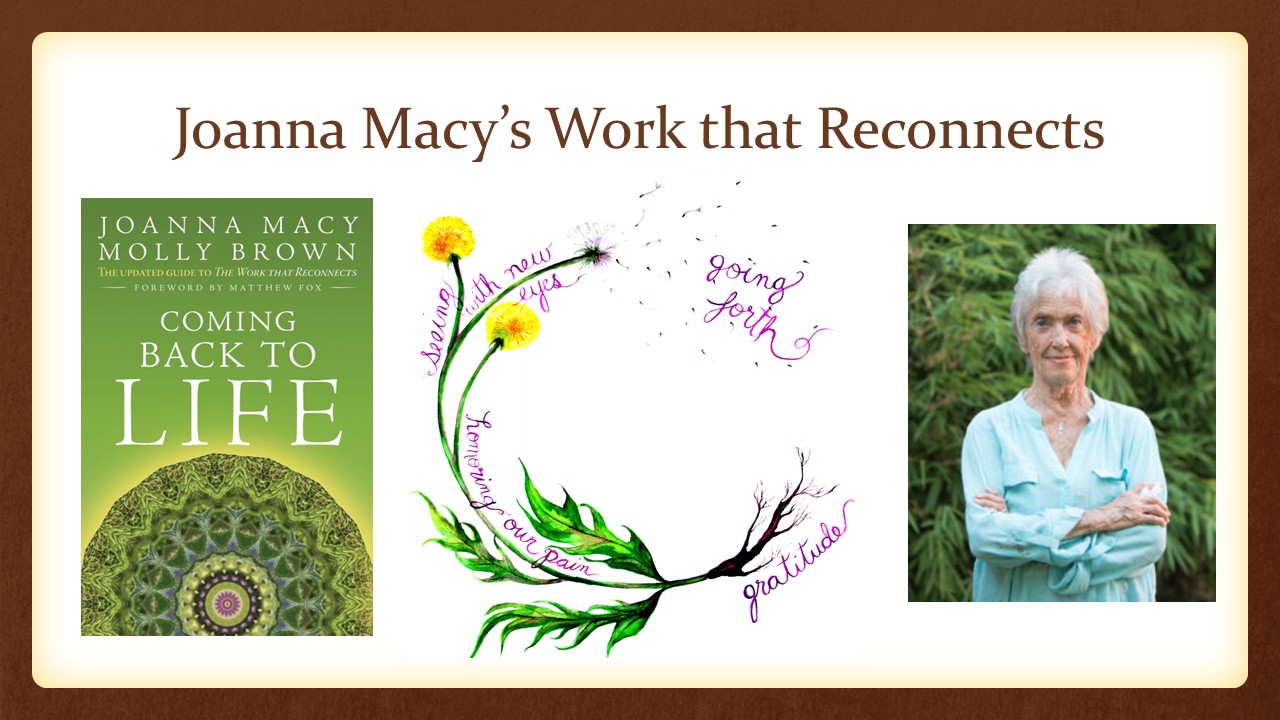
Joanna Macy’s Work that Reconnects began as a pioneering method for processing movement and ecological grief. Her cyclical, almost liturgical practices, encourage us to return again and again to gratitude. Then, turning our attention to honoring our pain allows us to see the world with new eyes. And even after one hundred burn outs, doing so enables us to go forth, back into the fray. To say with Samuel Becket, “I can’t go on. I’ll go on.” In a way, I structured this talk around this liturgy of hope: Gratitude, pain, new ways of seeing and the ways we might go forth from this conference.

Trebbe Johnson, a former wilderness guide, has started an organization called Radical Joy for Hard Times. Through annual Earth Exchanges, she invites us to love wounded and neglected places with simple acts of beauty. In a similar act of beauty, on June 16, 2017, during a Save the Arctic Campaign Ludovico Einaudi’s played “Elegy for the Arctic” before a calving glacier. This was of course primarily a public awareness campaign, but it reminded me of the famous epigram from German playwright Bertolt Brecht who wrote from exile, “In the dark times will there be singing? Yes, there will be singing. About the dark times.”

Ecological Grief is deeply personal, but we also need ways to express collective grief. I am open to ideas. Even bad ones! Perhaps we could create rituals that honor the losses we are too numb to feel. Perhaps we could sing our grief together and walk our grief together and dance our grief together. Or, perhaps we could experiment with nurturing trees and plants that are adapted to warmer climates. The many projects popping up all over the world help me to see that grief is not the opposite of hope, it is its pollinator.

Just as death is a mirror that we hold up to life to see how precious it is; grief is a mirror that is held up to love to feel how risky it can be. Public intellectual Cornel West once said that “justice is what love looks like in public;” well, my friends, if that is so, then perhaps what love feels like in public, at least sometimes, is grief. And perhaps that is what storyteller Brother Blue meant when he said, “My heart is broken. I never want it to mend.”

Thank you for listening!

Cultivating Placefulness

Prelude

Toward the end of writing the manuscript for my book about the monastic sense of place, a simple turn of phrase occurred me: Placefulness. This seemed to sum up in a simple word how monks in the Benedictine/Cistercian monastic tradition related to the landscapes of their respective monastic communities. The were present not just to abstract theological notions, or the love of God, but to the intricacies of their surrounding environments, which were often extensive rural properties.

I googled the phrase. A workshop called Into the Mountain mentioned it, seeking an embodied encounter with the land. A travel writer named Vanessa Walker named her website after the word, and it appears to be a new site dedicated to travel writing. There were a few other hits, but nothing that explored the word as an academic concept or spiritual practice.

The word felt useful. So, in December 2022, when I was invited by the Multifaith Network for Climate Justice in Bellingham to give a talk on contemplative ecology, I thought I would think through the idea out loud. The talk was well attended, and I gave a follow up in Vancouver at Simon Fraser University’s Institute for the Humanities. This Sketch is an outline of that talk.

We seem to me living in the -fulness of times. You are probably familiar with the term Mindfulness: Meditation practice rooted in Buddhism; moment by moment awareness of sensations, thoughts and feelings without judgement. But there is also an emerging alternative called Bodyfulness, articulating the somatic therapist Christine Caldwell’s paradigm for a more embodied contemplative practice. Geologist Marcia Bjornerud has recently written a book called Timefulness which argues that as temporal creatures we are embedded in earth’s deep time cycles. Placefulness then would be something along the lines of the contemplative practice of attending to what is and what arises in our places, especially during troubled times. So, like any spirituality worth its salt, that means integrating the good, the bad and the ugly in the places we live, especially as climate change takes a deeper hold on the world.   

To Be in Place

The Greek philosopher Archytas (4th century BCE) is reputed to have said that “To be is to be in place.”[1] This positioned place as a central ontological notion in Greek thinking that was all but obliterated with the advent of geometric space during the Enlightenment and the seeming social construction of everything with the semiotic turn of the 20th century. Starting in the 1960s sense of place began to reclaim space (so to speak) in the theoretical circles of geography and the social sciences. For example, an early re-examination of place is found in Yi Fu Tuan, a geographer, who used the term Topophilia to explore the “feeling-link” between people and places (1974). This can be compared with EO Wilson’s Biophilia: The idea that we are biologically rooted to feelings of affinity with life. Edward Relph’s Place and Placelessness (1976) examines the importance of em-place-ment, and the malaise of place-less-ness that set in during the late modern period. One of my favorite explorations of place and perception is by anthropologist Tim Ingold, who developed a “Dwelling Perspective” on environmental perception that drew from the phenomenology of Heidegger and Merleau-Ponty, who were overtly opposed to the Cartesian project that had favored space over place. Echoing this ontological turn, anthropologists began to see that as Christian Norberg-Schulz writes, “To dwell means to belong to a given place.”[2]

A few examples:

Aboriginal Song Lines

Bruce Chatwin’s book The Songlines (1987) explores settler and aboriginal understandings of place in Australia. In the publicly available sources, Aboriginal sense of place can be described as relating to the Dreaming. During the Dream Time (Every-when), the Ancestors of all life sang the world into being along tracks, called Songlines. during the Dreamtime. A Dreaming is one’s first Ancestor whether it be Kangaroo, Lizard, Bandicoot, Honey Ant, or Badger. Most Dreamings are animals, a few are plants or trees. An initiated person receives a portion of a Songline that traverses the first track of their Dreaming. The tempo and melody of the Songline express the topography of the place. So, forms of the land are a remnant of the first ancestors first movements, and each place is stacked with stories from that sacred canon.

Moral Place-scapes Among Western Apache

Indigenous placenames in the American West are often made up by afforded features of the landscape: Trees, mountains, valleys. Or they speak of activities that take place there like harvesting, council, or hunting. For example, in Western Apache place names, Tséé Chiizh Dah Sidilé means Coarse-Textured Rocks Lie Above in a Compact Cluster. This is a descriptive name for the features of that place.

In short, places teach Western Apache how to live. The collective history of the Apache has accumulated in these places, and they speak their lessons to the people. For example, at one such place a man attempted to commit incest with his stepdaughter. In Keith Basso’s account of these places in his amazing book Wisdom Sits in Places, his informant Ruth gets visibly uncomfortable as they pass this place in their car, and says, “I know that place, it stalks me every day.” In Ruth’s case the place reminded her of an assault she suffered by someone close to her. Not a romantic notion, but the wrongness of the act is written in the landscape which gave her strength. To put a person in their place so the speak, one need only recite a particular place name and its lessons will shoot like an arrow into the mind of one’s interlocutor.

Well Known Coast Salish Transformer Sites

In my part of the world, Cascadia, where Coast Salish peoples have lived and flourished for thousands of years, Transformer Spirits such as Xáays among the Squamish are responsible for certain prominent features of the landscape. A few publicly available examples: The Lions Peaks / Twin Sisters (Ch’ich’iyúy Elxwíkn) on the North Shore Mountain range were transformed for negotiating a peace treaty. The Stawamus Chief (Siám’ Smánit) in Squamish was a Long House where people and animals met for ceremony. Skalsh Rock in Stanley Park was an ancient chief turned into stone for insisting on purifying himself before his child’s birth. Additionally, obsidian deposits were understood as places where Thunderbird shot lighting out of his eyes. These sites were not only moral lesson, but monuments to their deep ties to place.

To be Rooted

Place is a richly textured part of Indigenous spirituality and lifeways. However, despite a reputation for Platonic otherworldliness, the Christian contemplative tradition has deep roots in a biblical sense of place. Simone Weil once wrote that “To be rooted is perhaps the most important and least recognized need of the human soul.”[3] Rootedness was a central idea for Weil, whose life was cut short by her own radical asceticism.

Biblical scholar Walter Brueggemann (2002) wrote that “In the [Bible] there is no timeless space, but there also is no spaceless time. There is rather storied place, that is, a place that has meaning because of the history lodged there.”[4] The Peoples of the Levant were covenanted to the Divine through places: Jacob/Israel wrestled with an angelic person, and the placename Penuel means Face of/facing Adonai. Many passages in the Hebrew Bible either begin or end with a reference to the name of a place, or the origin of that place’s name. Stone altars, groves, and mountain peaks were places of contact with the Divine or the history of the Patriarchal period. This is not a reverent nature spirituality, but a sacred geography where a peoples’ claim to the land was rooted in encounters with the Divine. Layered over this history, is the motif of the tension between the Paradise-Garden and Desert-Wilderness, starting with the very first chapters in Genesis where Adam and Eve are exiled from the garden. The entire arc of the story of Israel is God alluring them back to the garden through covenant, obedience and justice.

The story of Jesus of Nazareth is told through particular places. The arc of his vocation as Messiah recapitulated the places of Hebrew tradition: Bethlehem, Egypt, Jerusalem, Mount Tabor, and finally the Tree of Life (cross) and the Garden (tomb). Jesus consistently leaves the towns and cities to pray in the desert. Early Christians recognized certain places as sacred based on their association with Hebrew prophets, Christian martyrs, monks and ascetics and the life of Jesus. The early hermits and monks fled to the desert as means of radical asceticism, but also because the desert is an ideal place to practice a spirituality of silence.

The Christian relation to place becomes more ambivalent as it weds Greek metaphysics. As Saint Augustine wrote, “Our heart is restless until it rests in You.” Christian writers often portray humanity as a wandering pilgrim on earth, much as Plato saw the Forms as the really real. Belden Lane (2001) and John Inge (2003) show that despite a rich sense of place throughout Hebrew and Christian sacred writings, there is a tension with the mystic placelessness of Christian eschatology: Lane writes, “…one finds a continuing tension between place and placelessness, between the local and the universal. God is here—in this place at Bethlehem, Lourdes, Iona, even Boston and Salt Lake City.”[5]

The Monastic Sense of Place

My book Dwelling in the Wilderness: A Liturgy of Place for the Anthropocene (2023) will explore how contemporary monastic communities are invited into a rich sense of place. Rather than being born from the place as Indigenous peoples are, monks take a vow of stability that encourages them to become ‘lovers of the place;’ to root their whole spiritual life of seeking God in a place and a community of imperfect monks. That life is punctuated by daily and seasonal liturgies that can attune the monks to the cycles and seasons of their places. Manual work balances a life of prayer by engaging the body and can enrich spiritual development by linking tasks to places and teaching vital lessons about the spiritual life. A monk’s time spent in formation, work and leisure means that over many years memories and lessons accumulate in place, giving shape to a personal spiritual ecology that connects place, spirituality and theology. And while some monks may return to certain places over and over, it was often the ‘Charged Moments’, as one monk put it, that ended up being most significant. By Charged Moments the monk was referring to times when a feeling of communion, or a spiritual insight comes out of nowhere. Those unexpected places are then integrated into a monks’ spiritual ecology, or moral landscape: places of rich memory, lesson or insight that then continue to teach monks how to be monks. As one monk said, “You become part of the land. Our vow of stability grounds us, and an image that was really helpful for me was the idea of these trees [points] taking root; you know we’ve got thirty feet of topsoil, and the roots go deep… So that was the image of stability that I had. The longer I stay here, the more I can see myself growing in ways I never thought possible. It’s of course not always easy, staying in one place, but the [longer] you stay the [the higher you can] reach.”

Placefulness as Contemplative Ecology

European descended peoples in North America live with a devalued sense of place. It has been re-placed by mobility, commodity and sentimentality. We see uprootedness, placelessness, dis-placement. The troubling loss of place can been seen through the post-modern attempt to respond to a deep yearning for rootedness in the culture. As philosopher Vince Vycinas wrote, “[W]e are homeless even if we have a place to live”[6] Often, new architecture seeks to emplace us by building homey Town Centres that mimic public or even domestic spaces, flashing a sense of place to our meaning-hungry hearts. Consumerism is as much driven by manufactured needs as it is a sense of belonging or self that has been expertly packaged and sold back to us. The Anthropocene, the so-called geological epoch of human domination, is as much a crisis of meaning as it is a crisis of ecology and extinction.

As parties gather in international conferences to discuss emissions reductions targets, many activists have also been looking for ways to heal a wounded sense of meaning, purpose and sacredness in a world on the brink. In the scholarly world, tracking this movement is often called Religion and Ecology or Religion and Nature. But activists tend to use terms like Spiritual Ecology or as Pope Francis does in his encyclical letter Laudato Si, Integral Ecology. These broad movements represent the spiritual wing of environmentalism that sees ecological issues as moral issues, the earth as sacred. As Sufi teacher Llewelyn Vaughn Lee expresses, “The world is not a problem to be solved; it is a living being to which we belong. The world is part of our own self and we are a part of its suffering wholeness. Until we go to the root of our image of separateness, there can be no healing.”[7] Separateness and displacement from earth are roots of our ecological crisis.

This sense of oneness is echoed in the non-religious but deeply spiritual ethnographic memoir of anthropologist Richard Nelson, which takes places on the island of Haida Gwaii in British Columbia. He writes,

“There is nothing in me that is not of earth, no split instant of separateness, no particle that disunites me from the surroundings. I am no less than the earth itself. The rivers run through my veins, the winds blow in and out with my breath, the soil makes my flesh, the sun’s heat smolders inside me. A sickness or injury that befalls the earth befalls me. A fouled molecule that runs through the earth runs through me. Where the earth is cleansed and nourished, its purity infuses me. The life of the earth is my life. My eyes are the earth gazing at itself.”[8]

Without reference to God, religion or even spirituality, Nelson describes a realization that is perhaps obvious to Indigenous peoples, and those who are rooted in place, whose ancestors nourish the land they harvest their food from. For Nelson, it was an ecological Apokalypsis, a great revealing of a truth hidden before his very eyes.

My own writing at Holyscapes has been oriented toward a contemplative spiritual ecology that reflects on the relationship between inscape and landscape. Really what I am interested in is to learn the liturgy of my place. My walks attend to the cycles of the stars, sun and moon; I am even learning the rudiments of the astrological archetypes and Greek stories that accompany the constellations. I want to attune to the cycles and patterns of season and weather, the features of topography and surficial geology. The Latin, common and/or Indigenous names of plants, animals and fungi. The lifeways of food, medicinal plants and fungi. The soundscape and seasonality of local and migratory birds. And a growing awareness of the memories, lessons, experiences, symbols and rituals that embed themselves in the places I visit.

In addition to learning the liturgy of place, I think it is essential that we engage and support ecological restoration projects. While ecological restoration has its critics, one of its potential benefits is not just to local biodiversity or ecosystem function, but to our sense of place. As ecologist Stephanie Mills (1996) writes,

“[The act of restoration] gives [people] a basis for commitment to the ecosystem. It is very real. People often say, we have to change the way everybody thinks. Well, my God, that’s hard work! How do you do that? A very powerful way to do that is by engaging people in experiences. It’s ritual we’re talking about. Restoration is an excellent occasion for the evolution of a new ritual tradition.”[9]

Ecological restorations’ biggest potential might be in its ability to restore people to a deeper relationship with our places.

Caution I: Beware Spiritual Extractivism

One of the core moral lessons of the conservation movement, was that industrial civilization’s hunger for converting the earth into cash or calories has devastated ecosystems and caused a culture-induced mass extinction. Many of those who are interested in shifting the conversation toward a more sacred sense of the world have started many wonderful projects such as retreat centres, Wild Churches, or Forest Bathing circles. As I shift my mind set of seeing the world as a background to one of home, I want to say that caution is in order. In some ecological spirituality circles, workshops or liturgies I have attended, there is often a circle sharing exercise in which we are encouraged to go out into the forest and find a natural object that speaks to us, or to have a conversation with a tree, etc. We are charged, dismissed and given 45 minutes to soak up the forest’s spiritual lessons and the pressure is on! As I talk about Placefulness, my first caution would be to beware of a taking our extractivist cultural instinct and simply shifting it toward what I am calling a spiritual extractivism. Theologian Belden Lane’s words are a much better caution:

“The challenge is to honor the thing itself, as well as the thing as metaphor. When [Ralph Waldo] Emerson declared in 1836 that ‘every natural fact is a symbol of some spiritual fact,’ he sent people racing to the woods, anticipating the voice of God in the call of every thrush. But too often they paid scant attention to the songbird in their anxiousness to hear some transcendent message. They returned home full of nothing but themselves, their pockets stuffed with metaphors. As the imagination reaches relentlessly for a timeless, interior soulscape, it is easy to sail over the specificity of particular landscapes” –Belden Lane, The Solace of Fierce Landscapes (1998, 17)

Caution II: Beware Dissociative Jargon

This one’s for me. In academia, we are coming up with some important terms to describe what is happening to our world, words like Solastalgia, coined by Glenn Albrecht has gotten a lot of traction because it speaks to a feeling that is becoming more common, and just as potent as nostalgia was thought to be during the 1700s, where it was diagnosed as serious illness due to longing for one’s homeland. Solastalgia is the feeling of loss and longing for one’s home place as it changes before our eyes. This kind of language, though abstract and new, is powerful for describing our feelings. What I mean by dissociative jargon is more in line with words like environment, ecosystems and even ecology. Ecosystem is a word for places coined by a culture without a home. I learned this caution from a hero of mine, agrarian writer Wendell Berry. I have a lot to learn from this caution. As Berry writes:

“No settled family or community has ever called its home place an “environment.” None has ever called its feeling for its home place “biocentric” or “anthropocentric.” None has ever thought of its connection to its home place as “ecological,” deep or shallow. The concepts and insights of the ecologists are of great usefulness in our predicament, and we can hardly escape the need to speak of “ecology” and “ecosystems.” But the terms themselves are culturally sterile. They come from the juiceless, abstract intellectuality of the universities which was invented to disconnect, displace, and disembody the mind. The real names of the environment are the names of rivers and river valleys; creeks, ridges, and mountains; towns and cities; lakes, woodlands, lanes roads, creatures, and people.” –Wendell Berry, Sex, Economy, Freedom and Community (1993, 35)

Troubles: Therapizing Place and NIMBY-ism

In addition to these cautions, I am also interested in the troubles on the horizon, troubles for which I don’t have direct prescriptions to solve. These are troubles that I want to think out loud about in future writing and if possible, public gatherings.

First, there is a strong tendency to assume that developing a place is space is a kind of wellness technique. For example, forest-based therapists often see places through a therapeutic lens (this is often good). We develop a practice of deep attention to place as a means of de-stressing, unwinding, or spiritually tuning in to the happenings of a forest. However, I must insist that just as mindfulness is not just to be practiced when we are happy, a practice of Placefulness is not just practiced when our places are lush, or when we are comfortable and happy, or simply in need of cheering up. Forests are places of predation, decay, rot, parasitism, suffering and pain. If we go to the forest and only see vibrant life, interconnection and cooperation we are missing half of the experience.

Sense of place can also become something of a classist project of protecting a strict view of land that elevates places that are primarily in wild states, lined with walking trails and recreational areas. Working landscapes are often excluded, which tends to bias our notions of places worthy of our attention toward those that fit the narrow aesthetics of urban and wealthy recreators, retirees, or second homeowners. NIMBY-ism (Not In My Backyard) can even kill renewable energy projects that threaten a cherished viewshed. Some communities value places primarily for wellness, aesthetics, spirituality and leisure and these are important values. But Placefulness needs to wrap its arms around the reality that many people have to make their livings from the land, as foresters, miners, loggers, truckers, farmers, ranchers and many other professions and many of them are trying their best to do a good job, usually small scale, independent operators. This is tricky, because we need to radically transform our economy, but the answer isn’t simply building a wall around some places while others go to shit.

With Trebbe Johnson’s Radical Joy for Hard Times, we need to be prepared to love damaged places. We need to witness and resist cultures of destruction but also as Donna Haraway encourages us, to “stay with the trouble”. This means resisting either/or narratives that trade in either apocalyptic or techno-optimistic storylines. It means attuning to our neighborhoods as well as our local wild forest parks. It means supporting and celebrating a stream restoration project and grieving an oil spill in the bay. Our places are wounded, so are we. Attention, holy grief and acts of beauty in wounded places are integral to Placefulness.

Troubles: Weaponizing Place

Another important trouble is that deep reverence to places are caught up in human conflicts all over the world. Control over (sacred) places is often enlisted by ethno-nationalist agendas. For example, Hindu nationalists (VHP) demolished the Babri Masjid in 1992 because they claimed it was built by Muslim invaders on a sacred Hindu site. Sacred Groves in India, which are often pointed to as examples of ancient conservation projects, are often caste-restrictive, gender restrictive and include taboos that look nothing like the egalitarian access Westerners expect from protected areas. Sense of place is often accompanied by knowing one’s place in a social hierarchy. In addition, Israel/Palestine continues to be a conflict between those who are deeply invested in their identities and home places. Zionism is a place-based movement. Placefulness needs to grapple with this toxic dimension of sense of place.

Troubles: Reconciling Place

Last, sense of place is not communing with Nature with a capital N. In the pacific West where I live, he beloved forests where I walk, the parks and neighborhoods are all the traditional territory of the Musqueam people. To go into the forest and see only nature is to negate that these are cultural landscapes whose ancient stewards have been stripped of their claims by force. There is a political ecology to Placefulness.

There are some very encouraging large-scale trends: The BC Treaty Commission, Indigenous protected and conserved areas; the advancement of Rights and Title settlements; co-management, profit sharing agreements. The Land Back, Land Guardians, Indigenous land trusts, revitalization movements, Voluntary Land Tax projects like the Reciprocity Funds program. These are all gesturing in the right direction, but reconciliation and decolonization are not the same thing, and Placefulness needs to grapple with what that means for settler and immigrant peoples who love where they live. A post-colonial “Cascadia” should be able to include settler and immigrant peoples, but Indigenous peoples need to be treated with the historical justice that making right deserves. How far does that go? I don’t know. Perhaps I should start look into immigrating back to England after 7 or so generations of ancestry in North America? Or, perhaps my practice of Placefulness needs to be able to sit with discomfort, ambivalence, and the historical wrongs that I had no part in carry out, but whose privileged fruits I unquestionably benefit from. As Nigerian Post-Christian Yoruba writer Bayo Akomolafe says:

“I like to say that, sometimes the best answer to a pressing question is bewilderment. It’s not the answer itself, it’s not the correct answer, it’s the gift of bewilderment, it’s a gift of straying away from the algorithms of easy arrival. And my Elders always taught me that…the answers are not always going to be available…thank you for holding the space for queer questions, and uneasy arrivals for tending to the tense fields where new kinds of beings and becomings can thrive and grow…”[10]

Placefulness is about making space for the unknown, cultivating holy grief for a rapidly changing world, and loving our places even when it might be uncomfortable.


[1] Edward Casey, Getting Back into Place, 1993, 14.

[2] Christian Norbert Shultz, The Concept of Dwelling, 1993, 109.

[3] Simon Weil, The Need for Roots, 1949, 41.

[4] Walter Brueggemann, The Land, 2002, Pos. 3051, Kindle edition.

[5] Belden Lane, Landscapes of the Sacred. 1996, 242.

[6] Vincent Vycinas, Earth and Gods, 1969, 268.

[7] Llewelln Vaugan Lee, Spiritual Ecology: The Cry of the Earth, 2013, 7.

[8] Richard Nelson, The Island Within, 1989, 249.

[9] Cited IN: Gretel Van Wieren “Ecological Restoration as Public Spiritual Practice” Worldviews 12 (2008) 237-254.

[10] For the Wild Podcast: https://forthewild.world/podcast-transcripts/dr-bayo-akomolafe-on-slowing-down-in-urgent-times-encore-285

Saying Grace with Adam Miller

A short review of Adam Miller’s excellent book Original Grace: An Experiment in Restoration Thinking.

Prelude

The Church of Jesus Christ of Latter-day Saints (LDS) seems to have a grace problem. Like almost all Christian denominations in North America and Europe, the LDS Church has struggled in recent years to retain young people and progressives. Though the LDS Church’s support for conservative social issues will continue to be a point of tension for many, LDS philosopher Adam Miller’s Original Grace is an attempt to experiment with “Restoration Thinking” in order to affirm a core Christian doctrine to LDS spiritual practice: Grace. His research question: What happens when Justice and Grace are not seen as oppositional? His hypothesis: It changes everything.

Raised in the LDS church, but leaving in my late 20s, I have had my eye on Miller’s Zen-infused prose for a while. This is because Miller has wrestled with one of the issues that led me away from LDS practice and toward a more contemplative expression of Christianity. As an LDS person there was a grace-shaped hole in my life that I didn’t even know was there, but after suffering through deep depression during my mission years, mostly because of my own feelings of unworthiness, grace found me, and I began to believe that my status as a creature of God came before my actions or behaviors. In his boldly titled Future Mormon (2016), Miller’s essay ‘A General Theory of Grace’ simply states: “Grace is Original.” In this short review, I want to commend Adam Miller for his book length elaboration on that sentence and raise some questions for his ongoing experiment with a doctrine that has yet to find a comfortable place at the table of LDS spiritual practice.

Miller’s Radical Justice

Original Grace is a touching tribute to Miller’s late father, a disciple of Christ whose strongest theological proof of God’s existence was the self-giving love he felt all around him. For Miller, his father taught him that Justice and Mercy were always on the same team.

Central to Adam Miller’s claim is that the doctrine of Original Sin, a doctrine that the LDS church has negated since its ‘13 Articles of Faith’ were published in 1842, has nonetheless tainted the way LDS people live their understanding of the Gospel.

Despite LDS religious culture’s rejection of the austere Calvinist doctrine of “total depravity”, and its dismissal of Sola Fide (faith alone) soteriology, faithful LDS have nevertheless absorbed the idea that true justice justifies, at least in theory, the necessity of punishment for sin. That falling short of the Gospel merits our feelings of guilt and shame and that only by redoubling our efforts to be righteous will we come to our salvation.

LDS have often seen justice as a kind of divinely anointed karma: They, along with some other Christian lineages, intuitively believe the proposition that humans suffer because we deserve it. The Old Testament’s admonition of an eye for an eye is often described as a bridle for vengeance within a proportional tit for tat. The Hebrew imagination saw justice as restoring right relation among peoples, castes, land and God, and this certainly included God’s punishment of Israel’s enemies or those who strayed from Torah. Diseases, plagues and natural disasters were often interpreted as God’s justice playing out in the world (See 1 Chronicles 21:14).

Miller doesn’t negate the goodness of the law, but with LDS Apostle Dallin H. Oaks claims that Christ offers a better way. Miller asserts that this better way is to align justice with grace by returning not only good for good but also good for evil. This is a play taken directly from Jesus of Nazareth’s Sermon on the Mount. For Miller, in a Christian cosmos, suffering can never be deserved, only learned from and wrestled with.

Miller shares that as a missionary he constantly fought feelings of inadequacy and unworthiness. That is until he picked up Stephen Robinson’s 1992 Believing Christ. Robinson diagnoses the problem in his own spouse, who after working hard to be the perfect LDS woman collapses into a pile of defeat and despair. She accepted that her efforts would never be enough to merit the full measure of LDS salvation. Robinson takes the whole of the church to task on her behalf for refusing to believe that Christ means what he says and did what he did.

Robinson’s theory of the atonement is not so much of substitution, Jesus suffers on our behalf, but of being saved “after all you can do” (See 2 Nephi 25:23). To illustrate this Robinson shares ‘The Parable of the Bicycle’ wherein a little girl scrimps and saves for a bicycle for weeks, but still falls short, even after all her hard work. The loving father steps in and pays the rest. Grace, after all we can do.

Miller lauds Robinson’s first step, but argues that this “after thought” or “backup plan” soteriology still does not fully grasp the radical claim grace has upon us. When grace and justice are aligned, they ask not what we deserve, but what we need. Sin in this understanding is not a law broken, but grace rejected. Miller writes, “The problem isn’t that God is unwilling to offer the grace I need. The problem is that I’m unwilling to receive the grace God is giving” (14).  

LDS tend to think that salvation is the highest reward for living a righteous life, rather than seeing righteousness as the fruit of our embrace of the saving (salving) love of God. The commonly quoted LDS scripture Doctrine and Covenants section 82 reads: “I, the Lord, am bound when ye do what I say” is an underlying motivation for an LDS version of the prosperity Gospel, an esoteric incantation that extracts blessings from a God of justice. It is Max Weber’s Protestant Work Ethic liberated from Calvin’s total depravity. Strange bed fellows indeed.

Miller admonishes LDS that salvation is better sought and understood as a present-tense reality. “A shared life lived in Christ’s presence is the end. It is salvation” (20). Christian virtues like charity are what grace looks like in human clothing, not what Christians do to impress God, whose grace is the very air we breathe (37-38). He writes, “If we take Jesus’s Sermon on the Mount as our guide, the logic of justice is the logic of grace” (37). Thus, no instance of a karmic approach to justice in scripture can dissuade Miller from seeing justice as an expression of how to arrive at what human beings need rather than what we deserve. The Bible is not after all a story of justice executed judiciously in each case, it is a story about a thousand broken promises met by a God who loves us as a nursing child at his breast.

Grace and Nature

Perhaps because the book is tailored to a general audience, and went through the editing filters of Deseret Book, the LDS publishing house, I found myself wanting Adam to weave in threads of the “Traditional Christianity” he is partly polemicizing against. I found the lack of historical context for Original Sin or Grace for that matter a weakness of the initial chapters, even if the book is aimed to keep folks from slogging through the theological mud. In addition, I found that his work of aligning justice with grace was more successful than his case against Original Sin. A brief discussion of what I mean.  

First, a bit of background on the doctrine of Original Sin: This core doctrine is found at the heart of all Christian communions: Oriental Orthodox, Eastern Orthodox, Roman Catholic, Anglican, Lutheran, Calvinist, Anabaptist, Pentecostal and Evangelical. The theology claims that our mortality entails a proclivity to sin by nature.

This theology is primarily absorbed from the second account of Adam and Even in the Garden found in Genesis 3, wherein eating of the fruit of the Tree of Knowledge of Good and Evil results in the couple being expelled from the Garden of Eden. However, the doctrine also draws from the poetry of Psalm 51 where the poet writes, “Behold, I was shapen in iniquity; and in sin did my mother conceive me” (KJV). In the letter of Paul to the Romans (Ch. 5), he claims that if death came to humanity through one person (Adam), salvation most certainly could as well (Jesus).

However, Original Sin does not appear in Jewish theology. It was Saint Augustine of Hippo (354–430) an early Church Father who really solidified the doctrine. Augustine had a sudden and unexpected conversion to Christianity at the age of 31. His own riotous past convinced him that human beings are utterly dependent on God’s grace.

Miller’s only mention of non-Mormon theology is his mention of the theology of John Calvin, the 16th century French reformer whose understanding of faith meant that unlike the sacramental approach of the Catholic and Orthodox communions, no rite, ritual or sacrament was effective in ensuring our salvation. Not even an act of faith could save us. Our natures are totally depraved of the good, we are utterly and completely dependent on God’s grace. Our election is only made known to us through our desires to live a Christian life, or through the fruits of that life. The Westminster Confession, the current articles of faith of the American Presbyterians, continues to affirm that humans are: “Wholly defiled in all the parts and faculties of soul and body.” [1] Original Sin indeed. Interestingly, the Catechism of the Catholic Church reads:

“It is a sin which will be transmitted by propagation to all mankind, that is, by the transmission of a human nature deprived of original holiness and justice. And that is why original sin is called “sin” only in an analogical sense: it is a sin ‘contracted’ and not ‘committed’—a state and not an act.”[2]

In other words, human nature is wounded, but not totally depraved. The notion of an LDS human nature (which tends to be more optimistic) is never fully resolved by Miller who writes:

Christ’s atonement directly addresses a problem internal to my own nature as a sinner, not a problem internal to God’s nature. He bridges a gap caused by my rebellion against justice and grace, not a gap between God’s justice and God’s grace (59).

In all Christian readings, even LDS, my nature as a sinner comes through contraction, I have inherited my nature as a sinner. LDS do not appear to believe that our nature as sinners goes all the way back into the LDS pre-existence. Another option is that sin comes into the world only when we chose to sin. There is no pre-existing conditions, only a long string of spiritual lifestyle choices that our natures are vulnerable to slipping into.

When Miller says that his nature is as a sinner, he seems to be implying then that our sinful nature is contracted through our humanity and understood through the myth of Adam and Eve as the parents of our humanity. While this theory of sin feeds the logic of karmic justice Miller critiques, it is also at the center of his theology of grace, which does not presume to merit God’s grace, only strives to be a receptive vessel for it.

The LDS Church’s Palagian Problem

This leads to another bit of historical context. The rejection of Original Sin in the Christian tradition has tended to be by those who embrace the idea that we can earn our salvation. For example, Pelagius (c. 355 – c. 420 AD) a British monk, asserted that Original Sin did not taint our nature because our nature was synonymous with being, and being is sacred. Pelagius was one of the early Christians who demanded strict moral obedience for all Christians, especially priests. Pelagius’s view was quite popular in the 5th century, before Augustine’s Original Sin rose to the status of dogma. His notion of free will (free agency) suggested that God would not command us to be perfect (Matthew 5:48) if it were not possible. And God didn’t create anyone to be evil, this was a Manichean (dualist, gnostic) doctrine. However, after a public run in with Augustine, Pelagius’s ideas were condemned primarily at the councils of Carthage between 411–418 CE.  

Miller’s challenge going forward is that Mormonism’s rejection of Original Sin is in my view primarily a Palagian move. This is evidenced, not just in many LDS’ embrace of the Prosperity Gospel, but in the persistence of certain folk theologies that come from Joseph Smith Jr.’s later revelations. For example, Miller uses the word “Creation” in the book but does not clarify whether he also rejects the Ex Nihilio (out of nothing) Creation of “traditional Christianity”. LDS tend to talk about creation as an activity of organization overseen by a certain Celestial precinct’s God, in earth’s case Jesus Christ out of existing matter. Many LDS believe that our pre-mortal selves participated in that organization, a beautiful thought for some, but also a move that steals something of the grace at the heart of what it means to be a Creature. These two rejections: Ex Nihilo and Original Sin seem to leave the possibility of embracing grace less likely. Rather, embracing the strong contingency of my existence that ex nihilo creation asserts, and my nature as a sinner that original sin canonizes, leaves me prone to the radical beauty of God’s grace. 

Other Braids in the Estuary of Grace

Before I conclude, I would like to point readers to several other worthy explorations of grace-centered Christianity which flow in the same direction as Miller’s.

1)    The Franciscan Alternative Orthodoxy

The Franciscan Order, founded in 1209, has since the writings of Duns Scotus (1265/66-1308), asserted a minority position on the Incarnation (the doctrine that God took on a human form/nature). Since Scotus, Franciscans have asserted that rather than a ransom, or substitutionary approach to salvation, which is predicated on the inevitability of sin, Franciscans assert that Incarnation has been part of God’s plan from the beginning. Contemporary Franciscan teacher Richard Rohr likes to say that God becomes what he saves, and the Incarnation was not just a single event in Jesus of Nazareth, but an ongoing event from the beginning (See John 1).

2) Matthew Fox’s Original Blessing

In 1997, Dominican Friar Matthew Fox wrote a book entitled Original Blessing. His book proves that Roman Catholicism has just as deep a wound related to Original Sin as the LDS Church. The book got him excommunicated by Cardinal Ratzinger. In the book, Fox emphasizes the many affirmations of the goodness of creation in Genesis 1 that preceded the sin of Adam and Eve that saw them exiled from the garden. While I don’t find Fox’s scholarship all that impressive or well-disciplined, his assertion that the interpretation of Original Sin needs a complete overhaul, was well received with progressive Christians, especially those interested in ecological theology.

3)    The Neo-Celtic Christianity of John Phillip Newell

A former pastor in the Church of Scotland, John Phillip Newell has sought to amplify the teachings of the Church in the British Isles before the Roman standardizations of the 6th century. While he calls his Christianity Celtic, it is more accurately classified as a kind of Neo-Celtic Christianity, which infuses pre-Roman Christianity with contemporary concern for equality, spirituality, feminism and environmental stewardship. Newell negates the Virgin birth and believes that Creation was not effected out of nothing, but out of God.  He boldly claims that holding an infant is the best argument against the doctrine of Original Sin, a doctrine that he simplistically explains as primarily about imperial control and oppression of the masses. For Newell, Original Sin is psychologically damaging and makes up the core wound of Western Civilization, which leads to so much shame and self-loathing.

Conclusion

There are perhaps many more examples, but these writers sketch out the basic topography of the Christian interlocutors that Miller is in conversation with. Each of them emphasizes the primacy of grace as a bewildering gift, not a post mortal rewards package. I commend the razor-sharp prose of Adam Miller’s excellent book. Any discussion of grace is a balm to the common affliction of shame and guilt that justice-oriented approaches to religion too often take. And as Miller says, the LDS Restoration it isn’t finished.


[1] See Ch. 6, https://www.pcaac.org/bco/westminster-confession/

[2] Catechism of the Catholic Church, #404 https://www.catholicculture.org/culture/library/catechism/cat_view.cfm?recnum=624

Sketches: An Emerging Christian Mythodoxy

Over the next few weeks, I will post a series of sketches of some ideas I have kicking around in my head. With luck, they might become longer essays or full length books! Apologies in advance for grammar and spelling errors…

Living in Vancouver I have always felt a bit lonely in my Christianity. I love the catholic tradition, but I have serious hesitations about a full-throated enthusiasm for being part of the Roman Catholic Church. Recently, I learned that two men I admire converted (or in one case reverted) to Christianity. This has made me feel a bit less lonely and pointed to something I see happening among some spiritual but not religious ecological types. Paul Kingsnorth and then Martin Shaw, both British, and both frequent speakers on podcast and YouTube circuits, converted to Christianity in 2021. Paul converted directly into Eastern Orthodoxy, and Martin, after being baptized by an Anglican priest, has entered catechesis with a local Orthodox church in Exeter.

Shaw grew up in the Baptist tradition, with a preacher as a father, but in his teens became a musician and eventually left the church (very familiar to my own story). He was raised not just with theology but the telling of fairytales and myths. Now in his late 40s, at the end of a 101-night vigil in the forest, Shaw saw a multicolored star-like aura of light moving toward him which pierced the ground like an arrow. He heard a voice that said “Inhabit the time in Genesis of your original home.” He says he felt the presence of “the mossy face of Christ.” Thereafter, entering the lockdowns of COVID-19, he had series of dreams in which a clear message was conveyed. Podcasters Mark Vernon and then Justin Brierley have observed that many in the West are seeking for deeper meaning beyond the fuzzy post-Christian spiritual but not religious landscape of the liberal and progressive West. They have cautiously suggested that Christianity is entering a new phase.

Paul is a talented novelist, who for many years, was a front lines environmental activist. He always had a spiritual side and spent time in Buddhism and Wicca as an unapologetic Deep Ecologist and critique of industrial civilization. His book Confessions of a Recovering Environmentalist was a public break with his career in the mainstream environmental movement and a manifesto of slowing down, staying put and giving up on the “carbon game.” His response to environmentalism, and his lavish praise for writers like Wendell Berry always sounded to me quasi-monastic. His decision to move to a small farm in Ireland sealed that impression. Kingsnorth continues to rail against “the machine” but he is now doing so within a consciously English, even Celtic, Christianity that shares very little of the New Age trappings of the Neo-Celtic visions of folks like Matthew Fox or John Phillip Newell.

In both of their Substack threads Kingsnorth and Shaw have been thinking out loud about their newfound Christian practice. One thread of Shaw’s is entitled “A Liturgy of the Wild” and in it Shaw curates several wonder stories and archetypal hero journeys that are accompanying him as he learns the rhythms of the Christian liturgical calendar. I have always admired both men, and I feel a deeper kinship with their stories. I don’t always agree with Kingsnorth’s politics, but I certainly have taken heart in my own lonely journey with the catholic contemplative tradition.  

My pilgrimage into catholic Christianity began when I stumbled onto the writings of Thomas Merton, the Trappist writer-monk who spent much of life writing about contemplative spirituality from his monastery in Kentucky. When I attended my first Easter Vigil (Saturday evening service before Easter Sunday), I felt the power of the liturgy through the candle-lit depth of anticipated resurrection. It was a powerful, aesthetic, and affective experience. As the warmth of the liturgy sank in over the days and weeks thereafter, I realized that for me the power of the Christian tradition lay not just in creeds and atonement for sin, but in an ability to invite us into a participation with the cruciform nature of the cosmos. By this I mean that through a liturgy that aligns with the seasons of the Norther Hemisphere’s waxing and waning and the earth’s own resurrection, we bring our own bodies to the pascal mystery: birth, death, and resurrection. Coming to believe in the resurrection of Christ was made possible for me by experiencing first a real attention to the resurrection of the earth. Thereafter, the resurrection of Jesus was not an exercise in intellectual ascent to the proposed truthfulness of an enchanted version of History, but to the reality of resurrection that spoke out of every flower and tree and my own circadian pilgrimage through the year. Jesus distilled and recapitulated that rhythm with his life.

I recount this here because what I am observing and learning from Kingsnorth and Shaw is that to a large extent they too were drawn to the archetypal, storied mysterious depth of the tradition. Their hearts were caught in the fisher’s net, and they have lived to tell the tale. Like the mystics, who classically emphasize direct experience, they are speaking from their own bewildered walk with a wild Christ. Not the buddy Christ of contemporary mainstream Christians, but a dark figure who broods in the wildlands and rails against convention.

Shaw for example specifically states that he was drawn back to Christianity because of the strangeness and wildness of Christ and the story. He calls Christianity “the last great mystery”. And now he is a on a mission to reclaim the contemplative, wild, ecologically rich texture of the faith. Whereas many converts to Orthodoxy I have read about tend to emphasize coming to some ascent to its authenticity in relation to some imagined original or continuous Christianity, what I hear Kingsnorth and Shaw doing, is, walking in the tracks of the mystics, drawing close to the warm glow of the power of Christianity’s stories and liturgies.  

They are in short espousing what I want to call a Christian Mythodoxy. Mythos: from a root that comes from mouth, myths are not untruths to be busted, but the stories and deep human truths in which we see ourselves participating; not just moral lesson or entertainment. Doxy: meaning praise is our orientation toward the Divine, how do we soak up the rays of the Divine? It constitutes our spiritual practices, our liturgy and worship.

In the wider orbit of ecological spirituality, there are a lot of wonderful conversations that are trying to reconnect with the earth’s rhythms, place, archetypes, myths and even astrology. Adaya’s ecological spirituality courses, the School of Mythopoetics, the now defunct Seminary of the Wild, and many more. Yet while many of these courses can feel quite hostile to Christianity (speaking from personal experience), several renegade threads have been seeking to rewild the Christian lifeway.

For example, Franciscan Ilia Delio has showed that Catholic, from the Greek Kata-holon, according to the whole, must catch up with the facts of evolution and the implications of the discoveries of quantum physics regarding matter-energy as a continuous reality. Others like philosopher John D. Caputo have talked about post-modern Christianity as an exercise not in theology as science, but as a kind of Theo-poetics. As I often tell my students, religion done well is poetry about a mystery, meaning that theology for the most part is not meant to be an exercise certainty, proofs and evidence, but one of awe, wonder, praise and sometimes lament. Others such as writers Bayo Akomolafe and Sophie Strand are doing fascinating things with the possibilities of a wilder, earthier, porous Christianity. These two seem to be more on the outside margins of the tradition, but they speak eloquently about the wild origins of Jesus’s teachings, parables, and connections to the natural world in first century Palestine. Brie Stoner’s podcast Unknowing has also been the grounds for some interesting conversations about what comes after a rigid, denominational Christian identity at the dawn of the Anthropocene.

What I see happening more and more in these discoveries or reimaginings of Christianity does not fit into any denominational category. It is rather a kind of diffuse gesture, posture or dare I say (leaderless) movement. A Christian Mythodoxy seems to be one possible green shoot germinating out of the compost pile of a religion in decline (at least in the West). Stoner’s series on composting Christianity, and Sophie Strand have used that wonderful metaphor to talk about living on the edge of something that feels like both a death rattle and a birth pang (Romans 8). The so-called Anthropocene is bringing about great harm but is also opening space for something new.

What I am experiencing and observing is the idea that to be a Christian is not just to ascent to a platform of beliefs and then check one’s life against it. Rather, beyond theology (not in opposition to it), there lies a move toward a mythic praise, a mytho-doxy, grounded in the body and grounded in the cycles of the earth, that is the tangled fabric of our messy faith, which is always, already embedded in the liturgy of the cosmos, the good earth, and the breathtaking beauty of the pascal mystery.

A Communion of Earthly Saints

“I believe in the Holy Spirit, the holy catholic Church, the communion of the saints, the forgiveness of sins, the resurrection of the body, and life everlasting. Amen.

–The Apostles Creed

“The only true joy on earth is to escape from the prison of our own false self, and enter by love into union with the Life Who dwells and sings within the essence of every creature and in the core of our own souls.”[1]

–Thomas Merton

A Communion of the Saintly

Toward the end of the Nicaean and Apostle’s Creeds, Christians from many denominations affirm the belief in the Communion of the Saints. In practice, Roman Catholic, Anglican, Oriental, and Easter Orthodox traditions commonly integrate saints into our liturgies, calendars and even patronal names at baptism. My own patron saint is Saint Kevin of Ireland. Not only is he the patron saint of very ordinary names like mine, but as a hermit, he embodied the deep love of Creation at the heart of Irish Paganism and Christianity.

The Catechism of the Roman Catholic Church defines a saint as someone who is closer or more united with Christ in heaven. Intercessory prayer, which seems to pick up where Pagan polytheism leaves off, sees this proximity to heaven as a legitimate and effective way of amplifying one’s prayers. It emphasizes the idea that the church is a communal structure that is not confined to the living.

Saints are also culture-heroes that elevate our eyes toward heavenly virtues through the prism of their unique gifts. Saints are the celebrities and athletes of the spiritual life. They are role models and icons of holiness and character. For example, sounding a bit like a Catholic Bodhisattva, 19th century French Saint Therese of Lisieux wrote, “I want to spend my heaven in doing good on earth.”[2] Saints are heroic in virtue, and yet they are often keenly aware of their own woundedness. Contemporary Catholic commentator and YouTube evangelist Bishop Robert Barron uses the analogy of a pane of glass to describe the saintly heart. As it becomes more directly illuminated by light, even the slightest smudges and blemishes become readily apparent. As Barron puts it, saints are simply people who know they are sinners. Saints don’t earn this merit, they simply orient their lives toward the light already there.

In a broader sense, all Christians, or even all people, are saints. In his letters, the Apostle Paul refers to the ordinary members of his churches as Saints—as contemporary Mormons, the Church of Jesus Christ of Latter-day Saints, continue to do. For Paul, the Saints (Gk: hagiois, holy ones) were those who had chosen to bask in the Grace of the risen Christ.

This notion of ordinary folks being Saints shouldn’t surprise us. Think of Paul’s stark transformation from a persecutor of the church to a Christic visionary; or of Peter’s penchant for cowardly self-preservation at the time of the crucifixion, to a miracle working evangelist-martyr who tradition holds was crucified upside down. From the earliest moments of Christianity there is a notion that each of us are saints in embryo, holy not just through extraordinary feats of virtue, but through our createdness, our belovedness, and our utter dependence on God, who brings us into being and sustains us in each moment.

Making Room for Creation in the Communion of the Saints

For most of Christian history, Sainthood has been seen as a human affair. However, it seems like the time has come to decenter the human person as the only creature in Creation worthy of the title. I don’t want to devalue us, I want to decenter us, there is a difference. I want to think about this with the help of 20th century spiritual writer and monk Thomas Merton (1915-1968), the patron saint of ecology Saint Francis of Assisi, and a few other geologians.

It isn’t actually that much of a leap to go from the notion of a primordial sainthood at the heart of our human createdness, which emerges from no merit of our own, to the saintliness of the rest of Creation with whom we share our evolutionary morphology and instincts. As a monk explained to me on retreat regarding his belief in animal souls: “Do we have the same Father? Ok, then we are siblings!”

In his poem Canticle to Creation, Saint Francis of Assisi affirmed this close kinship with creation in the 12th century. In writing with the reconciliation of two rival cities in mind, Francis declared with the Psalms that all of creation rightly gives God praise. However, he also went a step further by referring to Sun, Moon, Water, Plants, Earth, and Fire as our siblings. He wrote: “Praise be to you Lord God through Brother Sun…”[3] This kinship language is striking for a pre-ecological age that affirms the interrelatedness of all creation. And yet, there is no confusing Creation and Creator, only a more directly aligned prism that is able to see God’s loving presence in Creation.

In his foundational book New Seeds of Contemplation, Thomas Merton meditates on the depth of contemplative spirituality in the Catholic tradition. Merton’s writing had a great deal to do with bringing mysticism and contemplative spirituality to an entirely new generation of Catholics, and his influence has reached into the generations of the 21st century through the efforts of the International Thomas Merton Society. One of the most startling and beautiful passages in New Seeds beautifully amplifies saintliness beyond the more than human Creation in a way that would have turned Henry David Thoreau’s scruffy head. Merton writes:

“A tree gives glory to God by being a tree. For in being what God means it to be it is obeying Him. It “consents,” so to speak, to His creative love. It is expressing an idea which is in God and which is not distinct from the essence of God, and therefore a tree imitates God by being a tree.”[4]

A tree’s substance, its tree-ness, is its praise, and because that substance owes its very being to God, it is fundamentally united with God, or, in other words, a Saint. Merton continues:

“The forms and individual characters of living and growing things, of inanimate beings, of animals and flowers and all nature, constitute their holiness in the sight of God. Their inscape is their sanctity.”

Here, Merton alludes to a word coined by Jesuit poet Gerard Manley Hopkins. The Inscape for Hopkins is a creature’s most intimate uniqueness, which bears the very finger print of God. As Dan Horan has written, this is a deeply Franciscan idea, which echoes the heady theology of 14th century theologian John Duns Scotus. Merton, say on!

“The special clumsy beauty of this particular colt on this April day in this field under these clouds is a holiness consecrated to God by His own creative wisdom and it declares the glory of God. The pale flowers of the dogwood outside this window are saints. The little yellow flowers that nobody notices on the edge of that road are saints looking up into the face of God. This leaf has its own texture and its own pattern of veins and its own holy shape, and the bass and trout hiding in the deep pools of the river are canonized by their beauty and their strength.”[5]

Swoon. This is one of my very favorite passages from Merton, and when I first read it as a seasonal forester in Utah in 2012, it changed the way I saw the woods. It is recalling this passage that I affirm the idea that the Communion of Saints is ready for an update.

Extinction is Martyrdom

Death is a fact of evolution. Most species have an ecological life span of about a million or so years. Human beings may be no different if we don’t shape up. Extinction, the death of a species, happens naturally. Admittedly difficult to calculate, the background rate of natural extinctions is about one species per million species per year. The industrial machine is speeding up that rate so by estimates of between 100 to 1000 times the background rate. There have been five major extinctions of life on this planet, reducing species diversity by 75-90 per cent. Human expansion out of Africa, but especially the activities of industrial humanity initiated what some are calling the Sixth Extinction event.

For those of us who see the world as more than a God-given grocery store, extinction caused by human beings is a travesty. Extinction has been likened to the silencing of an instrument in the symphony of Creation. Said another way, if each creature is a word of God, unique and singular in its particularity and bespokeness, a species, is an epic cosmic poem. Extinction at the hands of human expansion impoverishes the vocabulary of this cosmic epic that makes up an earthly Communion of Saints. Just as murder is not just death, extinction by our hands is a kind of martyrdom.

Escha-ecology

In his Letter to the Romans chapter 8:22, Paul writes that “all creation has been groaning as in the pains of childbirth.” There is a sense that Christ is a cosmic event, and salvation an earthly affair. In the famous John 3:16, “God so loved the world”, after all. Eschatology is the study of last things, final words, and end times. For many Christians, only humans will accompany God into post-moral eternities. But in an era of ecological conscience, eschatology needs an earthy reassessment. As ecological theologian Sallie McFague has written, “Salvation is the direction of all of creation, and creation is the very place of salvation.”[6] Salvation was not just a single event, but an ongoing trajectory of Creation as the Body of God.

Theologians like the Jesuit priest Teilhard de Chardin and his contemporary interpreter Franciscan Sister Ilia Delio, see Big Bang cosmology as affirming the idea that Creation is moving toward its fulfillment in God. For Teilhard the Omega point was synonymous with the Logos of John Ch. 1, where the author states that the Word (Logos) was with God from the beginning and is God.

Omega is the last letter in the Greek alphabet, and Teilhard used this as an image of the entirety of Creation being drawn into God through the humanity of Christ (Logos). Of course for Teilhard, the Omega point insinuated that the Noosphere, or mental realm, would become independent of the physical world, but Delio’s writings make a stronger claim that all of creation is involved in this ongoing cosmic soteriology. She writes, “Rather, reality is a single, organic, evolutionary flowing.”[7] The lives of Saints are powerful because they give us a taste of heaven on earth. To expand the Communion of Saints is acknowledge that like the Our Father prayer, salvation is the ongoing process of earth merging with heaven.

Finally, if a human can be a saint, perhaps we should consider whether or not her gut flora, eye mites, viruses, lice, skin and mouth bacteria, fungi, and parasites might be as well. Perhaps as well, we should wonder whether the species that have been domesticated with us are Saints: Heather, corn, wheat, barley, millet, cows, chickens, dogs, pigs. Perhaps as well those that have accompanied us as we made our cities: Cats, rats, mice, cockroaches, pigeons, squirrels, starlings, coyotes, dandelions, and crows. And perhaps those species and ecologies that provided the materials, medicines, and wild foods that nourished us. And all those that populated our symbols, languages and stories. Perhaps the Communion of Saints is nothing less than an ongoing Being-One-With the Holy-Ones-of-Creation.  

A Litany of Ten Salish Sea Rainforest Trees

Saint Western Red Cedar pray for us…

Saint Douglas fir pray for us…

Saint Western Hemlock pray for us…

Saint Grant Fir pray for us…

Saint Sitka Spruce pray for us…

Saint Amabilis Fir pray for us…

Saint Big Leaf Maple pray for us…

Saint Red Alder pray for us…

Saint Paper Birch pray for us…

Saint Yew pray for us…


[1] Thomas Merton, New Seeds of Contemplation (New Directions. Kindle Edition, 1961/2007), 27.

[2] St. Therese of Lisieux, The Final Conversations, (Washington: ICS, 1977), 102.

[3] Here is a link to the whole poem! https://www.catholic.org/prayers/prayer.php?p=3188

[4] Thomas Merton, New Seeds of Contemplation (New Directions. Kindle Edition, 1961/2007), 31.

[5] Thomas Merton, New Seeds of Contemplation (New Directions. Kindle Edition, 1961/2007), 32.

[6] Sally McFague, The Body of God: An Ecological Theology (Fortress Press: 1993), 287.

[7] Ilia Delio, The Unbearable Wholeness of Being, (Orbis Books 2020), 176.  

Hope is a Stubborn Buoy

Short panicked breaths

Treading icy water

Rounded waves pulse—Zenith and nadir

Tidal times—like the moon drawing our living water toward Underworld

Alone.

The lights of shore blink

The choking drench of wet waves blinds and garbles

One, two last buoyant breathes…

Silence. 

But hope is a stubborn buoy

Even with the rock and tilt of the storm,

I rise, peak and pitch above the soaking wet

The marrow in my bones refuses to be frozen

At last, grace orients me across the patterned swell

And I begin to swim

I am not adrift, but have somehow set sail

I sprout mast and sail and rigging and lift off the water

Catch the howling wind and am one with the very waves that menaced destruction  

Encounters with Coyote

In many plains and southwestern cultures, Coyote is an ancestral kin. In many stories, Coyote’s antics introduce pain, suffering and chaos into the world. In comparative mythology, Coyote-like characters are often portrayed as Tricksters. A Trickster often subverts the norm, plays tricks, and holds secret knowledge. Coyote can also be a Hero figure where he slays a monster like Thunderbird. The astrological season of Gemini (May 21-June21) is also Trickster sign, at least according to the folks at the School for Mythopoetics where I have just enrolled as a Founding Member.

Today, I was walking home from the library through Queen Elizabeth Park. I was walking slowly up a hill, and was mostly in my head as I thought about the day’s tasks. As I came to a fork in the steep path, I looked right, and there squatting in the middle of the path was a large coyote taking a shit. We locked eyes as the turd flopped to the ground. I recoiled in disgust and started laughing hysterically. Had I arrived seconds earlier or seconds later and I would have avoided the encounter, and probably felt more of a sense of wonder than of aversion.

I love to find beauty and meaning in the natural world, my writings at Holyscapes is all about this. But today, I was reminded not to take myself too seriously. Reminded that our plans don’t always go the way we expect. Seeing the Trickster in the act of defecating was the ultimate overturning of order and my expectations of natural beauty. Long live the Trickster!

Easter Vigil

On Maundy Thursday

I will wash my feet in the riffle of a creek

On Good Friday

I will lament the crucifixion with the dear earth

and venerate the weeping wood of too many crosses born by still living trees

On Holy Saturday

I will sit in vigil

at the tomb under a night sky

greyed by a shroud of sleepless electric lights

And on Easter Sunday

I will wander and worship

the resurrection body

in the cherry petals

that bloom and waft all over my garden city

More on Embodied Contemplative Spirituality

In a previous post I discussed the ethical questions of borrowing spiritual practices from the Hindu and Daoist traditions. Wary of inappropriate cultural appropriation, I have resisted adopting practices outside of a general contemplative Christian framework. However, I realized that Christianity simply does not have the resources for an embodied spirituality that many other traditions such as Yoga and Daoism do. Some may disagree, but this has been my experience. In this post I just want to add a bit more context to the question of embodiment in spiritual practice.

For many years I have been a somewhat consistent practitioner of what has been called contemplative spirituality or Centering Prayer. Fully fleshed out by Trappist monks like Fr. William Meninger, Fr. M. Basil Pennington and Abbot Thomas Keating in the 1970s, the practice modernizes the musings of the medieval author of the Cloud of Unknowing. This form of prayer is Apophatic, in that it attempts to move beyond words, images and ideas about God and into a place of unknowing, or forgetting the world of self, sacrament and matter. Apophatic prayer moves beyond Cataphatic prayer, from creation to creator, from world to heaven. The writer of Cloud states, “During contemplative prayer all created things and their words must be buried beneath the cloud of forgetting.”[i] (The author imagines a Cloud of Unknowing above and a Cloud of Forgetting below the novice meditator.) The practice strives to move the practitioner into the Cloud of Unknowing, the very presence of God’s being, toward a sort of objectless awareness beyond guided meditations, mantras, rote prayers, petitions, visualizations. This is of course a form of (neo) Platonism, moving from body and world to Source and God. And even if the author maintains the goodness of creation, as they do with words, the ultimate experience of God is beyond all words and things.

Centering Prayer is meant to train us in the slow lifelong spelunking to the cave of the heart, to the core of our being where God is actively creating us in each moment. Thomas Merton, the Trappist monk largely responsible for popularizing contemplative spirituality in the 1950s and 60s, in his book Contemplative Prayer wrote: “Monastic prayer begins not so much with ‘considerations’ as with a ‘return to the heart,’ finding one’s deepest center, awakening the profound depths of our being in the presence of God.”[ii] For Merton, contemplative prayer was a practice for achieving the ultimate communion with God, who could be conceived as dwelling at the inmost space of our being, much like the Atman/Brahman (Soul/Source) theology of the Hindu Upanishads. Catholic critics of Centering Prayer however, claim that Centering Prayer is not prayer at all but a form self-hypnosis or even self-worship.[iii]

In recent years, writer Cynthia Bourgeault and Franciscan Father Richard Rohr have become the most visible advocates of Centering Prayer through the Center for Action and Contemplation. They teach the method as a form of prayer and self-discovery.[iv] In recent years, there has been some lovely discussions of the method taking forms not narrowly influenced by the more sedentary Zen sensibilities of the practice. For example, Barbara A. Holmes in her book Joy Unspeakable: Contemplative Practices of the Black Church (2017) surveys the history of contemplative practice in the black church in North America (Mostly the United States) which takes place in spaces that are saturated with the charismatic worship of black churches and the vital spaces of political activism in the wake of Black Lives Matter.

So far I have described spirituality in at least two senses:

Spirituality 1: “The quality of being concerned with the human spirit or soul as opposed to material or physical things” (Oxford Dictionary). In this sense, spirituality is a dualized concept that sets spirit in opposition to matter. The intuition behind aphorisms like: “We are spiritual beings having a human experience.”

Spirituality 2: “An understanding of how life should be lived and an attempt to live that way” (Gottlieb 2012). In this sense, spirituality is a method or practice designed to achieve a religiously-minded goal. Contemplative Prayer it seems is often framed in this way. We engage in the practice to achieve some state of mind or being but also with a hope in some end goal, usually communion with God, enlightenment, Moksha, Nirvana.

However, beyond these two senses of contemplative spirituality, a broader definition is emerging that blurs boundaries between ontological and methodological senses. Many in North America have begun to adopt a more “immanent frame” to borrow Charles Taylor’s phrase from his landmark book A Secular Age. This sense can defined this way:

Spirituality 3: “Spiritual but not Religious”. No longer as concerned with Transcendence, we claim to be spiritual in this sense when we have a vague notion of the world’s sacredness, or when we are in a zone of body-mind synchronization (Flow States or In the Zone). This “New” spirituality is expressed most often in the surge in popularity of the vaguely spiritual athleticized forms of North American Yoga.

It would see that Senses 1 and 2 are compatible, and Senses 2 and 3 are compatible, but Senses 1 and 3 are not compatible. In North America the assumption that one could be spiritual without the trappings of a specific religion is almost an article of faith. We have seen books and seminars on Bodifulness rather than Mindfulness. Art, music, performance, dance, craft, sex, rock climbing, surfing are spoken of as a kind of spiritual practice in Sense 3 above.

Forest Bathing as a therapeutic and spiritual practice has also rocketed into the collective imagination. Zero Waste, Green, Sustainable and Vegan lifestyle-isms have taken not only a moralizing character but a sort of green monastic asceticism. And attending to the dying and death practices has also become an area for discussion both as a form of ecological activism, critique of capitalist professionalization the death industry, and a form of accompaniment-based spirituality.

For me, the exploration of Yoga and Qigong (still very amateur) are motivated by a blending of Senses 2 and 3 of spirituality. Because Centering Prayer tends to have a strong Sense 1 and 2 motivation, engaging the body has been less a part of the conversation in contemplative prayer circles in my experience. We focus on the power of silence and stilling the monkey mind. Of slowing down and not being in movement all the time. Centering Prayer finds God in the center of our being. This is powerful stuff! I think practicing stillness and silence will always be important to my practice. But could an Embodied Contemplative Spirituality help us de-center the Self and thus de-center the presence of God? Not only found in some core Essential Self, but within the wider Ecological Self that is hopelessly entangled, hybrid and open to the more-than-human world. Rather than contrasting Transcendence and Immanence, to speak of Inscendence as the intertwined threads of the tapestry of Being.[v] Not as distinct domains of reality but as folds and contours in the evolving fabric of Cosmos.

Does Embodied Contemplative Prayer resonate? What practices do you engage with that you would consider a form of Embodied Spirituality?


[i] The Cloud of Unknowing (Image Classics) (p. 65). The Crown Publishing Group. Kindle Edition.

[ii] Merton, Thomas (2009). Contemplative Prayer (First paperback ed.). New York: Crown Publishing Group. pp. 5–6. ISBN 978-0-307-58953-8.

[iii] https://www.catholicculture.org/culture/library/view.cfm?recnum=234

[iv] https://cac.org/

[v] https://www.contemplation.com/inscendence-and-deconstruction/