Your Forestry is Your Theology: How Forest Management Decisions Reflect Society’s Ultimate Concern

On Monday the Trump administration rescinded a 2001 Clinton era roadless rule that affects 59 million acres of National Forest land. This move reveals not just an economic and political strategy, but a theology that has been at the heart of industrial forestry since its inception. Secretary of Agriculture Brooke Rollins said this about the decision:

“Once again, President Trump is removing absurd obstacles to common sense management of our natural resources by rescinding the overly restrictive roadless rule, … It is abundantly clear that properly managing our forests preserves them from devastating fires and allows future generations of Americans to enjoy and reap the benefits of this great land,”[1]

This rule affects over 30% of the National Forest System, but 90% of Alaska’s Tongass National Forest, in addition to major swaths of National Forest lands in Montana and Utah. The Trump administration’s philosophy of government revolves around deregulation in line with his Executive Order 14192, Unleashing Prosperity Through Deregulation. The order aims to reduce the barriers to extractive industries in order to stimulate the economy.

President Trump has made numerous comments to the effect that America is already a beautiful place and that the rules governing ecological health are excessive. While some want healthy ecosystems, Trump want’s a healthy economy, and sees regulations as a feature of the “swamp” in need of draining. This agricultural metaphor is apt, as it speaks to the central agrarian story at the heart of Western civilization: the natural world needs improvement through the application of technology.

In my essay “Give Me That Old Growth Religion: Finding Common Ground in the War in the Woods” I lay out three major perspectives on North American forestry: Industrial, Wilderness, and Relational. These perspectives are rooted in the worldviews shaping forestry decisions. The Industrial theology is primarily aimed at maximizing profit and social benefits in the form of economic growth, Wilderness focuses on preservation of rare and fragile ecosystems, and the Relational theology represents the approaches taken by people to live and work with a deep cultural connection to the forests they harvest from.

What seems clear from Monday’s announcement, is that each of these approaches to forest management reflects the wider worldview of its defenders. With protestant theologian Paul Tillich I think a theology is not just a belief system, butreflects one’s “Ultimate Concern”[2], something toward which one is completely oriented. In this sense an Industrial worldview that is oriented toward maximizing human flourishing is not just a policy but a theology.

The rescinding of the roadless rule reflects this theology. Opening more forests to roads is common sense because forests are a material resource for humans to manage, and a healthy economy is highest good. This approach didn’t begin with Trump or even George W. Bush. Rather, it goes back to figures like Gifford Pinchot, the famed American conservationist, who defended forests against boom-and-bust exploitation so that they would be used prudently for the benefit of the whole society. But the forest reserves he created were not ecological reserves, they were economic ones. Pinchot the conservationist had a falling out with wilderness preservationist John Muir over his view that protected areas should be “temples” where we worship rather than resources that we manage.

Despite his erratic and idiosyncratic style of governance, President Trump has merely followed along with the mainstream of the industrial forestry approach. Roads allow us to manage fires more effectively the argument goes, and to generate some wealth in the meantime. In keeping with the Industrial theology, President Trump would point to massive wildfires as evidence of poor management that has failed to maximize the forests’ economic potential. This is California’s original sin.

Unfortunately, President Trump has also consistently shown very little confidence in climate science, which should be considered when discussing forest management and the increasing severity of fires in recent years. In 2020 President Trump chided California officials in the midst of the Mcclellen Park fire claiming that sure the climate might change, but that maybe it would get cooler. When Governor Newsom insisted that climate change was a factor, Trump dismissed him saying, “Well I don’t think science knows, actually.”[3] Trump continues to ignore the repeated and consistent IPCC reports that state with the highest possible confidence that climate change is a real existential threat and a factor in increasingly catastrophic wildfires.

Despite this willful ignorance, what President Trump has fixated on is rooted in a partial truth. Much of the conservation efforts of the 1980s and 1990s promoted a hands-off management strategy that looked at the massive clear cuts of that era and proposed their opposite. This “wilderness ethic” preached that nature knows best. Thus, California’s fire adapted ecosystems were often managed to exclude fire, and as a result many state and federally managed forests became very dense with trees. Historic photos from the 19th century show massive increases in tree density for example. This density is historically mitigated by natural fires, intentional fires embedded in Indigenous food systems, and forestry.

The public facing justification for the new rollback of the roadless rule is that 28 million acres of these roadless areas are at high risk of wildfire, and allowing roads will allow management prescriptions that decrease the risk of catastrophic, stand replacing fires. The hope is that this will protect people and allow for modest harvests that will benefit the economy.

However, roadless areas are frequently far from human settlements. And in recent decades, fires in remote areas, have been allowed to burn to enable these ecologies to develop a more historically consistent fire return interval. A more frequent fire return interval results in lower intensity fires. Thus, the dense forests that burn with such high intensity have been fueled by both management decisions and climate change.

President Trump, and perhaps wilderness advocates too, refuse to accept that both things can be true and than management needs to focus on local conditions informed by local knowledge. Yet both camps are devoutly committed to their theologies of forestry: More cutting on the one hand, and less intervention on the other.

What’s more, Alaska’s Tongass National Forest, where 92% of its forests will be affected by the rollback of the roadless rule, is a sopping wet temperate rainforest. The fire risk in Southern Alaska is never zero, but it’s not a high risk. Rather, it seems clear that rescinding the roadless rule is the latest attempt by timber companies and their Industrial theology to get at the old growth forests in Alaska it has been drooling over for decades. To make an economic impact, management interventions, likely large clear cuts, will negatively impact dozens of species, including bears, salmon and whales, which are also intimately connected to the economy of Southern Alaska.

Unfortunately, the loudest voices about the implications for the Tongass National Forest will be the Industrial theology who frame the development as a major boon for jobs and industry, and the Wilderness theology who lament this as a desecration of sacred old growth wilderness. Nuanced rural and Indigenous voices will likely be marginalized by these two dominant theologies.

Yet, if we would just look to Indigenous and rural communities, we would see that a healthy economy and healthy ecosystems do not have to be mutually exclusive. They only require a Relational theology that is more committed to the places we are managing than to ecological purity or corporate profits. Forests are not just sacred sanctuaries for weary urbanites, and they are not just crops for absentee corporate landlords. They are places with names, and there are people who love them. Perhaps instead of the tired back and forth posturing over jobs versus the environment, its time to return to a theology that sees people whose lives are tied to the places they manage as the best way to ensure that the earth community, including us humans, prosper.


[1] The administration’s Press Release: https://www.usda.gov/about-usda/news/press-releases/2025/06/23/secretary-rollins-rescinds-roadless-rule-eliminating-impediment-responsible-forest-management

[2] See Paul Tillich, Dynamics of Faith

[3] https://trumpwhitehouse.archives.gov/briefings-statements/remarks-president-trump-briefing-wildfires-mcclellan-park-ca/

Must Meditation Lead to Action?

Last year, I attended a meditation conference in Vancouver with a prominent international organization. The event featured an important teacher of Christian contemplative spirituality who spends much of his time travelling and teaching. I wrote much of this reflection the day after the conference and then decided not to post it. But I want to publish it now that some time has past because I think the distinctions I make are still relevant to our unfolding meta-crisis.

After my talk I was on a panel. An elderly woman stood and in her shaky voice said that she wants to know what we can do about climate change. And that for her, at her age, the best thing she could think to do is pray and meditate. I empathized with her desire to know what we can do, and I tried to assuage her guilt a little for not being able to do more. This was a meditation conference after all. So, I said, its not as though meditation is a tool in our climate action toolbox and that we should walk away from a conference on meditation with a list of five things you can do to solve the climate crisis.

The figurehead of the conference, who was also on the panel followed up in his characteristically blunt, didactic tone. Despite what I thought was a realistic and contemplative response, he took me to task for suggesting that there was nothing we could do (I did not say that). He suggested that while we shouldn’t instrumentalize meditation, it should always lead to action; and that there are plenty of things we can do to take meaningful action to solve the climate crisis.

At the end of the conference, the local organizer (who works in corporate finance) asked us to get into small groups and literally make a list of things we could do to combat climate change. This felt like a direct jab at my panel contribution, and at that point I could not stay in the room or join a small group. So, I stood up and left.

I admit this was not the most mature thing to do. But I also think that the gesture expressed without words how I feel about the risk they were taking in packaging the purpose of contemplative practices as useful action. So let me defend my one man walk out.

There is a controversy that goes all the way back to the Greeks between contemplation and action. Should the good life be devoted to higher things of the mind or the worldly things of politics and society? The Benedictine monks I have worked with say, do both! Their motto is Ora et Labora, Work and Prayer. But notice that the motto is not Work is Prayer. Work and prayer both have their place in the monastic life, as do contemplative and active pursuits outside of the monastery. But in relation to climate change, there is an important space to keep between these two domains.

Because here is where we are: avoiding 1.5- and even 2-degree warming targets are likely unattainable at current rates of emissions and international commitments. So, when we talk about “taking action” on climate, we are not talking about little things that will contribute to a gradual cultural shift. We are not talking about our individual actions adding up to dodging the worst implications of two degrees warming. We are talking about urgent, massive internationally coordinated efforts to radically reduce carbon emissions, and, at this point, because we have no other option, to pull carbon out of the atmosphere because if we don’t, we are looking at three or four degrees warming by the end of the century. That is where we are.

So, I agree, we should never stop asking the question “What must I do?” We are living out the risks of not being able to answer this question. My lifetime may never fully answer this question. I want to keep asking it. But when it comes to climate change, I just do not know of an answer that can be packaged into a pithy hope-slogan or a list of actions. There are dozens of things we can do with our days. And I have too long lists of them. But there is no thing that we can do individually, municipally, provincially or even nationally that will swallow this meta-crisis whole.

And that is where meditation resides. It lives in the dark folds of my still hopeful heart. Contemplative Practice is not a tool to get us ready for the right action. It is not just one of our strategies for effective climate action. It is not just a practice of self-care to process our burn out from our at-least-we-are doing-something actions. It is not just a means to an end. Contemplative practices are the ground of our action. They are the soil out of which right action grows and the air our actions breath. I engage in contemplative practices whether our actions succeed or fail, whether I know what to do or not. I meditate as I wait for the answers to come, or not.

How to Grieve the Death of a Species

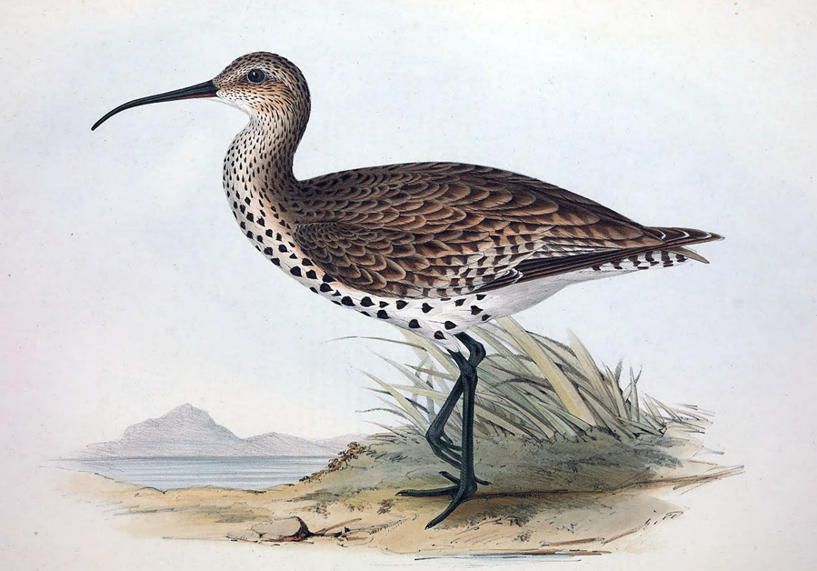
Slender Billed Curlew (Numenius tenuirostris)

In November of 2024 scientists declared that they were now confident another species had gone extinct. The Slender Billed Curlew (Numenius tenuirostris) is in the sand piper family and was last photographed in Morocco in 1995. Dr. Alex Bond, Senior Curator at the Natural History Museum in the UK reviewed all the available recent sightings and data and made this grim conclusion.

Europeans have caused extinctions in the past. The Dodo, the Great Auk or the Canary Island Oystercatcher. But these birds were endemic to islands. The Slender Billed Curlew was a shore bird that inhabited mainland habitat from Europe to North Africa. It was known to have bred in Siberia, but migration wintering grounds were observed in the Mediterranean and the Middle East.

It is a notable extinction because it is the first continental bird species to be declared extinct in recent history. The decline was long, but scientists are confident that the species is now globally extinct. What do we make of an extinction? How do we mourn a body of bodies that no longer flies, an avian language that is now silent?

We know that animals grieve for their dead kin in their own ways. Tahlequah, the Salish Sea resident orca mother carried her dead baby for 17 days. Primates, dogs, even crows show distinct behaviors around their dead. Elephants have been observed fondling the bones of their dead matriarchs tenderly, standing in quiet circles over the remembered dead.

On September 1, 1914, Martha the last Passenger Pigeon (Ectopistes migratorius) died in the Cincinnati Zoo. Once numbering in the billions, passenger pigeons formed sun-darkening flocks over much of eastern North America. They were hunted into oblivion by people with guns. Martha may not have understood that she was the last of her species, but I am sure there was a dove-shaped loneliness to her final days.

Death is part of life, not an exception. Extinction is part of evolution and not a failure of it. All that is true in this world is also all that is change, flux and transformation. From death comes new life. From extinction comes openings in the ongoing ecologies of our home. Just as death must be grieved, even in the hope of new life, so too must extinction be grieved. But the difference is that extinction in these times is one of many outward symptoms of a global illness that is threatening us with planetary death. And this death would not hold the promise of new life for a very long time. It is this death, not death in general, that we must resist; the death of a vibrant and living earth who should not yet die. And just as in ancient alchemy and Chinese variolation the cure was to be found in the illness itself, resistance is our only medicine, our lives lived well the best anti-bodies.  

Nov. 30th has begun to be honored as a Remembrance Day for Lost Species. To face our grief and to acknowledge this planetary illness is to commit ourselves to healing, to building strength to fight. The documented events suggest that in the past there have been gatherings that encourage art making, speaker series, poetry readings. They encourage lighting candles, holding vigils and procession. I did not know the Slender Billed Curlew; can I still grieve authentically for her absence from the world? How might you sit with the strangeness of extinction in these heartbreaking times? Perhaps we could sit together. I am open to ideas.

Resources

www.lostspeciesday.org

Buchanan, G.M., Chapple, B., Berryman, A.J., Crockford, N., Jansen, J.J.F.J. and Bond, A.L. (2024), Global extinction of Slender-billed Curlew (Numenius tenuirostris). Ibis. https://doi-org.proxy.lib.sfu.ca/10.1111/ibi.13368

Honoring Our Grief as a Community

“In the dark times

Will there be singing?

There will be singing

of the dark times.”

— Bertolt Brecht, Svendborg Poems, II

Bertolt Brecht (1889-1956) was a German playwright and poet. He fled Nazi Germany and later became a Hollywood screenwriter. In one collection of poems, he wrote the motto above. It was written in Svendborg, Denmark, where he first fled from the rise of Nazi Germany. His words remind us that though we did not choose to live in these times, we can choose how we respond to them.

Every age has its darkness, but in a time of climate chaos, heartbreaking warfare and political uncertainty, many of us are feeling the weight of anxiety and anticipated grief. Walking the halls of our university between classes or meetings, we wonder what good might come of our disciplines, our research, our reading, our lives. In the coming months some of us will make plans, New Year’s resolutions, earn degrees and find jobs. And yet, each step carries a hesitation, a whisper that the times are too hard for our lives to matter. We wonder at a future that feels less and less certain.

For others, people we love have slipped from view. Parents, siblings, friends or non-human companions have died; cherished relationships have ended; jobs or careers or imagined pathways have turned out differently than we planned. We worry about wildfire, violent storms, species extinctions, deforestation, drought. Sometimes it feels almost too much to bear.

It is no wonder we are afraid of facing our grief. But Brecht reminds us, in dark times there should be singing about dark times. “This is how the heart makes a duet of wonder and grief,” writes the poet Mark Nepo in his poem Adrift. “I am so sad and everything is beautiful.”

This is because grief touches something deep inside of each of us that dares to be named hope and love and “yes, I will keep going.” This is because to honour our grief is not to give in but to live on. To honour our grief is to let the seeds we have buried rise rooted in the loamy soil of these dark times and to grow. And like a forest, we cannot grow in isolation.

So, what if Simon Fraser University was a place where we didn’t feel like we had to hide our grief? What if as a community we honoured our losses, our pain and our uncertainties?

Tuesday, November 19th is National Grief and Bereavement Day and the Ecological Chaplaincy Program is hosting a gathering to honour our personal, political and ecological grief.

Register here.

We will also be hosting a table in the northeast corner of the AQ with resources. Stop by our table from 11 a.m. to 2 p.m. on November 20th through the 22nd. Write a letter to your loss. Honour your beloved with a photograph and candle. And take a blue ribbon with you to show that we don’t have to hide our grief, and that grief is a way of loving ourselves, our community and the future even during times of uncertainty.

Resources for grief and bereavement

  • SFU Ecological Chaplaincy Discord
  • BC Grief and Bereavement Helpline: Visit their website or call 604-738-9950; toll free 877-779-2223
  • MySSP 24/7 crisis support: 833-768-2188
  • Staff and faculty support: lesjames_reimer@sfu.ca
  • Counselling Rapid Access appointment: 778-782-4615 
  • Indigenous Counselling Services: iscwell@sfu.ca

A Month at the Brandt Hermitage

I had never been alone in the Brandt hermitage before. I first visited Fr. Charles in 2017, when I was completing my PhD on monastic sense of place at the University of British Columbia. We sat on his back porch and talked about Thomas Berry, the state of environmental activism and climate change. And at the end of July, four years after Charles death, I was sitting alone on that same back porch listening to the Oyster River hush toward the sea.

Fr. Charles’ successor at the hermitage, was a contemplative nurtured by the Benedictine tradition and the spirituality of the Desert Mothers and Fathers (She has asked to keep her name private). However, she has recently moved to Nanaimo, to start the next chapter in her life journey. For the month of August, I took up temporary residence at the hermitage to work on getting the house ready for the Hermitage Society’s contemplative in residency program. We invite people of all backgrounds to experience the benefits of silence, solitude and immersion in the natural world while living in this historic and prayer-infused space.

Contemplative Ecology can be defined in many ways. We call Fr. Charles a contemplative ecologist because he brought his vocations of priest, hermit, bookbinder and land-keeper together into a single life well lived. A monk once told me that a hermit (a monk who lives mostly in solitude) is not someone who is running away from the world but running toward God. In my time here I can affirm that silence and stillness are compost for feeding the gardens of healing, growth and spiritual connection.

I have started and ended each day with silent meditation. In the mornings, after my meditation, I would make coffee and watch the day unfold before I buckled down to the day’s tasks of writing, my duties for the university, and coordinating the many repairs and upgrades to the hermitage that inevitably come with an aging building.

So, to be honest, I was not alone the whole time free of work. We have a very talented craftsperson who has taken on the hermitage as a personal project (we pay her of course) and members of the board stop by to help with the work. On my walks in the forest, I often meet people from the neighborhood and their dogs. I have met many slugs and birds, but no bears or cougars.

There is only a narrow driveway on which to walk on the property, as most of the property is on a steep bluff facing the Oyster River. But even on this small trail I never feel bored. My favorite thing about walking in the forest is how the light changes. In the morning the sunlight slants in from the east and by afternoon these slender sheets of light have shifted to the west. Each moment is its own eternity and when I am really paying attention, each footstep like a pilgrimage.

Sometimes late at night, when the weather was clear, I would wake up and stumble out to the deck to crane my neck at the night sky. I was lucky enough to catch some of the Perseid meteor shower and an early morning Mars/Jupiter conjunction. Cassiopia was my most constant constellation in the east, with trees obscuring most of the southern sky. Above me and to the west I could just make out through the trees, Vega and Arcturus, two of the brightest stars in the night sky. Being able to see the dark sky with her bejewelled cloak of stars felt very sacred to me. It both makes me feel very small and insignificant in size, and preciously and uniquely valued by this warm greenhouse world that spins so precariously on the vast oceans of the cosmos.

On Tuesdays I ride my bike to volunteer with the Oyster River Salmon Enhancement Society at Bear Creek Nature Park, which is only a few kilometres west of the hermitage on the Oyster River. The organization was founded in the late 1980s, and Fr. Charles was a part of it from the beginning. There is a picture of Fr. Charles in the small cabin that serves as a meeting area for board members and volunteers and his name is on a small plaque on a memorial bench near the river. Mostly what we do is maintain predator exclusion fences, feed fish, and brush algae off the river water intake screens. On my first day, I walked the meandering trails of the hatchery with a retired commercial fisherman and pruned shrubs and cleared debris.

As I was leaving the hatchery I saw hundreds of pink salmon who were beginning to venture into the Oyster River from the ocean as they prepare to spawn. Their sleek bodies syncopating through swirls and eddies delighted me. So, I decided that I would go fishing. Fr. Charles was a long-time fly fisherman, and many of the volunteers had met Fr. Charles. One old timer had tied flies for him. Later in life, Fr. Charles admitted that he really went fishing to feel more a part of the river, and that it seemed rather cruel to hook a fish and let it go. But I didn’t want to let one go. I wanted to eat one.

So, I found a fly-fishing guide in Campbell River and early in the morning we put on waders, and I soon felt the power of the river rushing past me. We spent time on the banks casting into deep pools for clouds of pink salmon who weren’t biting. We rafted down the river in his small boat and by the end of the day found ourselves at the kissing mouths of the Campbell River and the Salish Sea. I had hooked several pinks and a cutthroat trout with a small blue nymph, but none of them had wanted to go home with me.

Feeling bad, the guide invited me to come back to his house the next day, which is right on the south bank of the Campbell River, to see if I might catch one to keep. I returned the next morning and after a few fumbles and false starts, I felt that familiar tug on the line. She gave chase but after only a minute I could feel the line soften and I reeled her toward shore. I netted her and put her in a cooler filled with water, not sure if I could bring myself to end her life. I didn’t want to use a rock, that seemed barbaric, so I used a slender fishing knife and soon her water breathing gills fell still in the rose-clouding water.

As I cleaned the fish, I was amazed by the dense clusters of orange eggs marbled through the innards. I brought the fish to friends, and they mercifully taught me how to prepare and cook the fish on a cedar plank. We ate the smoky fillets with relish and cooked the roe in butter. I also made a stock out of the bones. I really wanted to use as much of the fish as I could to honor its life and to recognize that all life depends on death to continue. This cycle is embedded in ecosystems and the spiritual ecology of what Christians call the Paschal Mystery: Life, Death, Resurrection. Eating that fish was, in the language of the catholic tradition, eucharistic and sacramental because it pointed to the divine mystery that is shot through our days and meals and bodies and prayers.

I am grateful for my time at the Brandt Hermitage, and I am very hopeful to return for additional time there. But I am also excited to welcome in a single file community of folks from many faiths and paths and parts of the world to experience the power of silence and solitude. If you or someone you know might be interested in becoming a contemplative in residence, please have a look at our call for residents or send me an email with any questions at jason.minton.brown@gmail.com.

A Blessing for Living in a Chaotic Climate

In Laura Schmidt, Aimee Lewis Reau and Chelsie Rivera’s book How to Live in a Chaotic Climate. There are ten steps to work through climate anxiety, grief and connect with meaningful purpose and action. I used this book as the textbook for a seminar on ecological grief and radical hope in the Spring term of 2024. The steps are:

  1. Accept the Severity of the Predicament
  2. Be with Uncertainty
  3. Honor My Mortality and the Mortality of All
  4. Do Inner Work
  5. Develop Awareness of Biases and Perception
  6. Practice Gratitude, Seek Beauty, and Create Connections
  7. Take Breaks and Rest
  8. Grieve the Harm I Have Caused
  9. Show Up
  10. Reinvest in Meaningful Efforts

The book is a wonderful framework for working with difficult feelings. And the course went well. At the end of the course as I thought about how I would rap it up, the Irish spiritual teacher John O’Donohue came to mind. John loved to write blessings, which in a word are not overtly religious though they often are. They come from the Latin Bene, to will the good for someone. We need more blessings in our lives. What a powerful way to express our goodwill for family, friends and loved ones. So here are ten Blessings related to the ten steps of the book:

  1. May your acceptance of the severity of the predicament deepen your care for the preciousness of life.
  2. May your encounter with uncertainty solidify your certainty that life is worth fighting for.
  3. When you honor your mortality, remember the softness of it too.
  4. When you do inner work, remember that it is not just work, but exploration.
  5. As you compost the messiness of biases, prejudices and perceptions may it also germinate seeds of self-compassion.
  6. May you be grateful for something every hour, seek beauty every day, and create connections that last a lifetime.
  7. May your radicalization include taking breaks and deep rest.
  8. When you grieve the harm you have caused, let that grief point you toward that which is still resisting destruction by the dominant system.
  9. When you show up, show up with everything you’ve got: love, fear, excitement, despair, joy, anger, optimism, rage, and active hope.
  10. And, lastly, whenever you harvest a bounty of blessings from your life, reinvest it into meaningful efforts so that at the end of your life you can say that you fought hard for all we can save.

Hope is an Heirloom

Hope can have different meanings. One sense of the word is when it is used as a wish: I hope there will be seats at the movie. I hope there is asparagus at the grocery store. This kind of hope can be rooted in expectations that defy reality, or long for our expectations to be true. We hope that the climate crisis isn’t happening, that it isn’t too bad. But hope as written about by many authors these days is radical, active, and critical. It is a living thing that we nourish with our action.

I’d like to add to this biodiversity. For me, hope is a bone deep faith in the goodness of things; in the beauty of the world, and the worthiness of being alive in troubled times.
If we think about it, we are the embodiments of thousands of hopes gone by.
Hope is inherited from our ancestors and borrowed from future generations.
Hope is an intergenerational heirloom. It does not depend on a feeling. It depends on a keeping. Hope is a seed to be saved and planted when the time is right and harvested when the time is right and saved all over again.
What is something you are too scared to hope for because it seems impossible?

From Lectio Divina to Lectio Terra

Contemplative spirituality embraces a process of sacred reading called Lectio Divina. This “sacred reading” is a way of sitting with scripture or other sacred texts as an anchor for communion with the Divine. Its dimensions entail: Lectio, Meditatio, Oratio, Contemplatio… Reading, meditation, prayer, contemplation. We begin with the words, we move into pondering the text, we grasp words and phrases as seeds of prayer, we watch for longings and prayers that bubble to the surface. And then, we sink into to cool stream of silence that immerses us in the Divine. Silence. Beyond words, but not without them.

Of course, process-oriented Westerners might believe that each of these is a step that must be followed in sequence. I have never found this all that helpful. A text can start with longing in its first words, and slip into silence before we move back into the rich symbols of the text. I have integrated this practice into my life, sometimes more fruitful with poetry than the Bible, but nonetheless I appreciate how the different aspects invite me into relationship with the Divine.

Reading for a living, most of the time I would rather pray on foot, in my neighborhood park or the rainforest parks that I am lucky enough to have close by. I have begun to translate Lectio Divina as a form of prayer onto the land as Lectio Terra, reading the land. I often start my walks praying a version of the Rosary or Jesus Prayer. Then my soul moves through at least four modes: First I draw attention to how I perceive the land with my senses. I scan and open my senses to the place as I walk (Lectio, or Perceiving/Sensing). I zoom in and zoom out to small details. I crouch down and sit with the particular and let my awareness drift to the wider happening all around me. I identify plants, trees, mushrooms with apps and listen for bird song (Meditatio, or Interpreting/Naming). Third, I watch and wait for the prayers of gratitude and praise that come to my lips. My longings, sorrows, joys. My hopes and petitions. I offer up my wounds to the soil, the mosses, the ravens, the trees, the forest, and to the Divine presence that suffuses this land like a mist (Oratio, or Praying/Praising). Lastly, as my muscles warm and my mind begins to quiet, I often find myself passing into the awe and wonder of embodied silence (Contemplatio, Resting/Holding). This is a place for silence, beyond words, beyond naming and just being with this place at this time. Then I meander back through each of these as they arise.

Try it yourself sometime and see if this approach to experiencing the world bears fruit.

  • Perceiving/Sensing (Lectio)
  • Interpreting/Naming (Meditatio)
  • Praying/Praising (Oratio)
  • Resting/Holding (Contemplatio)

Encounters with Salmon-Christ: Sketches from a Cascadian Christianity

Opening the creaking door of the large pickup truck that had driven us down the hatchery road, I was overwhelmed by the smell of death and decay. I let out a groan and my host, a board member of the Oyster River Salmon Enhancement Society, laughed and said, “That’s why I don’t eat fish most of the year!”

I had come for a scheduled tour of the Society’s hatchery. Our first stop was a fish trap that was filled with pink and a few early coho salmon. The trap was a large rectangular metal container submerged in a small side channel of the Oyster River. As we approached, we could hear loud banging coming from inside as the salmon jumped. When we opened the lid, a large pink salmon sprung out of the water with gusto and landed with a splash. The Society has been working for decades to restore salmon to historic numbers in the Oyster River which has been severely impacted by logging, mining, and development.

I felt a rush of childlike wonder at the sight of these living breathing aqua-bodies, swirling, and lusting for the gravel beds where they would spawn. They were born here, lived their lives in the oceans and then came back to these places to mate and die. The Society collected them, harvested their eggs and milt and then released them back into the river to live out the rest of their short lives. This might sound romantic, but salmon who have spawned start to look like zombies, their flesh decomposing and falling from their torsional bodies. Bears make frequent appearances along the banks, fishing with ease for the spent salmon, though we didn’t see any the day I went. Ravens and crows pick at the fishy bodies. Animals will sometimes carry the salmon deeper into the forest, and their bones nourish the roots of trees. The dying salmon give their bodies to the river and the forest, and in a way to the world.

A few days later, I came across a reference to New Testament scholar John Dominic Crossan’s book Jesus: A Revolutionary Biography. Crossan is known for his vivid and controversial portrayal of the “historical” Jesus. This moniker is to distinguish him from the Jesus of faith, belief, and miracles that is so familiar to the Christian story. In the passage, Crossan speculated that any convicted traitor crucified by the Romans was likely either left on the cross to terrorize the public, eventually devoured by carrion eaters; or, tossed into a shallow mass grave, and then, likely scavenged by dogs. Crossan believes that in all likelihood, Jesus of Nazareth met this fate, and stories of the tomb, the bodily resurrection and ascension emerged from the disciples’ grief, realistic visions of Jesus alive, enduring faith in his message and teachings, and the living breathing developments of oral traditions.

At first, the idea and image of the body of Jesus being picked at by vultures or eaten by dogs felt scandalous, blasphemous. Certainly, it is not an unprecedented claim. Denial of the resurrection is often part of larger polemics against Christianity from Greco-Roman Pagans or later materialists. All the same, I felt a flash of defensive anger at the implied disrespect to the central story of my Christian (even if unconventional) faith.

The Paschal Mystery is a deep and cherished cosmic myth and reality for me. God is not some distant First Cause, but implicates Themself into the world. Each day is a death and resurrection. Each phase of my life is death and rebirth. The Christian liturgical wheel of the year cycles through the birth, life, death, and resurrection of the landscapes of the Northern hemisphere and the Christ. The universe proceeds on the principle of star death and resurrection. The story feels deeply woven into the world, and into the land. And that is why I believe it. It has been less about whether it was historically true, but more about whether it felt real.

Visually, I am used to seeing the Jesus of stained-glass windows and icons. Stern, serene, floating in the air. Even if some of our more gruesome crosses vividly portray his suffering and death, we all know how the story ends. Jesus was resurrected and ascended bodily into heaven.

As I allowed Crossan’s image to sink a little deeper into my heart, my anger transformed into peace. Jesus, the God-Man, eaten by buzzards and dogs began to touch the soft edges of my faith. It was not at all that with Crossan’s scholarly boldness, the story finally made sense, appealing to my reason, intellect, and now I could just get on with taking the resurrection metaphorically or symbolically.

The image of a God who descended into our deepest pain and suffering through death on the cross, being further humiliated and devoured only enhanced the image of a God whose weakness is Their power. A God who enters fully into the world “saves” it by becoming one with it. The body of Jesus going the way of all flesh, cycling into the body of animals and the soil is an earthier resurrection. But it also adds a step to the Paschal Mystery. The world is in a constant cycle of Birth, Life, Death, Decomposition, and Resurrection. My God Decomposed before the resurrecting into the bodies of the animals, plants and fungi.

This may seem absurd to the orthodox ear, but Jesus himself invokes this kind of horticultural mysticism in the Gospel of John. The author writes Jesus saying, “Very truly I tell you, unless a kernel of wheat falls to the ground and dies, it remains only a single seed. But if it dies, it produces many seeds” (John 12:24). The seed does not grow in space. It does not ascend in the air. It sinks into the dark moist humus of the earth. This is the fabric of cosmic, biological and spiritual evolution. Jesus entered into this mystery, but we turned it into a fairytale about how good always wins and the wicked are always punished. The cross became a ransom, a universal sacrifice rather than a grand archetype of the way suffering must be metabolized and transformed for new life to emerge.

Most theological claims about the resurrection are primarily spiritual anyway. It isn’t that the resurrection is imagined to be a post-mortem resuscitation. Theologians claim that Jesus really died, and that the resurrected body was a post-mortal eschatological reality. It represented the Humanity 2.0 of the coming Age. Paul understood this as a spiritual body, and later Gnostics would assume that it was only spiritual, the physicality being illusory.

To be honest, despite my love for the Paschal Mystery, I have always struggled with the doctrine of resurrection as a historical event. The way it comes across in the New Testament is fragmentary, somewhat contradictory, and dream-like. The Ascension too has always troubled me, especially because it seems to be a clear homage to the power and legacy of the Hebrew Prophet Elijah, and a taunt to claims that some Roman Emperors were taken into heaven.

The idea of the resurrected body as an ecological body endears me to Jesus’s carnality, but still retains the Divinity he points to in himself, humanity, and the earth community. In addition, I like to imagine the life of Jesus after the resurrection as an insension rather than an Ascension. God went deeper into our world by becoming it. After all, Jesus didn’t come down to earth, he emerged from the fleshy humanity of Mary. He was born just like the rest of us.[1]

Franciscan Friar Richard Rohr writes of the difference between Jesus and Christ: “The Christ Mystery anoints all physical matter with eternal purpose from the very beginning.”[2] Rohr sees creation, Jesus, and the Christian community as instances of the Universal Christ spoken of in Colossians chapter 1. In Christ the world was created; the Son is a visible image of the invisible God, etc. With this scriptural Cosmic Christ, Rohr wants Christianity to expand not contract our view of God in the world and at the beginning of his book The Universal Christ he asks us directly:

“What if Christ is a name for the transcendent within of every “thing” in the universe? What if Christ is a name for the immense spaciousness of all true Love? What if Christ refers to an infinite horizon that pulls us from within and pulls us forward too? What if Christ is another name for everything—in its fullness?”[3]

The mystical body of the world includes the earth community evolving toward greater complexity. The French Jesuit Pierre Teilhard de Chardin saw Christ as the horizon of evolution, the Omega Point of all creation and Jesus as the living Heart of the Cosmos, which is love.

To be clear, I don’t want you to take my sketches here as anything like a truth claim. I am not trying to convince you that the resurrection is false. That Crossan’s is the real story. I don’t believe I have now discovered the true history of Christianity. My faith in the Paschal Mystery is not literal, it is literary. I am not seeking authentic orthodoxy but realistic mythodoxy.

There are times when I will resonate with the bodily resurrection after three days and the Ascension into Heaven after forty. But watching salmon give themselves to the world, and hearing Crossan’s scandalous claims about Jesus in the same week felt significant. I remember feeling like the salmon were a kind of Forest-Eucharist, and that to talk of Jesus’s body leaving the earth was a strange tale that abstracted his fleshliness from the earth that made him.

This fleshly eucharist was illustrated beautifully in Cormac McCarthy’s last dual-novel The Passenger and Stella Maris. A brother and sister are entangled in a forbidden love that is never consummated. Alicia Western is driven to suicide by vivid visions of mutated vaudevillian creatures and Bobby Western lives with the regret and guilt of her death. At the end of Stella Maris, which is a series of transcripts from interviews between Alicia and her therapist, Alicia longs to give herself back to the earth and end her deep existential loneliness. She says,  

“I thought that I would go to Romania and that when I got there I would go to some small town and buy secondhand clothes in the market. Shoes. A blanket. I’d burn everything I owned. My passport. Maybe I’d just put my clothes in the trash. Change money in the street. Then I’d hike into the mountains. Stay off the road. Take no chances. Crossing the ancestral lands by foot. Maybe by night. There are bears and wolves up there. I looked it up. You could have a small fire at night. Maybe find a cave. A mountain stream. I’d have a canteen for water for when the time came that I was too weak to move about. After a while the water would taste extraordinary. It would taste like music. I’d wrap myself in the blanket at night against the cold and watch the bones take shape beneath my skin and I would pray that I might see the truth of the world before I died. Sometimes at night the animals would come to the edge of the fire and move about and their shadows would move among the trees and I would understand that when the last fire was ashes they would come and carry me away and I would be their eucharist. And that would be my life. And I would be happy.” (my emphasis)

Alicia wants to become a eucharist for the world. She intuits that for there to be life there must be death. Alicia’s self-emptying (the Greek is kenosis) impulse is much like that of the salmon, and much like that of Jesus. My encounter with the Salmon-Christ taught me that to get from life to death and back to life again, there must also be decomposition.


[1] I heard Richard Rohr say this in one of his daily emails somewhere.

[2] Rohr, Richard. The Universal Christ (p. 19). The Crown Publishing Group. Kindle Edition.

[3] Rohr, Richard. The Universal Christ (p. 5). The Crown Publishing Group. Kindle Edition.

Contemplating an Ecological Chaplaincy: A Soft Manifesto for Hard Times

I am launching a pilot project in Ecological Chaplaincy at my university! Here are some thoughts about what I mean by Ecological Chaplaincy.

Pre-Amble

For a good long while now I have felt like I wanted to be a priest in a religion that does not yet exist. Like reading poetry in translation, there is always this nagging feeling that something deeper is being missed. Words that rise up from the murk when I have thoughts about vocation have mostly been words like teacher, forester, monk. These are all paths I have more or less explored, or participate in to some degree. I am now a university lecturer and I teach and write about religion, contemplative ecology, monasticism, and forestry among other things, so I am not too far off from that imagined arrival.

For a time before I started my PhD, I worked briefly as a forester. In Utah, where I worked, beetles were ravaging pine and spruce forests and leaving clusters of grey poles in their places. The US Forest Service does the best it can, but with budget cuts and lawsuits from environmental organizations it can’t afford to manage forests properly. Our relationship to the forest has never been more polarized. Activists decry the desecration of forests as sacred groves, foresters and loggers scoff at their naivete at our reality of society’s need for timber.

For the most part in North America, monastic communities are elderly. More and more monasteries are closing their doors for good. The average age of a monk on this continent is pushing well into the 70s. In my many visits to monasteries, I have seriously considered vowed life. The lack of young monks, the shift away from serious work on the land, the repetitive schedule and closing off of the option to marry, have kept me from becoming anything more than an eager student of contemplative spirituality.  

After a crisis of faith led me away from the Mormon (LDS) tradition of my youth, I joined with a broadly Catholic contemplative practice. I moved to Vancouver to pursue doctoral studies. I officially joined the Anglican Church and then the Roman Catholic, and then found myself back in the Anglican Church discerning a calling to the priesthood. While I was discerning, I stumbled across the word chaplain on an instructional retreat on the pastoral care related to death and dying. Tending to those who are grieving resonated deep within the hallowed hollow of my longing. I read books about green funerals, I worked for a summer as a funeral attendant, I taught a course on death and dying in religion and enrolled in a short End-of-Life Doula training.

After discerning out of the Anglican Church, I have settled into a practice I call contemplative ecology—cultivating a sense of place, literacy and reverence for the world around me. I appreciate much that is small ‘c’ catholic—The Eucharist, Centering Prayer, liturgy, Gregorian chant, and the rich symbolism of Christian theopoetics. But all too often on political, social and theological issues, I feel myself to be too heterodox for comfortable belonging in any one creed or tradition within this religious family.

So, I have immersed myself in my practice and my teaching. My students admit to experiencing anxiety, worry, grief, and fear. Many are anxious about finding a fulfilling job. Some worry that wildfire smoke is becoming a regular health hazard of the summer season. Others feel a nagging anticipated grief and fear as the future shifts under our feet with every failed international climate summit. Many progressives and activists feel spiritually adrift, melancholy, burnt out. The so-called Anthropocene—the age of human supremacy—is bringing along with it a spiritual malaise that compounds the existential loneliness of modernity with the anticipated grief of the ecological crisis into the cool alloy of hopelessness. Those of us of European descent feel orphaned by our cultures, even ashamed of aspects of our civilization. We are searching for ways of reconnecting to each other and the earth community but feel lost.

Over the last several years, that word “chaplain” began to show up more and more often. Talking to a student about the existence of God over coffee, writing an email of consolation to a student whose loved one has unexpectedly died. Writing a letter of recommendation for a student applying to a graduate program in ecological restoration. The topics I teach are loaded with uncertainty and being a professor often includes a great deal of what might be called pastoral or spiritual care. An ecological chaplaincy is the thread that just might stitch my disparate vocations together. This then is something of a soft manifesto. No hard edges, no bold proclamations, no demands, no platforms. Just musings, sketches, notes on an emerging vocation.

Amble

            “Even a wounded world is feeding us. Even a wounded world holds us, giving us moments of wonder and joy. I choose joy over despair. Not because I have my head in the sand, but because joy is what the earth gives me daily and I must return the gift.”

–Robin Wall Kimmerer, Braiding Sweetgrass (2013)

What is a chaplain anyway? A chaplain tends. A chaplain serves. A chaplain listens. A chaplain sometimes officiates rituals. Most chaplains you might have interacted with are attached to both an institution and a religious tradition. Sometimes chaplains are ordained ministers, sometimes they are not. The most common chaplain titles are those qualified by one or the other: Muslim Chaplain, Buddhist Chaplain, Pagan Chaplain; the setting: prison, corporate office, military, hospice, hospital.

Institutions have specific circumstances that require spiritual care: the regret of a prison sentence, the rigors of the corporate work environment, the devastation of warfare. Religious denominations have specific spiritual goals and guides that chaplains use to companion the bereaved. Kadish prayers, passages from the Bhagavad Gita, the Hadith of the Prophet Muhammad, or Buddhist loving kindness meditation. A chaplain doesn’t try to talk anyone into belief, we sit and listen and serve and tend.

However, many folks in North America these days, particularly on the West Coast, do not belong to a single or a particular religious tradition. There might be echoes of one or several from ancestors, but many have long since passed into the realms of spiritual-but-not-religious, secular un-belief, or irreligion. Many feel comfortable outside of religious practice, and yet feel like something is still missing. Many find moments immersed in the more-than-human world to be wholly holy experiences that need very little doctrine to go along with it. While the thrust of traditional Abrahamic religion is to connect with a higher power; contemporary spirituality in general, and practices like contemplative ecology in particular, seek to connect to a wider power.

An ecological chaplaincy then might be one that tends to the spiritual care of people of any or no faith who want to connect more deeply with the earth, or who worry about what is happening to the earth. As an Earth Chaplain I would serve those who feel ecologically disconnected, spiritually lost, or emotionally overwhelmed. An ecological chaplaincy would be place-based rather than institution-based. As an Earth Chaplain I would tend to the wellbeing of humans as part of the wider ecological community. An ecological chaplaincy would provide spiritual care that is comfortable with discomforts past, present and future. As an Earth Chaplain I would not provide Sunday-school-answers to the problem of suffering, evil and death, would not be afraid of the dark.

Place-based Chaplaincy

“Wisdom sits in places. It’s like water that never dries up. You need to drink water to stay alive, don’t you? Well, you also need to drink from places. You must remember everything about them. You must learn their names. You must remember what happened at them long ago. You must think about it and keep on thinking about it.”

–Dudley, in Keith Basso’s Wisdom Sits in Places (1996)

An ecological chaplaincy would be a place-based chaplaincy. An Earth Chaplain tends to the soul of places. Monks make a vow of stability which voluntarily ties them to a particular place and community. Perhaps for us un-vowed, making a bond of stability to our places would suffice. Our abbot underfoot, our obedience to the land. This might enable us to explore the contemplative depths of being alive in a lush and wounded world. Rather than being part of a congregational Diocese, we might see ourselves as part of a bioregional Biocese, a place presided over by the bishopric of weather and season.

To say that I chaplain the place does not make me a chaplain for all, some kind of authority. It only means that I put myself forward as one of many willing to witness, tend and defend. It does not infringe on existing place-based elderhoods that exist in religious and Indigenous communities. It is a vocation of listening to the land, and accompanying those who are unsettled and yet still here. As I practice it, it might especially be for European-descended settlers and immigrants who feel deep ambiguity about our place in North America; acknowledging that we need spiritual care too, even as we stumble in confusion on the far side of Abrahamic faith, and lend our support to the Indigenous resurgences happening across the globe and in our places.

While I may live on unceded Musqueam land here in Vancouver, BC, I dwell in Cascadia, an aspirational biocultural zone that spans from Alaska to California along the watershed boundaries called a bioregion. It is an idea that reimagines place along ecological lines. It is imagined not as a new nation, but as a federation of smaller settler, immigrant and Indigenous peoples nested within the wider/wilder ecological community.

As an Earth Chaplain then I would share a practice I call Placefulness: The contemplative practice of attending to what is and what is arising in our places, especially during troubled and dark times. This means cultivating a spiritual practice that seeks to learn the liturgies of place, the unfolding of the seasons and cycles. Developing literacies of the place and the creatures as a form of lectio terra, rather than lectio divina. Placefulness is learning stories and myths, making art. It is re-cognizing in our languages the hidden “grammars of animacy” that Robin Wall Kimmerer suggests see the world as filled with active, vibrant and enmeshed personhoods. Personhoods that have for too long been turned to lifeless objects by the noun-based materialist metaphysics of the mainstream of Western culture and science.

But Placefulness is not Nature spirituality. It is not forest therapy. Our ecological communities have rich and complex histories especially in areas where Indigenous peoples have been displaced or oppressed. Placefulness encourages wrestling with the tensions of being unsettled in these places, as well as learning to love them. Placefulness is also the practice of loving landscapes and ecologies that have been modified, degraded or destroyed. Trebbe Johnson calls this Radical Joy for Hard Times—a global network that offers acts of beauty to wounded places as a step toward healing them, and in the process ourselves. Therefore, a placeful contemplative ecology, and the ecological chaplaincy that expresses it, is not just focused on cultivating reverence and connection with pristine places, cherished protected areas or blessed smoke free horizons. It is also for the green cracks in sidewalks, backyard blackberries, street trees, parks, clear cuts, urban interfaces, rip rapped rivers, and naturalizing trees. Loving a place is the first step to defending it. But continuing to love places that have been wounded, is also an act of radical self-compassion, for by insisting on loving even the most wounded of places we affirm that our own wounds, living in the folds of our soft animal bodies, are also worthy of love.  

Cosmic Uncertainty

“At the end of uncertainty comes the uncertainty of the end.”

–Viktor Frankl, Man’s Search for Meaning (1946)

An ecological chaplaincy would learn to sit with the uncertainty and hard emotions of these times. An Earth Chaplain would preach, as John Caputo writes, a theology of perhaps. Developing an ecological chaplaincy is not collecting practices aimed at fixing or assuaging our anxiety. It is not therapy. For moderns, therapy is an essential tool for working through the impact of trauma and psychological harms we have suffered. Therapy is often a treatment for the array of symptoms that accompany emotional distress and mental illnesses. In clinical settings we attempt to square a desired state with past traumas and experiences that are causing us to languish in some way. Therapy is not the place to question the underlying conditions of a world that is inducing the symptoms in the first place.

As climate writer and researcher Britt Wray writes in her book Generation Dread however, “Despair and fear are not inherently bad. Hope and optimism are not inherently good…We must move from an either/or to a both/and model. There is meaning in every emotion.” Learning to live with greater uncertainty is a spiritual practice in itself, and every emotion has something to teach us. Our anxiety is not just pathological. It is a signal from the heart of the earth that something is desperately wrong.

Ecological chaplaincy as spiritual care might be imagined as trans-therapeutic. To me this means that it is not an alternative to therapy, it focuses on the deeper dimensions of our soul’s wellbeing and the deeper spiritual crisis that has attacked that wellbeing from every side. The spiritual care that chaplains offer is not curative or even preventative. It is companion-ative.

Chaplaincy speaks to and sits with cosmic uncertainty. We tend to our existential, philosophical, ethical, ritual, and aesthetic health. Meaning, purpose, and connection are our watch words. Chaplains are not technicians of the soul who fix wounded hearts. We are not even guides who pretend to know the way home. We are wounded companions who walk with other wounded hearts through landscapes spiritual and ecological.

An ecological chaplaincy would remind us that the grief we pour out is also the overflowing of a love that has filled us. As spiritual activist Stephen Jenkinson defines it, “Grief is a way of loving what has slipped from view. Love is a way of grieving that which has not yet done so.” An Earth Chaplain would be a practitioner of griefcraft—learning to live with loss even as we keep on loving.  

As a chaplain I would not offer any certainty about the outcome of the ecological crises, or even insist that we stay optimistic. I would however, attempt to carry a radical hope, the kind that is made of the earth herself and lives in our bones as an intergenerational heirloom that has been passed down to us. A heritage that we must pass on to others. I acknowledge that my ancestors, scattered as they are across North America and England, are the reason I am alive. And the future I work toward is in a way part of becoming a good ancestor myself.

As Stephen Harrod Buhner writes in his book Earth Grief

“Hope is a quiet, enduring, persistent thing. It is not filled with the excited, uplifting, future-oriented energy of optimism. It possesses instead a slow-moving groundedness, an enduringness, a solidity, a nowness. It isn’t going anywhere, it just is. It’s a form of faith, a faith that comes from life itself…”

Faith in and from life. The spark of life that dwells in me and is me is not mine. It is inherited from my ancestors and borrowed from future generations. I must tend to that spark so that it can light the way.

Navigating Through the Darkness  

“But when I lean over the chasm of myself—it seems my God is dark and like a web: a hundred roots silently drinking.”

–Rainer Maria Rilke, Book of Hours ([1905] 2005)

An ecological chaplaincy would be comfortable in the dark. An Earth Chaplain would provide no easy arrivals or answers. When I say dark, I don’t mean the evil, nefarious; realms of ghostly entities that cause mischief. When I say dark, I am speaking into the deep, mystical dimness that is just below the surface of the earth’s contemplative traditions.

The mystics speak of a theology in the negative, an apophatic—literally other than the spoken—dimension to spirituality. The Lineages of Chinese Buddhism and Daoism are well known for their discourses on the ineffable. Lao Tzu’s Tao teh Ching (Dao de Jing) opens with this famous line: “Tao can be talked about, but not the Eternal Tao. Names can be named, but not the Eternal Name.” For Christian mystics like Dionysius the Areopagite, Nicolas of Cusa, and Meister Eckhart, the luminous dark of the Divine required an unlearning and an unknowing. For many Zen Buddhists this is the return to Beginner’s Mind that prepares one for enlightenment.

There is a rich loamy fecundity in darkness. In When the Heart Waits (1990) novelist and spiritual writer Sue Monk Kidd observes that most living things incubate or gestate in darkness. To live, seeds must die and be buried. In the silent obscurity of the heart, we ripen, even when it may feel like we are wasting away. Spanish mystic Juan de la Cruz (John of the Cross) speaks of this as a Dark Night of the Senses and of the Soul. It is a spiritual malaise, an aloneness that comes over even the most disciplined practitioner. These are not just hard times, but times that feel like being hopelessly lost in a thick fog, buried under a landslide of crushing earth. The union or enlightenment that breaks through is not a reward for virtue or hard work, but the result of a slow ripening that we can only patiently await.

The world has been dark before. Plagues, war and famine are endemic to civilizations past. But beyond political upheaval or pandemic, it seems clear that culturally the West is passing through a great Dark Night of the Soul—an absence of direction, inspiration, and purpose at the far end of post-modern cynicism. We orphaned Westerners struggle with a creeping sense of unworthiness. We suffer from privilege guilt, settler guilt, human guilt. Sometimes we wonder if the earth would be better off without us. This kind of wrestling is the kind that happens in a dark night of the soul. We even begin to doubt the worth of our existence.

And yet, the other side of darkness is not noonday sunshine. There is no guarantee that light will dawn again for us. Even though our species will almost certainly survive, much of our civilization will need to die for the earth community to live. How much, I don’t know. But coming to terms with our individual and collective mortality is part of the deep spiritual practice of navigating the dark. We cannot emerge from the chrysalis and be the same.  

As Gerald May writes, “Sometimes the only way we can enter the deeper dimensions of the journey is by being unable to see where we’re going.” We cannot escape the dark except by sitting still for a while and letting our eyes adjust to it. Then, and only then, can we start to move our way through it. We cannot go back the way we came; we must cross to the other side. Like the ancient Inca, we need to start making dark constellations from the gaps between the clusters of stars of this dark night sky. So, we’ll need brave dark pilgrims to explore this shadowland. We’ll need dark storytellers to make sense of the gaps.

We don’t have much time. But each of us will always have just enough time to fall in love with life and with the world before it is our time to return to earth’s embrace. And then, to pass that love on to those who come after. The good earth’s liturgy of dying is always followed by a lush rebirth and resurrection. I believe in this resurrection.

Resources and Other Projects

This manifesto is how I am thinking about the topic, there are a lot of other ways to walk this journey.

Gabrielle Gelderman, Climate Chaplain

One Earth Sangha, Eco-Chaplaincy

Alanna Birch, Environmental Chaplaincy

Green Chaplains, Out of Australia

Center for Religion and Environment, Eco-Chaplain

The Chaplaincy Innovation Lab, Chaplaincy and the Environment

Trebbe Johnson’s Radical Joy for Hard Times

The BTS Center, Chaplaincy and the Environment

Joanna Macy’s The Work that Reconnects

All we can Save Project

The Good Grief Network

Jennifer Atkinson’s Podcast Facing It

Elders

Stephen Harrod Buhner, Earth Grief

John Caputo, The Insistence of God: A Theology of Perhaps

Douglas Christie, Blue Sapphire of the Mind: Notes for a Contemplative Ecology

Ashlee Cunsolo, Ecological Grief

Ilia Delio, The Unbearable Wholeness of God

Victor Frankl, Man’s Search for Meaning

Stephen Jenkinson, Die Wise

Sue Monk Kidd, When the Heart Waits

Robin Wall Kimmerer, Braiding Sweetgrass

Llewellyn Vaughn Lee, Spiritual Ecology

Joanna Macy, Coming Back to Life

John O’Donohue, Beauty

LaUra Schmidt with Aimee Lewis Reau and Chelsie Rivera, How to Live in a Chaotic Climate

Toko-Pa Turner, Belonging

Francis Weller, The Wild Edge of Sorrow

Britt Wray, Generation Dread