Last year, I attended a meditation conference in Vancouver with a prominent international organization. The event featured an important teacher of Christian contemplative spirituality who spends much of his time travelling and teaching. I wrote much of this reflection the day after the conference and then decided not to post it. But I want to publish it now that some time has past because I think the distinctions I make are still relevant to our unfolding meta-crisis.
After my talk I was on a panel. An elderly woman stood and in her shaky voice said that she wants to know what we can do about climate change. And that for her, at her age, the best thing she could think to do is pray and meditate. I empathized with her desire to know what we can do, and I tried to assuage her guilt a little for not being able to do more. This was a meditation conference after all. So, I said, its not as though meditation is a tool in our climate action toolbox and that we should walk away from a conference on meditation with a list of five things you can do to solve the climate crisis.
The figurehead of the conference, who was also on the panel followed up in his characteristically blunt, didactic tone. Despite what I thought was a realistic and contemplative response, he took me to task for suggesting that there was nothing we could do (I did not say that). He suggested that while we shouldn’t instrumentalize meditation, it should always lead to action; and that there are plenty of things we can do to take meaningful action to solve the climate crisis.
At the end of the conference, the local organizer (who works in corporate finance) asked us to get into small groups and literally make a list of things we could do to combat climate change. This felt like a direct jab at my panel contribution, and at that point I could not stay in the room or join a small group. So, I stood up and left.
I admit this was not the most mature thing to do. But I also think that the gesture expressed without words how I feel about the risk they were taking in packaging the purpose of contemplative practices as useful action. So let me defend my one man walk out.
There is a controversy that goes all the way back to the Greeks between contemplation and action. Should the good life be devoted to higher things of the mind or the worldly things of politics and society? The Benedictine monks I have worked with say, do both! Their motto is Ora et Labora, Work and Prayer. But notice that the motto is not Work is Prayer. Work and prayer both have their place in the monastic life, as do contemplative and active pursuits outside of the monastery. But in relation to climate change, there is an important space to keep between these two domains.
Because here is where we are: avoiding 1.5- and even 2-degree warming targets are likely unattainable at current rates of emissions and international commitments. So, when we talk about “taking action” on climate, we are not talking about little things that will contribute to a gradual cultural shift. We are not talking about our individual actions adding up to dodging the worst implications of two degrees warming. We are talking about urgent, massive internationally coordinated efforts to radically reduce carbon emissions, and, at this point, because we have no other option, to pull carbon out of the atmosphere because if we don’t, we are looking at three or four degrees warming by the end of the century. That is where we are.
So, I agree, we should never stop asking the question “What must I do?” We are living out the risks of not being able to answer this question. My lifetime may never fully answer this question. I want to keep asking it. But when it comes to climate change, I just do not know of an answer that can be packaged into a pithy hope-slogan or a list of actions. There are dozens of things we can do with our days. And I have too long lists of them. But there is no thing that we can do individually, municipally, provincially or even nationally that will swallow this meta-crisis whole.
And that is where meditation resides. It lives in the dark folds of my still hopeful heart. Contemplative Practice is not a tool to get us ready for the right action. It is not just one of our strategies for effective climate action. It is not just a practice of self-care to process our burn out from our at-least-we-are doing-something actions. It is not just a means to an end. Contemplative practices are the ground of our action. They are the soil out of which right action grows and the air our actions breath. I engage in contemplative practices whether our actions succeed or fail, whether I know what to do or not. I meditate as I wait for the answers to come, or not.
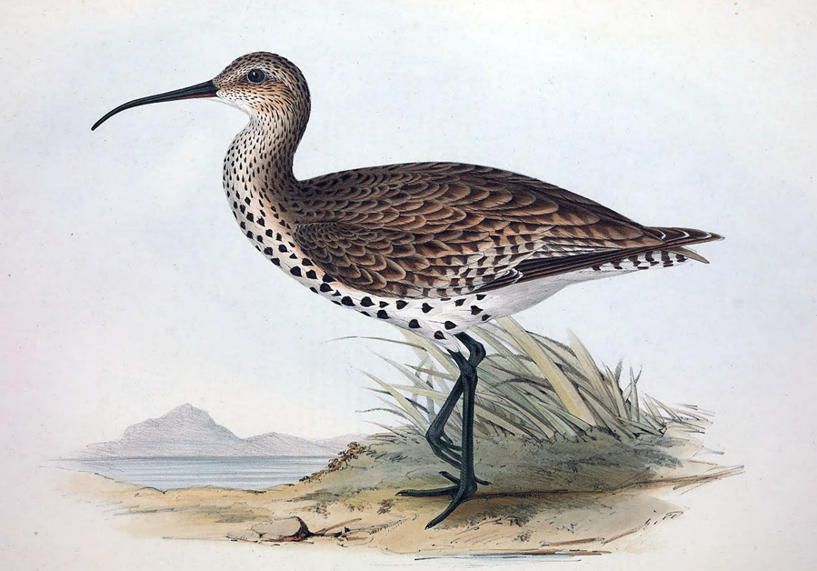
In November of 2024 scientists declared that they were now confident another species had gone extinct. The Slender Billed Curlew (Numenius tenuirostris) is in the sand piper family and was last photographed in Morocco in 1995. Dr. Alex Bond, Senior Curator at the Natural History Museum in the UK reviewed all the available recent sightings and data and made this grim conclusion.
Europeans have caused extinctions in the past. The Dodo, the Great Auk or the Canary Island Oystercatcher. But these birds were endemic to islands. The Slender Billed Curlew was a shore bird that inhabited mainland habitat from Europe to North Africa. It was known to have bred in Siberia, but migration wintering grounds were observed in the Mediterranean and the Middle East.
It is a notable extinction because it is the first continental bird species to be declared extinct in recent history. The decline was long, but scientists are confident that the species is now globally extinct. What do we make of an extinction? How do we mourn a body of bodies that no longer flies, an avian language that is now silent?
We know that animals grieve for their dead kin in their own ways. Tahlequah, the Salish Sea resident orca mother carried her dead baby for 17 days. Primates, dogs, even crows show distinct behaviors around their dead. Elephants have been observed fondling the bones of their dead matriarchs tenderly, standing in quiet circles over the remembered dead.
On September 1, 1914, Martha the last Passenger Pigeon (Ectopistes migratorius) died in the Cincinnati Zoo. Once numbering in the billions, passenger pigeons formed sun-darkening flocks over much of eastern North America. They were hunted into oblivion by people with guns. Martha may not have understood that she was the last of her species, but I am sure there was a dove-shaped loneliness to her final days.
Death is part of life, not an exception. Extinction is part of evolution and not a failure of it. All that is true in this world is also all that is change, flux and transformation. From death comes new life. From extinction comes openings in the ongoing ecologies of our home. Just as death must be grieved, even in the hope of new life, so too must extinction be grieved. But the difference is that extinction in these times is one of many outward symptoms of a global illness that is threatening us with planetary death. And this death would not hold the promise of new life for a very long time. It is this death, not death in general, that we must resist; the death of a vibrant and living earth who should not yet die. And just as in ancient alchemy and Chinese variolation the cure was to be found in the illness itself, resistance is our only medicine, our lives lived well the best anti-bodies.
Nov. 30th has begun to be honored as a Remembrance Day for Lost Species. To face our grief and to acknowledge this planetary illness is to commit ourselves to healing, to building strength to fight. The documented events suggest that in the past there have been gatherings that encourage art making, speaker series, poetry readings. They encourage lighting candles, holding vigils and procession. I did not know the Slender Billed Curlew; can I still grieve authentically for her absence from the world? How might you sit with the strangeness of extinction in these heartbreaking times? Perhaps we could sit together. I am open to ideas.
Bertolt Brecht (1889-1956) was a German playwright and poet. He fled Nazi Germany and later became a Hollywood screenwriter. In one collection of poems, he wrote the motto above. It was written in Svendborg, Denmark, where he first fled from the rise of Nazi Germany. His words remind us that though we did not choose to live in these times, we can choose how we respond to them.
Every age has its darkness, but in a time of climate chaos, heartbreaking warfare and political uncertainty, many of us are feeling the weight of anxiety and anticipated grief. Walking the halls of our university between classes or meetings, we wonder what good might come of our disciplines, our research, our reading, our lives. In the coming months some of us will make plans, New Year’s resolutions, earn degrees and find jobs. And yet, each step carries a hesitation, a whisper that the times are too hard for our lives to matter. We wonder at a future that feels less and less certain.
For others, people we love have slipped from view. Parents, siblings, friends or non-human companions have died; cherished relationships have ended; jobs or careers or imagined pathways have turned out differently than we planned. We worry about wildfire, violent storms, species extinctions, deforestation, drought. Sometimes it feels almost too much to bear.
It is no wonder we are afraid of facing our grief. But Brecht reminds us, in dark times there should be singing about dark times. “This is how the heart makes a duet of wonder and grief,” writes the poet Mark Nepo in his poem Adrift. “I am so sad and everything is beautiful.”
This is because grief touches something deep inside of each of us that dares to be named hope and love and “yes, I will keep going.” This is because to honour our grief is not to give in but to live on. To honour our grief is to let the seeds we have buried rise rooted in the loamy soil of these dark times and to grow. And like a forest, we cannot grow in isolation.
So, what if Simon Fraser University was a place where we didn’t feel like we had to hide our grief? What if as a community we honoured our losses, our pain and our uncertainties?
Tuesday, November 19th is National Grief and Bereavement Day and the Ecological Chaplaincy Program is hosting a gathering to honour our personal, political and ecological grief.
We will also be hosting a table in the northeast corner of the AQ with resources. Stop by our table from 11 a.m. to 2 p.m. on November 20th through the 22nd. Write a letter to your loss. Honour your beloved with a photograph and candle. And take a blue ribbon with you to show that we don’t have to hide our grief, and that grief is a way of loving ourselves, our community and the future even during times of uncertainty.
In Laura Schmidt, Aimee Lewis Reau and Chelsie Rivera’s book How to Live in a Chaotic Climate. There are ten steps to work through climate anxiety, grief and connect with meaningful purpose and action. I used this book as the textbook for a seminar on ecological grief and radical hope in the Spring term of 2024. The steps are:
Accept the Severity of the Predicament
Be with Uncertainty
Honor My Mortality and the Mortality of All
Do Inner Work
Develop Awareness of Biases and Perception
Practice Gratitude, Seek Beauty, and Create Connections
Take Breaks and Rest
Grieve the Harm I Have Caused
Show Up
Reinvest in Meaningful Efforts
The book is a wonderful framework for working with difficult feelings. And the course went well. At the end of the course as I thought about how I would rap it up, the Irish spiritual teacher John O’Donohue came to mind. John loved to write blessings, which in a word are not overtly religious though they often are. They come from the Latin Bene, to will the good for someone. We need more blessings in our lives. What a powerful way to express our goodwill for family, friends and loved ones. So here are ten Blessings related to the ten steps of the book:
May your acceptance of the severity of the predicament deepen your care for the preciousness of life.
May your encounter with uncertainty solidify your certainty that life is worth fighting for.
When you honor your mortality, remember the softness of it too.
When you do inner work, remember that it is not just work, but exploration.
As you compost the messiness of biases, prejudices and perceptions may it also germinate seeds of self-compassion.
May you be grateful for something every hour, seek beauty every day, and create connections that last a lifetime.
May your radicalization include taking breaks and deep rest.
When you grieve the harm you have caused, let that grief point you toward that which is still resisting destruction by the dominant system.
When you show up, show up with everything you’ve got: love, fear, excitement, despair, joy, anger, optimism, rage, and active hope.
And, lastly, whenever you harvest a bounty of blessings from your life, reinvest it into meaningful efforts so that at the end of your life you can say that you fought hard for all we can save.
Hope can have different meanings. One sense of the word is when it is used as a wish: I hope there will be seats at the movie. I hope there is asparagus at the grocery store. This kind of hope can be rooted in expectations that defy reality, or long for our expectations to be true. We hope that the climate crisis isn’t happening, that it isn’t too bad. But hope as written about by many authors these days is radical, active, and critical. It is a living thing that we nourish with our action.
I’d like to add to this biodiversity. For me, hope is a bone deep faith in the goodness of things; in the beauty of the world, and the worthiness of being alive in troubled times. If we think about it, we are the embodiments of thousands of hopes gone by. Hope is inherited from our ancestors and borrowed from future generations. Hope is an intergenerational heirloom. It does not depend on a feeling. It depends on a keeping. Hope is a seed to be saved and planted when the time is right and harvested when the time is right and saved all over again. What is something you are too scared to hope for because it seems impossible?
Is it time grieve the imminent extinction of the Northern Spotted Owl?
NOTE: While writing a draft of this essay, the following New York Time op-ed was published! This one written by philosophers in Oregon. I support their skepticism but do doubt some of their empirical claims. Here I add my own philosophical and spiritual questions to the conversation.
In my environmental ethics and humanities classes, we cover many different subjects from pollution to consumerism to climate change. One of the most important topics in the age of extinction is the question of value. At what scale are we willing to invest intrinsic worth? (value that is inherent, and not oriented toward some greater purpose). The individual organism? The species? The ecosystem? The biosphere? Clearly a holistic ethic considers the relationships between these interacting agents and contexts, but in some case studies we must decide what is more valuable in the long run, and what criteria to use to assess this value judgement and the decisions and consequences that flow from it.
For example, the emerging strategy of conservation organizations in the Pacific Northwest of the US and southwestern Canada to cull Barred Owls (Strix varia) on an ongoing and apparently indefinite basis so that the Northern Spotted Owl (Strix occidentaliscaurina) might not go extinct is a case where the existence value of the subspecies Northern Spotted Owl has been valued above the suffering and death of thousands of individual Barred Owls. This is a heart-rending decision for many conservationists I am sure, and I sympathise with the intent, and for me it illustrates the strangeness of one thread of contemporary nativist ecological dogma.
Northern Spotted Owls are a subspecies Strix occidentalis which has two other subspecies: California and Mexican. The ecological importance of these owls is not as a keystone species, but more as one indicator among many of ecosystem health. The idea is that when Northern Spotted Owls are healthy, so are a range of other old growth forest inhabitants such as marbled murrelet, salamanders, flying squirrels and species of forest voles and mice.
Surprisingly, the Northern Spotted Owl is not listed as endangered in the United States but as threatened. There are an estimated 3,000-5,000 individuals left in the US. In British Columbia, the owl has been put on the red list, which is the most endangered category of risk before extirpation. Historically, there were likely no more than 1,000 Northern Spotted Owls in BC, which touches the northern extent of their range. In 2022, it was reported that there was literally only one wild born Northern Spotted Owl left in BC. Since then the Province has been goaded to initiate a recovery plan mostly through a captive breeding program.[1] The Canadian Spotted Owl Recovery Team has also been monitoring populations of both species in some 300,000 hectares of protected area, some of which is located in deferred old growth logging concessions, for recovery of wild breeding pairs. They have also attempted to relocate Barred Owls when they are encountered near known Spotted Owl nests.
Some conservationists have devoted their whole careers to saving this beautiful being. And during the 1990s, the Northern Spotted Owl became a flash point for public conflicts related to old growth conservation. The Jobs vs. Owls debate was framed narrowly as a culture war between hard working loggers, truckers and millworkers and the environmental movement.
Billions of dollars were spent, and thousands of jobs were lost when the Northwest Forest Plan, presided over by President Clinton, was implemented in 1994. The plan is currently being updated by federal officials under President Biden. The Plan spanned some 17 federal forests and protected over tenmillion acres across a landscape that spans some twenty-five million acres. In recent years, British Columbia has gearing up for a major paradigm shift in old growth phased forest conservation which has resulted in the protection and deferral of some 6.4 million acres.
Despite these gradual changes, many in the conservation movement are feeling like with the Barred Owl in play, it is critical to save the Spotted Owl by any means necessary. Anything less would mean the whole enterprise was a failure. In a Guardian piece from 2023, Susan Jane Brown (no relation), a lawyer for the Western Environmental Law Center said, “I think the spotted owl is going to go extinct in my lifetime. For someone who has spent their entire career trying to conserve the species, that’s a failure.”[2] She sees the extinction of the owl as a failure of the movement, despite the major wins in terms of acreage protected.
This line of thinking has led to the justification for plans to cull the Barred Owl as a regrettable but necessary solution. Journalist Jim Robbins recently explored the US’s strategy to cull Barred Owls amid news that the US Federal Government is renewing funding for Barred Owl killings throughout California, Oregon and Washington States. The plan will kill 15,000 owls per year starting in 2024, including any hybrid “Sparred” owls they find. Previous pilot projects as early as 2010 in the region have already killed thousands of Barred Owls, and test plots show that where Barred Owls are killed, Spotted Owl populations can stabilize and may recover.
This species-centric view understands habitat as the backdrop for the main event: Species. So, to succeed, you must ensure that the species sticks around as it has been taxonomized and understood in its historical ecology. We are acting out an analogy of preserving a painting and a museum. A historic baseline determines which species belong and which do not.
As far as we know, Barred Owls have the longest history in eastern North America. Our best guess is that they were able to slowly migrate west through the suburbs and urban forests of the Midwest. They did this on their own, without any direct assistance from humans, except that we like trees and plant them wherever we go. The owl didn’t arrive in the Pacific Northwest until the 1970s, right when the Spotted Owl was in steep decline due to the voracious rate of old growth logging in the region.
Geneticists have identified two clades within the Barred Owl species that run latitudinally (north to south) and correspond to pre-Pleistocene refugia populations. The current distribution is longitudinally broader, and not predictive of this ice age bottle neck. Claims in the NYT Op-Ed that the Barred Owl has been in the Pacific West for longer than the conventional story seems to be picking up on this major taxonomic fork, but there doesn’t seem to be evidence that the Owl was in the Pacific West before the 20th century.[3]
The trouble with their arrival, is that because the Barred Owl is more versatile than the Spotted Owl in both preferred habitats, hunting and prey, they have adapted well to the urban wildland interface habitat that humans have co-created. They also appear to be outcompeting Spotted Owls in old growth phase forests, sometimes preying on them, but also sometimes mating with them. In addition to major declines in preferred habitat, the Spotted Owl has had to deal with a new competitor.
I feel that the decision to cull Barred Owls is not made lightly or with malice by federal agencies and that conservationists feel that by killing one owl they are saving two. But I have also observed a kind of crusader’s enthusiasm among some ecologists against any species they deem to be out of place, exotic, or part of an invasive scenario.[4] A student related to me that one of her biology professors once gloated about drowning grey squirrels which many conservationists have labeled as an invasive species, which implies a duty to eradicate them for the good of the whole, a troubling ethos that I need not elaborate on.
Animal rights and welfare organizations have voiced opposition to the killing of Barred Owls because their approach to intrinsic value is focused on the level of the sentient organism. The species Barred Owl cannot suffer, only individual owls can suffer. Therefore, intentionally kill thousands of owls a year is a breach of an ethic that believes that regardless of how the owls arrived, they deserve to be treated with dignity and have a right not to be subjected to undue suffering.
This ethical objection has led to an approach to the control of aggressive species called compassionate conservation which seeks to save species without causing the undue suffering of non-native species who are only doing what organisms do. From rats and mice to cats and goats, compassionate conservation believes that ends and means matter, and saving a species should not unfold in the wake of mass shooting, painful time delayed poisoning or limb breaking traps. In the case of Spotted Owls, the relocation of Barred Owls from Spotted Owl nesting zones, as has been tested in British Columbia, would be the preferred option rather than culling. There are other options if we want to both reduce suffering and give Spotted Owls a chance as recovery.[5] Emma Marris’s book Wild Souls: Freedom and Flourishing in the Non-Human World (2021) is an excellent exploration of the nuances and limitations of these approaches.
I have never seen a Spotted Owl in the wild, but I have seen dozens of Barred Owls. And they are a magical site to see. Their existence is just as worthy and beautiful as the Spotted Owl, even if their prowess is displacing their spotty cousins. So, what I want to say is that I don’t like the idea of Spotted Owls going extinct; and I feel visceral horror at the plan to slaughter Barred Owls. I think we should do what we can to save the Spotted Owl but not at the cost of thousands of dead Barred Owls.
I also find it interesting that one of the definitions of species is the ability to interbreed. More than 10 per cent of birds can mate across species, but still, I find it a fascinating twist in this story. One interesting fact is that the genetics of Sparred Owls often come from female Barred Owls and male Spotted Owls.[6] Typical Owl courtship involves calling and offerings of food by the male and then mutual preening within pairs. It appears that female Barred Owls, the more aggressive species, are accepting courtship displays from male Spotted Owls. This might sound silly, but are these owls trying to adapt to local conditions? Is this integration rather than colonization? If that were the case, wouldn’t we expect to see the most dominant and aggressive Barred Owl males occasionally mating with female Spotted Owls? Again, I might be stretching my social science of owls here, but it strikes me as interesting. More specifically, what it makes me think is that evolutionary ecology has surprised us before. And evolution is always a dance between confluence and conflict, and we need to think harder about how to relate to these intermingling choreographies.
From my perspective, it seems that continuing to protect and steward resilient ecosystems is the best use of our time and resources. Ensuring that there are large swaths of old growth phase forest for Spotted Owls considers both the intrinsic value of this majestic bird and its relationship to its wider ecology.
It also seems to me that the current conservation paradigm’s approach suffers from a primal denial: the denial of death. The anthropologist Ernst Becker argued that the belief in immortality in the world’s cultures has its roots in this primordial human consciousness of our own deaths and our anxiety about its implications.
Becker argues that our species’ immortality stories and heroes’ journeys are ways of projecting ourselves onto the stars and into the future so that something of ourselves might live forever. Human consciousness longs for stability and eternity. And our era of human rights has affirmed this infinite and intrinsic worth. No human being needs to justify its existence. Our inherent dignity comes from who we are, not what we do.
Recognizing the intrinsic value of a species, was a powerful step beyond an imagined human supremacy and into a more ecologically oriented ethic. A species has a right to exist not because it provides us with some service, but because it is a unique and precious incarnation of the unfolding wonder of evolution and plays an important role in evolving ecosystems.
But it feels like draconian culls are the result of a denial of the reality of ecological death. When a loved one dies, we must grieve their death. When a species goes extinct, we must accept that it is gone. Spotted Owl extinction would be an irreplaceable loss from an ecology that has resisted much of the onslaught of European colonial expansion and ecocide.
Yet, the Spotted Owl is dying, and that death is an inevitable part of life. To seek to restore ecosystems, to fund captive breeding programs, to relocate Barred Owls from known Spotted Owl nesting sites are heroic efforts to preserve the Spotted Owl’s fingerprint in the sacred body of our ecologies.
But by attempting to do this by slaughtering thousands of Barred Owls is to somehow cross a moral threshold. It is to believe that immortality for the species is the only outcome we will accept, rather than preparing to grieve the loss of a species even as we are working within our value system to protect it. And then, if we fail, feeling the full weight of that failure and continuing to work to protect the ecological conditions under which new species, including hybrid Sparred Owls will emerge. To insist on preserving the Spotted Owl as we imagine it to have been, and to do so at the cost of the suffering of thousands of Barred Owls feels like losing faith in the creative and generative potential of evolution and ecology.
I sympathize with compassionate conservation on this issue, not because I think we can prevent all suffering in the natural world, or because I do not consider species or ecosystems as possessing intrinsic value. I object to culls and sympathize with more compassionate measures in this case because not only do the means and ends align, but because I recognize that even where ecosystems have been protected, captive breeding programs have been funded, relocation efforts have been tried, and Barred Owls continue to spread, what is truly needed is grief not guns.
[3] Barrowclough, George F., Jeff G. Groth, Karan J. Odom, and Jonas E. Lai. “Phylogeography of the barred owl (Strix varia): species limits, multiple refugia, and range expansion.” The Auk 128, no. 4 (2011): 696-706.
[4] I do not call any species ‘Invasive’. Invasion is never a direct trait of a species, invasion scenarios always play out as an interplay of aggressive species, exacerbated by human-caused disturbances, and are dependent on the novel ecological conditions and the lack of potential predators in early phases of range expansion.
[5] I am not speaking here to other examples of culling on small islands where rats, cats or goats have decimated populations of ground nesting birds. These present a range of other questions, and I have sympathy for those working on these projects which are crucial for saving some island bound species from extinction.
[6] Haig, Susan M., Thomas D. Mullins, Eric D. Forsman, Pepper W. Trail, and L. I. V. Wennerberg. “Genetic identification of spotted owls, barred owls, and their hybrids: legal implications of hybrid identity.” Conservation Biology 18, no. 5 (2004): 1347-1357. https://conbio.onlinelibrary.wiley.com/doi/10.1111/j.1523-1739.2004.00206.x
I am launching a pilot project in Ecological Chaplaincy at my university! Here are some thoughts about what I mean by Ecological Chaplaincy.
Pre-Amble
For a good long while now I have felt like I wanted to be a priest in a religion that does not yet exist. Like reading poetry in translation, there is always this nagging feeling that something deeper is being missed. Words that rise up from the murk when I have thoughts about vocation have mostly been words like teacher, forester, monk. These are all paths I have more or less explored, or participate in to some degree. I am now a university lecturer and I teach and write about religion, contemplative ecology, monasticism, and forestry among other things, so I am not too far off from that imagined arrival.
For a time before I started my PhD, I worked briefly as a forester. In Utah, where I worked, beetles were ravaging pine and spruce forests and leaving clusters of grey poles in their places. The US Forest Service does the best it can, but with budget cuts and lawsuits from environmental organizations it can’t afford to manage forests properly. Our relationship to the forest has never been more polarized. Activists decry the desecration of forests as sacred groves, foresters and loggers scoff at their naivete at our reality of society’s need for timber.
For the most part in North America, monastic communities are elderly. More and more monasteries are closing their doors for good. The average age of a monk on this continent is pushing well into the 70s. In my many visits to monasteries, I have seriously considered vowed life. The lack of young monks, the shift away from serious work on the land, the repetitive schedule and closing off of the option to marry, have kept me from becoming anything more than an eager student of contemplative spirituality.
After a crisis of faith led me away from the Mormon (LDS) tradition of my youth, I joined with a broadly Catholic contemplative practice. I moved to Vancouver to pursue doctoral studies. I officially joined the Anglican Church and then the Roman Catholic, and then found myself back in the Anglican Church discerning a calling to the priesthood. While I was discerning, I stumbled across the word chaplain on an instructional retreat on the pastoral care related to death and dying. Tending to those who are grieving resonated deep within the hallowed hollow of my longing. I read books about green funerals, I worked for a summer as a funeral attendant, I taught a course on death and dying in religion and enrolled in a short End-of-Life Doula training.
After discerning out of the Anglican Church, I have settled into a practice I call contemplative ecology—cultivating a sense of place, literacy and reverence for the world around me. I appreciate much that is small ‘c’ catholic—The Eucharist, Centering Prayer, liturgy, Gregorian chant, and the rich symbolism of Christian theopoetics. But all too often on political, social and theological issues, I feel myself to be too heterodox for comfortable belonging in any one creed or tradition within this religious family.
So, I have immersed myself in my practice and my teaching. My students admit to experiencing anxiety, worry, grief, and fear. Many are anxious about finding a fulfilling job. Some worry that wildfire smoke is becoming a regular health hazard of the summer season. Others feel a nagging anticipated grief and fear as the future shifts under our feet with every failed international climate summit. Many progressives and activists feel spiritually adrift, melancholy, burnt out. The so-called Anthropocene—the age of human supremacy—is bringing along with it a spiritual malaise that compounds the existential loneliness of modernity with the anticipated grief of the ecological crisis into the cool alloy of hopelessness. Those of us of European descent feel orphaned by our cultures, even ashamed of aspects of our civilization. We are searching for ways of reconnecting to each other and the earth community but feel lost.
Over the last several years, that word “chaplain” began to show up more and more often. Talking to a student about the existence of God over coffee, writing an email of consolation to a student whose loved one has unexpectedly died. Writing a letter of recommendation for a student applying to a graduate program in ecological restoration. The topics I teach are loaded with uncertainty and being a professor often includes a great deal of what might be called pastoral or spiritual care. An ecological chaplaincy is the thread that just might stitch my disparate vocations together. This then is something of a soft manifesto. No hard edges, no bold proclamations, no demands, no platforms. Just musings, sketches, notes on an emerging vocation.
Amble
“Even a wounded world is feeding us. Even a wounded world holds us, giving us moments of wonder and joy. I choose joy over despair. Not because I have my head in the sand, but because joy is what the earth gives me daily and I must return the gift.”
–Robin Wall Kimmerer, Braiding Sweetgrass (2013)
What is a chaplain anyway? A chaplain tends. A chaplain serves. A chaplain listens. A chaplain sometimes officiates rituals. Most chaplains you might have interacted with are attached to both an institution and a religious tradition. Sometimes chaplains are ordained ministers, sometimes they are not. The most common chaplain titles are those qualified by one or the other: Muslim Chaplain, Buddhist Chaplain, Pagan Chaplain; the setting: prison, corporate office, military, hospice, hospital.
Institutions have specific circumstances that require spiritual care: the regret of a prison sentence, the rigors of the corporate work environment, the devastation of warfare. Religious denominations have specific spiritual goals and guides that chaplains use to companion the bereaved. Kadish prayers, passages from the Bhagavad Gita, the Hadith of the Prophet Muhammad, or Buddhist loving kindness meditation. A chaplain doesn’t try to talk anyone into belief, we sit and listen and serve and tend.
However, many folks in North America these days, particularly on the West Coast, do not belong to a single or a particular religious tradition. There might be echoes of one or several from ancestors, but many have long since passed into the realms of spiritual-but-not-religious, secular un-belief, or irreligion. Many feel comfortable outside of religious practice, and yet feel like something is still missing. Many find moments immersed in the more-than-human world to be wholly holy experiences that need very little doctrine to go along with it. While the thrust of traditional Abrahamic religion is to connect with a higher power; contemporary spirituality in general, and practices like contemplative ecology in particular, seek to connect to a wider power.
An ecological chaplaincy then might be one that tends to the spiritual care of people of any or no faith who want to connect more deeply with the earth, or who worry about what is happening to the earth. As an Earth Chaplain I would serve those who feel ecologically disconnected, spiritually lost, or emotionally overwhelmed. An ecological chaplaincy would be place-based rather than institution-based. As an Earth Chaplain I would tend to the wellbeing of humans as part of the wider ecological community. An ecological chaplaincy would provide spiritual care that is comfortable with discomforts past, present and future. As an Earth Chaplain I would not provide Sunday-school-answers to the problem of suffering, evil and death, would not be afraid of the dark.
Place-based Chaplaincy
“Wisdom sits in places. It’s like water that never dries up. You need to drink water to stay alive, don’t you? Well, you also need to drink from places. You must remember everything about them. You must learn their names. You must remember what happened at them long ago. You must think about it and keep on thinking about it.”
–Dudley, in Keith Basso’s Wisdom Sits in Places (1996)
An ecological chaplaincy would be a place-based chaplaincy. An Earth Chaplain tends to the soul of places. Monks make a vow of stability which voluntarily ties them to a particular place and community. Perhaps for us un-vowed, making a bond of stability to our places would suffice. Our abbot underfoot, our obedience to the land. This might enable us to explore the contemplative depths of being alive in a lush and wounded world. Rather than being part of a congregational Diocese, we might see ourselves as part of a bioregional Biocese, a place presided over by the bishopric of weather and season.
To say that I chaplain the place does not make me a chaplain for all, some kind of authority. It only means that I put myself forward as one of many willing to witness, tend and defend. It does not infringe on existing place-based elderhoods that exist in religious and Indigenous communities. It is a vocation of listening to the land, and accompanying those who are unsettled and yet still here. As I practice it, it might especially be for European-descended settlers and immigrants who feel deep ambiguity about our place in North America; acknowledging that we need spiritual care too, even as we stumble in confusion on the far side of Abrahamic faith, and lend our support to the Indigenous resurgences happening across the globe and in our places.
While I may live on unceded Musqueam land here in Vancouver, BC, I dwell in Cascadia, an aspirational biocultural zone that spans from Alaska to California along the watershed boundaries called a bioregion. It is an idea that reimagines place along ecological lines. It is imagined not as a new nation, but as a federation of smaller settler, immigrant and Indigenous peoples nested within the wider/wilder ecological community.
As an Earth Chaplain then I would share a practice I call Placefulness: The contemplative practice of attending to what is and what is arising in our places, especially during troubled and dark times. This means cultivating a spiritual practice that seeks to learn the liturgies of place, the unfolding of the seasons and cycles. Developing literacies of the place and the creatures as a form of lectio terra, rather than lectio divina. Placefulness is learning stories and myths, making art. It is re-cognizing in our languages the hidden “grammars of animacy” that Robin Wall Kimmerer suggests see the world as filled with active, vibrant and enmeshed personhoods. Personhoods that have for too long been turned to lifeless objects by the noun-based materialist metaphysics of the mainstream of Western culture and science.
But Placefulness is not Nature spirituality. It is not forest therapy. Our ecological communities have rich and complex histories especially in areas where Indigenous peoples have been displaced or oppressed. Placefulness encourages wrestling with the tensions of being unsettled in these places, as well as learning to love them. Placefulness is also the practice of loving landscapes and ecologies that have been modified, degraded or destroyed. Trebbe Johnson calls this Radical Joy for Hard Times—a global network that offers acts of beauty to wounded places as a step toward healing them, and in the process ourselves. Therefore, a placeful contemplative ecology, and the ecological chaplaincy that expresses it, is not just focused on cultivating reverence and connection with pristine places, cherished protected areas or blessed smoke free horizons. It is also for the green cracks in sidewalks, backyard blackberries, street trees, parks, clear cuts, urban interfaces, rip rapped rivers, and naturalizing trees. Loving a place is the first step to defending it. But continuing to love places that have been wounded, is also an act of radical self-compassion, for by insisting on loving even the most wounded of places we affirm that our own wounds, living in the folds of our soft animal bodies, are also worthy of love.
Cosmic Uncertainty
“At the end of uncertainty comes the uncertainty of the end.”
–Viktor Frankl, Man’s Search for Meaning (1946)
An ecological chaplaincy would learn to sit with the uncertainty and hard emotions of these times. An Earth Chaplain would preach, as John Caputo writes, a theology of perhaps. Developing an ecological chaplaincy is not collecting practices aimed at fixing or assuaging our anxiety. It is not therapy. For moderns, therapy is an essential tool for working through the impact of trauma and psychological harms we have suffered. Therapy is often a treatment for the array of symptoms that accompany emotional distress and mental illnesses. In clinical settings we attempt to square a desired state with past traumas and experiences that are causing us to languish in some way. Therapy is not the place to question the underlying conditions of a world that is inducing the symptoms in the first place.
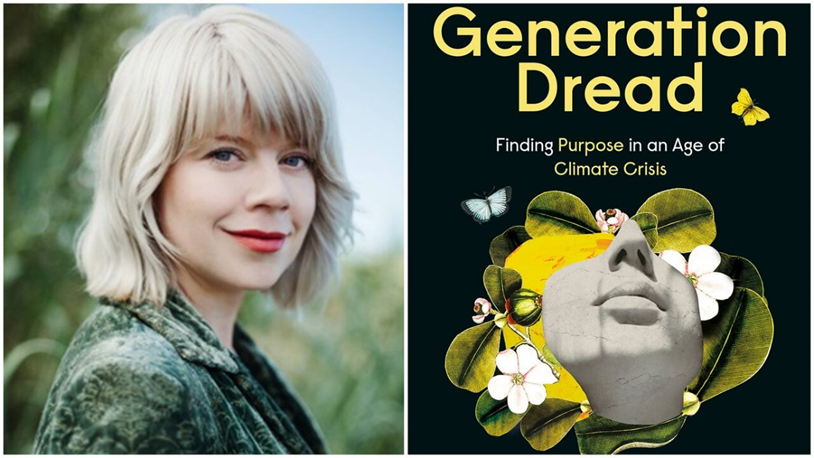
As climate writer and researcher Britt Wray writes in her book Generation Dread however, “Despair and fear are not inherently bad. Hope and optimism are not inherently good…We must move from an either/or to a both/and model. There is meaning in every emotion.” Learning to live with greater uncertainty is a spiritual practice in itself, and every emotion has something to teach us. Our anxiety is not just pathological. It is a signal from the heart of the earth that something is desperately wrong.
Ecological chaplaincy as spiritual care might be imagined as trans-therapeutic. To me this means that it is not an alternative to therapy, it focuses on the deeper dimensions of our soul’s wellbeing and the deeper spiritual crisis that has attacked that wellbeing from every side. The spiritual care that chaplains offer is not curative or even preventative. It is companion-ative.
Chaplaincy speaks to and sits with cosmic uncertainty. We tend to our existential, philosophical, ethical, ritual, and aesthetic health. Meaning, purpose, and connection are our watch words. Chaplains are not technicians of the soul who fix wounded hearts. We are not even guides who pretend to know the way home. We are wounded companions who walk with other wounded hearts through landscapes spiritual and ecological.
An ecological chaplaincy would remind us that the grief we pour out is also the overflowing of a love that has filled us. As spiritual activist Stephen Jenkinson defines it, “Grief is a way of loving what has slipped from view. Love is a way of grieving that which has not yet done so.” An Earth Chaplain would be a practitioner of griefcraft—learning to live with loss even as we keep on loving.
As a chaplain I would not offer any certainty about the outcome of the ecological crises, or even insist that we stay optimistic. I would however, attempt to carry a radical hope, the kind that is made of the earth herself and lives in our bones as an intergenerational heirloom that has been passed down to us. A heritage that we must pass on to others. I acknowledge that my ancestors, scattered as they are across North America and England, are the reason I am alive. And the future I work toward is in a way part of becoming a good ancestor myself.
As Stephen Harrod Buhner writes in his book Earth Grief
“Hope is a quiet, enduring, persistent thing. It is not filled with the excited, uplifting, future-oriented energy of optimism. It possesses instead a slow-moving groundedness, an enduringness, a solidity, a nowness. It isn’t going anywhere, it just is. It’s a form of faith, a faith that comes from life itself…”
Faith in and from life. The spark of life that dwells in me and is me is not mine. It is inherited from my ancestors and borrowed from future generations. I must tend to that spark so that it can light the way.
Navigating Through the Darkness
“But when I lean over the chasm of myself—it seems my God is dark and like a web: a hundred roots silently drinking.”
–Rainer Maria Rilke, Book of Hours ([1905] 2005)
An ecological chaplaincy would be comfortable in the dark. An Earth Chaplain would provide no easy arrivals or answers. When I say dark, I don’t mean the evil, nefarious; realms of ghostly entities that cause mischief. When I say dark, I am speaking into the deep, mystical dimness that is just below the surface of the earth’s contemplative traditions.
The mystics speak of a theology in the negative, an apophatic—literally other than the spoken—dimension to spirituality. The Lineages of Chinese Buddhism and Daoism are well known for their discourses on the ineffable. Lao Tzu’s Tao teh Ching (Dao de Jing) opens with this famous line: “Tao can be talked about, but not the Eternal Tao. Names can be named, but not the Eternal Name.” For Christian mystics like Dionysius the Areopagite, Nicolas of Cusa, and Meister Eckhart, the luminous dark of the Divine required an unlearning and an unknowing. For many Zen Buddhists this is the return to Beginner’s Mind that prepares one for enlightenment.
There is a rich loamy fecundity in darkness. In When the Heart Waits (1990) novelist and spiritual writer Sue Monk Kidd observes that most living things incubate or gestate in darkness. To live, seeds must die and be buried. In the silent obscurity of the heart, we ripen, even when it may feel like we are wasting away. Spanish mystic Juan de la Cruz (John of the Cross) speaks of this as a Dark Night of the Senses and of the Soul. It is a spiritual malaise, an aloneness that comes over even the most disciplined practitioner. These are not just hard times, but times that feel like being hopelessly lost in a thick fog, buried under a landslide of crushing earth. The union or enlightenment that breaks through is not a reward for virtue or hard work, but the result of a slow ripening that we can only patiently await.
The world has been dark before. Plagues, war and famine are endemic to civilizations past. But beyond political upheaval or pandemic, it seems clear that culturally the West is passing through a great Dark Night of the Soul—an absence of direction, inspiration, and purpose at the far end of post-modern cynicism. We orphaned Westerners struggle with a creeping sense of unworthiness. We suffer from privilege guilt, settler guilt, human guilt. Sometimes we wonder if the earth would be better off without us. This kind of wrestling is the kind that happens in a dark night of the soul. We even begin to doubt the worth of our existence.
And yet, the other side of darkness is not noonday sunshine. There is no guarantee that light will dawn again for us. Even though our species will almost certainly survive, much of our civilization will need to die for the earth community to live. How much, I don’t know. But coming to terms with our individual and collective mortality is part of the deep spiritual practice of navigating the dark. We cannot emerge from the chrysalis and be the same.
As Gerald May writes, “Sometimes the only way we can enter the deeper dimensions of the journey is by being unable to see where we’re going.” We cannot escape the dark except by sitting still for a while and letting our eyes adjust to it. Then, and only then, can we start to move our way through it. We cannot go back the way we came; we must cross to the other side. Like the ancient Inca, we need to start making dark constellations from the gaps between the clusters of stars of this dark night sky. So, we’ll need brave dark pilgrims to explore this shadowland. We’ll need dark storytellers to make sense of the gaps.
We don’t have much time. But each of us will always have just enough time to fall in love with life and with the world before it is our time to return to earth’s embrace. And then, to pass that love on to those who come after. The good earth’s liturgy of dying is always followed by a lush rebirth and resurrection. I believe in this resurrection.
Resources and Other Projects
This manifesto is how I am thinking about the topic, there are a lot of other ways to walk this journey.
Keynote address presented to Facing Ecological Grief at Simon Fraser University, April 29, 2023
I don’t know how you all build community, but planning conferences like this is one of my favorite ways! Planning this conference has been a joy. I am very grateful to Naomi Krogman, Paul Kingsbury, Laurie Anderson, Laurie Wood, Candace Ratelle-Le Roy and Chelsie de Souza for believing in this gathering. I am also grateful to all of you, who trust us enough with your day to come and sit and talk.
But I am not just grateful to you. I need you. We are going to need each other to weather the coming age. I am not sure if what we are witnessing is a death rattle or a birth pang. Perhaps, both. What I am going to do is outline some perspectives on ecological anxiety and grief. Not as a psychologist but more as a cultural and spiritual activist.
I want to gesture towards an engagement with grief that holds all the wonderful and terrifying tensions that are building in our time. I don’t come to grief as a problem to be solved. A symptom to be alleviated. A neurosis to be alchemized into action by positive thinking.
Rather, I want to suggest that grief is more like an art form. Grief is a skill. I would even say that grief is a companion or a friend.In the arriving age, we need movements and justice and policy and technology. We also need practitioners of what I call Griefcraft: Midwives and storytellers and artists and chaplains. So let’s talk about our time of trouble with no easy answers.
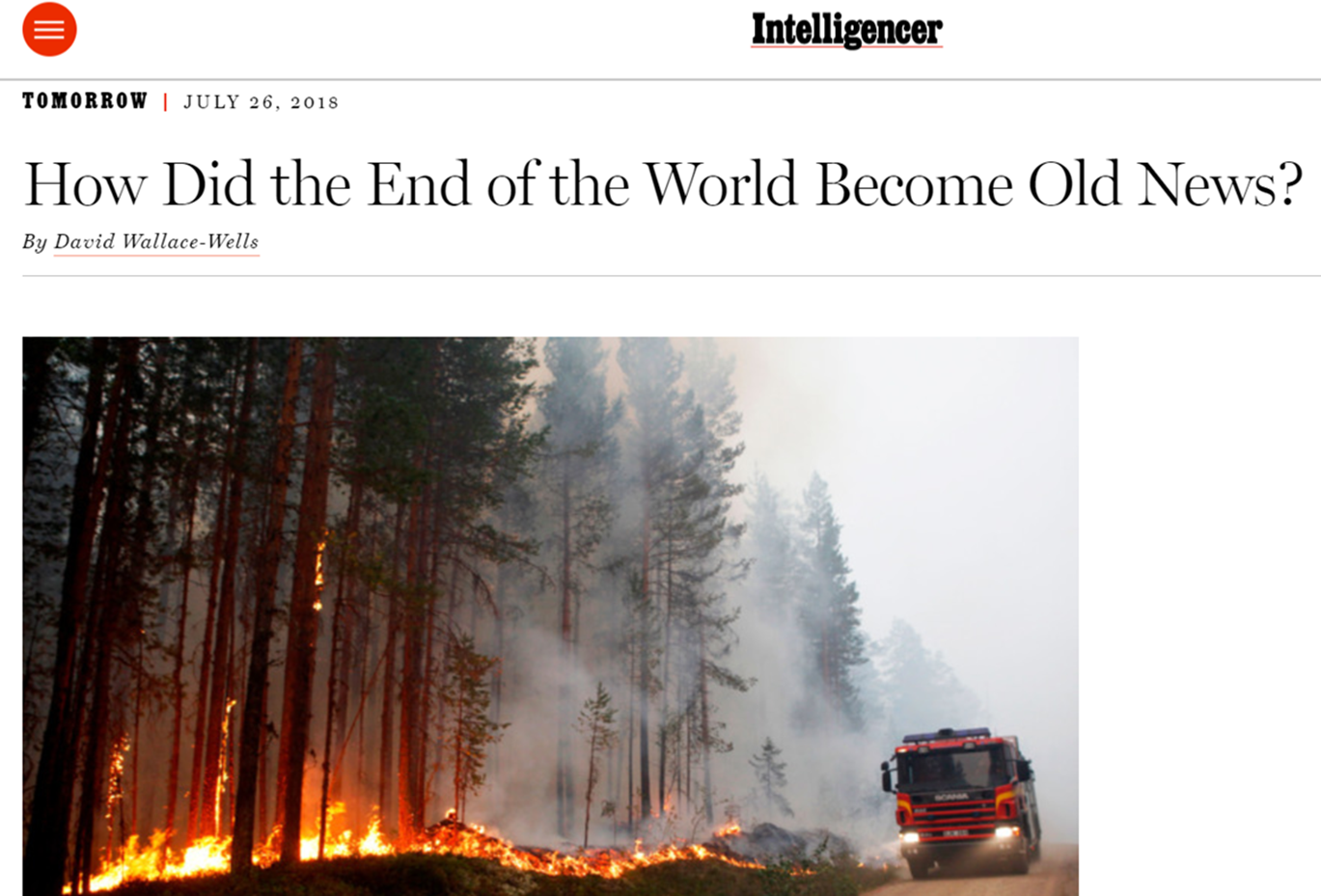
Because I don’t know if you’ve heard, but the world as we know it is ending. There has been a steady litany of troubling news from policy experts and scientists. There has been a litany of pleading for change from the world’s religious leaders, environmentalists and Indigenous communities. Listen to a few of these actual headlines from my newsfeed in recent weeks:
“Temperatures in 2023 could be record breaking with rapidly developing El Niño.”
“We are not the first civilization to collapse, but we will probably be the last.”
“Living sustainably isn’t just a trend, it’s a necessity.”
“As 1.5 degrees looms, scientists see growing risk of runaway warming, urgent need to slash emissions.”
“Climate diplomacy is failing — but we need it to survive.”
“Catastrophic warming will claim lives without action.”
“Ocean currents could collapse this century.”
“Oceans littered with 171 trillion pieces of plastic.”
“Record deforestation in Brazil’s Amazon a challenge for incoming president.”
“Extinction crisis puts one million species on the brink.”
“Scientists deliver ‘final warning’ on climate crisis: act now or it’s too late.”
Of course, there is lots of good news peppered in there too! Deforestation rates have slowed, nations are committing to more protected areas, or even that the garbage patch in the Pacific Ocean is enabling novel marine ecologies! But these days the scales seem to be tipped toward the catastrophic. We know there are still several pathways forward. But as the weeks and months pass, fewer and fewer of these pathways exclude a great reckoning with massive ecological, cultural and spiritual losses. This litany of troubling headlines can trigger in me a deep well of anxiety and anticipated grief. But what’s worse is that most of the time the sheer quantity of bad news results in numbness to feeling anything at all. (It also helps that the next frame is usually a tree or a cat or someone falling or a brand-new baby!)
Generation Dread
So, while there is no longer any uncertainty about the reality of anthropogenic climate change, it is not certain what kind of world our children will inherit. While passing 1.5, 2 or even 3 degrees warming will not be the end of the world full stop; this does not resolve a sense of dread about how bad things are and will continue to get. How much loss will the coming generations have to metabolize? How many species, whose evolutionary lineages span millions of years, will be put to an end? As psychologist and holocaust survivor Viktor Frankl wrote in Man’s Search for Meaning, “at the end of uncertainty comes the uncertainty of the end.”
For me, this uncertainty at the end of the Holocene climate invokes a buzzing anxiety. Ecological Anxiety is typically defined as a state of worry about the future that invokes feelings of sadness, despair, anger, helplessness or hopelessness. Mental health and therapy circles have been talking about climate and ecological anxiety as an impact or symptom of the unfolding crises. This clinical approach tends to revolve around adapting one-on-one therapy models to equip individuals with more tools for coping with their climate-induced emotions. But anxiety is a completely normal response to an unfolding crisis.
Anxiety is as much a signal being communicated from the heart of the world as it is a complex of subjective emotional responses. So rather than just coping with symptoms, deep attention to all of our feelings is an important part of engaging with anxiety related to the ecological crises. In her book Generation Dread, Britt Wray writes, “Despair and fear are not inherently bad. Hope and optimism are not inherently good…. We must move from an either/or to a both/and model. There is meaning in every emotion.”
There is a powerful practice here which is borrowed from Buddhist mindfulness. Anxiety is not best dealt with by insisting that I think positively or try to just focus on feeling gratitude. As Alain de Botton writes through his School of Life organization: “Peace of mind doesn’t come from hoping for the best; it comes from close attention to the very worst…”
A common misconception in discussions of climate anxiety and grief is that this is primarily a concern of the privileged, global north. However, psychologist Susan D. Clayton and co-authors which included Britt Wray have shown, young people in the global south self-reported negative emotions related to climate anxiety at a higher rate than those in the global north. Their essay published in the peer reviewed journal Sustainability analyzed the data from a survey of 10,000 young people between the ages of 16-25 from ten different countries. For young people all over the world, climate anxiety is impacting their ability to function on a daily basis. In Western countries however, self-reported impacts averaged around 45% whereas in the countries from the global south it was closer to 75%.
These findings reveal the obvious: Those closest to the front lines of these unfolding crises are most impacted by them. This is also the case for the far north. As the research of Ashlee Cunsolo, Dean of Arctic and Subarctic Studies at the Memorial University of Newfoundland shows, Northern and Inuit peoples are on the front lines of ecological anxiety and grief in an ecology that is seeing rates of warming four times higher than the global average. One of Cunsolo’s research partners, an Inuit Elder remarked: “Inuit are people of the sea ice. If there’s no more sea ice, how can we be people of the sea ice?”
Two Temptations
In a civilization that has perfected the art of either or, the media often presents us with two responses to the unfolding crises. The first is Climate Doomism which believes it is too late for any meaningful action. The second is a Hyper-Optimism that includes the belief that the more we do the better chance we have of fixing all the world’s troubles.
American writer Roy Scranton, in his book Learning to Die in the Anthropocene writes, “The greatest challenge we face is a philosophical one: understanding that this civilization is already dead. The sooner we confront our situation and realize that there is nothing we can do to save ourselves, the sooner we can get down to the difficult task of adapting, with mortal humility, to our new reality.”
Scranton frames himself as a climate realist, rather than an alarmist or reactionary. In my view he is more motivated by his anti-capitalist politics than a healthy realism about the future of the earth’s climate. Swedish academic and activist Andreas Malm, himself a Marxist scholar, calls Scranton’s book a reification of despair. This means that too often the Doomist view risks becoming a self-fulfilling prophecy that frees its adherents from any responsibility “in the meantime.”
But there is something else going on here too. Having frequented environmentalist circles and taught in universities in different parts of North America, I worry that a contributing factor to the Doomist mentality is the belief that our species deserves to go extinct. It is imagined that perhaps the earth community would be better off without us.
This intuition is actually a kind of self-hatred that appears among some settlers and progressives. Some days, I empathize. But I worry that we will not bother building the foundation for a world that we don’t believe our children are worthy to inherit.
Rather, with scholar Lyla June Johnston, who has Navajo, Cheyenne and European ancestry, I believe that “Human beings are meant to be a gift to the land.” Human extinction would be as tragic as passenger pigeon extinction or monk seal extinction or tiger extinction or orca whale extinction. Human beings emerged from a mesh of ecological brilliance; and there is a place for us in the web of life so long as we can stop techno-industrial civilization from unraveling it completely.
Hyper-Optimism
On the other side of this false choice is what I am calling Hyper-Optimism; which feeds a well-intentioned fix-it mentality. All of us struggle with finding meaningful ways to take action. But this urge is so powerful that we sometimes demand ten ways to take action, before listening to what’s really going on. Fed on a sugary diet of can-do’s, many activists throw their lives into the work and end up burning out in a few years. In his excellent book Earth Grief, Stephen Harrod Buhner reflects, “Activism is an institution that compulsively seeks to heal the world’s pain rather than feel it.”
Of course, he (and I) are not against action, or activism. We worry that a compulsive activism, fueled by urgency but also by guilt, can end up bypassing the necessary work of processing our feelings of fear, anxiety and grief. Some of this hyper-optimism is also deeply rooted in the modernist humanism which created these crises in the first place. The so-called techno-optimists, sometimes referred to as Eco-Modernists or Pragmatists, promise us that we are one technological breakthrough away from solving the climate crisis. Geoengineering, carbon credits, carbon capture and de-extinction will allow us to finally usher in the ecological utopia we have been dreaming of. I am very often tempted by their promises myself. Boosters of this approach are not so shy about suggesting that soon we will be managing every aspect of the planet’s biosphere.
There is, I think, a middle way between Doomism and its self-hatred and Hyper-optimism and its over-activism. Ecological Grief is part of this middle way: Griefcraft engages with complexities and uncertainties. As Donna Haraway writes, it’s part of the work of Staying with the Trouble. As an analogy, perhaps rather than franticly thrashing around in the dark to find the light switch, we might sit still for a moment and let our eyes adjust.
Topographies of Grief
In his book about the death phobia that pervades European descended North Americans, Stephen Jenkinson offers a novel description of grief: “Grief is a way of loving what has slipped from view. Love is a way of grieving that which has not yet done so.” This definition of grief shows how deeply connected it is to love, to feeling connected. We cannot grieve for that which we do not love.
Our experience of grief can vary from person to person and culture to culture. The famed psychiatrist Elisabeth Kübler-Ross developed a typology for the stages of grief: Denial, Anger, Depression, Bargaining, and finally Acceptance. This has been a helpful tool for individuals coping with a terminal diagnosis or the death of a loved one. But as the illustration below shows, there may be a common definition of grief, but there is no common experience of it.
We began today with a land acknowledgement. And every land acknowledgement brushes up against a deep well of historical trauma and grief. To speak of ecological grief as an emerging phenomenon is absurd without first acknowledging that it is a present reality for so many. As Indigenous scholar Kyle Whyte writes, “In the Anthropocene, then, some indigenous peoples already inhabit what our ancestors would have likely characterized as a dystopian future.” As a philosopher, Whyte has theorized an Indigenous ethic of sustainability and spiritually appropriate science. He also amplifies the many examples of Indigenous communities that are restoring ecological and cultural connections to place and species despite the heavy losses wrought by colonial violence and erasure.
To some extent, all of our bodies carry the grief of our ancestors. But the topography of ancestral grief is anything but flat. The collision of colonial, racist, gender-based and species-ist violence with ecologies and Indigenous bodies, black bodies, brown bodies and women’s bodies shape the contours of the topographies of grief like tectonic plates. Some are subducted under the enormous weight of oppression, while others are lifted to greater heights of privilege and social mobility.
Humans are not alone in feeling grief over lost loved ones. There are cultures of grief woven through the earth community. Fellow primates express grief and may even have a form of ritual. For example, chimpanzees have been observed ritually cleaning the fur of a dead loved one. Elephants are well known to reverence the dead and even to handle their bones. And closer to home, J35 was a Salish Sea resident mother Orca who carried her dead newborn with her for over 17 days.
Psychologist and writer Andrew Solomon writes, “To be creatures who love, we must be creatures who despair at what we lose.” Most of us have felt that icy absence of a partner, a loved one or a pet from our homes. We have walked around familiar places after a divorce or tough break up and felt both cherished and painful memories.
There is an ecology to our grief that is at once a response to loss within the web of our relationships, and the slow composting of loss into new life that finds a way to keep going. Grief after the death of a loved one is learning to inhabit a new interpersonal landscape, a rearranged social ecology. Paraphrasing writer and mythologist Sophie Strand, “Each loss opens a wound and a song in the Animate Everything.”
Zooming out a little, loss is also an integral part of the earth’s ecosystems. But on the ecological level, the long-term effects of loss are more difficult to judge. By this I mean that ecosystems are not nouns they are verbs, they are not things but events. Ecologies are adept at reorienting around loss and forming new processes and pathways. Afterall, with hindsight, I am incredibly grateful for the many losses that melted the glaciers that once covered this very spot and made way for lush rainforests to grow.
Death and loss are not separate from change and life and birth. The good earth subsumes interconnection and rupture, balance and imbalance. If you go into a forest and only see what is alive, you are only seeing half the picture. So, to my fellow environmentalists, if all we see when we look at changing ecosystems is loss, then we are not seeing the possibilities that change might afford for fostering novel relationships that are regenerative.
But do not get me wrong! I am not saying that actually, loss is just change, let’s accept it. There is a massive work of discernment here! It is true that a fear of change makes me allergic to loss. So, engaging with ecological grief helps me become better acquainted with loss and death. But ecological grief, as contemplative as it is, is not quietism! It is not a resignation to whatever may come. If grief is a way of loving, then I am not afraid to admit: We still have a lot to lose! This is going to mean that Griefcraft is not just the skill of accommodating loss and tragedy. It is not passive or reactive.
As the twin sister of love, grief teaches us to accept loss when it comes, yes it does. But a love-bound grief is also willing to resist the losses that should not yet be let go of! In Cormac McCarthy’s novel The Road we read a grueling and gritty thought experiment with a stripped-down sense of human purpose. In the novel, a man and his son stumble through a post-catastrophe landscape scrounging for food and avoiding roving bands of cannibals. The man’s only purpose is to see his son survive. His son is deeply committed to an objective sense of the Good. He carries with him the flame of hope that some day a better world might exist. At the end of the novel, McCarthy warns us against inheriting a world that is starved of life and beauty. He writes,
“Once there were brook trout in the streams in the mountains. You could see them standing in the amber current where the white edges of their fins wimpled softly in the flow. They smelled of moss in your hand. Polished and muscular and torsional. On their backs were vermiculate patterns that were maps of the world in its becoming. Maps and mazes. Of a thing which could not be put back. Not be made right again. In the deep glens where they lived all things were older than man and they hummed of mystery.”
We have a lot to lose, and I do not want to make meaning with the scraps of a once beautiful world! I want to live in a world that teams with life and love and beauty. And yes, even in that world that we all know is possible, grief will not disappear. On some deep level, I know that to love is to risk great suffering.
Building on this idea that love grows out of the rich compost of grief, University of Washington scholar Jennifer Atkinson writes that, “Grief is strength in these times. Burying our emotions might shield us for a while, but grief keeps us in contact with truth, and beneath everything, it opens our eyes to the profound love we feel for the fabric of life that’s under threat. Grief is a direct expression of connection—a pain we could never feel if it weren’t for the depth of our love. And more than cheerfulness or stoicism or more information, it is love that will move us to fight. No scientific report or technological innovation will ever match that kind of power.”
So being willing to risk the deep wounds of grief might give us a fighting chance. And that, my friends, brings us to Hope.
Litanies of Hope
Writer Rebecca Solnit’s Hope in the Dark is a powerful meditation on the complexities of history and the power of collective action over the long term. Solnit argues that Hope is active, but it does not die when things don’t turn out the way we expect. Hope is a stance of openness to the possibilities that uncertainty may bring. It is a posture of prayer. Hope is what got me out of bed this morning. Hope is what led Britt Wray, the author of Generation Dread, to the decision to have a baby despite her deep fears for the future. Hope is what is blooming all over Vancouver right now. Hope is what brough the goldfinches and chickadees and sparrows to my bird feeder this morning.
For these reasons, I appreciate Stephen Harrod Buhner’s reflections. He writes, “Hope is a quiet, enduring, persistent thing. It is not filled with the excited, uplifting, future-oriented energy of optimism. It possesses instead a slow-moving groundedness, an enduringness, a solidity, a nowness. It isn’t going anywhere, it just is. It’s a form of faith, a faith that comes from life itself.”
Hope is our animal soul’s very breath! There are dozens of projects, workshops, circles, art exhibitions and gardens that are engaging with the skills that accompany what I am calling grief-craft. Projects that are exploring the personal and collective depths of ecological grief. Francis Weller’s book The Wild Edge of Sorrow outlines many ways of engaging with grief through ritual. And groups in Iceland and Switzerland have already held public funerals for glaciers that are melting out of existence. A woman named Gabrielle Gelderman who lives in Edmonton, Alberta has begun using the title of Climate Grief Chaplain. In Victoria, a small collective of artists has started a magazine called Solastalgia which aims to be a resource for art, movement building and grief-craft. (I’ll explain this word in a moment.) There are earth hospices, good grief networks, grief circles and climate cafés being explored all over the world, online and off.
Just to highlight a few more of my favorite projects: Participatory artists Heidi Quante and Alicia Escott founded the “Bureau of Linguistic Reality”. This project solicits new words that express worries and the textures of our unfolding reality. They took inspiration from philosopher Glenn Albrecht’s neologism Solastalgia which means Comfort-Pain, was imagined to get at a pervasive uneasiness about the losses our home places are incurring. This word has spoken to thousands of people from Appalachians fighting against mountain top removal, to the Inuit peoples witnessing the rapid warming unfolding before their eyes. This is a powerful reminder that cultivating a love for our home places is not just for good days. Placefulness, as I call it, is also about loving our places after they have been clear cut, or on the days that wildfire smoke is turning the sun orange and we cannot breathe.
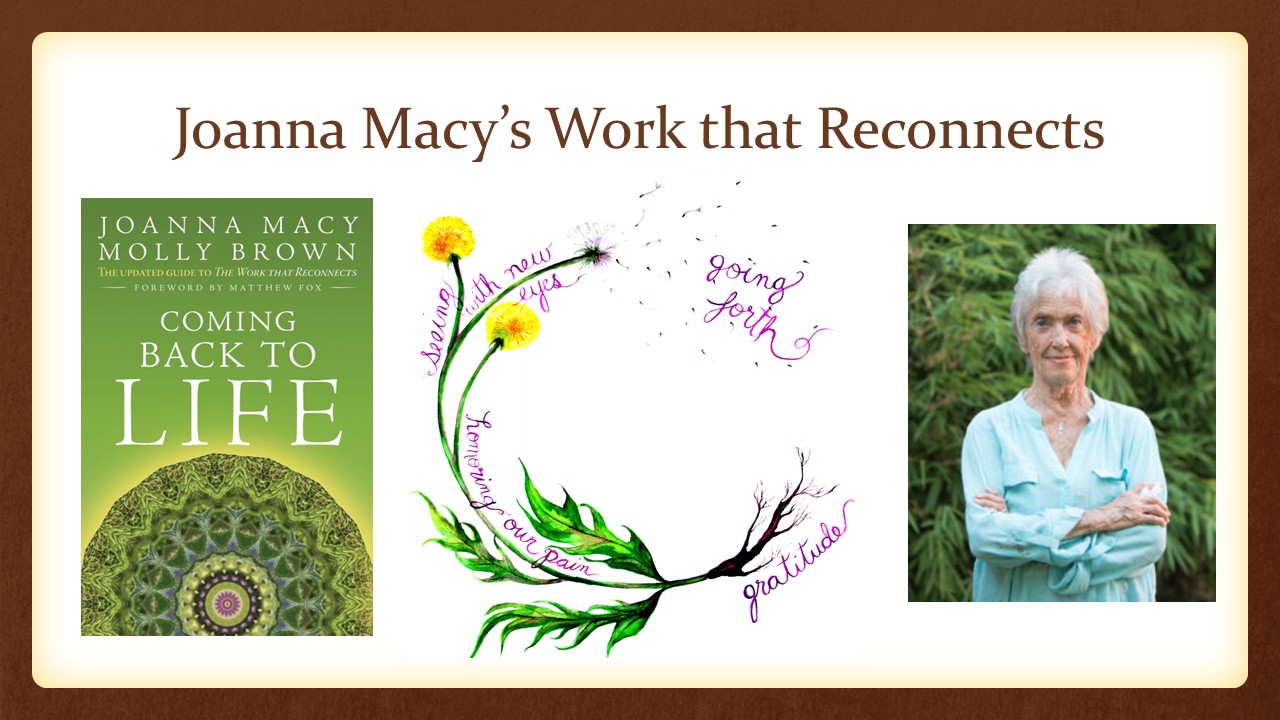
Joanna Macy’s Work that Reconnects began as a pioneering method for processing movement and ecological grief. Her cyclical, almost liturgical practices, encourage us to return again and again to gratitude. Then, turning our attention to honoring our pain allows us to see the world with new eyes. And even after one hundred burn outs, doing so enables us to go forth, back into the fray. To say with Samuel Becket, “I can’t go on. I’ll go on.” In a way, I structured this talk around this liturgy of hope: Gratitude, pain, new ways of seeing and the ways we might go forth from this conference.
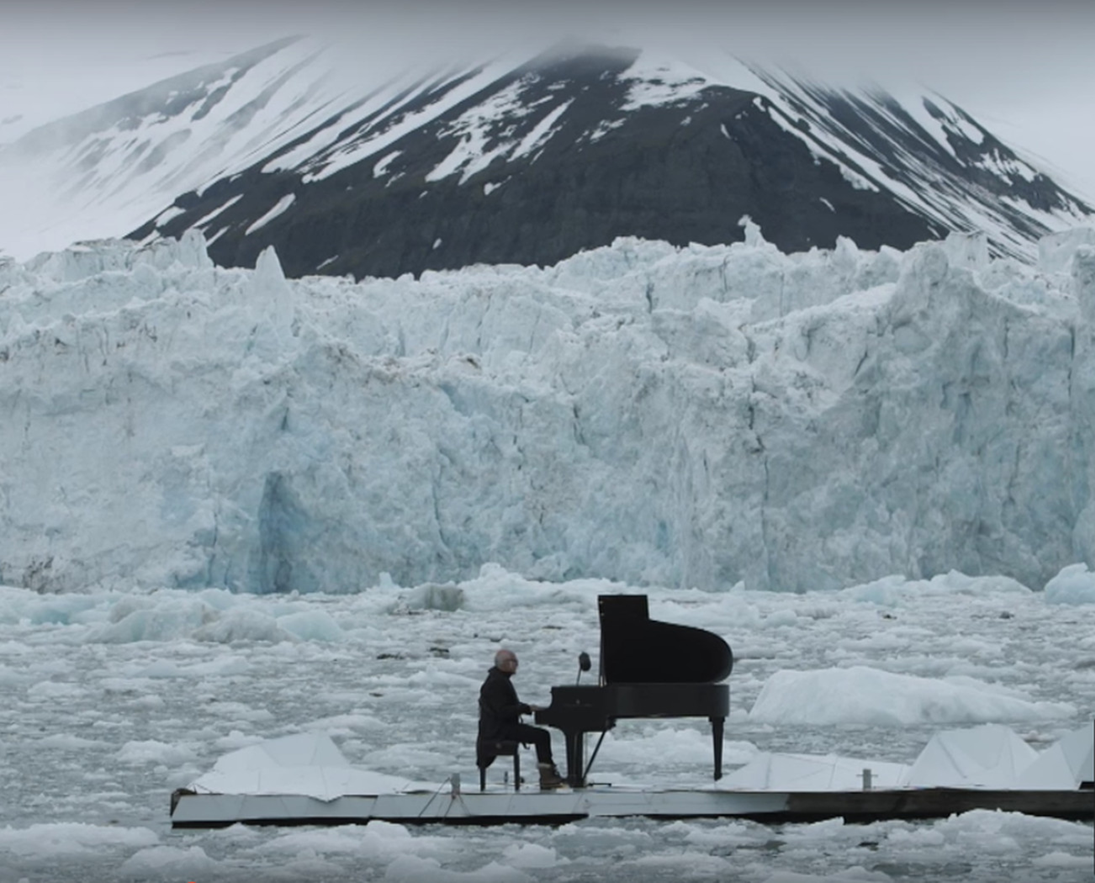
Trebbe Johnson, a former wilderness guide, has started an organization called Radical Joy for Hard Times. Through annual Earth Exchanges, she invites us to love wounded and neglected places with simple acts of beauty. In a similar act of beauty, on June 16, 2017, during a Save the Arctic Campaign Ludovico Einaudi’s played “Elegy for the Arctic” before a calving glacier. This was of course primarily a public awareness campaign, but it reminded me of the famous epigram from German playwright Bertolt Brecht who wrote from exile, “In the dark times will there be singing? Yes, there will be singing. About the dark times.”
Ecological Grief is deeply personal, but we also need ways to express collective grief. I am open to ideas. Even bad ones! Perhaps we could create rituals that honor the losses we are too numb to feel. Perhaps we could sing our grief together and walk our grief together and dance our grief together. Or, perhaps we could experiment with nurturing trees and plants that are adapted to warmer climates. The many projects popping up all over the world help me to see that grief is not the opposite of hope, it is its pollinator.
Just as death is a mirror that we hold up to life to see how precious it is; grief is a mirror that is held up to love to feel how risky it can be. Public intellectual Cornel West once said that “justice is what love looks like in public;” well, my friends, if that is so, then perhaps what love feels like in public, at least sometimes, is grief. And perhaps that is what storyteller Brother Blue meant when he said, “My heart is broken. I never want it to mend.”



 holyscapes