On Monday the Trump administration rescinded a 2001 Clinton era roadless rule that affects 59 million acres of National Forest land. This move reveals not just an economic and political strategy, but a theology that has been at the heart of industrial forestry since its inception. Secretary of Agriculture Brooke Rollins said this about the decision:
“Once again, President Trump is removing absurd obstacles to common sense management of our natural resources by rescinding the overly restrictive roadless rule, … It is abundantly clear that properly managing our forests preserves them from devastating fires and allows future generations of Americans to enjoy and reap the benefits of this great land,”[1]
This rule affects over 30% of the National Forest System, but 90% of Alaska’s Tongass National Forest, in addition to major swaths of National Forest lands in Montana and Utah. The Trump administration’s philosophy of government revolves around deregulation in line with his Executive Order 14192, Unleashing Prosperity Through Deregulation. The order aims to reduce the barriers to extractive industries in order to stimulate the economy.
President Trump has made numerous comments to the effect that America is already a beautiful place and that the rules governing ecological health are excessive. While some want healthy ecosystems, Trump want’s a healthy economy, and sees regulations as a feature of the “swamp” in need of draining. This agricultural metaphor is apt, as it speaks to the central agrarian story at the heart of Western civilization: the natural world needs improvement through the application of technology.
In my essay “Give Me That Old Growth Religion: Finding Common Ground in the War in the Woods” I lay out three major perspectives on North American forestry: Industrial, Wilderness, and Relational. These perspectives are rooted in the worldviews shaping forestry decisions. The Industrial theology is primarily aimed at maximizing profit and social benefits in the form of economic growth, Wilderness focuses on preservation of rare and fragile ecosystems, and the Relational theology represents the approaches taken by people to live and work with a deep cultural connection to the forests they harvest from.
What seems clear from Monday’s announcement, is that each of these approaches to forest management reflects the wider worldview of its defenders. With protestant theologian Paul Tillich I think a theology is not just a belief system, butreflects one’s “Ultimate Concern”[2], something toward which one is completely oriented. In this sense an Industrial worldview that is oriented toward maximizing human flourishing is not just a policy but a theology.
The rescinding of the roadless rule reflects this theology. Opening more forests to roads is common sense because forests are a material resource for humans to manage, and a healthy economy is highest good. This approach didn’t begin with Trump or even George W. Bush. Rather, it goes back to figures like Gifford Pinchot, the famed American conservationist, who defended forests against boom-and-bust exploitation so that they would be used prudently for the benefit of the whole society. But the forest reserves he created were not ecological reserves, they were economic ones. Pinchot the conservationist had a falling out with wilderness preservationist John Muir over his view that protected areas should be “temples” where we worship rather than resources that we manage.
Despite his erratic and idiosyncratic style of governance, President Trump has merely followed along with the mainstream of the industrial forestry approach. Roads allow us to manage fires more effectively the argument goes, and to generate some wealth in the meantime. In keeping with the Industrial theology, President Trump would point to massive wildfires as evidence of poor management that has failed to maximize the forests’ economic potential. This is California’s original sin.
Unfortunately, President Trump has also consistently shown very little confidence in climate science, which should be considered when discussing forest management and the increasing severity of fires in recent years. In 2020 President Trump chided California officials in the midst of the Mcclellen Park fire claiming that sure the climate might change, but that maybe it would get cooler. When Governor Newsom insisted that climate change was a factor, Trump dismissed him saying, “Well I don’t think science knows, actually.”[3] Trump continues to ignore the repeated and consistent IPCC reports that state with the highest possible confidence that climate change is a real existential threat and a factor in increasingly catastrophic wildfires.
Despite this willful ignorance, what President Trump has fixated on is rooted in a partial truth. Much of the conservation efforts of the 1980s and 1990s promoted a hands-off management strategy that looked at the massive clear cuts of that era and proposed their opposite. This “wilderness ethic” preached that nature knows best. Thus, California’s fire adapted ecosystems were often managed to exclude fire, and as a result many state and federally managed forests became very dense with trees. Historic photos from the 19th century show massive increases in tree density for example. This density is historically mitigated by natural fires, intentional fires embedded in Indigenous food systems, and forestry.
The public facing justification for the new rollback of the roadless rule is that 28 million acres of these roadless areas are at high risk of wildfire, and allowing roads will allow management prescriptions that decrease the risk of catastrophic, stand replacing fires. The hope is that this will protect people and allow for modest harvests that will benefit the economy.
However, roadless areas are frequently far from human settlements. And in recent decades, fires in remote areas, have been allowed to burn to enable these ecologies to develop a more historically consistent fire return interval. A more frequent fire return interval results in lower intensity fires. Thus, the dense forests that burn with such high intensity have been fueled by both management decisions and climate change.
President Trump, and perhaps wilderness advocates too, refuse to accept that both things can be true and than management needs to focus on local conditions informed by local knowledge. Yet both camps are devoutly committed to their theologies of forestry: More cutting on the one hand, and less intervention on the other.
What’s more, Alaska’s Tongass National Forest, where 92% of its forests will be affected by the rollback of the roadless rule, is a sopping wet temperate rainforest. The fire risk in Southern Alaska is never zero, but it’s not a high risk. Rather, it seems clear that rescinding the roadless rule is the latest attempt by timber companies and their Industrial theology to get at the old growth forests in Alaska it has been drooling over for decades. To make an economic impact, management interventions, likely large clear cuts, will negatively impact dozens of species, including bears, salmon and whales, which are also intimately connected to the economy of Southern Alaska.
Unfortunately, the loudest voices about the implications for the Tongass National Forest will be the Industrial theology who frame the development as a major boon for jobs and industry, and the Wilderness theology who lament this as a desecration of sacred old growth wilderness. Nuanced rural and Indigenous voices will likely be marginalized by these two dominant theologies.
Yet, if we would just look to Indigenous and rural communities, we would see that a healthy economy and healthy ecosystems do not have to be mutually exclusive. They only require a Relational theology that is more committed to the places we are managing than to ecological purity or corporate profits. Forests are not just sacred sanctuaries for weary urbanites, and they are not just crops for absentee corporate landlords. They are places with names, and there are people who love them. Perhaps instead of the tired back and forth posturing over jobs versus the environment, its time to return to a theology that sees people whose lives are tied to the places they manage as the best way to ensure that the earth community, including us humans, prosper.
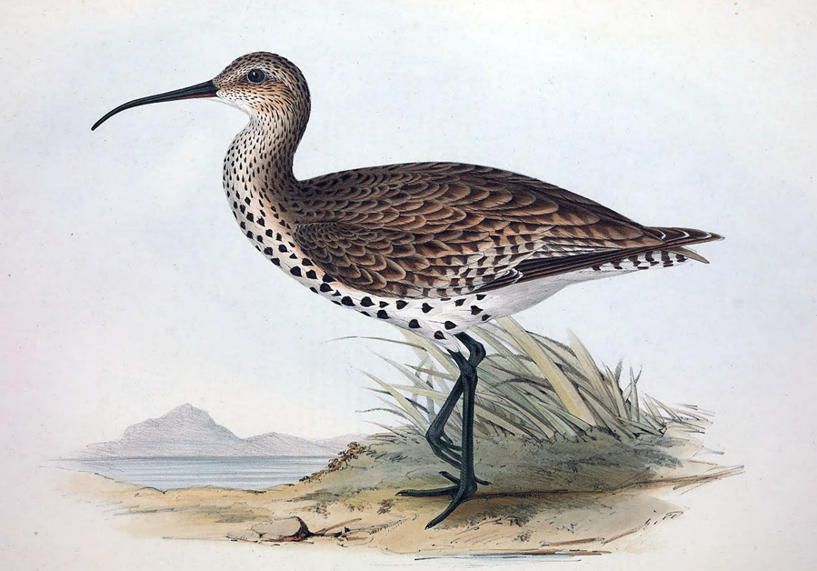
In November of 2024 scientists declared that they were now confident another species had gone extinct. The Slender Billed Curlew (Numenius tenuirostris) is in the sand piper family and was last photographed in Morocco in 1995. Dr. Alex Bond, Senior Curator at the Natural History Museum in the UK reviewed all the available recent sightings and data and made this grim conclusion.
Europeans have caused extinctions in the past. The Dodo, the Great Auk or the Canary Island Oystercatcher. But these birds were endemic to islands. The Slender Billed Curlew was a shore bird that inhabited mainland habitat from Europe to North Africa. It was known to have bred in Siberia, but migration wintering grounds were observed in the Mediterranean and the Middle East.
It is a notable extinction because it is the first continental bird species to be declared extinct in recent history. The decline was long, but scientists are confident that the species is now globally extinct. What do we make of an extinction? How do we mourn a body of bodies that no longer flies, an avian language that is now silent?
We know that animals grieve for their dead kin in their own ways. Tahlequah, the Salish Sea resident orca mother carried her dead baby for 17 days. Primates, dogs, even crows show distinct behaviors around their dead. Elephants have been observed fondling the bones of their dead matriarchs tenderly, standing in quiet circles over the remembered dead.
On September 1, 1914, Martha the last Passenger Pigeon (Ectopistes migratorius) died in the Cincinnati Zoo. Once numbering in the billions, passenger pigeons formed sun-darkening flocks over much of eastern North America. They were hunted into oblivion by people with guns. Martha may not have understood that she was the last of her species, but I am sure there was a dove-shaped loneliness to her final days.
Death is part of life, not an exception. Extinction is part of evolution and not a failure of it. All that is true in this world is also all that is change, flux and transformation. From death comes new life. From extinction comes openings in the ongoing ecologies of our home. Just as death must be grieved, even in the hope of new life, so too must extinction be grieved. But the difference is that extinction in these times is one of many outward symptoms of a global illness that is threatening us with planetary death. And this death would not hold the promise of new life for a very long time. It is this death, not death in general, that we must resist; the death of a vibrant and living earth who should not yet die. And just as in ancient alchemy and Chinese variolation the cure was to be found in the illness itself, resistance is our only medicine, our lives lived well the best anti-bodies.
Nov. 30th has begun to be honored as a Remembrance Day for Lost Species. To face our grief and to acknowledge this planetary illness is to commit ourselves to healing, to building strength to fight. The documented events suggest that in the past there have been gatherings that encourage art making, speaker series, poetry readings. They encourage lighting candles, holding vigils and procession. I did not know the Slender Billed Curlew; can I still grieve authentically for her absence from the world? How might you sit with the strangeness of extinction in these heartbreaking times? Perhaps we could sit together. I am open to ideas.
Is it time grieve the imminent extinction of the Northern Spotted Owl?
NOTE: While writing a draft of this essay, the following New York Time op-ed was published! This one written by philosophers in Oregon. I support their skepticism but do doubt some of their empirical claims. Here I add my own philosophical and spiritual questions to the conversation.
In my environmental ethics and humanities classes, we cover many different subjects from pollution to consumerism to climate change. One of the most important topics in the age of extinction is the question of value. At what scale are we willing to invest intrinsic worth? (value that is inherent, and not oriented toward some greater purpose). The individual organism? The species? The ecosystem? The biosphere? Clearly a holistic ethic considers the relationships between these interacting agents and contexts, but in some case studies we must decide what is more valuable in the long run, and what criteria to use to assess this value judgement and the decisions and consequences that flow from it.
For example, the emerging strategy of conservation organizations in the Pacific Northwest of the US and southwestern Canada to cull Barred Owls (Strix varia) on an ongoing and apparently indefinite basis so that the Northern Spotted Owl (Strix occidentaliscaurina) might not go extinct is a case where the existence value of the subspecies Northern Spotted Owl has been valued above the suffering and death of thousands of individual Barred Owls. This is a heart-rending decision for many conservationists I am sure, and I sympathise with the intent, and for me it illustrates the strangeness of one thread of contemporary nativist ecological dogma.
Northern Spotted Owls are a subspecies Strix occidentalis which has two other subspecies: California and Mexican. The ecological importance of these owls is not as a keystone species, but more as one indicator among many of ecosystem health. The idea is that when Northern Spotted Owls are healthy, so are a range of other old growth forest inhabitants such as marbled murrelet, salamanders, flying squirrels and species of forest voles and mice.
Surprisingly, the Northern Spotted Owl is not listed as endangered in the United States but as threatened. There are an estimated 3,000-5,000 individuals left in the US. In British Columbia, the owl has been put on the red list, which is the most endangered category of risk before extirpation. Historically, there were likely no more than 1,000 Northern Spotted Owls in BC, which touches the northern extent of their range. In 2022, it was reported that there was literally only one wild born Northern Spotted Owl left in BC. Since then the Province has been goaded to initiate a recovery plan mostly through a captive breeding program.[1] The Canadian Spotted Owl Recovery Team has also been monitoring populations of both species in some 300,000 hectares of protected area, some of which is located in deferred old growth logging concessions, for recovery of wild breeding pairs. They have also attempted to relocate Barred Owls when they are encountered near known Spotted Owl nests.
Some conservationists have devoted their whole careers to saving this beautiful being. And during the 1990s, the Northern Spotted Owl became a flash point for public conflicts related to old growth conservation. The Jobs vs. Owls debate was framed narrowly as a culture war between hard working loggers, truckers and millworkers and the environmental movement.
Billions of dollars were spent, and thousands of jobs were lost when the Northwest Forest Plan, presided over by President Clinton, was implemented in 1994. The plan is currently being updated by federal officials under President Biden. The Plan spanned some 17 federal forests and protected over tenmillion acres across a landscape that spans some twenty-five million acres. In recent years, British Columbia has gearing up for a major paradigm shift in old growth phased forest conservation which has resulted in the protection and deferral of some 6.4 million acres.
Despite these gradual changes, many in the conservation movement are feeling like with the Barred Owl in play, it is critical to save the Spotted Owl by any means necessary. Anything less would mean the whole enterprise was a failure. In a Guardian piece from 2023, Susan Jane Brown (no relation), a lawyer for the Western Environmental Law Center said, “I think the spotted owl is going to go extinct in my lifetime. For someone who has spent their entire career trying to conserve the species, that’s a failure.”[2] She sees the extinction of the owl as a failure of the movement, despite the major wins in terms of acreage protected.
This line of thinking has led to the justification for plans to cull the Barred Owl as a regrettable but necessary solution. Journalist Jim Robbins recently explored the US’s strategy to cull Barred Owls amid news that the US Federal Government is renewing funding for Barred Owl killings throughout California, Oregon and Washington States. The plan will kill 15,000 owls per year starting in 2024, including any hybrid “Sparred” owls they find. Previous pilot projects as early as 2010 in the region have already killed thousands of Barred Owls, and test plots show that where Barred Owls are killed, Spotted Owl populations can stabilize and may recover.
This species-centric view understands habitat as the backdrop for the main event: Species. So, to succeed, you must ensure that the species sticks around as it has been taxonomized and understood in its historical ecology. We are acting out an analogy of preserving a painting and a museum. A historic baseline determines which species belong and which do not.
As far as we know, Barred Owls have the longest history in eastern North America. Our best guess is that they were able to slowly migrate west through the suburbs and urban forests of the Midwest. They did this on their own, without any direct assistance from humans, except that we like trees and plant them wherever we go. The owl didn’t arrive in the Pacific Northwest until the 1970s, right when the Spotted Owl was in steep decline due to the voracious rate of old growth logging in the region.
Geneticists have identified two clades within the Barred Owl species that run latitudinally (north to south) and correspond to pre-Pleistocene refugia populations. The current distribution is longitudinally broader, and not predictive of this ice age bottle neck. Claims in the NYT Op-Ed that the Barred Owl has been in the Pacific West for longer than the conventional story seems to be picking up on this major taxonomic fork, but there doesn’t seem to be evidence that the Owl was in the Pacific West before the 20th century.[3]
The trouble with their arrival, is that because the Barred Owl is more versatile than the Spotted Owl in both preferred habitats, hunting and prey, they have adapted well to the urban wildland interface habitat that humans have co-created. They also appear to be outcompeting Spotted Owls in old growth phase forests, sometimes preying on them, but also sometimes mating with them. In addition to major declines in preferred habitat, the Spotted Owl has had to deal with a new competitor.
I feel that the decision to cull Barred Owls is not made lightly or with malice by federal agencies and that conservationists feel that by killing one owl they are saving two. But I have also observed a kind of crusader’s enthusiasm among some ecologists against any species they deem to be out of place, exotic, or part of an invasive scenario.[4] A student related to me that one of her biology professors once gloated about drowning grey squirrels which many conservationists have labeled as an invasive species, which implies a duty to eradicate them for the good of the whole, a troubling ethos that I need not elaborate on.
Animal rights and welfare organizations have voiced opposition to the killing of Barred Owls because their approach to intrinsic value is focused on the level of the sentient organism. The species Barred Owl cannot suffer, only individual owls can suffer. Therefore, intentionally kill thousands of owls a year is a breach of an ethic that believes that regardless of how the owls arrived, they deserve to be treated with dignity and have a right not to be subjected to undue suffering.
This ethical objection has led to an approach to the control of aggressive species called compassionate conservation which seeks to save species without causing the undue suffering of non-native species who are only doing what organisms do. From rats and mice to cats and goats, compassionate conservation believes that ends and means matter, and saving a species should not unfold in the wake of mass shooting, painful time delayed poisoning or limb breaking traps. In the case of Spotted Owls, the relocation of Barred Owls from Spotted Owl nesting zones, as has been tested in British Columbia, would be the preferred option rather than culling. There are other options if we want to both reduce suffering and give Spotted Owls a chance as recovery.[5] Emma Marris’s book Wild Souls: Freedom and Flourishing in the Non-Human World (2021) is an excellent exploration of the nuances and limitations of these approaches.
I have never seen a Spotted Owl in the wild, but I have seen dozens of Barred Owls. And they are a magical site to see. Their existence is just as worthy and beautiful as the Spotted Owl, even if their prowess is displacing their spotty cousins. So, what I want to say is that I don’t like the idea of Spotted Owls going extinct; and I feel visceral horror at the plan to slaughter Barred Owls. I think we should do what we can to save the Spotted Owl but not at the cost of thousands of dead Barred Owls.
I also find it interesting that one of the definitions of species is the ability to interbreed. More than 10 per cent of birds can mate across species, but still, I find it a fascinating twist in this story. One interesting fact is that the genetics of Sparred Owls often come from female Barred Owls and male Spotted Owls.[6] Typical Owl courtship involves calling and offerings of food by the male and then mutual preening within pairs. It appears that female Barred Owls, the more aggressive species, are accepting courtship displays from male Spotted Owls. This might sound silly, but are these owls trying to adapt to local conditions? Is this integration rather than colonization? If that were the case, wouldn’t we expect to see the most dominant and aggressive Barred Owl males occasionally mating with female Spotted Owls? Again, I might be stretching my social science of owls here, but it strikes me as interesting. More specifically, what it makes me think is that evolutionary ecology has surprised us before. And evolution is always a dance between confluence and conflict, and we need to think harder about how to relate to these intermingling choreographies.
From my perspective, it seems that continuing to protect and steward resilient ecosystems is the best use of our time and resources. Ensuring that there are large swaths of old growth phase forest for Spotted Owls considers both the intrinsic value of this majestic bird and its relationship to its wider ecology.
It also seems to me that the current conservation paradigm’s approach suffers from a primal denial: the denial of death. The anthropologist Ernst Becker argued that the belief in immortality in the world’s cultures has its roots in this primordial human consciousness of our own deaths and our anxiety about its implications.
Becker argues that our species’ immortality stories and heroes’ journeys are ways of projecting ourselves onto the stars and into the future so that something of ourselves might live forever. Human consciousness longs for stability and eternity. And our era of human rights has affirmed this infinite and intrinsic worth. No human being needs to justify its existence. Our inherent dignity comes from who we are, not what we do.
Recognizing the intrinsic value of a species, was a powerful step beyond an imagined human supremacy and into a more ecologically oriented ethic. A species has a right to exist not because it provides us with some service, but because it is a unique and precious incarnation of the unfolding wonder of evolution and plays an important role in evolving ecosystems.
But it feels like draconian culls are the result of a denial of the reality of ecological death. When a loved one dies, we must grieve their death. When a species goes extinct, we must accept that it is gone. Spotted Owl extinction would be an irreplaceable loss from an ecology that has resisted much of the onslaught of European colonial expansion and ecocide.
Yet, the Spotted Owl is dying, and that death is an inevitable part of life. To seek to restore ecosystems, to fund captive breeding programs, to relocate Barred Owls from known Spotted Owl nesting sites are heroic efforts to preserve the Spotted Owl’s fingerprint in the sacred body of our ecologies.
But by attempting to do this by slaughtering thousands of Barred Owls is to somehow cross a moral threshold. It is to believe that immortality for the species is the only outcome we will accept, rather than preparing to grieve the loss of a species even as we are working within our value system to protect it. And then, if we fail, feeling the full weight of that failure and continuing to work to protect the ecological conditions under which new species, including hybrid Sparred Owls will emerge. To insist on preserving the Spotted Owl as we imagine it to have been, and to do so at the cost of the suffering of thousands of Barred Owls feels like losing faith in the creative and generative potential of evolution and ecology.
I sympathize with compassionate conservation on this issue, not because I think we can prevent all suffering in the natural world, or because I do not consider species or ecosystems as possessing intrinsic value. I object to culls and sympathize with more compassionate measures in this case because not only do the means and ends align, but because I recognize that even where ecosystems have been protected, captive breeding programs have been funded, relocation efforts have been tried, and Barred Owls continue to spread, what is truly needed is grief not guns.
[3] Barrowclough, George F., Jeff G. Groth, Karan J. Odom, and Jonas E. Lai. “Phylogeography of the barred owl (Strix varia): species limits, multiple refugia, and range expansion.” The Auk 128, no. 4 (2011): 696-706.
[4] I do not call any species ‘Invasive’. Invasion is never a direct trait of a species, invasion scenarios always play out as an interplay of aggressive species, exacerbated by human-caused disturbances, and are dependent on the novel ecological conditions and the lack of potential predators in early phases of range expansion.
[5] I am not speaking here to other examples of culling on small islands where rats, cats or goats have decimated populations of ground nesting birds. These present a range of other questions, and I have sympathy for those working on these projects which are crucial for saving some island bound species from extinction.
[6] Haig, Susan M., Thomas D. Mullins, Eric D. Forsman, Pepper W. Trail, and L. I. V. Wennerberg. “Genetic identification of spotted owls, barred owls, and their hybrids: legal implications of hybrid identity.” Conservation Biology 18, no. 5 (2004): 1347-1357. https://conbio.onlinelibrary.wiley.com/doi/10.1111/j.1523-1739.2004.00206.x
This essay is based on an interactive workshop given at the Swan Lake Nature House in Saanich, BC on Oct. 13, 2023.
Grieving Our Aloneness
Philosopher David Abram mused that the West is a civilization that has been increasingly talking to itself for the several hundred years. In so many ways, the mainstream of Western cultures have disenchanted the world and tuned out the hymn of praise that is being sung from its heart. This isolation is sometimes referred to as the modern malaise, a loss of meaning and purpose in what is felt to be a vast, godless cosmos. It is no wonder that so many of us feel a sense of longing and grief that is sometimes hard to place.
Biologist Paul Shepherd in Talking on the Water said, “The grief and sense of loss, that we often interpret as a failure in our personality, is actually a feeling of emptiness where a beautiful and strange otherness should have been encountered.” This quote appears in Francis Weller’s book The Wild Edge of Sorrow, where the author begs us to apprentice ourselves with the hidden pain in our hearts and of the world. As we Westerners move to re-enchant our worlds, we are sheepishly coming back into conversation with the earth community, which according to our science from the last 200 years, is merely driven by the laws of matter, chemical reactions and biological urges. For this reason, as Weller writes,
“…the perennial conversation has been silenced for the vast majority of us. There are no daily encounters with woods or prairies, with herds of elk or bison, no ongoing connection with manzanita or scrub jays. The myths and stories about the exploits of raven, the courage of mouse, and the cleverness of fox have fallen cold.”
Much of our grief for the world comes not from an inner imbalance, but from an outer absence from the web of life that make up our day-to-day worlds.
Tuning in, learning to listen again, witnessing the pain and joy of the world, and collaborating in a vast conversation is essential for these troubled times. We must, as Robin Wall Kimmerer admonishes, re-learn the grammar of animacy that exists in so many Indigenous languages. She writes,
“It’s no wonder that our language was forbidden. The language we speak is an affront to the ears of the colonist in every way, because it is a language that challenges the fundamental tenets of Western thinking—that humans alone are possessed of rights and all the rest of the living world exists for human use. Those whom my ancestors called relatives were renamed natural resources. In contrast to verb-based Potawatomi, the English language is made up primarily of nouns, somehow appropriate for a culture so obsessed with things.”[1]
The materialism of the West developed with and through our noun-based languages. Our lives and our tongues have been stripped of vibrancy, animacy and aliveness.
Fostering Ecological Dialogue
Western cultures are waking up to the rich chatter of the natural world in ways that were lost to us for half a millennium of mis-enchantment by our anthropocentric theologies and sciences. We are connecting with the ancient wisdom preserved by Indigenous peoples, rural people, and many ethnic and esoteric knowledge systems that have existed underground and on the margins within Western cultures.
In recent years, forest ecologist Dr. Suzanne Simard has made headlines for claiming that trees communicate through a neural-like web of root grafts and mycorrhizal networks. Though her work has come under fire in recent months for overstating this claim, she articulates a widespread intuition shared by many of us and reinforced by popular works from foresters like Peter Wohlleben or biochemist Diana Beresford-Kroeger. This intuition is that trees are more than natural objects that can be valued either as so many board feet of timber or for their intrinsic aesthetic beauty. Simard writes, “Our modern societies have made the assumption that trees don’t have the same capacities as humans. They don’t have nurturing instincts. They don’t cure one another, don’t administer care. But now we know Mother Trees can truly nurture their offspring.”[2] Trees are alive and they’re talking!
Trees seem to communicate as much with each other as with their fungal partners. Mycorrhizal fungi enter the very cells of trees and trade sugars for water, nutrients and information. A healthy and resilient forest is one that has a web of connections and dialogue partners. Despite being competitive when it comes to canopy real estate, trees have been documented sharing resources with other trees, especially kin, but also between species such as Douglas fir and Paper Birch. Trees can also communicate above ground. Some trees that are being attacked by defoliating insects, for example, release a pheromone that can be “smelled” by adjacent trees, queuing them to up their chemical defenses.
This awakening on the part of Western cultures and sciences to the amazing complexity of forests has got me thinking. How might we humans (of immigrant and settler backgrounds), learn to better listen to the conversations of the more than human world? And more specifically, what kinds of dialogue partners could help us discern a more reciprocal, relational and regenerative place in the rapidly changing ecologies of the so-called Anthropocene, an age of expanded human impacts on the earth community?
While it is certainly the case that we should continue to demand ecological justice, biodiversity protections, and an extreme reduction in carbon emissions, we are now at the point where reductions will almost certainly have to be paired with removal. This might mean that our children will come of age in a brave new world of geoengineering experiments and a global network of carbon vacuum plants.
Of course, planting trees is certainly an important activity and part of the solution, but with slow growth rates and their susceptibility to becoming carbon sources due to their pesky flammability, any carbon forestry should probably be nested within wider ecological and common good goals, rather than being integrated into market-based offset initiatives. In other words, we should plant trees because planting trees has a range of ecological and cultural benefits apart from the hyped quantified economic or climate benefits.
To these two general points—couching our ecological actions in dialogue and increasing tree-covered landscapes for a range of values—I want to start a conversation with a tree that has witnessed the entirety of human evolution across the globe. I am speaking of, and to, the mighty oak tree.
A Love for Oaks
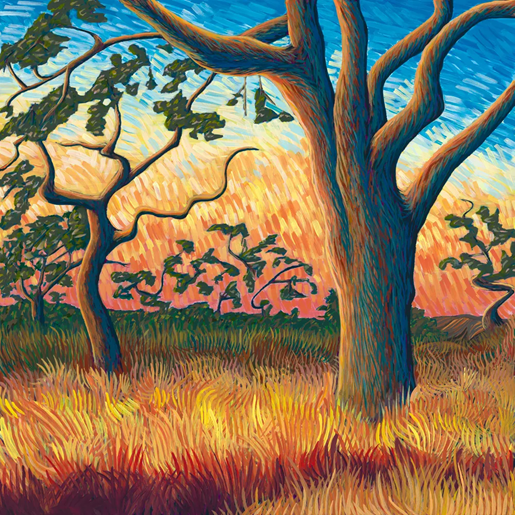
Quercus agrifolia (Source: Wikipedia)
I grew up with an orange tree in the back yard, and our neighborhood streets were lined with Eucalyptus windrows. The oranges migrated from southeast Asia via Spain, and the Eucalypts directly from Australia. Orange County, a sleepy network of agrarian villages, eventually enlisted a narrow band of fruits in a botanical get rich quick scheme where they now grow mostly high-end houses and luxury malls.
Despite this charismatic flora, I will never forget the dusty smell and dappled light of the patches of preserved oak woodlands that were the destination of naturalist programs and school field trips. California boasts nearly 20 oak species, and the California Live Oak (Quercus agrifolia) was a common oak in protected areas and patches of undeveloped foothills inhabited by lurching dinosaur-shaped oil rigs. The Live Oak’s glaucous holly-shaped leaves and slender charcoal-colored acorns spoke to me of an ancient way of life. A way of living in this place that my people had never really been interested in learning. And so, the oak whispered softly in the background of my childhood, and most of my arboreal memories are of foraging lush oranges, feral figs, and blood red pomegranates from the shaggy suburbs of Yorba Linda.
When I lived in Utah, I met the Gambel Oak (Quercus gambelii) who lived in the foothills below the alpine fir forests. It is a scrubby oak that dwells in clusters and thickets and rarely grows taller than 10 meters. They are expertly fire adapted, and quickly regrow from their vital roots. They are a stable food source for bears, turkeys and deer. And Indigenous peoples of the Wasatch range and great basin harvested them regularly for food which was even used as an aphrodisiac by the Isleta Pueblo.
When I moved to Connecticut for forestry school, I worked for a summer at the Yale Forest in Northeaster Connecticut. The hardwood forests of Connecticut are home to at least 13 Quercus species. As foresters, we were attempting to manage the forests so that they would retain oak in perpetuity. Because oak trees need more light than maple trees, selection harvesting of choice oak trees can shift the forests species composition toward more shade tolerant species such as maples. To ensure that oaks would be in the next generation, harvest plans not only needed to ensure that there were enough oak trees in the canopy left to provide acorns, but also that there was enough room in the harvested forest floor for the oaks to germinate and thrive. I loved my time in the forest, and even though we marked for cutting some hefty oaks, we left behind many more, and opened space for the next generation to grow.
In 2014, I spent a month living with the monks of Our Lady of Guadalupe Trappist Abbey in Carlton, Oregon. I was there preparing for my doctoral dissertation which would study the sense of place and ecological spirituality of Catholic monastics. The 1,300-acre property had been clear cut in the 1950s and the monks spent many decades reforesting their steep hill with Douglas fir plantations. In the 1990s however, the abbey underwent an ecological paradigm shift. They wanted to manage the forest more sustainably, and more in line with the local ecology. They hired a talented local forester who wrote a new management plan for the abbey and began diversifying the abbey’s forests. One project he proposed was a full-scale restoration of the Oregon White Oak (called Gary oaks in British Columbia) savannas that used to be in abundance in western Oregon. After some persuasion the monks agreed, and the abbey now boasts several hundred acres of grasslands dotted with majestic oak trees. I have visited the abbey many times over the years, and I always enjoy reunited with both my monk and oaken friends.
Oak as Provider
Oaks are in the Beech family, Fagaceae. Globally, there are over 500 oak species, with Mexico and China being countries with the most species. Oaks evolved over 56 million years ago with the emergence of flowering plants. Oaks predate humans by millions of years, and by the time humans emerged, oaks had wrapped a green embrace around the temperate northern hemisphere.
Oaks are a loquacious species. They have associated with dozens of fungal partners including truffles. One source identified over 800 insects that are associated with the oaks, 48 of which were obligates. These obligates include the visible gall wasps which hijack to oak leaves to create a swollen outgrowth from which young wasps emerge sometimes gall oak apples. Mammals and birds also love their acorns which are a staple food for many diverse forest ecosystems.
In 1985, David A. Bainbridge coined the term Balanocultures. Balano is the Greek word for acorn, and Bainbridge argued that what in Asia and the Mediterranean were assumed to be mortar and pestles for grinding grain, in fact predated the widespread domestication of grains. Bainbridge suggested rather, that across the temperate zone, oak and oak ecosystems were the primary food system of our budding old-world civilizations.
Forest lands have always been multiuse spaces where game, cultivation and harvesting happened simultaneously. From the earliest archaeological accounts, fire was used as a management tool. Many forests containing oak, hazel, and chestnut were burned to maintain open pastures that were also good for grazing game species. As grain and domesticated animals replaced these forest-gathering systems, orchards, hedgerow and silvopastures were adopted. In some cases, hazel was coppiced under oak standards. And throughout Europe, but especially in Spain, pigs were enlisted in converting acorns into pork.[3]
All along the California Coast Indigenous peoples forged abiding relationships to oaks. Half a dozen oak species were managed with fire to provide a staple starch to their diverse diets. In her book Tending the Wild M. Kat Anderson writes about the sophistication of Indigenous food systems management, which, in addition to fire included intentional cultivation and planting, pruning, weeding and training branches into particular shapes such as digging sticks, tools and arrows. The West Coast of North America’s balanocultures were some of the last peoples to rely so heavily on acorns as a staple food, though acorns are still widely consumed in parts of Asia, especially Korea.
In Octavia Butler’s novel The Parable of the Sower, the main character Lauren Oya Olamina, lives in a post-prosperity United States that is struggling to stay out of all out survivalist chaos. Her small community gardens and has returned to making bread from acorn flour. They represent a kind of post-apocalyptic balanoculture. Later, forced to leave her relatively secure neighborhood she forms a new religious movement called Earthseed and the community Laura forms with a rag tag group of survivors is named Acorn.
The Oak is an abundant gift giver. Gifts are a kind of language, oaks speak in seasonal flows of acorns, bark, truffles and leaves. The bark and leaves have traditionally been used as astringent and have anti-inflammatory properties that can stop bleeding or sooth external sores. It is also anti-diarrheal and antioxidant. The bark is also used for tanning and for wine making.
The wood is structurally very sound and sought after for fuel and fine woodworking such as ship building. Neolithic European dugout canoes were sometimes made of oak trees. The Lurgan canoe, was used over 4,000 years ago in Galway, Ireland. It was re-discovered in the early 20th century and measured more than fourteen meters long. In Medieval Europe, trees were trained to become specific parts of the ships’ hulls and body.
Strong mature oak beams were also sought out to build the roofs of Westminster Abbey and Notre Dame. As an aside, when Notre Dame burned down in 2019, the restoration of the building insisted on using mature oak, which were sought from all over France. The Villefermoy forest has provided over 50 trees for the project. This was of course a controversial move, as more than 40,000 people signed petitions calling the cutting of oaks “ecocide.”
This foundational abundant gift giving on the part of oaks and their associated species, also contributed to the spiritual ecology that populated the imaginal realms of these primal peoples. For example, oak is a totem of almost all the sky gods within early Indo-European religious expressions. This probably means that oak was a sacred tree that later became anthropomorphized as the familiar male sky gods of Zeus/Jupiter, Dagda, Perun, Thor and Indra. These lightning bolt wielding thunderers were present in the form of oak, which itself has an affinity with lightning strikes due to its high water content. Even early fragments referring to Yahweh connect him to groves of trees some of which were identified as oaks. Later, extreme monotheists would cut down these sacred groves, so the official theology of Judaism’s relationship to trees certainly evolved. But after people, trees are the most often referred to entity in the Hebrew/Christian Bible.
In the Finnish epic The Kalevala, during the creation of the world, a massive oak tree shaded out the other trees, and more importantly the barley fields, from the sun.
“Spread the oak-tree’s many branches,
Rounds itself a broad corona,
Raises it above the storm-clouds;
Far it stretches out its branches,
Stops the white-clouds in their courses,
With its branches hides the sunlight,
With its many leaves, the moonbeams,
And the starlight dies in heaven.” (Rune II)
The tale’s hero Vainamoinen called on the goddess of Nature to help him. From the primal waters emerged a small man clothed in bronze. Despite his size, and tiny ax, he felled the mighty oak with three blows and Vainamoinen and his helper are again able to sow the fields and forests with seed. On one level the story reveals the tension that surely arose between the early balanocultures and the ascendant granocultures. The massive tree was not a tree of life, but a hindrance to the open growing conditions needed for barley.
In the Greek religious imagination, a dryad is a tree nymph or tree spirit. But the word Drys (δρῦς) is just the word for “oak” in Greek. Dodona was originally a center of worship and divination of a mother goddess, Dione, related to other feminine figures such as Rhea, Gaia, Hera and Aphrodite. Divination was often undertaken by listening to the rustle of leaves or to the sound of windchimes hung from the branches of sacred oak trees. Augury, or bird divination, was also done from within these sacred groves. By the 1200s BCE, Dodona had been appropriated by the cult of Zeus. But even then, a sacred oak was identified with him and was later walled off by King Pyrrhus (~290 BCE) to protect it.
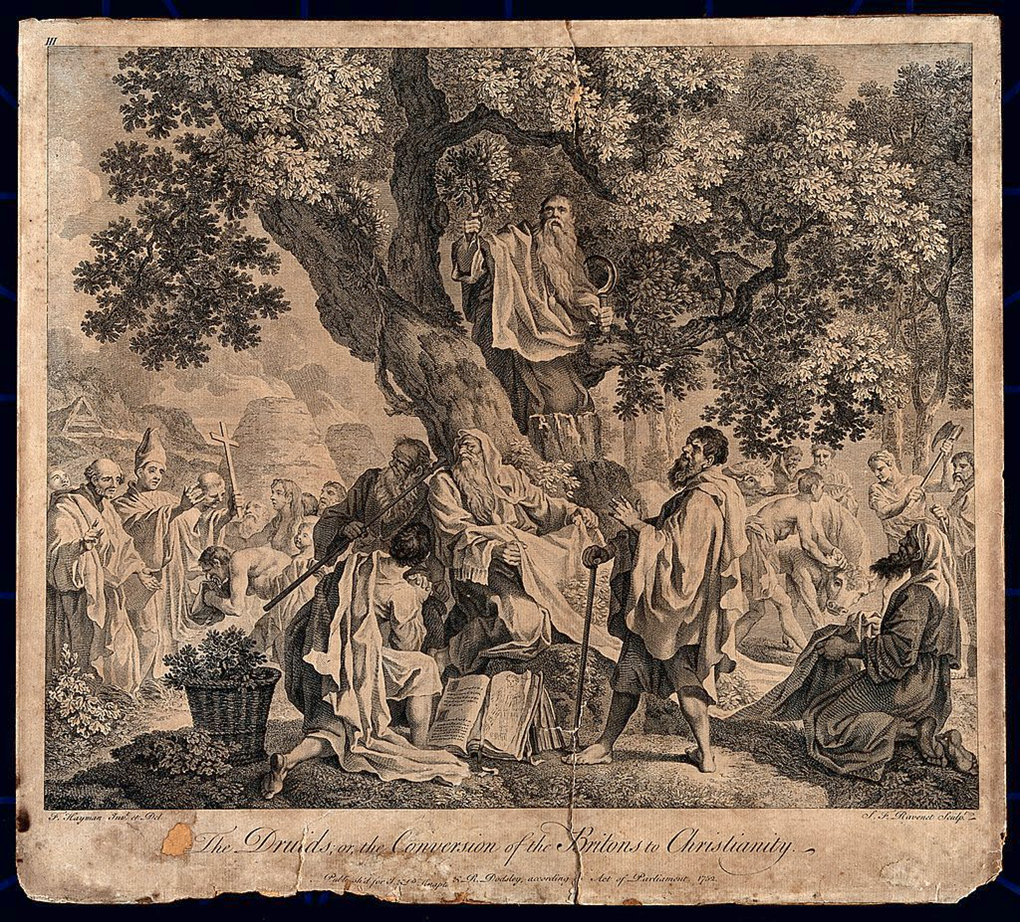
You have probably heard of the connection between oaks and Druids. In Ireland, the word Druid, the name for their scholar-priests, refers to groves of oak trees where they performed their councils, rituals and perhaps even human sacrifices. Druid is sometimes translated as “knower of oaks”, and the harvest of mistletoe from these oaks was a sacred rite. We don’t know much about them, and there is plenty of Neo-Pagan romanticism about their proto-ecological ethics, it is likely that human sacrifice was part of their oaken religious rituals. Nothing is certain about this however, because much of our information comes to us through Roman imperial eyes. What is certain, is that oaks played an important role in the foodways and spiritways of these pre-Christian earthy pagans.
Druids harvesting mistletoe from oak groves (Image source: Wikipedia)
In the Salish Sea Bioregion, Coast Salish territories, or Cascadia, where I live, we dwell alongside only a single oak species. The Saanich (SENĆOŦEN) word for this oak is ĆEṈ¸IȽĆ (pronounced chung-ae-th-ch). In botanical Latin, it is the Quercus Garryana—the Garry Oak (The same species I encountered in Oregon). The name Garry came from explorer David Douglas who named the oak for his friend Nicholas Garry of the Hudson’s Bay Company (1782–1852). The rest of this essay is about my dialogue with Quercus Garryana and trying to tune into what they may have to teach us about living together in this messy post-colonial world. For English speakers, I propose that we begin to call them the Cascadia Oak. Sorry Garry!
According to Western archeological pollen studies, the Cascadia Oak migrated here around 10,000 years ago and flourished at its greatest extent from 8000-6000 years before present. After that its range began to shrink as the climate grew wetter. Many histories of the Cascadia Oak in this region suggest that a Mediterranean climate “prevails” over most of the oak’s range. While the rain shadow of Vancouver Island certainly provides conditions more suitable for the Cascadia Oak, they seem to flourish best when humans co-manage their range with fire. If I understand my reading of the history correctly, the oak savannas and grasslands where the oaks are most iconic may have disappeared completely if it had not been for continuous Indigenous management. This entanglement with human culture is what fascinates and inspires me most about oak trees in general and the Cascadia Oak in particular. Oak savannas are not a rare ecosystem just because European colonialism has displaced or replaced them, they are rare because they need fire to maintain themselves. Left untended, Douglas fir trees overtop them, and unless a natural fire comes through, they likely will die out after a couple of decades.
The Cascadia Oak, like most oaks, are also social trees. Over 100 species of birds have been identified in Cascadia Oak woodlands. Hundreds of insects and invertebrates make their homes with Cascadia Oaks. Indigenous peoples up and down the west coast used their bark, leaves, wood and acorns as sustenance, medicine, and tools. Their ecologies were also hunting grounds and camas prairies (Camassia quamash), a flowering plant with a starchy tuber that was one of several root crops cultivated by Coast Salish peoples. The Capital of British Columbia, Victoria is originally named Camosun, or “place to gather camas.” Like California, Island and lower mainland British Columbia maintained strong balanocultural food systems.
Dialogue through Ecological Restoryation
In Anna Tsing’s book, The Mushroom at the End of the World, she shows us how another ecological dialogue has been going on for many thousands of years. She studies the ways that matsutake mushrooms have not just been prized gourmet foods, but how their allure has ebbed and flowed with human land management, especially second growth pine lands in Japan. She writes,
“…one could say that pines, matsutake, and humans all cultivate each other unintentionally. They make each other’s world-making projects possible…As sites for more-than-human dramas, landscapes are radical tools for decentering human hubris. Landscapes are not backdrops for historical action: they are themselves active. Watching landscapes in formation shows humans joining other living beings in shaping worlds.”[4]
In a similar way, the Cascadia Oak was an integral part of a diverse land-based food system that included clam gardens, berry patches, salmon and herring runs, hazel orchards and camas gardens. These food systems were intensively managed by Coast Salish and Vancouver Island First Peoples. Cascadia Oak savannas were kept open from encroaching fir forests using fire, even as the climate got wetter. Burning was a technique for enhancing a set of anthropocentric management goals: keep grasses vigorous, keep bugs out of the duff and acorns. European invaders did not recognize these landscapes as anthromes, or if they did, did not respect Indigenous tenure enough to care. Much of what was assumed to be wilderness or unclaimed, was in fact ancient active landscapes where humans and a myriad other species made each other’s “world-making projects” possible.
Fast forward to contemporary restoration ecology. In recent decades, the Pacific West of North America has seen several organizations pop up like mushrooms to protect and restore the Cascadia Oak’s unique and biodiverse ecology. It seems to me that the central dialogue or story of Restoration Ecology is one of repair, purification, and penance. Ecological experts restore species composition and ecosystem function to make right, restore balance, bring order back to the natural world, which Western humans, from the outside have disrupted. We are the serpent in the Garden. So, Cascadia Oak ecosystems are seen to be under threat from “invasive” species and development. The Garry Oak Ecosystem Recovery Team comes across like First Aid to a wounded ecological person. The medicine is to eradicate invasives, wall off ecological precincts and begin to implement professionally supervised prescribed burns to maintain oak prevalence over Douglas Fir.
This approach has its place, and endangered species must be given room to flourish. However, on their website, GOERT has a page dedicated to resources for gardeners and landowners. This is the approach that enchants me most. This is what I would call a Collaborative or Reconciliation Ecology. A more collaborative ecology might accompany us from a so-called “crisis narrative” in which wild nature is besieged by a voracious culture; to a “dynamic narrative” in which all cultures are understood in ever shifting relationships to biodiversity.
Wherein diverse biocultures and values collaborate in restoring plural relationships to places, species, foods and materials. Native and non-native species are welcomed (not necessarily invasives), and Indigenous and non-indigenous perspectives and technologies are experimented with. This Restoryation is about approaching ecosystems where humans are back in right relationship to places, not restricting them to the status of invader, visitor or tourist. If all we see when we look at changing ecosystems is loss, we are not seeing the possibilities that change might afford for fostering novel relationships that are regenerative.
The Indigenous peoples who stewarded Cascadia Oaks were not park rangers, they were managers, gardeners. So, what if we began to think of oaks, and many other species, not as victims to be saved and protected, but as interlocutors and companions in responding to the unfolding climate crisis. The plants that I know are going to fight like hell to keep on living. I want to fight alongside them, not as a savior but as collaborator and kin. I want to grieve losses as they happen, but I also want gardening, which is a kind of ecological dialogue, to become one of many tactics for resisting consumerism and climate doom.
Restoryation, is not so much about a re-consecrating and purifying an ecosystem of its human influence as an act of environmental penance, it is about restoring our relationship to the earth community, a relationship which has been betrayed in many ways throughout time by our rampant and destructive economic culture. Ecologist Stephanie Mills even suggests that restoration, Restoryation, is a form of ecological ritual:
“[The act of restoration] gives [people] a basis for commitment to the ecosystem. It is very real. People often say, we have to change the way everybody thinks. Well, my God, that’s hard work! How do you do that? A very powerful way to do that is by engaging people in experiences. It’s ritual we’re talking about. Restoration is an excellent occasion for the evolution of a new ritual tradition”.[5]
We don’t have to endure the coming losses and changes in isolation. We have each other and we have the living, breathing world on our side. Oaks, like so many of the species on this planet, are here to dialogue with us about how to live in a chaotic and changing world, and for me at least, that makes fighting for a just and livable world just a little bit less lonely.
–Cruella Deville, Once Upon a Time, Season 5, Episode 19
For all the photographs I take and writing I do about trees, forests, theology and walking, I must admit that I also love watching movies. Netflix has been a regular guilty pleasure for me, one I eschew during Lent (a great sacrifice!). I have watched a lot of shows, and I find Netflix’s original series to be mostly very well done, interesting and timely. One thing that I keep noticing in many of the more recent shows, is that the scenery and cityscapes are very similar to my own. It is no secret that Vancouver, British Columbia has become “Hollywood North” and movies and TV producers flock here during all months of the year to set their stories in our futuristic skyline, our gritty downtown eastside and Chinatown, or, our majestic forests.
Sometimes Vancouver itself serves as a substitute city for where the film is supposed to be based. Other times, the vast forests of our Pacific home are the setting of post-apocalyptic or fantasy concept films. Interestingly enough, British Columbia’s official tourism slogan is ‘Super, Natural’ riffing on the Supernatural. Major films and TV shows have taken advantage of Vancouver’s diverse settings: The X-Files, Battlestar Galactica, Twilight, various X-Men franchises, Dirk Gently, Deadpool, Supernatural, Jumanji, have all been filmed in or around the Vancouver area. For a full list see this very long Wikipedia page.
I grew up in Southern California, a place that is also steeped in Hollywood imaginaries. Even my own neighborhood growing up even gave a nod to fantasy. The architecture and landscaping were mostly done according to the taste of the owner, not necessarily according to the region. We had country style homes with wrap around porches and horse corrals, sleek modern glass boxes, New Mexico style adobe and cactus gardens, and Spanish colonial style with evergreen pine trees or tropical ficus. Our backyard pool gave the impression of an alpine oasis, in the middle of a Mediterranean desert. Pine, palm or eucalyptus trees lined many of the streets so that we felt like we were in a land of eternal green and eternal summer.
And of course we kept our lawns pristine year round. Nature was malleable because we had the climatic flexibility and the water resources to adapt the place to our preferences and imaginations. And don’t get me wrong, I am not complaining! My neighborhood was a lush arboretum of vastly more tree and plant biodiversity than ever existed before settlers arrived. There were also many fruit trees as well: Pomegranate, kumquat, fig, loquat, persimmon, orange, lemon, apple and nectarine trees, all of which we enjoyed as roving bands of pre-teens.
Three shows that I have watched in the last few years have really got me thinking about the way our imaginations shape nature in a place like Vancouver which has world class natural beauty. Once Upon a Time, a clever mashup of just about every classic European and Disney fairy tale with a modern and overtly feminist spin. The 100, a post-apocalyptic sci-fi series where the last humans fight to survive on a toxic planet among hostile rivals; and The Man in the High Castle (Amazon Prime), a fascinating historical sci-fi drama that imagines a North America where Japan and Germany won WWII. However, an alternative reality which shows a different outcome to the war has been captured by a series of 16mm films which a small but dedicated resistance must gather at any cost.
Each of these series makes use of the urban and forested landscapes here in BC. But what is it about this landscape and our modern understanding of nature that makes British Columbia such a hotspot for sci-fi and post-apocalyptic themed shows? I propose that our modern understanding of nature as ‘greenspace’ is the imaginative descendent of our more overtly colonial-era notion of Terra Nullius, or, nobody’s land. The only way we could be convinced of a landscape’s authenticity in a film is if it holds a cultural significance that is stripped of its previously rich cultural meanings. During colonization and conflict between European powers, if land was understood to be unoccupied, it was annexable by the state. Roman law applied a similar concept to abandoned building or recovered slaves. It was basically a legalized version of finders-keepers.
Joseph Trutch was the first Lieutenant Governor of British Columbia. He believed that First Nations peoples did not actually own the land, because they didn’t have the concept of private property, so it was fair game for settlers. Governor General James Douglas characterized indigenous people as “mere wandering denizens of the forest.” Douglas like virtually all settlers who arrived here, could not see just how lush with food production zones the place actually was. What they saw was unkempt, untidy and un-owned wilderness. This is why much of British Columbia territory remains ‘unceded’ today, because no treaties were seen as necessary in lands where no one lived.
As is commonly known, many indigenous communities were decimated by diseases even before settlers arrived in BC, but during their pre-colonial civilization, which had been more or less intact for 10,000 years. First Peoples held clan and kin-based usufruct rights to land as berry, salmon, hunting or other food gathering territories. These were for the most part demarcated and understood by First Peoples.
In fact, what the Europeans mistook for vacant wilderness, for Terra Nullius, were the neglected remains of deeply human-influenced food forests, pharmacies, woodshops and shore gardens. As disease swept over the region, traditional food production methods and zones became neglected. Before disease hit, massive old growth Western Red Cedars were used for cordage, canoes, and long house planks. Fire was used to keep trees out of hereditary berry patches and camas bulb gardens. Herring and salmon spawning sites were enhanced with tree branches, which created more surface area for fish to lay their eggs on. The local breed of Salish Wooly Dogs (now extinct) were bred for their hair, and packs of the adorable creatures sometimes occupied entire islands. In addition, Coast Salish and inland peoples actively cultivated groves of crabapple and hazelnut trees which were traded north to south making their way as far as what is now the Yukon Territory. And lastly, thousands of kilometers of coastline were modified to enhance clam productivity by carrying large rocks to the low tide mark so that steeper shorelines would eventually level out, creating more surface area for clams to breed.
In addition to their pervasive agro-ecological influence, for all First Peoples, the features, creatures and places of the land were alive with personhood, significance and story. These are not my stories to tell, but I can say that for example, many creatures such as orcas, wolves, frogs, ravens and bears were totems of family lineages, and were thus often portrayed on long house, shaman and village poles.
Prominent geological features, rocks and peaks were often understood as ‘transformer sites’, or sites where legendary people and creatures were either punished or rewarded by supernatural beings and consequently converted into the feature as it appears today. This is widely understood to be the origin of Skalsh rock (called Siwash rock in signage), located off the shore of Stanley Park. For geologists, the rock is a basaltic obtrusion of volcanic origin, which resisted erosion in the mostly sandstone foundations of the rest of the park. A large Squamish village was located in Stanley Park, and for Coast Salish peoples, the site commemorates the transformation of Skalsh by Xaays, a supernatural being, to memorialize the ideal of Fatherhood and the warrior. However, various nations have their own stories associated with this rock.https://0f3ff9c4e74044c30b05afb65c644e24.safeframe.googlesyndication.com/safeframe/1-0-37/html/container.html
Other places such as obsidian deposits are places where Thunderbird shot lightning from its eyes. Other sites are the very places where humans emerged from the watery chaos of their respective creation stories. The land was not the background of the human story, it was itself an actor bursting with uses, meaning and stories of its own.
This is what I mean when I marvel at how easy it is for us to see the forest as a kind of neutral space. Vancouver has maps with detailed streets and addresses, but forested areas are often blocks of monochromatic ‘green space.’ This simplified representation renders these rich places as essentially culturally neutral, primordially natural where we stressed out urbanites can come to relax, hike, run or walk our dogs.
If Once Upon a Time had shown a scene of Mount Rushmore, and claimed it was an ancient pagan shrine to unknown deities, Euro-North Americans would understandably balk unconvinced. That is simply not believable given what we know about the presidential persons whose likenesses are carved into the living rock of that monument. Yet, if Once Upon a Time flashes a scene with a Musqueam or Squamish Transformer site that is clearly identifiable within those worlds, we settlers see beautiful scenery. This goes for The 100 and Man in the High Castle as well. A post-apocalyptic landscape and an imaginary Nazi regime are just as believable in these forests to eyes that see only green space.
Clearly I too enjoy spending time in these beautiful places, and I have gotten to know their contours and inhabits to some degree during my 6 years in Vancouver. I have done this largely within my own Western scientific and religious paradigms, both of which have served me quite well. I am not seeking to fully enter into the worlds of indigenous peoples, or assume their significance. However, I would like to be better equipped to respect the rich cultural history of this landscape, just as I would if I entered a cathedral for the first time. While some sites should not be publicly known because of their sacredness, others could be more widely popularized through interpretive signs, greater cultural and historical awareness campaigns and bi-cultural place naming initiatives. And perhaps some of these shows could begin with territorial acknowledgements of the traditional territories where their heroes are winning hearts and minds.
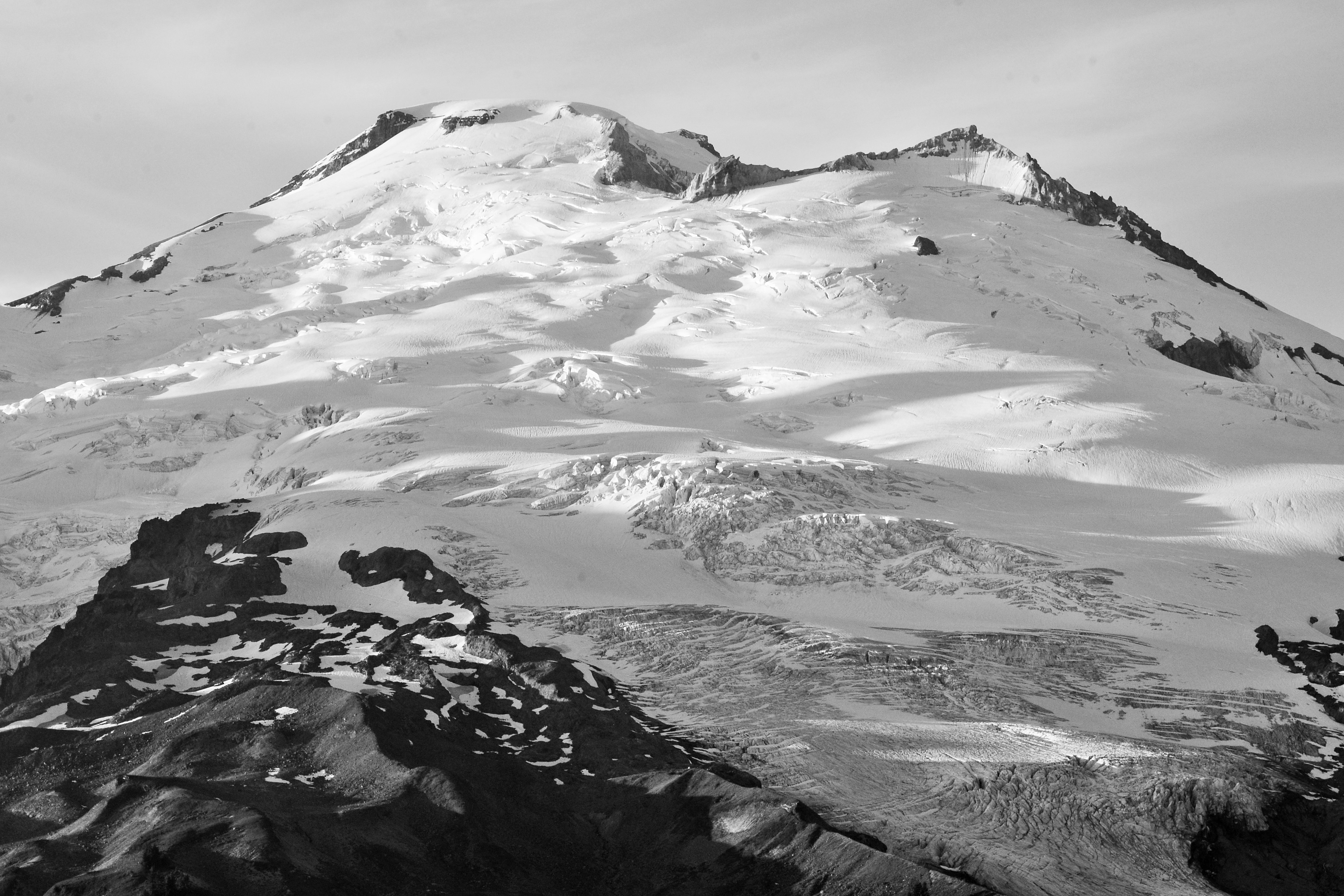
Standing on the creaky porch of Park Butte fire lookout, it felt like I was face to face with the southern slope of Mount Baker. Thirty miles east of Bellingham, Washington, on this 4th of July, the trail had been practically empty. I stayed the night in the lookout, and watched the colorful flicker of fireworks on the coast below mirror the twinkle of the stars above. As I began my hike down the next morning, I wanted somehow to reverence the commanding presence of the mountain in whose close proximity I had slept. I asked myself a simple question: Does it matter if I think of the mountain by its Settler name? Or, should I refer to it by its Lummi name: Kulshan?
I didn’t really know anything Mr. Baker, except that he was English; or much about the word Kulshan, except that it was one of the hip new breweries in town. So, I mustered a hasty sign of the cross, brought my hands close to my heart, and said ‘thank you.’
After my trip, I began to do a little research. Mount Baker is a 10,700 foot, relatively young at 100,000 years, active strato-volcano. Which means it is made up by layers of igneous rock, lava and pumice. It is glaciated, and snow-covered year round and has one of the highest snowfalls in the world.
Coast Salish peoples have dwelt in the area for at least 14,000 years. The Lummi word for the peak is as I already knew Kulshan, but it doesn’t mean White Sentinel, or The Shining One as I had heard. The word means something closer to ‘puncture wound.’ For the nearby Nooksack people, Kulshan actually refers to the area around the peak, used for hunting and gathering. Kweq’ Smánit, which simply means ‘white mountain’, is the name for the summit.
There are at least two stories associated with Kulshan. A 1919 ethnography recorded a retelling of the story of the Thunderbird, a supernatural being who dwells in the tops of mountains. A Lummi man related
“Thunder is caused by a great bird…the thunderbird is many hundreds of times larger than a fish hawk. It is so large that it can carry a large whale in its talons from the ocean to its nest….This huge bird has its home yonder on Mt. Baker, where you see the clouds piling up now. Whenever this bird comes from its nest and flies about the mountain top it thunders and lightnings, and even when it is disturbed in its nest it makes the thunder noise by its moving about even there…. The lightning is caused by the quick opening and shutting of its powerfully bright, snappy eyes and the thunder noise by the rapid flapping of its monstrous wings” (Reagan, 1919, 435).
The Thunderbird is a being in most if not all Coast Salish cosmologies, and it is often both a respected and feared presence in the land that demands respect and sometimes placation through the burning of ceremonial fires. For the Squamish peoples, the rich deposits of obsidian are places where lighting that shoots from thunderbirds eyes hit the earth.
The ethnographer Charles Buchanan in 1916, recorded another story of a man named Kulshan who had two wives; one beautiful, and one kind. Kulshan loved the kinder wife more, and the beautiful wife grew jealous and decided to leave him, hoping he would realize what he lost and come after her. As she walked south, she turned back many times to see if Kulshan was looking, and as she got farther away she had to stretch higher and higher to see Kulshan. Eventually she made camp on a high outcropping and stared back at Kulshan, waiting for him to come. Eventually she turned into the peak we today call Mount Rainier, and he into Mount Kulshan.
During the age of conquest, the mountain was sketched by Gonzalo Lopez de Haro on a Spanish voyage in 1790. He named it ‘La Gran Montaña de Carmelo,’ in reference to both Mount Carmel, but also the Carmelite Order, home of Saint John of the Cross and Teresa of Avila. In 1792, it donned the now familiar name of Englishman Joseph Baker, who was Captain George Vancouver’s Lieutenant.
Over the years, Anglo mountain climbers, ethnographers and history buffs have been in favor of renaming the peak Kulshan. Proof of this are the dozens of local businesses, mountaineering clubs, or botany societies who have taken it on as a namesake. But in doing so are we paying deference to an authentic place-name tradition? Or feeding our own ideas about indigeneity? Perhaps both.
Personal Spiritual Ecology
Acknowledging indigenous place-names certainly look toward a reconciliatory stance, provided it is accompanied by respect for sacred sites, more resource management autonomy, and Treaty and Title rights if possible. However, phenomenologically, a place-name does not automatically give us admittance to the world the name upholds. For example, Coast Salish place-names are fairly simple descriptives: ‘white mountain’, ‘place for herring fish’, etc. It is rather, the activities of dwelling that accumulate around those place-names that give rise to an experience of the world. This is beautifully illustrated of course by Keith Basso’s Wisdom Sits in Places but unlike Basso’s semiotic approach, Tim Ingold’s insights show us that landscape is not just a cultural layer we project onto the physical world, but the world itself. While I might be able to understand or recall certain Coast Salish place-names or stories, I must admit that I do not dwell in that world, and an attempt to do so for my own academic or spiritual curiosity carries with it the weight and suspicion of the colonialism of the last 200 years. In addition, in retelling these stories, there is the danger not only of losing details in translation, but importing my own world into the telling. And yet, are there any ontologies, especially today, that are not plural? Hybrid?
Learning about the history of the mountain, I confess that Mount Carmel resonated most with me. I am of course aware that to stick with ‘Carmel’, is to return to where we started, to run the risk of perpetuating imperial Christianity; but it is also to connect the place to the rich contemplative spiritual tradition of which I am a practitioner. John of the Cross’s Ascent of Mount Carmel, features the mountain as a symbol for our longing for union with God.
Lastly, regardless of one’s spiritual orientation, the land can speak to us in ways that we cannot always predict. I recall sitting in a discussion group at a Salish Sea conference. I made some point about place names. A Nooksack woman responded patiently that it was not we who named places, but the places themselves that gave people their names as gifts when they are ready. Translated into contemplative spirituality, this is the practice of attention, or, Prosoche (pro-soh-KHAY) in Greek. Being present a person, place, or organism, we listen to what they might say about the world, about ourselves, or about God. Perhaps it is with this practice that new names and thus, new worlds might arise.
This paper was presented at the recent Mountains and Sacred Landscapes Conference at the New School for Social Research in New York City.
References
Buchanan, Charles M. 1909. The Origin of Mounts Baker and Rainier: The Indian Legend, The Mountaineer, Volume 9, pages 32-35, Seattle WA.
Reagan, Albert 1919. Some notes on the Lummi-Nooksack Indians. Transaction of the Kansas Academy of Science, pages 423-437.
Richardson, Allan and Brent Galloway 2011. Nooksack Place Names: Geography, Culture, and Language, UBC Press, Vancouver BC.
Winthrop, Theodore 1862. The Canoe and the Saddle: Adventures Among the Northwestern Rivers and Forests and Isthmiana, John W. Lovell Company, New York NY.

 holyscapes