In Part I, I wrote about my visit to a small religious community called the Doukhobors. Those who remain of this fascinating religious movement live mostly in the Kootenays region of British Columbia. I enjoyed visiting the Doukhobor service and getting to know a few of them. But I left feeling a mix of peace, sadness and a familiar longing. In this short piece, I want to put words to these emotions, even if just to work through them for myself.
I have always felt that there is something beautiful about group religious worship and identity. There is such a strong sense that those in the room know who they are, where they are, and why they are. I still appreciate this when I attend a religious service, visit temples, monasteries, or gurdwaras. I even appreciate this when I return to a Mormon meetinghouse with my family during the holidays. Though I have long since stopped identifying and practicing the religion of my upbringing, the familiar hymns, the inflection of prayer, the smell of a church, and everyone dressed in their Sunday best, tap into my longing for be-longing.
The sadness is harder to articulate. I think is has to do with a mixture of spiritual and existential loneliness. Though the Mormon / LDS tradition never espoused as radical an approach to Christianity as the Doukhobors, like many restorationist movements in the 19th century, they were certainly committed to living out Christianity in what they saw as an authentic and radical way. And I would even say that Mormonism’s roots were what led me to my exploration of radical politics.
At the Mormon university I attended, I really struggled with how overwhelmingly partisan Mormon culture can be, especially in the so-called Book of Mormon belt. By that I mean intentionally aligning itself with the US Republican Party. As if Jesus or Joseph Smith were teaching modern conservative talking points. I had always seen religion differently, and I soon found a community of more left-learning and radical Mormons, many soon to be ex-Mormons, and I felt very seen and understood in my leanings and struggles.
As I wrestled and read, I sympathized with more radical formulations of Christianity by authors like Leo Tolstoy, and non-religious writers Peter Kropotkin and Murray Bookchin. I even wrote an article about the first convert to Mormonism in Mexico, the Greek radical Plotino Constantino Rhodakanaty (1828-1890). Like him I saw something powerful at the heart of the early Mormon relationship to land, place and social organization. The Mormons attempted to create The United Order as a cooperative social-economic system. It was never fully realized. Like Rhodakanaty, I was eventually disillusioned with Mormonism’s assimilation of the American capitalist religion, though I tried for years to find my own sort of Mormon radicalism. I wrote several articles for a Catholic Worker inspired newspaper called The Mormon Worker. That was a long time ago.
I also felt sad because the Doukhobors are dwindling, and their tradition cannot live as they envisioned. As I chatted with my new Doukhobor friends, they related to me how the community gets along today, and how it has had to adapt with the times, and how from their peak in the early 20th century, only about 1,675 identify Doukhobor as their religion, according to the 2021 Canadian census. The Doukhobors work through a legal nonprofit structure, they do not own land communally, and many don’t bother observing vegetarianism anymore. I understand, but in addition to the existential loneliness of longing for belonging, seeing a tradition with such a beautiful way of live dwindling is a bit tragic.
And it’s not as though I would want to be Mormon again or become a Doukhobor, even if they were more radical. But there is a nameless love that is hidden inside the feeling I got sitting with the Doukhobors and listening to them sing together. After the visit, back on the road, I was marketed to by countless fruit stands, new distilleries, luxury retreats and resorts and excursions. The warm summer world seemed to be buckling under the weight of us ravenous experience-seeking tourists. This is a landscape of leisure, of make believe, of Air BnB rentals, cabins and resorts for the religion of consumerism. It feels like the opposite of that nameless longing. It feels like the contours of a spiritual wasteland of sorts. Always seeking, never finding, we wander around hungry for meaning and experiences. Why is this “religion” flourishing while the Doukhobors languish? I don’t know. But I want to keep finding places where I feel that feeling and keep trying to name that nameless love that is hiding within it.
I am driving to Calgary to pick up my parents from the airport so we can tour Banff and Jasper National Parks. It is going to be Disneyland-dense with fellow tourists, each of us seeking to feel something like awe, to connect with the rawest aspects of nature. Still, I am very excited to go and see the beauty of the Canadian Rockies!
From Vancouver I decided to take the southern route along the US border which passes through the Kootenays on Highway 3. It was a stunning drive, even with the pangs of climate anxiety I occasionally nursed from seeing massive clear cuts, fire scarred mountainsides, aspen groves drying out too soon, and browned-over fir forests dying from some unknown pathogen (Spruce bud worm?).
While I was planning my trip, I realized that the route would take me right through the traditional heartland of the Doukhobors, an ethno-religious community originally from Russia. I learned about the Doukhobors shortly after moving to BC, when I was chatting with the barber cutting my hair (I had more then). I told her I was studying religion and ecology at UBC, and she told me she grew up in a Doukhobor village in the Kootenays.
As I came to learn, the Doukhobors emerged in the late 1600 and early 1700s. The word means “Spirit Wrestlers”, and as a sect of radical Christianity, they were known for their communalism and simplicity. Some of their beliefs are similar to branches of Radical Reformation groups such as the Amish and the Mennonites. The Doukhobors however also resemble the Quakers in that they believed that God dwells in every person, and that this meant clergy and even scriptures were not necessary. Instead, they speak of the “Book of Life”, wisdom embodied in sayings, hymns, psalms and prayers.
If this was not controversial enough, they got into more hot water in 1734 when they were declared iconoclasts for preaching against the use of icons, a cherished piety in the Russian Orthodox Church. Eventually they came to espouse a vegetarian diet for ethical rather than ascetical reasons and as pacifists, they refused to swear oaths or join the military.
They were persecuted by Russian Orthodox clergy and a string of Tzars. Many were forced to migrate to various places in the Transcaucasia region and their leaders were often exiled to Siberia. In 1895, a group of Doukhobors burned their weapons in protest, causing another wave of persecution. One community attempted to settle in British controlled Cyprus, but soon many died of disease in route.
In 1899, around 6,000 Doukhobors emigrated to Saskatchewan with the help of local Quakers and Russian pacifist author Leo Tolstoy. Others such as Russian anarchist Peter Kropotkin and professor of economics James Mavor at the University of Toronto donated to the cause. By 1930 there were over 8,000.
They worked on communal farms and ran a grain mill and a brick factory among other things. They built communal dormitories, but unlike the Shakers of New England, they were not celibate. Their communal land and pacifism eventually got them in trouble with the Canadian government as well. In 1906, they refused to surrender their communal title to land and lost much of it to the Crown when a law was passed requiring landownership to be under a single person’s name. During the world wars, they were also resented by Canadians for not supporting the war effort. In the 1920s, a breakaway group calling themselves the Sons of Freedom staged naked protests and engaged in arson attacks against more law-abiding Doukhobor families causing tensions within the community.
Today, the majority of practicing Doukhobors live in Grand Forks and other areas of British Columbia. Many moved here in 1908 after the Canadian law against communal landholding. Tensions also grew within the community, and it seems likely that a Doukhobor bombed the train that community leader Peter V. Verigin (1859-1924) was on as he headed to British Columbia in 1924. So much for pacifism (though we still don’t know who planted the bomb). Some of the Doukhobor children were forcibly interned into boarding school much like Indigenous residential schools.
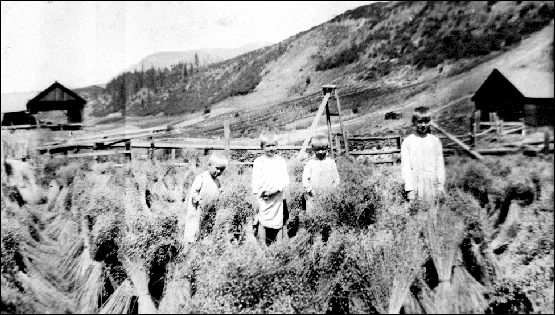
I pulled up to the Doukhobor meeting house, now officially called The Union of Spiritual Communities of Christ (USCC) and noticed several veiled women making their way to the door accompanied by men and some younger folks. A large stylized dove adorned the doorway, symbolizing the Holy Spirit, and their persistent commitment to peace.
I had planned to just snap a picture and be on my way, but when I realized that they were gathering for service, it was Sunday after all, and I happened to arrive at the top of the hour, it seemed providential that I attend the meeting. I guess I half expected them to speak only Russian, but when I wandered over and asked a young man if the public were allowed to attend, he spoke to me in unaccented English and said, “of course!” I was greeted warmly by all and began chatting with one of the men, who immediately inquired as to my own religious convictions. I told him it was a long, meandering story, but that I had been raised in the Mormon tradition. I mentioned that in my view, Mormons shared a few similarities—a health code (The Word of Wisdom), early experiments with communalism (The United Order), friendly people, and a love for the land they settled in Utah.
There were about a dozen and a half people attending the service, with men and women sitting on opposite sides facing each other. There was a small table at the front that held a loaf of bread, a pitcher of water and a small wooden bowl of salt. These symbols, which we never partook of during the service, were symbolic of “hospitality, sharing, and our basic principle—Toil and Peaceful Life.” (from the Doukhobor hymn book).
The service was simple, the singing beautiful. They did a sort of ritual greeting call and response as people entered. The women were veiled and the elder women dressed in what seemed like more traditional dress, though I saw one carrying her things in a Lululemon bag. They sang and prayed in Russian and bowed after each hymn. There was also a sort of passing of the peace ritual during the beginning which involved three handshakes and a kiss. But only a few folks in the first rows did it. Toward the end they asked me to come to the front and say a few words, and I introduced myself and thanked them for their hospitality, kindness and way of life. After the service I perused some of the historic wall photos, chatted a bit more and was given a stack of literature to take with me.
The experience left me feeling a mix of familiar longing and a bit of sadness. And I am not quite sure how to articulate it… perhaps a part two of this essay is in order, or perhaps not.
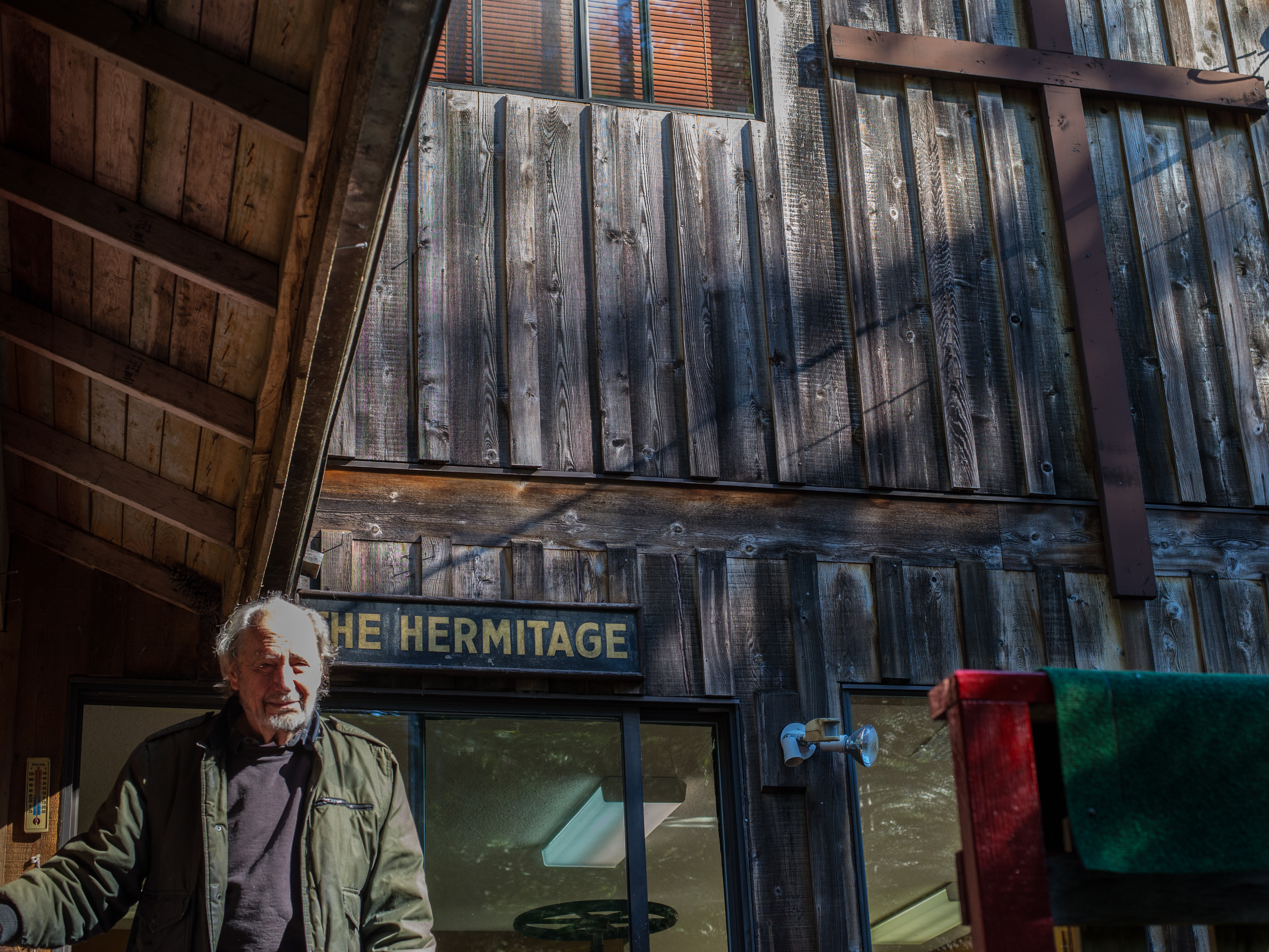
I had never been alone in the Brandt hermitage before. I first visited Fr. Charles in 2017, when I was completing my PhD on monastic sense of place at the University of British Columbia. We sat on his back porch and talked about Thomas Berry, the state of environmental activism and climate change. And at the end of July, four years after Charles death, I was sitting alone on that same back porch listening to the Oyster River hush toward the sea.
Fr. Charles’ successor at the hermitage, was a contemplative nurtured by the Benedictine tradition and the spirituality of the Desert Mothers and Fathers (She has asked to keep her name private). However, she has recently moved to Nanaimo, to start the next chapter in her life journey. For the month of August, I took up temporary residence at the hermitage to work on getting the house ready for the Hermitage Society’s contemplative in residency program. We invite people of all backgrounds to experience the benefits of silence, solitude and immersion in the natural world while living in this historic and prayer-infused space.
Contemplative Ecology can be defined in many ways. We call Fr. Charles a contemplative ecologist because he brought his vocations of priest, hermit, bookbinder and land-keeper together into a single life well lived. A monk once told me that a hermit (a monk who lives mostly in solitude) is not someone who is running away from the world but running toward God. In my time here I can affirm that silence and stillness are compost for feeding the gardens of healing, growth and spiritual connection.
I have started and ended each day with silent meditation. In the mornings, after my meditation, I would make coffee and watch the day unfold before I buckled down to the day’s tasks of writing, my duties for the university, and coordinating the many repairs and upgrades to the hermitage that inevitably come with an aging building.
So, to be honest, I was not alone the whole time free of work. We have a very talented craftsperson who has taken on the hermitage as a personal project (we pay her of course) and members of the board stop by to help with the work. On my walks in the forest, I often meet people from the neighborhood and their dogs. I have met many slugs and birds, but no bears or cougars.
There is only a narrow driveway on which to walk on the property, as most of the property is on a steep bluff facing the Oyster River. But even on this small trail I never feel bored. My favorite thing about walking in the forest is how the light changes. In the morning the sunlight slants in from the east and by afternoon these slender sheets of light have shifted to the west. Each moment is its own eternity and when I am really paying attention, each footstep like a pilgrimage.
Sometimes late at night, when the weather was clear, I would wake up and stumble out to the deck to crane my neck at the night sky. I was lucky enough to catch some of the Perseid meteor shower and an early morning Mars/Jupiter conjunction. Cassiopia was my most constant constellation in the east, with trees obscuring most of the southern sky. Above me and to the west I could just make out through the trees, Vega and Arcturus, two of the brightest stars in the night sky. Being able to see the dark sky with her bejewelled cloak of stars felt very sacred to me. It both makes me feel very small and insignificant in size, and preciously and uniquely valued by this warm greenhouse world that spins so precariously on the vast oceans of the cosmos.
On Tuesdays I ride my bike to volunteer with the Oyster River Salmon Enhancement Society at Bear Creek Nature Park, which is only a few kilometres west of the hermitage on the Oyster River. The organization was founded in the late 1980s, and Fr. Charles was a part of it from the beginning. There is a picture of Fr. Charles in the small cabin that serves as a meeting area for board members and volunteers and his name is on a small plaque on a memorial bench near the river. Mostly what we do is maintain predator exclusion fences, feed fish, and brush algae off the river water intake screens. On my first day, I walked the meandering trails of the hatchery with a retired commercial fisherman and pruned shrubs and cleared debris.
As I was leaving the hatchery I saw hundreds of pink salmon who were beginning to venture into the Oyster River from the ocean as they prepare to spawn. Their sleek bodies syncopating through swirls and eddies delighted me. So, I decided that I would go fishing. Fr. Charles was a long-time fly fisherman, and many of the volunteers had met Fr. Charles. One old timer had tied flies for him. Later in life, Fr. Charles admitted that he really went fishing to feel more a part of the river, and that it seemed rather cruel to hook a fish and let it go. But I didn’t want to let one go. I wanted to eat one.
So, I found a fly-fishing guide in Campbell River and early in the morning we put on waders, and I soon felt the power of the river rushing past me. We spent time on the banks casting into deep pools for clouds of pink salmon who weren’t biting. We rafted down the river in his small boat and by the end of the day found ourselves at the kissing mouths of the Campbell River and the Salish Sea. I had hooked several pinks and a cutthroat trout with a small blue nymph, but none of them had wanted to go home with me.
Feeling bad, the guide invited me to come back to his house the next day, which is right on the south bank of the Campbell River, to see if I might catch one to keep. I returned the next morning and after a few fumbles and false starts, I felt that familiar tug on the line. She gave chase but after only a minute I could feel the line soften and I reeled her toward shore. I netted her and put her in a cooler filled with water, not sure if I could bring myself to end her life. I didn’t want to use a rock, that seemed barbaric, so I used a slender fishing knife and soon her water breathing gills fell still in the rose-clouding water.
As I cleaned the fish, I was amazed by the dense clusters of orange eggs marbled through the innards. I brought the fish to friends, and they mercifully taught me how to prepare and cook the fish on a cedar plank. We ate the smoky fillets with relish and cooked the roe in butter. I also made a stock out of the bones. I really wanted to use as much of the fish as I could to honor its life and to recognize that all life depends on death to continue. This cycle is embedded in ecosystems and the spiritual ecology of what Christians call the Paschal Mystery: Life, Death, Resurrection. Eating that fish was, in the language of the catholic tradition, eucharistic and sacramental because it pointed to the divine mystery that is shot through our days and meals and bodies and prayers.
I am grateful for my time at the Brandt Hermitage, and I am very hopeful to return for additional time there. But I am also excited to welcome in a single file community of folks from many faiths and paths and parts of the world to experience the power of silence and solitude. If you or someone you know might be interested in becoming a contemplative in residence, please have a look at our call for residents or send me an email with any questions at jason.minton.brown@gmail.com.
In the same week that Pope Francis went to hospital, Silvio Berlusconi, Italy’s former Prime Minister, Ted Kaczynski, the unibomber, and famed American writer Cormac McCarthy died.
What a strange collage of legacies. I don’t know much about Berlusconi, but when I was on an 8th grade field trip to Washington DC I got the news that my uncle, who was a timber industry lobbyist in northern California, had been killed by a bomb addressed to his boss. Ted Kaczynski, an anarchist/primitivist living in a remote cabin was terrorizing the forces of ecological evil. He was arrested in 1996 and spent the rest of his live in prison.
I remember hearing about Cormac McCarthy in university. He had just published The Road (2006). He was beginning to be known as one of the greatest living American writers.
I didn’t get around to reading McCarthy until a few years ago, when I finally picked up The Road I couldn’t put it down. His stainless steel prose and the exploration of human purpose stripped to its most elemental struck a deep chord. The book is heartbreaking and horrific. But it somehow still touched something like the holy in me. Perhaps that is a predictable response from a privileged first worlder to post-apocalyptic simplicity, but still.
Last year, while teaching a course on death, disease and disaster in the humanities, McCarthy’s novel seemed an obvious choice for exploring the possible ruin of earth the coming age of the so-called Anthropocene may bring. At the end of the novel he writes:
“Once there were brook trout in the streams in the mountains. You could see them standing in the amber current where the white edges of their fins wimpled softly in the flow. They smelled of moss in your hand. Polished and muscular and torsional. On their backs were vermiculate patterns that were maps of the world in its becoming. Maps and mazes. Of a thing which could not be put back. Not be made right again. In the deep glens where they lived all things were older than man and they hummed of mystery.” (Pg. 287).
The Road makes clear that we have a lot to lose, and that enduring that loss may cost more than some of us can muster.
I have read most of McCarthy’s major works. I can’t say I love it all, but something that keeps coming up in my experience of McCarthy is an abiding encounter with the holy, or to put it another way, grace. By grace in this instance I mean an unspoken wholeness that seems to be shot through it all, or as poet Gerard Manley Hopkins put it “the dearest freshness deep down things.”
Now don’t get me wrong, McCarthy’s stories, characters and plots don’t directly speak to this. McCarthy’s world is a world of fallen, wounded, and downright evil human beings. McCarthy liked to show humanity at its worst. But each story is set in a richly alive world bursting with fecundity. In his first novel, the Orchard Keeper (1965), a hermit figure lives deep in the Tennessee woods. He is a kind of Appalachian Adam, before the fall that surely comes.
“Curled in a low peach limb the old man watched the midmorning sun blinding on the squat metal tank that topped the mountain. He had found some peaches, although the orchard went to ruin twenty years before when the fruit had come so thick and no one to pick it that at night the overborne branches cracking sounded in the valley like distant storms raging. The old man remembered it that way, for he was a lover of storms.” (pg. 51).
Lush prose for a lush landscape.
In Blood Meridian (1985), where the huge, pale, erudite and depraved “Judge” seems to be a personification of a simultaneously civilizing and terrorizing Manifest Destiny, the pools of blood and monstrosity are somehow poulticed by the beauty of McCarthy’s language and vast western landscapes.
“He woke in the nave of a ruinous church, blinking up at the vaulted ceiling and the tall swagged walls with their faded frescoes. The floor of the church was deep in dried guano and the droppings of cattle and sheep. Pigeons flapped through the piers of dusty light and three buzzards hobbled about on the picked bone carcass of some animal dead in the chancel.” (pg. 27-28).
“Dust stanched the wet and naked heads of the scalped who with the fringe of hair below their wounds and tonsured to the bone now lay like maimed and naked monks in the bloodslaked dust and everywhere the dying groaned and gibbered and horses lay screaming.” (pg. 57).
“It grew cold in the night and it blew stormy with wind and rain and soon all the wild menagerie of that country grew mute. A horse put its long wet face in at the door and Glanton looked up and spoke to it and it lifted its head and curled its lip and withdrew into the rain and the night.” (pg. 124).
McCarthy’s landscape is not moral, enchanted or invested in his characters’ lives. But somehow the spaciousness of the land allows for the possibility that another path might have been chosen. And that for all the terror, small moments of peace are never to be squandered.
I am not a literary critic, so maybe some has already said all this, but in my experience, there is something holy about a beauty that includes darkness. McCarthy doesn’t try to persuade the reader to see the beauty in bad things, he simply zooms out far enough so that even humanity’s most sinister acts are humbled by a grandeur not of our own making.
The Catholic novelist Flannery O’Connor has been credited with writing to a similar effect—invoking a sense of grace through stories of violence. Her two novels and many short stories contain characters blinded by their own selfishness, greed and hatred. There is supposed to be a kind of path not chosen in O’Connor that points toward grace.
I have read many of O’Connor’s stories and her novels with this in mind. But personally, I just don’t experience it. I find O’Connor’s characters’ evil deeds so sticky and unflinchingly proximate that I never get to see another path or a bigger world. I leave the reading feeling closed in on and the wider world cut off. There doesn’t seem to be any cosmos, just dark, eccentric human foibles on colorful display like wax models in a museum. The trouble being that no matter how lifelike the museum pieces, their backdrops are only a hasty two dimensional painting under dim lighting.
O’Connor’s first novel Wise Blood (1952) in particular felt this way. Hazel Motes, an ex-army man, starts to preach the Church of Christ without Christ. The philosophical premise is promising but the delivery is a string of nasty interactions that left me feeling sad and existentially disappointed. Displaced even.
Again, McCarthy’s characters are not better people, they don’t come around. But somehow when I read McCarthy, a dull melancholy throb transfigures into grace, not disappointment.
So the Catholic writer (O’Connor) feels more like a nihilist than whatever McCarthy might be called in his raw portrayals of human evil and the yawning void of an apathetic cosmos. Personally, over and over as I have read and reread McCarthy, I was surprised by grace. Thank you, rest in peace.
Throughout my trip to Israel, Jordan and Palestine I had to manage a feeling I have come to call Holy Letdown. I expect anyone who has gone on a pilgrimage or a spiritual journey—whether to Jerusalem, Mexico City, Mecca, Varanasi or Bali—has experienced something like this.
Via Dolorosa
Holy Letdown is a complicated mixture of expectation, imagined realities and whatever happens in the blurred pace of the present moments as it zooms by.
On one of the first mornings of my trip, I woke up early and walked down to the Lake of Galilee to watch the sunrise. We had covered a lot of ground the day before and that day promised even more sites. The lake was a beautiful molten blue with the hazy orange ball of the sun rising lazily over the Golan Heights.
I felt some intimacy with the man Yeshua in his wanderings. Surely he took in a sunrise like this many times. Surely he slept under these dawning stars. It was a Holy moment.
At my feet I had successfully ignored plastic bags, fishing line and broken glass littered along the boardwalk for a while. But its presence invaded.
Walking farther north along the shore I found a narrow beach surrounded by 19th century ruins. The beach was completely trashed and I stifled a feeble rage and disappointment with an attempt at a culturally relative view on trash and empathy with local public services stretched thin.
But still, when I returned to the Lake on foot during my pilgrimage along the Jesus Trail, the shoreline was positively trashed by beach goers and their refuse. This time there was no excuse. The beach was dotted with lined garbage cans many of which were almost completely empty. Holy Letdown.
Is the Lake still Holy? I think so. But my ability to tap into that holiness, to experience the sacred is refracted by (a somewhat) culturally conditioned expectation of holiness and its encounter.
Another example. To get to the traditional baptismal site of Jesus on the Israeli side, we had to drive through a very serious looking militarized zone. We could see Jordanian soldiers with guns on the other side. The water level was low, the water was turbid and it was certainly polluted. I touched the water but many swam or were baptized. I sat with my Holy Letdown trying to stay with the place and the moment despite all the distractions.
What does it mean when the holiness of the place does not live up to the holiness of the presences it contains?
In all the places thronged with spiritually hungry crowds of pilgrims and tourists, it really does detract from the experience of the holiness of the place. That is partly because for me holiness is also stillness and the greater the solitude the better. This is obviously my Eurocentric bias, but I think its a perfectly legitimate preference for connecting with the Divine. Many cultures experience the sacred collectively. Cool. But trying to pray the stations of the cross in Jerusalem’s Old City which is a tourist hotspot and thriving local market, felt absurd.
It got me asking, “Is the exact imagined route of Jesus’ tortured death march really so important when its this busy? Couldn’t we go out to the desert and do this and really feel it?” A lot of folks in my group still loved the experience. Again, good for them. But for me the Via Dolorosa was a Holy Letdown.
I am not passing any judgement on these places or my fellow pilgrims. I just think this term might be a dimension of Holyscapes. Any similar experiences in your travels?
Everywhere I have been in Israel, Palestine and Jordan is more than one place. These ‘wheres’ are layered with ‘whens’. The hillsides have been grazed for millennia. Caves have been inhabited by thousands of generations. Even Neanderthals have been found in the Carmel mountain range.
Each church or basilica is often a collage, a composite assemblage of past shrines. Byzantine establishment, Islamic conquest, Crusader rebuilding, reconquest, 19th or 20th century restoration. Ottoman and then British colonial rule. Most recently, the state of Israel.
Israeli nationalism imagined a unified Jewish homeland. After WWII this aspiration gained traction. When Israel declared itself a state with British permission in what was then Mandatory Palestine, some 400 Arab villages were “depopulated.” Either razed or reinhabited by Israeli re-settlers. A massive global diaspora felt it was coming home. Arabs who had lived in these places for hundreds of years felt like they were being driven from their traditional territories so to speak.
Nationalisms of all stripes tend to purify and reify places and construct them as if there were an original people and place. Palestinian and Israeli nationalisms both make claims to autochthony, which literally means self-earth. Of the place. And all these peoples have strong claims to this land. Throughout the long list of empires that have trampled and exploited the region, some measure of plurality has been navigated. From Pagan to Christian to Muslim empires.
We are now living in a time of either/or, left/right, oppressors/oppressed. Israel and Palestine’s aspirations will continue to play into this winner/looser political rhetoric.
In this way, Nationalism is a kind of sacralized mono-culture. One that tries to control stories and identity by imposing a single reading of place. Regardless of the future arrangement, plurality is going to have to be recognized by all sides.
From May 15-31 I will be in Israel/Palestine on pilgrimage. Going to post some jottings. But I’m writing them on my phone so forgive the brevity and choppiness.
The first ten days will be on a tour led by a Franciscan friar named Father Ben. He is originally from Ghana. Getting here was a long journey but very smooth. On my over night plane from JFK to Tel Aviv, there were many different kinds of Jewish folk. The man next to me wore a black woven Kippah on a bald head and it kept falling off when his head dipped in sleep.
I would wake up and look around with groggy eyes and see men dressed in full Jewish prayer regalia bobbing in place with prayer books in hand or sitting quietly adjusting their phylacteries on forehead and left arm.
The airline steward asked if I wanted my mid flight meal kosher, or “just regular.” I looked at my Jewish seat companion and said, “um, non-kosher please.” I said that so as not to imply that eating Kosher was all that odd.
At the hotel, there were mezuzahs on every door. A surcharge for spa services on Shabbat. And there was an elevator that was designated for use on Shabbat, saving observant Jews from having to press the elevator buttons. There was a small synagogue in the hotel basement.
In the front of the hotel, just below their welcome sign, there was a small pipal tree growing, the holy tree of enlightenment for Buddhists. I think they are quite common here.
When I rented a car on the first day before the tour started so I could see Haifa, I saw a man pulled over to the side of the busy freeway praying on his mat in the dust. In the most mundane of places he was making that dust holy with his prayer.
As I drove on the busy Israeli freeway, I passed a Caesarea freeway exit and the Roman aqueduct that fed water to the city from Mount Carmel built by Herod to honor the Roman Emperor in 22 BCE. It felt surreal to see Biblical place names on street signage. But of course, how else would it be? These places did not freeze in time.
In Nazareth, we visited holy basilicas and shrines and then ate shawarma in an equally ancient grotto turned pilgrim cantina. I joked that perhaps it was the place Jesus himself had his first shawarma!
Eating fish at our hotel on the Lake of Galilee, where Jesus and his disciples fished. Walking the shoreline and seeing privatized beaches with kayak and sea doo rentals.
All the religious sites have been breathtaking, if crowded. But at the margins off all these places and spaces there has been a kind of dialect of the holy also spoken by the mundane. If holy places are so often sacred because of what we believe exists there objectively, holiness can also be a powerful practice of making-sacred-with our places.
I recently joined the board the Brandt Oyster River Hermitage Society. We are getting ready to launch our website, and I was tasked with writing a short bio on Father Charles Brandt, a Hermit-Priest who lived in a small cabin and supported himself as a bookbinder on Vancouver Island. I met Charles in 2016, when I was completing my dissertation at UBC.
Photo by the author, 2016
Charles Brandt was the fifth child of the six and was born on February 19, 1923, in Kansas City, Missouri. He is of Danish-English heritage, the child of Alvin Rudolph Brandt-Yde and Anna Chester Bridges. His father was an auto mechanic at a Buick dealership and later served as a pilot in the Airforce during World War II. After the war, he worked as a Park Superintendent at Swope Park. Charles had two brothers and two sisters.
At the age of three, the family moved to a small farm where he had some of his first encounters of wonder in the natural world. The family raised chickens and had a milking cow. A small spring emptied into a creek on the property and there Charles would fish for perch and crawdads. In primary school, an observant teacher encouraged Charles to paint, and he enjoyed painting apple blossoms with watercolors. His Aunt, Helen F. Bridges, was on the board of the Kansas City Art Gallery and encouraged all the Brandt children to pursue artistic talents. Charles continued studying art at the Kansas City Arts Institute on Saturdays for several years.
As a Boy Scout, he earned the rank of Eagle and was drawn toward craft and book binding. Eldon Newcomb, a scientist who was also the head of the nature staff at Osceola Boy Scout Camp, became a major mentor and influence on Charles. For several summers, he served as a counselor at the Osceola Boy Scout Camp, where he taught bird watching and natural history. As a Scout he was elected to the Mic-O-Say tribe, which is an honor society that exists within the Boy Scouts of America. (In recent years the organization has been criticized by Indigenous people over concern that it engages in cultural appropriation. But in Charles day, it was a different time.) Charles was very early on fascinated by birds. Charles writes,
“During the spring of my 2nd year of high school, having become quite interested in bird study, I had an experience on weekend out along the Blu River. It was beside a small stream with the spring foliage when I began to see a stream of warblers moving along the stream and in the bushes, feeding and calling. The amazing thing was there were about nine different species in all their mating plumages, migrating through their nesting grounds. It was an overwhelming experience of beauty and wonder and wild. I wanted to preserve it forever” (Brandt 2006, 2).
This fascination with birds, birding and wildlife was a key dimension of Charles’ contemplative approach to ecology, and ecological approach to contemplation.
Father Brandt attended high school in Raytown, Missouri. Active in debate, band, swimming, oratory, sports, drama. He also worked as a life saver and lifesaving instructor. When Charles was thirteen, he read Henry David Thoreau’s famous book Walden Pond, and immediately felt the desire to “go to the woods”, a desire that eventually would call him to the hermit vocation. On Thoreau Charles said,
“I got interested then in Henry David Thoreau. He went to the woods to find out what life was all about, and that was really quite exciting, and a real challenge for me; and I wanted to do something like that. That was probably my first inroad into the hermit life” (Grayston and Chang 2016, 42).
Land, place, ecology and silence were for Charles a single whole from a very young age.
But at university, he decided to study conservation at the University of Missouri where he majored in wildlife conservation. Reflecting on this later, Charles realized that he had roomed with Starker Leopold who was studying wild turkeys in the Ozarks. Starker was the son of the famed conservationist Aldo Leopold (1987-1948).
In 1943 Charles entered Active Service with the US Army Air Corps. It was around this time, while Charles was studying in Colorado for the army, that Charles began attending a Baptist Church. And until 1946, when Charles was discharged, he travelled and studied for his service positions with the US Army, including bombardier training in Victoriaville, California. Charles was appointed a Flight Officer but never saw active combat before the war ended. When he entered military service, he didn’t really reflect on whether or not it was the right thing to do, since it seemed to be a patriotic duty. But by the end of his service, he felt that he had become something of a pacifist and winced at the thought of being an actual bombardier.
In 1947, Charles headed to Cornell University to study ornithology. Charles studied birdsong recording under Dr. Peter Kellogg and studied nesting birds at the Edwin S. George Reserve in Michigan. He was also elected to Phi Kappa Phi, a student scientific society for his high academic achievement. Charles would go on to graduate first in his class with a Bachelor of Science in biology. Charles’ first scientific article was published in the Wilson Bulletin, based in Anne Arbor, Michigan. The essay was entitled “The Parasitism of the Acadian Flycatcher.”
Taking serious stock of his spiritual life, Charles began attending Saint John’s Episcopal Church in Ithaca, New York. Soon, Charles met the Reverent Francis Voelcker, the priest in residence there, who saw in Charles a great contemplative potential. He began mentoring Charles and encouraged him to explore a vocation to the Anglican priesthood. Charles spent that summer living with an Anglican religious order, the Brothers of Saint Barnabas, who were devoted to the care of men and boys with developmental disabilities and incurable illnesses.
Though as a Hermit-Priest Charles never married, and he doesn’t mention many romantic partners, it seems that during this time he was quite fond of a woman he refers to as C.C. They attended services together at Saint John’s and Charles simply writes, “we spent considerable time together” (Brandt 2006, 4).
After graduating from Cornell in 1948, Charles decided to pursue Holy Orders. He returned to Colorado where he lived during his military training and was accepted as candidate for Anglican priesthood by Bishop Bowen of the Colorado Diocese. He entered Nashotah House Seminary in Wisconsin, living there for three years where Charles enjoyed the routine of the community which included Mass and the daily office.
However, during seminary Charles continued to wrestle with finding a meaningful spirituality and began to read more widely from books by writers such as Jeremy Taylor and Father Benson of the Cowley Fathers of England, another Anglican religious order. He seemed to be seeking a deeper spirituality of silence and contemplation. Then, Charles stumbled upon Trappist monk Thomas Merton’s autobiography The Seven Story Mountain and found a deep resonance with Merton’s rich contemplative spirituality. Of Merton’s writing he said simply, “it blew me away.” So much so that he and several seminarians had arranged to spend easter at Gethsemani Abbey in Kentucky, where Thomas Merton lived, to experience Trappist life firsthand and meet Merton in person, but the trip was cancelled at the last minute, and they didn’t end up going. On reading Thomas Merton for the first time, Charles reflects,
“So when I read The Seven Story Mountain, that was what I was looking for; that really answered my question. I wanted to know if it was possible to really experience God in this lifetime, can you talk to him, as a person? That was really a revelation, The Seven Story Mountain, and it changed my whole thinking. From then on, I was thinking in terms of monastic the life” (Grayston and Chang 2016, 48).
That year, however, Charles ended up visiting another Trappist monastery. He made arrangements to meet with Father Bede O’Leary the Abbot and theologian of Our Lady of Guadeloupe Trappist Abbey which at the time was located in New Mexico (in 1954 the community relocated to Carlton, Oregon). Charles wanted to talk with O’Leary about contemplative, or mental prayer and Father Bede became a great voice of council for Charles.
In 1950 Charles spent the summer at the Community of Augustine and Anglican Contemplative House in Orange City, Florida and on December 7th Charles was ordained a Deacon at Saint Andrew’s Church in Denver, Colorado by Bishop Bowen.
In 1951, accompanied by Reverend Voelcker, Charles went to England to explore the varieties of the Church of England’s contemplative life. They visited Chevetogne, Belgium where he met with Dom Lambert Beauduin (OSB) who was interested in the Anglican re-unification with Rome. This meeting brought Charles to question the validity of Anglican Holy Orders, because he learned that they had been declared invalid by the Vatican.
From here, Charles began to try his hand at the monastic life in earnest and in 1951 he became a Postulant at Community of the Resurrection, an Anglican monastery in Mirfield, Yorkshire. Despite his doubts, in 1952 he was ordained an Anglican Priest by Bishop of Wakefield, UK.
In 1953 Charles left the Community of the Resurrection and spent some time in continental Europe making various stops in France and Rome. He spent ten days in Assisi, a few weeks in Rome, and met with a Benedictine monks named Father Dennis Stratham OSB. Father Stratham was from Saint Gregory’s monastery in Shawnee, Oklahoma. This meeting would prove providential, as Charles was received into the Roman Catholic Church there in 1956.
In the meantime, Charles continued his quest for a place to express his contemplative vocation within the existing religious communities of the Anglican/Episcopal traditions. When he returned from Europe in the latter half of 1953, he travelled to a property in Gaylordville, New York where Father Paul Weed had a property that he wanted to transform into a contemplative community. Father Charles built a small hermitage on the property out of old railroad ties and started working as a Chaplain at Kent School in Connecticut where he also helped with the garden.
Soon however, Charles discerned that this was not his place and he decided to move to Three Rivers Michigan, a small Anglican Benedictine community in 1954 and entered as a postulant. While he was there, he learned to chant the divine office in Latin, and continued his voracious reading of the mystics and contemplatives. Charles was deeply moved by the writings of Camaldoli monk Father Bede Griffiths whose autobiography The Golden String deeply impacted Charles. Griffiths was a monk in England for many years, but eventually found himself in India dialoguing with Hindu Sanyasis and fusing East and West. Father Charles also began reading John Henry Newman’s Apologia Pro Vita Sua. Newman had spearheaded the Anglo-Catholic revival in the Church of England in the late 19th century, but eventually converted to Catholicism and was made a Cardinal by Pope Leo XIII in 1879. This period sealed Father Charles movement to the Roman Catholic Church, so he left for Louisiana to meet with the only catholic priest he knew, Father Bede O’Leary who was on leave and serving a parish there. O’Leary sent Charles to St Benedict’s Monastery, and he met with the Prior there. Despite meeting daily for a month, Charles was not quite ready to make the move from Anglican to Roman Catholic. So, Charles decided to travel to Mexico City on pilgrimage to the Shrine of Our lady of Guadeloupe, accompanied by Father Bede.
Upon returning, he decided to head to Saint Gregory’s Abbey in Shawnee, Oklahoma where he continued his discernment, studied Latin, and met with a resident theology professor regularly. It was during this time that Father Charles fell in love with book binding, a skill that would become his own contemplative bread and butter throughout his years as a hermit in British Columbia.
On January 26, 1956, Charles Brandt was received into the Roman Catholic Church and in April he was confirmed in the Cathedral at Oklahoma City. Charles continued his stay at Saint Gregory’s, taking theology classes and deepening his bookbinding skills. That Easter Charles decided to travel to Gethsemani Trappist Abbey where he met with Thomas Merton who was the novice master at the time. Merton was warm and received Charles with kindness.
On his first meeting with the Trappist monk Thomas Merton, Brandt recounts, “So at Easter I went to Gethsemani. I knew Merton was the novice master. I didn’t realize I was going to meet him. I was in the guest house for about a week. So [knocking] I hear this knock on the door, and in enters Thomas Merton. You know, he sat down there, just the most ordinary person in the world. Immediately, I liked him, really liked him as a person, and we talked. My intent was to enter the novitiate there, but he said, “Don’t come here. We could make a good monk of you, but not a good contemplative”” (Grayston and Chang 2016, 52).
After several chats with Merton and later his Bishop, Charles decided to forgo a trip to Rome to pursue a quicker pathway to priesthood and decided to first solidify his vocation as a monk. Charles decided to enter New Melleray Abbey, Dubuque, Iowa, another Trappist Abbey. This decision seemed fruitful and in 1958 Charles made Simple Profession (temporary vows) and was put in charge of a small book bindery. Charles continued his studies in philosophy and theology.
In 1964, during the upheavals and experimentation of Vatican II, Charles became uncertain about making final profession (vows). All over the world, monastic orders were studying their roots, which went back to the hermits and recluses of Syria, Judea and Egypt. Charles remembered that Thomas Merton told him about the Camaldolese Order which had a monastery in Ohio. So, Charles and his Abbot drove to visit them. However, the Camaldolese stood for the duration of the divine office. Having a back problem, Charles knew within ten minutes that he wouldn’t make it.
Back to the drawing board, Charles wrote a letter to Thomas Merton. Merton’s reply was published in a collection of letters, and Merton encouraged Charles to continue his search for a more contemplative place to live out his vocation. Charles soon found two eremitic experiments: A Benedictine hermit named Peter Minard in North Carolina and Dom Winandy, greatly admired by Merton, who was leading a small group of hermits on Vancouver Island, British Columbia.
After visiting Peter Minard, Charles was impressed. Minard lived a simple life on old plantation. But soon it became clear that Father Minard was mostly looking for someone to run the farm. So, the Abbot of New Melleray wrote to Dom Winandy, who gave Charles permission to come for a visit.
In March of 1965 Charles arrived at Winandy’s group, The Hermits of Saint John the Baptist, located on the Tsolum River in Merville, BC one hundred acres of forested land. Charles moved into a small trailer and then began to build a hermitage there with some local help which was completed in September. To earn a living Charles decided he would try his hand at being a professional book binder, and the Trappists of Carlton, Oregon, Our Lady of Guadalupe Abbey (who Charles had previously visited in New Mexico), donated some book binding equipment. With this Charles began to search for clients in the local area.
Despite Dom Winandy’s misgivings about hermits becoming priests, Winandy gave Charles permission to meet with Bishop Remi De Roo, who eventually accepted him as candidate for priesthood. In August he received minor orders and was incardinated in the Diocese of Victoria which essentially ended his temporary vows at New Melleray. On November 21, 1966, Charles was ordained as a Roman Catholic priest by Bishop De Roo at the Canadian Martyrs Church. According to Charles, he was the first full time hermit ordained in Catholic Church in several hundred years.
While living on the Tsolum River, Charles began working as a fisheries technician, and assisted in some parish work in Cumberland on Sundays. Eventually the hermitage site became a bit too crowded, and Winandy and several hermits including Charles dispersed to other properties. In the Spring of 1970, Charles moved his hermitage structure to its current location on the Oyster River.
In the mid-1970s Charles travelled extensively to improve his bookbinding skills. He spent several months in San Francisco learning book restoration and then travelled to the New England Document Centre in Andover, Massachusetts to learn more about flatwork conservation of maps, parchments and prints. Charles was even appointed Chief of the Bindery, which kept him very busy teaching workshops and conducting surveys. In 1975-76, Charles travelled extensively in Europe where he both worked and studied additional conservation techniques.
Returning to Canada, from 1976-1981 Charles was employed by various Canadian book conservation programs. First, he worked for the Canadian Conservation Institute in Moncton, NB as Professional Book and Paper Conservator. Charles said a daily noon Mass in an English-speaking Church in Moncton. When this office closed, he moved to a centre based in Ottawa where he restored bound volumes, maps and art works on paper. Charles was also hired by the Manitoba government to design and oversee the building of a state-of-the-art restoration laboratory in Winnipeg from 1981-1984. The purpose was to survey and restore the Hudson’s Bay archives. Charles also travelled throughout Canada doing conservation work in Yukon, Manitoba, and Alberta during this time. On his love for bookbinding and conservation Charles wrote:
“Probably the best contemplative part of bookbinding is sewing the book. It’s a very relaxing, I think a very meditative, contemplative aspect of binding. Literature is disappearing at a great rate from our libraries all over the world, and it’s our written record of humanity. So if you’re preserving that, as I am, you’re preserving humanity, the culture, and I think that’s really quite worthwhile. It’s like preserving the earth. It’s not just a job, it’s something that’s conducive to the prolongation of civilization” (Grayston and Chang 2016, 55).
Charles was a craftsman and appreciated work well done. The embodied nature of the work, the quiet and the sense of purpose facilitated a contemplative atmosphere that was conducive of prayer.
In 1984, Charles finally returned to his beloved hermitage where he began making additions to the structure and installing a conservation lab and library. Charles began teaching conservation and restoration techniques at University of Victoria, UBC, Simon Fraser, University of Alberta, Washington State University and in many communities across Vancouver Island.
Even before he left for his travels related to book binding and document conservation, Charles was a passionate lover of place. He would write letters to local officials protesting proposed developments on the Oyster and Tsolum Rivers. When he returned to full time residency at the hermitage in 1984, he began lobbying campaign which mushroomed into a large number of environmental projects throughout Campbell River and the Comox Valley. Throughout the years, Charles was involved in many environmental groups and causes: The Steelhead Society of BC, Haig Brown Kingfisher Creek Society, the Campbell River Environmental Council, the Tsolum River Enhancement Committee, the Oyster River enhancement Society, the Oyster River Watershed Management Committee and the Tsolum River Restoration Committee. In the 1990s the local media began to take notice, and he even received several environmental awards for his work on river restoration and conservation.
It was at this same time that he began holding meditation retreats with the local community, despite some Catholic leaders warning against “Eastern” forms of prayer and meditation. His work of ecology and contemplation were quite a natural fit: Action and Contemplation were connected. In 1990, the meditation group became a regular event, which continued to the end of Charles’ life.
In 2001, Charles was the keynote Speaker at the Western Conference on Christian Meditation in Edmonton, Alberta which solidified his leadership in the global contemplative movement. On prayer, Charles reflected, “I think that anybody who prays benefits the whole body of Christ. Prayer touches everybody. The person next to me is affected by whatever I do. If I pray, that helps them, and it also helps the natural world” (Grayston and Chang 2016, 39).
Charles life was a series of questions lived out in many different places and among many different communities. But his love for craft, ecology, and prayer shine through all of this. Charles is an exemplar of contemplative ecology lived well. Toward the end of his life, Charles reflected on the contemplative life and on the hermitage property that the Hermitage Society lovingly maintains. He said,
“In a way, I’m looking towards eternity now. I’ll be 93 on February 19th, [2016], so I’m not going anywhere. I love this spot. I’m permanent. I feel steady, in a sense, with life, and with my calling. And this is my place. I walk out and I know the trees, and I know the birds and the animals. They’re my friends. As I said, the human community and the rest of the natural world has to go into the future as a single sacred community. I feel that I’m part of this community where the natural world and people come and go; and if we don’t, as Thomas Berry says, we’ll perish” (Grayston and Chang 2016, 57).
Father Charles Brandt died at the age of 97 on October 25, 2020, after a short stay at a local hospital in the Comox Valley. Upon his death, close friend and co-founder of the Brandt Oyster River Hermitage Society Bruce Witzel reflected, “His stature as a spiritual teacher as well as his whole legendary reputation as someone who integrated spirituality with ecology will live on after him in the lives and efforts of the many people he directly inspired” (Closter 2020).
Charles’ Publications
Charles Brandt. Meditations from the Wilderness: A Collection of Profound Writing on Nature as the Source of Inspiration (Harper Collins, 1997). 150 quotations about ecology, place and contemplation.
Self and Environment: On Retreat with Charles Brandt. (Bloomsbury Academic, 2000). An outline of Charles thinking on contemplative and ecology.
Bibliographical Sources
Charles Brandt, “Autobiographical Timeline” Email from Charles Brandt to Judy Hager (Dec. 14, 2006).
Rev. Don Grayston (1939-2017) and David Chang “A Single Sacred Community:
Over the next few weeks, I will post a series of sketches of some ideas I have kicking around in my head. With luck, they might become longer essays or full length books! Apologies in advance for grammar and spelling errors…
Living in Vancouver I have always felt a bit lonely in my Christianity. I love the catholic tradition, but I have serious hesitations about a full-throated enthusiasm for being part of the Roman Catholic Church. Recently, I learned that two men I admire converted (or in one case reverted) to Christianity. This has made me feel a bit less lonely and pointed to something I see happening among some spiritual but not religious ecological types. Paul Kingsnorth and then Martin Shaw, both British, and both frequent speakers on podcast and YouTube circuits, converted to Christianity in 2021. Paul converted directly into Eastern Orthodoxy, and Martin, after being baptized by an Anglican priest, has entered catechesis with a local Orthodox church in Exeter.
Shaw grew up in the Baptist tradition, with a preacher as a father, but in his teens became a musician and eventually left the church (very familiar to my own story). He was raised not just with theology but the telling of fairytales and myths. Now in his late 40s, at the end of a 101-night vigil in the forest, Shaw saw a multicolored star-like aura of light moving toward him which pierced the ground like an arrow. He heard a voice that said “Inhabit the time in Genesis of your original home.” He says he felt the presence of “the mossy face of Christ.” Thereafter, entering the lockdowns of COVID-19, he had series of dreams in which a clear message was conveyed. Podcasters Mark Vernon and then Justin Brierley have observed that many in the West are seeking for deeper meaning beyond the fuzzy post-Christian spiritual but not religious landscape of the liberal and progressive West. They have cautiously suggested that Christianity is entering a new phase.
Paul is a talented novelist, who for many years, was a front lines environmental activist. He always had a spiritual side and spent time in Buddhism and Wicca as an unapologetic Deep Ecologist and critique of industrial civilization. His book Confessions of a Recovering Environmentalist was a public break with his career in the mainstream environmental movement and a manifesto of slowing down, staying put and giving up on the “carbon game.” His response to environmentalism, and his lavish praise for writers like Wendell Berry always sounded to me quasi-monastic. His decision to move to a small farm in Ireland sealed that impression. Kingsnorth continues to rail against “the machine” but he is now doing so within a consciously English, even Celtic, Christianity that shares very little of the New Age trappings of the Neo-Celtic visions of folks like Matthew Fox or John Phillip Newell.
In both of their Substack threads Kingsnorth and Shaw have been thinking out loud about their newfound Christian practice. One thread of Shaw’s is entitled “A Liturgy of the Wild” and in it Shaw curates several wonder stories and archetypal hero journeys that are accompanying him as he learns the rhythms of the Christian liturgical calendar. I have always admired both men, and I feel a deeper kinship with their stories. I don’t always agree with Kingsnorth’s politics, but I certainly have taken heart in my own lonely journey with the catholic contemplative tradition.
My pilgrimage into catholic Christianity began when I stumbled onto the writings of Thomas Merton, the Trappist writer-monk who spent much of life writing about contemplative spirituality from his monastery in Kentucky. When I attended my first Easter Vigil (Saturday evening service before Easter Sunday), I felt the power of the liturgy through the candle-lit depth of anticipated resurrection. It was a powerful, aesthetic, and affective experience. As the warmth of the liturgy sank in over the days and weeks thereafter, I realized that for me the power of the Christian tradition lay not just in creeds and atonement for sin, but in an ability to invite us into a participation with the cruciform nature of the cosmos. By this I mean that through a liturgy that aligns with the seasons of the Norther Hemisphere’s waxing and waning and the earth’s own resurrection, we bring our own bodies to the pascal mystery: birth, death, and resurrection. Coming to believe in the resurrection of Christ was made possible for me by experiencing first a real attention to the resurrection of the earth. Thereafter, the resurrection of Jesus was not an exercise in intellectual ascent to the proposed truthfulness of an enchanted version of History, but to the reality of resurrection that spoke out of every flower and tree and my own circadian pilgrimage through the year. Jesus distilled and recapitulated that rhythm with his life.
I recount this here because what I am observing and learning from Kingsnorth and Shaw is that to a large extent they too were drawn to the archetypal, storied mysterious depth of the tradition. Their hearts were caught in the fisher’s net, and they have lived to tell the tale. Like the mystics, who classically emphasize direct experience, they are speaking from their own bewildered walk with a wild Christ. Not the buddy Christ of contemporary mainstream Christians, but a dark figure who broods in the wildlands and rails against convention.
Shaw for example specifically states that he was drawn back to Christianity because of the strangeness and wildness of Christ and the story. He calls Christianity “the last great mystery”. And now he is a on a mission to reclaim the contemplative, wild, ecologically rich texture of the faith. Whereas many converts to Orthodoxy I have read about tend to emphasize coming to some ascent to its authenticity in relation to some imagined original or continuous Christianity, what I hear Kingsnorth and Shaw doing, is, walking in the tracks of the mystics, drawing close to the warm glow of the power of Christianity’s stories and liturgies.
They are in short espousing what I want to call a Christian Mythodoxy. Mythos: from a root that comes from mouth, myths are not untruths to be busted, but the stories and deep human truths in which we see ourselves participating; not just moral lesson or entertainment. Doxy: meaning praise is our orientation toward the Divine, how do we soak up the rays of the Divine? It constitutes our spiritual practices, our liturgy and worship.
In the wider orbit of ecological spirituality, there are a lot of wonderful conversations that are trying to reconnect with the earth’s rhythms, place, archetypes, myths and even astrology. Adaya’s ecological spirituality courses, the School of Mythopoetics, the now defunct Seminary of the Wild, and many more. Yet while many of these courses can feel quite hostile to Christianity (speaking from personal experience), several renegade threads have been seeking to rewild the Christian lifeway.
For example, Franciscan Ilia Delio has showed that Catholic, from the Greek Kata-holon, according to the whole, must catch up with the facts of evolution and the implications of the discoveries of quantum physics regarding matter-energy as a continuous reality. Others like philosopher John D. Caputo have talked about post-modern Christianity as an exercise not in theology as science, but as a kind of Theo-poetics. As I often tell my students, religion done well is poetry about a mystery, meaning that theology for the most part is not meant to be an exercise certainty, proofs and evidence, but one of awe, wonder, praise and sometimes lament. Others such as writers Bayo Akomolafe and Sophie Strand are doing fascinating things with the possibilities of a wilder, earthier, porous Christianity. These two seem to be more on the outside margins of the tradition, but they speak eloquently about the wild origins of Jesus’s teachings, parables, and connections to the natural world in first century Palestine. Brie Stoner’s podcast Unknowing has also been the grounds for some interesting conversations about what comes after a rigid, denominational Christian identity at the dawn of the Anthropocene.
What I see happening more and more in these discoveries or reimaginings of Christianity does not fit into any denominational category. It is rather a kind of diffuse gesture, posture or dare I say (leaderless) movement. A Christian Mythodoxy seems to be one possible green shoot germinating out of the compost pile of a religion in decline (at least in the West). Stoner’s series on composting Christianity, and Sophie Strand have used that wonderful metaphor to talk about living on the edge of something that feels like both a death rattle and a birth pang (Romans 8). The so-called Anthropocene is bringing about great harm but is also opening space for something new.
What I am experiencing and observing is the idea that to be a Christian is not just to ascent to a platform of beliefs and then check one’s life against it. Rather, beyond theology (not in opposition to it), there lies a move toward a mythic praise, a mytho-doxy, grounded in the body and grounded in the cycles of the earth, that is the tangled fabric of our messy faith, which is always, already embedded in the liturgy of the cosmos, the good earth, and the breathtaking beauty of the pascal mystery.
“I believe in the Holy Spirit, the holy catholic Church, the communion of the saints, the forgiveness of sins, the resurrection of the body, and life everlasting. Amen.
–The Apostles Creed
“The only true joy on earth is to escape from the prison of our own false self, and enter by love into union with the Life Who dwells and sings within the essence of every creature and in the core of our own souls.”[1]
–Thomas Merton
A Communion of the Saintly
Toward the end of the Nicaean and Apostle’s Creeds, Christians from many denominations affirm the belief in the Communion of the Saints. In practice, Roman Catholic, Anglican, Oriental, and Easter Orthodox traditions commonly integrate saints into our liturgies, calendars and even patronal names at baptism. My own patron saint is Saint Kevin of Ireland. Not only is he the patron saint of very ordinary names like mine, but as a hermit, he embodied the deep love of Creation at the heart of Irish Paganism and Christianity.
The Catechism of the Roman Catholic Church defines a saint as someone who is closer or more united with Christ in heaven. Intercessory prayer, which seems to pick up where Pagan polytheism leaves off, sees this proximity to heaven as a legitimate and effective way of amplifying one’s prayers. It emphasizes the idea that the church is a communal structure that is not confined to the living.
Saints are also culture-heroes that elevate our eyes toward heavenly virtues through the prism of their unique gifts. Saints are the celebrities and athletes of the spiritual life. They are role models and icons of holiness and character. For example, sounding a bit like a Catholic Bodhisattva, 19th century French Saint Therese of Lisieux wrote, “I want to spend my heaven in doing good on earth.”[2] Saints are heroic in virtue, and yet they are often keenly aware of their own woundedness. Contemporary Catholic commentator and YouTube evangelist Bishop Robert Barron uses the analogy of a pane of glass to describe the saintly heart. As it becomes more directly illuminated by light, even the slightest smudges and blemishes become readily apparent. As Barron puts it, saints are simply people who know they are sinners. Saints don’t earn this merit, they simply orient their lives toward the light already there.
In a broader sense, all Christians, or even all people, are saints. In his letters, the Apostle Paul refers to the ordinary members of his churches as Saints—as contemporary Mormons, the Church of Jesus Christ of Latter-day Saints, continue to do. For Paul, the Saints (Gk: hagiois, holy ones) were those who had chosen to bask in the Grace of the risen Christ.
This notion of ordinary folks being Saints shouldn’t surprise us. Think of Paul’s stark transformation from a persecutor of the church to a Christic visionary; or of Peter’s penchant for cowardly self-preservation at the time of the crucifixion, to a miracle working evangelist-martyr who tradition holds was crucified upside down. From the earliest moments of Christianity there is a notion that each of us are saints in embryo, holy not just through extraordinary feats of virtue, but through our createdness, our belovedness, and our utter dependence on God, who brings us into being and sustains us in each moment.
Making Room for Creation in the Communion of the Saints
For most of Christian history, Sainthood has been seen as a human affair. However, it seems like the time has come to decenter the human person as the only creature in Creation worthy of the title. I don’t want to devalue us, I want to decenter us, there is a difference. I want to think about this with the help of 20th century spiritual writer and monk Thomas Merton (1915-1968), the patron saint of ecology Saint Francis of Assisi, and a few other geologians.
It isn’t actually that much of a leap to go from the notion of a primordial sainthood at the heart of our human createdness, which emerges from no merit of our own, to the saintliness of the rest of Creation with whom we share our evolutionary morphology and instincts. As a monk explained to me on retreat regarding his belief in animal souls: “Do we have the same Father? Ok, then we are siblings!”
In his poem Canticle to Creation, Saint Francis of Assisi affirmed this close kinship with creation in the 12th century. In writing with the reconciliation of two rival cities in mind, Francis declared with the Psalms that all of creation rightly gives God praise. However, he also went a step further by referring to Sun, Moon, Water, Plants, Earth, and Fire as our siblings. He wrote: “Praise be to you Lord God through Brother Sun…”[3] This kinship language is striking for a pre-ecological age that affirms the interrelatedness of all creation. And yet, there is no confusing Creation and Creator, only a more directly aligned prism that is able to see God’s loving presence in Creation.
In his foundational book New Seeds of Contemplation, Thomas Merton meditates on the depth of contemplative spirituality in the Catholic tradition. Merton’s writing had a great deal to do with bringing mysticism and contemplative spirituality to an entirely new generation of Catholics, and his influence has reached into the generations of the 21st century through the efforts of the International Thomas Merton Society. One of the most startling and beautiful passages in New Seeds beautifully amplifies saintliness beyond the more than human Creation in a way that would have turned Henry David Thoreau’s scruffy head. Merton writes:
“A tree gives glory to God by being a tree. For in being what God means it to be it is obeying Him. It “consents,” so to speak, to His creative love. It is expressing an idea which is in God and which is not distinct from the essence of God, and therefore a tree imitates God by being a tree.”[4]
A tree’s substance, its tree-ness, is its praise, and because that substance owes its very being to God, it is fundamentally united with God, or, in other words, a Saint. Merton continues:
“The forms and individual characters of living and growing things, of inanimate beings, of animals and flowers and all nature, constitute their holiness in the sight of God. Their inscape is their sanctity.”
Here, Merton alludes to a word coined by Jesuit poet Gerard Manley Hopkins. The Inscape for Hopkins is a creature’s most intimate uniqueness, which bears the very finger print of God. As Dan Horan has written, this is a deeply Franciscan idea, which echoes the heady theology of 14th century theologian John Duns Scotus. Merton, say on!
“The special clumsy beauty of this particular colt on this April day in this field under these clouds is a holiness consecrated to God by His own creative wisdom and it declares the glory of God. The pale flowers of the dogwood outside this window are saints. The little yellow flowers that nobody notices on the edge of that road are saints looking up into the face of God. This leaf has its own texture and its own pattern of veins and its own holy shape, and the bass and trout hiding in the deep pools of the river are canonized by their beauty and their strength.”[5]
Swoon. This is one of my very favorite passages from Merton, and when I first read it as a seasonal forester in Utah in 2012, it changed the way I saw the woods. It is recalling this passage that I affirm the idea that the Communion of Saints is ready for an update.
Extinction is Martyrdom
Death is a fact of evolution. Most species have an ecological life span of about a million or so years. Human beings may be no different if we don’t shape up. Extinction, the death of a species, happens naturally. Admittedly difficult to calculate, the background rate of natural extinctions is about one species per million species per year. The industrial machine is speeding up that rate so by estimates of between 100 to 1000 times the background rate. There have been five major extinctions of life on this planet, reducing species diversity by 75-90 per cent. Human expansion out of Africa, but especially the activities of industrial humanity initiated what some are calling the Sixth Extinction event.
For those of us who see the world as more than a God-given grocery store, extinction caused by human beings is a travesty. Extinction has been likened to the silencing of an instrument in the symphony of Creation. Said another way, if each creature is a word of God, unique and singular in its particularity and bespokeness, a species, is an epic cosmic poem. Extinction at the hands of human expansion impoverishes the vocabulary of this cosmic epic that makes up an earthly Communion of Saints. Just as murder is not just death, extinction by our hands is a kind of martyrdom.
Escha-ecology
In his Letter to the Romans chapter 8:22, Paul writes that “all creation has been groaning as in the pains of childbirth.” There is a sense that Christ is a cosmic event, and salvation an earthly affair. In the famous John 3:16, “God so loved the world”, after all. Eschatology is the study of last things, final words, and end times. For many Christians, only humans will accompany God into post-moral eternities. But in an era of ecological conscience, eschatology needs an earthy reassessment. As ecological theologian Sallie McFague has written, “Salvation is the direction of all of creation, and creation is the very place of salvation.”[6] Salvation was not just a single event, but an ongoing trajectory of Creation as the Body of God.
Theologians like the Jesuit priest Teilhard de Chardin and his contemporary interpreter Franciscan Sister Ilia Delio, see Big Bang cosmology as affirming the idea that Creation is moving toward its fulfillment in God. For Teilhard the Omega point was synonymous with the Logos of John Ch. 1, where the author states that the Word (Logos) was with God from the beginning and is God.
Omega is the last letter in the Greek alphabet, and Teilhard used this as an image of the entirety of Creation being drawn into God through the humanity of Christ (Logos). Of course for Teilhard, the Omega point insinuated that the Noosphere, or mental realm, would become independent of the physical world, but Delio’s writings make a stronger claim that all of creation is involved in this ongoing cosmic soteriology. She writes, “Rather, reality is a single, organic, evolutionary flowing.”[7] The lives of Saints are powerful because they give us a taste of heaven on earth. To expand the Communion of Saints is acknowledge that like the Our Father prayer, salvation is the ongoing process of earth merging with heaven.
Finally, if a human can be a saint, perhaps we should consider whether or not her gut flora, eye mites, viruses, lice, skin and mouth bacteria, fungi, and parasites might be as well. Perhaps as well, we should wonder whether the species that have been domesticated with us are Saints: Heather, corn, wheat, barley, millet, cows, chickens, dogs, pigs. Perhaps as well those that have accompanied us as we made our cities: Cats, rats, mice, cockroaches, pigeons, squirrels, starlings, coyotes, dandelions, and crows. And perhaps those species and ecologies that provided the materials, medicines, and wild foods that nourished us. And all those that populated our symbols, languages and stories. Perhaps the Communion of Saints is nothing less than an ongoing Being-One-With the Holy-Ones-of-Creation.
A Litany of Ten Salish Sea Rainforest Trees
Saint Western Red Cedar pray for us…
Saint Douglas fir pray for us…
Saint Western Hemlock pray for us…
Saint Grant Fir pray for us…
Saint Sitka Spruce pray for us…
Saint Amabilis Fir pray for us…
Saint Big Leaf Maple pray for us…
Saint Red Alder pray for us…
Saint Paper Birch pray for us…
Saint Yew pray for us…
[1] Thomas Merton, New Seeds of Contemplation (New Directions. Kindle Edition, 1961/2007), 27.
[2] St. Therese of Lisieux, The Final Conversations, (Washington: ICS, 1977), 102.



 holyscapes