On Monday the Trump administration rescinded a 2001 Clinton era roadless rule that affects 59 million acres of National Forest land. This move reveals not just an economic and political strategy, but a theology that has been at the heart of industrial forestry since its inception. Secretary of Agriculture Brooke Rollins said this about the decision:
“Once again, President Trump is removing absurd obstacles to common sense management of our natural resources by rescinding the overly restrictive roadless rule, … It is abundantly clear that properly managing our forests preserves them from devastating fires and allows future generations of Americans to enjoy and reap the benefits of this great land,”[1]
This rule affects over 30% of the National Forest System, but 90% of Alaska’s Tongass National Forest, in addition to major swaths of National Forest lands in Montana and Utah. The Trump administration’s philosophy of government revolves around deregulation in line with his Executive Order 14192, Unleashing Prosperity Through Deregulation. The order aims to reduce the barriers to extractive industries in order to stimulate the economy.
President Trump has made numerous comments to the effect that America is already a beautiful place and that the rules governing ecological health are excessive. While some want healthy ecosystems, Trump want’s a healthy economy, and sees regulations as a feature of the “swamp” in need of draining. This agricultural metaphor is apt, as it speaks to the central agrarian story at the heart of Western civilization: the natural world needs improvement through the application of technology.
In my essay “Give Me That Old Growth Religion: Finding Common Ground in the War in the Woods” I lay out three major perspectives on North American forestry: Industrial, Wilderness, and Relational. These perspectives are rooted in the worldviews shaping forestry decisions. The Industrial theology is primarily aimed at maximizing profit and social benefits in the form of economic growth, Wilderness focuses on preservation of rare and fragile ecosystems, and the Relational theology represents the approaches taken by people to live and work with a deep cultural connection to the forests they harvest from.
What seems clear from Monday’s announcement, is that each of these approaches to forest management reflects the wider worldview of its defenders. With protestant theologian Paul Tillich I think a theology is not just a belief system, butreflects one’s “Ultimate Concern”[2], something toward which one is completely oriented. In this sense an Industrial worldview that is oriented toward maximizing human flourishing is not just a policy but a theology.
The rescinding of the roadless rule reflects this theology. Opening more forests to roads is common sense because forests are a material resource for humans to manage, and a healthy economy is highest good. This approach didn’t begin with Trump or even George W. Bush. Rather, it goes back to figures like Gifford Pinchot, the famed American conservationist, who defended forests against boom-and-bust exploitation so that they would be used prudently for the benefit of the whole society. But the forest reserves he created were not ecological reserves, they were economic ones. Pinchot the conservationist had a falling out with wilderness preservationist John Muir over his view that protected areas should be “temples” where we worship rather than resources that we manage.
Despite his erratic and idiosyncratic style of governance, President Trump has merely followed along with the mainstream of the industrial forestry approach. Roads allow us to manage fires more effectively the argument goes, and to generate some wealth in the meantime. In keeping with the Industrial theology, President Trump would point to massive wildfires as evidence of poor management that has failed to maximize the forests’ economic potential. This is California’s original sin.
Unfortunately, President Trump has also consistently shown very little confidence in climate science, which should be considered when discussing forest management and the increasing severity of fires in recent years. In 2020 President Trump chided California officials in the midst of the Mcclellen Park fire claiming that sure the climate might change, but that maybe it would get cooler. When Governor Newsom insisted that climate change was a factor, Trump dismissed him saying, “Well I don’t think science knows, actually.”[3] Trump continues to ignore the repeated and consistent IPCC reports that state with the highest possible confidence that climate change is a real existential threat and a factor in increasingly catastrophic wildfires.
Despite this willful ignorance, what President Trump has fixated on is rooted in a partial truth. Much of the conservation efforts of the 1980s and 1990s promoted a hands-off management strategy that looked at the massive clear cuts of that era and proposed their opposite. This “wilderness ethic” preached that nature knows best. Thus, California’s fire adapted ecosystems were often managed to exclude fire, and as a result many state and federally managed forests became very dense with trees. Historic photos from the 19th century show massive increases in tree density for example. This density is historically mitigated by natural fires, intentional fires embedded in Indigenous food systems, and forestry.
The public facing justification for the new rollback of the roadless rule is that 28 million acres of these roadless areas are at high risk of wildfire, and allowing roads will allow management prescriptions that decrease the risk of catastrophic, stand replacing fires. The hope is that this will protect people and allow for modest harvests that will benefit the economy.
However, roadless areas are frequently far from human settlements. And in recent decades, fires in remote areas, have been allowed to burn to enable these ecologies to develop a more historically consistent fire return interval. A more frequent fire return interval results in lower intensity fires. Thus, the dense forests that burn with such high intensity have been fueled by both management decisions and climate change.
President Trump, and perhaps wilderness advocates too, refuse to accept that both things can be true and than management needs to focus on local conditions informed by local knowledge. Yet both camps are devoutly committed to their theologies of forestry: More cutting on the one hand, and less intervention on the other.
What’s more, Alaska’s Tongass National Forest, where 92% of its forests will be affected by the rollback of the roadless rule, is a sopping wet temperate rainforest. The fire risk in Southern Alaska is never zero, but it’s not a high risk. Rather, it seems clear that rescinding the roadless rule is the latest attempt by timber companies and their Industrial theology to get at the old growth forests in Alaska it has been drooling over for decades. To make an economic impact, management interventions, likely large clear cuts, will negatively impact dozens of species, including bears, salmon and whales, which are also intimately connected to the economy of Southern Alaska.
Unfortunately, the loudest voices about the implications for the Tongass National Forest will be the Industrial theology who frame the development as a major boon for jobs and industry, and the Wilderness theology who lament this as a desecration of sacred old growth wilderness. Nuanced rural and Indigenous voices will likely be marginalized by these two dominant theologies.
Yet, if we would just look to Indigenous and rural communities, we would see that a healthy economy and healthy ecosystems do not have to be mutually exclusive. They only require a Relational theology that is more committed to the places we are managing than to ecological purity or corporate profits. Forests are not just sacred sanctuaries for weary urbanites, and they are not just crops for absentee corporate landlords. They are places with names, and there are people who love them. Perhaps instead of the tired back and forth posturing over jobs versus the environment, its time to return to a theology that sees people whose lives are tied to the places they manage as the best way to ensure that the earth community, including us humans, prosper.
I used this list in my last module when teaching Environmental Ethics between 2018-2022. They are not doctrines but principles that I think are worth thinking about in relation to environmental action.
No single narrative or movement will save us; but we must each find a deep sense of meaning and purpose in this world and act from there.
There is no time for despair, but there is plenty of room for it.
Supremacy is not the same as primacy. We are not separate from the earth, but we do have unique capabilities and responsibilities to the rest of our earth community.
There will always be markets in society; but we should avoid ending up with a market-society.
Technology is not the enemy nor ours savior, therefore it must be expressed and harnessed by an ever ethically vigilant people.
In light of new ideas and propositions, we should embody the Precautionary Principle without being reactionary.
Wonder is a virtue that we should cultivate, just as dogmatism is a vice that we should avoid.
Everything we do matters. But nothing we do matters a great deal more than what others propose we do.
We need all hands on deck: Top down and bottom up; deontology and utility; religion and science; politics and personalism; technology and simplicity.
The dragon of capitalism is at fault for the global ecological crisis; but we will have a better chance of making change if we can tame the dragon, rather than try to kill it (for now).
Is it time grieve the imminent extinction of the Northern Spotted Owl?
NOTE: While writing a draft of this essay, the following New York Time op-ed was published! This one written by philosophers in Oregon. I support their skepticism but do doubt some of their empirical claims. Here I add my own philosophical and spiritual questions to the conversation.
In my environmental ethics and humanities classes, we cover many different subjects from pollution to consumerism to climate change. One of the most important topics in the age of extinction is the question of value. At what scale are we willing to invest intrinsic worth? (value that is inherent, and not oriented toward some greater purpose). The individual organism? The species? The ecosystem? The biosphere? Clearly a holistic ethic considers the relationships between these interacting agents and contexts, but in some case studies we must decide what is more valuable in the long run, and what criteria to use to assess this value judgement and the decisions and consequences that flow from it.
For example, the emerging strategy of conservation organizations in the Pacific Northwest of the US and southwestern Canada to cull Barred Owls (Strix varia) on an ongoing and apparently indefinite basis so that the Northern Spotted Owl (Strix occidentaliscaurina) might not go extinct is a case where the existence value of the subspecies Northern Spotted Owl has been valued above the suffering and death of thousands of individual Barred Owls. This is a heart-rending decision for many conservationists I am sure, and I sympathise with the intent, and for me it illustrates the strangeness of one thread of contemporary nativist ecological dogma.
Northern Spotted Owls are a subspecies Strix occidentalis which has two other subspecies: California and Mexican. The ecological importance of these owls is not as a keystone species, but more as one indicator among many of ecosystem health. The idea is that when Northern Spotted Owls are healthy, so are a range of other old growth forest inhabitants such as marbled murrelet, salamanders, flying squirrels and species of forest voles and mice.
Surprisingly, the Northern Spotted Owl is not listed as endangered in the United States but as threatened. There are an estimated 3,000-5,000 individuals left in the US. In British Columbia, the owl has been put on the red list, which is the most endangered category of risk before extirpation. Historically, there were likely no more than 1,000 Northern Spotted Owls in BC, which touches the northern extent of their range. In 2022, it was reported that there was literally only one wild born Northern Spotted Owl left in BC. Since then the Province has been goaded to initiate a recovery plan mostly through a captive breeding program.[1] The Canadian Spotted Owl Recovery Team has also been monitoring populations of both species in some 300,000 hectares of protected area, some of which is located in deferred old growth logging concessions, for recovery of wild breeding pairs. They have also attempted to relocate Barred Owls when they are encountered near known Spotted Owl nests.
Some conservationists have devoted their whole careers to saving this beautiful being. And during the 1990s, the Northern Spotted Owl became a flash point for public conflicts related to old growth conservation. The Jobs vs. Owls debate was framed narrowly as a culture war between hard working loggers, truckers and millworkers and the environmental movement.
Billions of dollars were spent, and thousands of jobs were lost when the Northwest Forest Plan, presided over by President Clinton, was implemented in 1994. The plan is currently being updated by federal officials under President Biden. The Plan spanned some 17 federal forests and protected over tenmillion acres across a landscape that spans some twenty-five million acres. In recent years, British Columbia has gearing up for a major paradigm shift in old growth phased forest conservation which has resulted in the protection and deferral of some 6.4 million acres.
Despite these gradual changes, many in the conservation movement are feeling like with the Barred Owl in play, it is critical to save the Spotted Owl by any means necessary. Anything less would mean the whole enterprise was a failure. In a Guardian piece from 2023, Susan Jane Brown (no relation), a lawyer for the Western Environmental Law Center said, “I think the spotted owl is going to go extinct in my lifetime. For someone who has spent their entire career trying to conserve the species, that’s a failure.”[2] She sees the extinction of the owl as a failure of the movement, despite the major wins in terms of acreage protected.
This line of thinking has led to the justification for plans to cull the Barred Owl as a regrettable but necessary solution. Journalist Jim Robbins recently explored the US’s strategy to cull Barred Owls amid news that the US Federal Government is renewing funding for Barred Owl killings throughout California, Oregon and Washington States. The plan will kill 15,000 owls per year starting in 2024, including any hybrid “Sparred” owls they find. Previous pilot projects as early as 2010 in the region have already killed thousands of Barred Owls, and test plots show that where Barred Owls are killed, Spotted Owl populations can stabilize and may recover.
This species-centric view understands habitat as the backdrop for the main event: Species. So, to succeed, you must ensure that the species sticks around as it has been taxonomized and understood in its historical ecology. We are acting out an analogy of preserving a painting and a museum. A historic baseline determines which species belong and which do not.
As far as we know, Barred Owls have the longest history in eastern North America. Our best guess is that they were able to slowly migrate west through the suburbs and urban forests of the Midwest. They did this on their own, without any direct assistance from humans, except that we like trees and plant them wherever we go. The owl didn’t arrive in the Pacific Northwest until the 1970s, right when the Spotted Owl was in steep decline due to the voracious rate of old growth logging in the region.
Geneticists have identified two clades within the Barred Owl species that run latitudinally (north to south) and correspond to pre-Pleistocene refugia populations. The current distribution is longitudinally broader, and not predictive of this ice age bottle neck. Claims in the NYT Op-Ed that the Barred Owl has been in the Pacific West for longer than the conventional story seems to be picking up on this major taxonomic fork, but there doesn’t seem to be evidence that the Owl was in the Pacific West before the 20th century.[3]
The trouble with their arrival, is that because the Barred Owl is more versatile than the Spotted Owl in both preferred habitats, hunting and prey, they have adapted well to the urban wildland interface habitat that humans have co-created. They also appear to be outcompeting Spotted Owls in old growth phase forests, sometimes preying on them, but also sometimes mating with them. In addition to major declines in preferred habitat, the Spotted Owl has had to deal with a new competitor.
I feel that the decision to cull Barred Owls is not made lightly or with malice by federal agencies and that conservationists feel that by killing one owl they are saving two. But I have also observed a kind of crusader’s enthusiasm among some ecologists against any species they deem to be out of place, exotic, or part of an invasive scenario.[4] A student related to me that one of her biology professors once gloated about drowning grey squirrels which many conservationists have labeled as an invasive species, which implies a duty to eradicate them for the good of the whole, a troubling ethos that I need not elaborate on.
Animal rights and welfare organizations have voiced opposition to the killing of Barred Owls because their approach to intrinsic value is focused on the level of the sentient organism. The species Barred Owl cannot suffer, only individual owls can suffer. Therefore, intentionally kill thousands of owls a year is a breach of an ethic that believes that regardless of how the owls arrived, they deserve to be treated with dignity and have a right not to be subjected to undue suffering.
This ethical objection has led to an approach to the control of aggressive species called compassionate conservation which seeks to save species without causing the undue suffering of non-native species who are only doing what organisms do. From rats and mice to cats and goats, compassionate conservation believes that ends and means matter, and saving a species should not unfold in the wake of mass shooting, painful time delayed poisoning or limb breaking traps. In the case of Spotted Owls, the relocation of Barred Owls from Spotted Owl nesting zones, as has been tested in British Columbia, would be the preferred option rather than culling. There are other options if we want to both reduce suffering and give Spotted Owls a chance as recovery.[5] Emma Marris’s book Wild Souls: Freedom and Flourishing in the Non-Human World (2021) is an excellent exploration of the nuances and limitations of these approaches.
I have never seen a Spotted Owl in the wild, but I have seen dozens of Barred Owls. And they are a magical site to see. Their existence is just as worthy and beautiful as the Spotted Owl, even if their prowess is displacing their spotty cousins. So, what I want to say is that I don’t like the idea of Spotted Owls going extinct; and I feel visceral horror at the plan to slaughter Barred Owls. I think we should do what we can to save the Spotted Owl but not at the cost of thousands of dead Barred Owls.
I also find it interesting that one of the definitions of species is the ability to interbreed. More than 10 per cent of birds can mate across species, but still, I find it a fascinating twist in this story. One interesting fact is that the genetics of Sparred Owls often come from female Barred Owls and male Spotted Owls.[6] Typical Owl courtship involves calling and offerings of food by the male and then mutual preening within pairs. It appears that female Barred Owls, the more aggressive species, are accepting courtship displays from male Spotted Owls. This might sound silly, but are these owls trying to adapt to local conditions? Is this integration rather than colonization? If that were the case, wouldn’t we expect to see the most dominant and aggressive Barred Owl males occasionally mating with female Spotted Owls? Again, I might be stretching my social science of owls here, but it strikes me as interesting. More specifically, what it makes me think is that evolutionary ecology has surprised us before. And evolution is always a dance between confluence and conflict, and we need to think harder about how to relate to these intermingling choreographies.
From my perspective, it seems that continuing to protect and steward resilient ecosystems is the best use of our time and resources. Ensuring that there are large swaths of old growth phase forest for Spotted Owls considers both the intrinsic value of this majestic bird and its relationship to its wider ecology.
It also seems to me that the current conservation paradigm’s approach suffers from a primal denial: the denial of death. The anthropologist Ernst Becker argued that the belief in immortality in the world’s cultures has its roots in this primordial human consciousness of our own deaths and our anxiety about its implications.
Becker argues that our species’ immortality stories and heroes’ journeys are ways of projecting ourselves onto the stars and into the future so that something of ourselves might live forever. Human consciousness longs for stability and eternity. And our era of human rights has affirmed this infinite and intrinsic worth. No human being needs to justify its existence. Our inherent dignity comes from who we are, not what we do.
Recognizing the intrinsic value of a species, was a powerful step beyond an imagined human supremacy and into a more ecologically oriented ethic. A species has a right to exist not because it provides us with some service, but because it is a unique and precious incarnation of the unfolding wonder of evolution and plays an important role in evolving ecosystems.
But it feels like draconian culls are the result of a denial of the reality of ecological death. When a loved one dies, we must grieve their death. When a species goes extinct, we must accept that it is gone. Spotted Owl extinction would be an irreplaceable loss from an ecology that has resisted much of the onslaught of European colonial expansion and ecocide.
Yet, the Spotted Owl is dying, and that death is an inevitable part of life. To seek to restore ecosystems, to fund captive breeding programs, to relocate Barred Owls from known Spotted Owl nesting sites are heroic efforts to preserve the Spotted Owl’s fingerprint in the sacred body of our ecologies.
But by attempting to do this by slaughtering thousands of Barred Owls is to somehow cross a moral threshold. It is to believe that immortality for the species is the only outcome we will accept, rather than preparing to grieve the loss of a species even as we are working within our value system to protect it. And then, if we fail, feeling the full weight of that failure and continuing to work to protect the ecological conditions under which new species, including hybrid Sparred Owls will emerge. To insist on preserving the Spotted Owl as we imagine it to have been, and to do so at the cost of the suffering of thousands of Barred Owls feels like losing faith in the creative and generative potential of evolution and ecology.
I sympathize with compassionate conservation on this issue, not because I think we can prevent all suffering in the natural world, or because I do not consider species or ecosystems as possessing intrinsic value. I object to culls and sympathize with more compassionate measures in this case because not only do the means and ends align, but because I recognize that even where ecosystems have been protected, captive breeding programs have been funded, relocation efforts have been tried, and Barred Owls continue to spread, what is truly needed is grief not guns.
[3] Barrowclough, George F., Jeff G. Groth, Karan J. Odom, and Jonas E. Lai. “Phylogeography of the barred owl (Strix varia): species limits, multiple refugia, and range expansion.” The Auk 128, no. 4 (2011): 696-706.
[4] I do not call any species ‘Invasive’. Invasion is never a direct trait of a species, invasion scenarios always play out as an interplay of aggressive species, exacerbated by human-caused disturbances, and are dependent on the novel ecological conditions and the lack of potential predators in early phases of range expansion.
[5] I am not speaking here to other examples of culling on small islands where rats, cats or goats have decimated populations of ground nesting birds. These present a range of other questions, and I have sympathy for those working on these projects which are crucial for saving some island bound species from extinction.
[6] Haig, Susan M., Thomas D. Mullins, Eric D. Forsman, Pepper W. Trail, and L. I. V. Wennerberg. “Genetic identification of spotted owls, barred owls, and their hybrids: legal implications of hybrid identity.” Conservation Biology 18, no. 5 (2004): 1347-1357. https://conbio.onlinelibrary.wiley.com/doi/10.1111/j.1523-1739.2004.00206.x
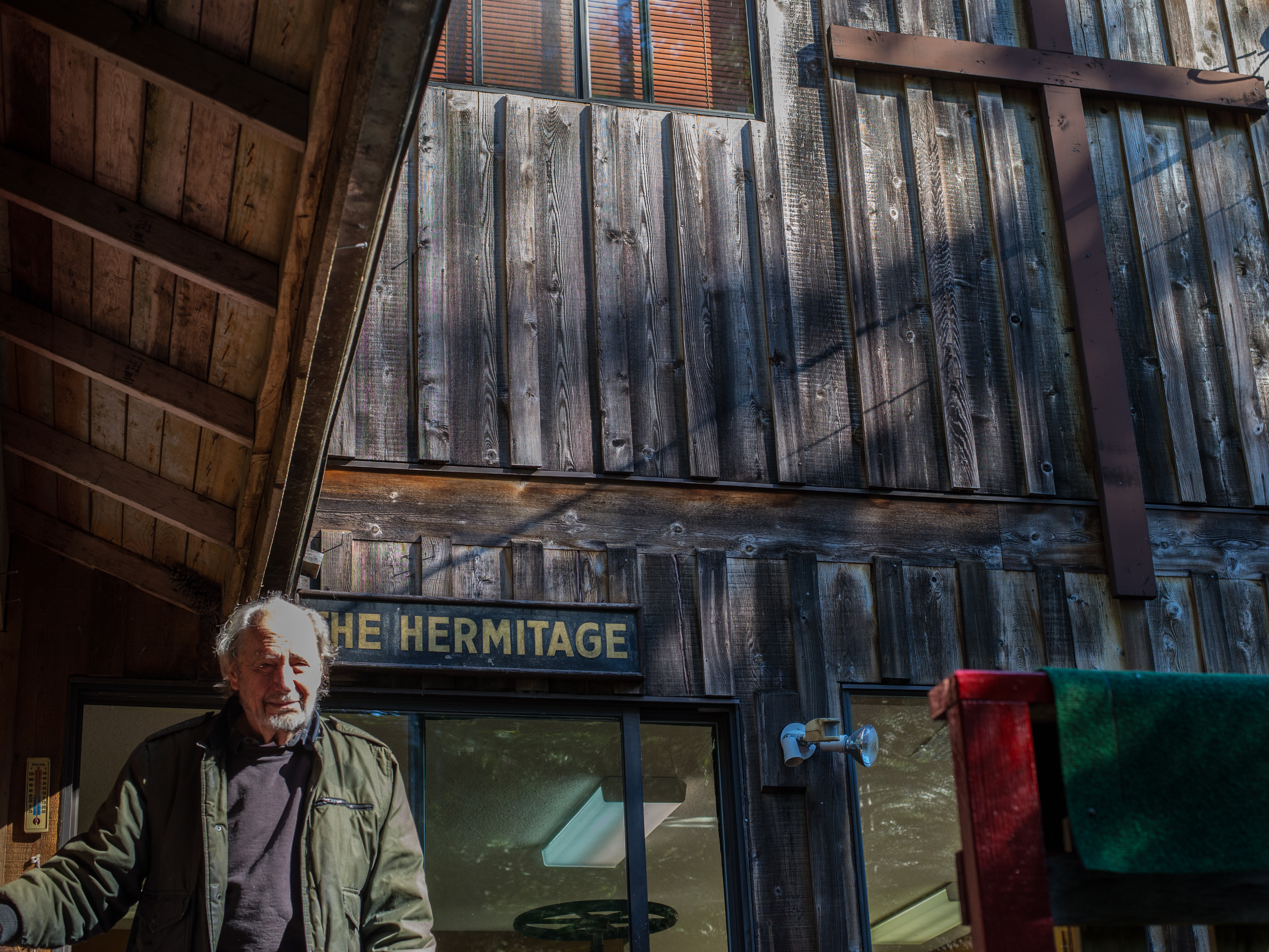
I recently joined the board the Brandt Oyster River Hermitage Society. We are getting ready to launch our website, and I was tasked with writing a short bio on Father Charles Brandt, a Hermit-Priest who lived in a small cabin and supported himself as a bookbinder on Vancouver Island. I met Charles in 2016, when I was completing my dissertation at UBC.
Photo by the author, 2016
Charles Brandt was the fifth child of the six and was born on February 19, 1923, in Kansas City, Missouri. He is of Danish-English heritage, the child of Alvin Rudolph Brandt-Yde and Anna Chester Bridges. His father was an auto mechanic at a Buick dealership and later served as a pilot in the Airforce during World War II. After the war, he worked as a Park Superintendent at Swope Park. Charles had two brothers and two sisters.
At the age of three, the family moved to a small farm where he had some of his first encounters of wonder in the natural world. The family raised chickens and had a milking cow. A small spring emptied into a creek on the property and there Charles would fish for perch and crawdads. In primary school, an observant teacher encouraged Charles to paint, and he enjoyed painting apple blossoms with watercolors. His Aunt, Helen F. Bridges, was on the board of the Kansas City Art Gallery and encouraged all the Brandt children to pursue artistic talents. Charles continued studying art at the Kansas City Arts Institute on Saturdays for several years.
As a Boy Scout, he earned the rank of Eagle and was drawn toward craft and book binding. Eldon Newcomb, a scientist who was also the head of the nature staff at Osceola Boy Scout Camp, became a major mentor and influence on Charles. For several summers, he served as a counselor at the Osceola Boy Scout Camp, where he taught bird watching and natural history. As a Scout he was elected to the Mic-O-Say tribe, which is an honor society that exists within the Boy Scouts of America. (In recent years the organization has been criticized by Indigenous people over concern that it engages in cultural appropriation. But in Charles day, it was a different time.) Charles was very early on fascinated by birds. Charles writes,
“During the spring of my 2nd year of high school, having become quite interested in bird study, I had an experience on weekend out along the Blu River. It was beside a small stream with the spring foliage when I began to see a stream of warblers moving along the stream and in the bushes, feeding and calling. The amazing thing was there were about nine different species in all their mating plumages, migrating through their nesting grounds. It was an overwhelming experience of beauty and wonder and wild. I wanted to preserve it forever” (Brandt 2006, 2).
This fascination with birds, birding and wildlife was a key dimension of Charles’ contemplative approach to ecology, and ecological approach to contemplation.
Father Brandt attended high school in Raytown, Missouri. Active in debate, band, swimming, oratory, sports, drama. He also worked as a life saver and lifesaving instructor. When Charles was thirteen, he read Henry David Thoreau’s famous book Walden Pond, and immediately felt the desire to “go to the woods”, a desire that eventually would call him to the hermit vocation. On Thoreau Charles said,
“I got interested then in Henry David Thoreau. He went to the woods to find out what life was all about, and that was really quite exciting, and a real challenge for me; and I wanted to do something like that. That was probably my first inroad into the hermit life” (Grayston and Chang 2016, 42).
Land, place, ecology and silence were for Charles a single whole from a very young age.
But at university, he decided to study conservation at the University of Missouri where he majored in wildlife conservation. Reflecting on this later, Charles realized that he had roomed with Starker Leopold who was studying wild turkeys in the Ozarks. Starker was the son of the famed conservationist Aldo Leopold (1987-1948).
In 1943 Charles entered Active Service with the US Army Air Corps. It was around this time, while Charles was studying in Colorado for the army, that Charles began attending a Baptist Church. And until 1946, when Charles was discharged, he travelled and studied for his service positions with the US Army, including bombardier training in Victoriaville, California. Charles was appointed a Flight Officer but never saw active combat before the war ended. When he entered military service, he didn’t really reflect on whether or not it was the right thing to do, since it seemed to be a patriotic duty. But by the end of his service, he felt that he had become something of a pacifist and winced at the thought of being an actual bombardier.
In 1947, Charles headed to Cornell University to study ornithology. Charles studied birdsong recording under Dr. Peter Kellogg and studied nesting birds at the Edwin S. George Reserve in Michigan. He was also elected to Phi Kappa Phi, a student scientific society for his high academic achievement. Charles would go on to graduate first in his class with a Bachelor of Science in biology. Charles’ first scientific article was published in the Wilson Bulletin, based in Anne Arbor, Michigan. The essay was entitled “The Parasitism of the Acadian Flycatcher.”
Taking serious stock of his spiritual life, Charles began attending Saint John’s Episcopal Church in Ithaca, New York. Soon, Charles met the Reverent Francis Voelcker, the priest in residence there, who saw in Charles a great contemplative potential. He began mentoring Charles and encouraged him to explore a vocation to the Anglican priesthood. Charles spent that summer living with an Anglican religious order, the Brothers of Saint Barnabas, who were devoted to the care of men and boys with developmental disabilities and incurable illnesses.
Though as a Hermit-Priest Charles never married, and he doesn’t mention many romantic partners, it seems that during this time he was quite fond of a woman he refers to as C.C. They attended services together at Saint John’s and Charles simply writes, “we spent considerable time together” (Brandt 2006, 4).
After graduating from Cornell in 1948, Charles decided to pursue Holy Orders. He returned to Colorado where he lived during his military training and was accepted as candidate for Anglican priesthood by Bishop Bowen of the Colorado Diocese. He entered Nashotah House Seminary in Wisconsin, living there for three years where Charles enjoyed the routine of the community which included Mass and the daily office.
However, during seminary Charles continued to wrestle with finding a meaningful spirituality and began to read more widely from books by writers such as Jeremy Taylor and Father Benson of the Cowley Fathers of England, another Anglican religious order. He seemed to be seeking a deeper spirituality of silence and contemplation. Then, Charles stumbled upon Trappist monk Thomas Merton’s autobiography The Seven Story Mountain and found a deep resonance with Merton’s rich contemplative spirituality. Of Merton’s writing he said simply, “it blew me away.” So much so that he and several seminarians had arranged to spend easter at Gethsemani Abbey in Kentucky, where Thomas Merton lived, to experience Trappist life firsthand and meet Merton in person, but the trip was cancelled at the last minute, and they didn’t end up going. On reading Thomas Merton for the first time, Charles reflects,
“So when I read The Seven Story Mountain, that was what I was looking for; that really answered my question. I wanted to know if it was possible to really experience God in this lifetime, can you talk to him, as a person? That was really a revelation, The Seven Story Mountain, and it changed my whole thinking. From then on, I was thinking in terms of monastic the life” (Grayston and Chang 2016, 48).
That year, however, Charles ended up visiting another Trappist monastery. He made arrangements to meet with Father Bede O’Leary the Abbot and theologian of Our Lady of Guadeloupe Trappist Abbey which at the time was located in New Mexico (in 1954 the community relocated to Carlton, Oregon). Charles wanted to talk with O’Leary about contemplative, or mental prayer and Father Bede became a great voice of council for Charles.
In 1950 Charles spent the summer at the Community of Augustine and Anglican Contemplative House in Orange City, Florida and on December 7th Charles was ordained a Deacon at Saint Andrew’s Church in Denver, Colorado by Bishop Bowen.
In 1951, accompanied by Reverend Voelcker, Charles went to England to explore the varieties of the Church of England’s contemplative life. They visited Chevetogne, Belgium where he met with Dom Lambert Beauduin (OSB) who was interested in the Anglican re-unification with Rome. This meeting brought Charles to question the validity of Anglican Holy Orders, because he learned that they had been declared invalid by the Vatican.
From here, Charles began to try his hand at the monastic life in earnest and in 1951 he became a Postulant at Community of the Resurrection, an Anglican monastery in Mirfield, Yorkshire. Despite his doubts, in 1952 he was ordained an Anglican Priest by Bishop of Wakefield, UK.
In 1953 Charles left the Community of the Resurrection and spent some time in continental Europe making various stops in France and Rome. He spent ten days in Assisi, a few weeks in Rome, and met with a Benedictine monks named Father Dennis Stratham OSB. Father Stratham was from Saint Gregory’s monastery in Shawnee, Oklahoma. This meeting would prove providential, as Charles was received into the Roman Catholic Church there in 1956.
In the meantime, Charles continued his quest for a place to express his contemplative vocation within the existing religious communities of the Anglican/Episcopal traditions. When he returned from Europe in the latter half of 1953, he travelled to a property in Gaylordville, New York where Father Paul Weed had a property that he wanted to transform into a contemplative community. Father Charles built a small hermitage on the property out of old railroad ties and started working as a Chaplain at Kent School in Connecticut where he also helped with the garden.
Soon however, Charles discerned that this was not his place and he decided to move to Three Rivers Michigan, a small Anglican Benedictine community in 1954 and entered as a postulant. While he was there, he learned to chant the divine office in Latin, and continued his voracious reading of the mystics and contemplatives. Charles was deeply moved by the writings of Camaldoli monk Father Bede Griffiths whose autobiography The Golden String deeply impacted Charles. Griffiths was a monk in England for many years, but eventually found himself in India dialoguing with Hindu Sanyasis and fusing East and West. Father Charles also began reading John Henry Newman’s Apologia Pro Vita Sua. Newman had spearheaded the Anglo-Catholic revival in the Church of England in the late 19th century, but eventually converted to Catholicism and was made a Cardinal by Pope Leo XIII in 1879. This period sealed Father Charles movement to the Roman Catholic Church, so he left for Louisiana to meet with the only catholic priest he knew, Father Bede O’Leary who was on leave and serving a parish there. O’Leary sent Charles to St Benedict’s Monastery, and he met with the Prior there. Despite meeting daily for a month, Charles was not quite ready to make the move from Anglican to Roman Catholic. So, Charles decided to travel to Mexico City on pilgrimage to the Shrine of Our lady of Guadeloupe, accompanied by Father Bede.
Upon returning, he decided to head to Saint Gregory’s Abbey in Shawnee, Oklahoma where he continued his discernment, studied Latin, and met with a resident theology professor regularly. It was during this time that Father Charles fell in love with book binding, a skill that would become his own contemplative bread and butter throughout his years as a hermit in British Columbia.
On January 26, 1956, Charles Brandt was received into the Roman Catholic Church and in April he was confirmed in the Cathedral at Oklahoma City. Charles continued his stay at Saint Gregory’s, taking theology classes and deepening his bookbinding skills. That Easter Charles decided to travel to Gethsemani Trappist Abbey where he met with Thomas Merton who was the novice master at the time. Merton was warm and received Charles with kindness.
On his first meeting with the Trappist monk Thomas Merton, Brandt recounts, “So at Easter I went to Gethsemani. I knew Merton was the novice master. I didn’t realize I was going to meet him. I was in the guest house for about a week. So [knocking] I hear this knock on the door, and in enters Thomas Merton. You know, he sat down there, just the most ordinary person in the world. Immediately, I liked him, really liked him as a person, and we talked. My intent was to enter the novitiate there, but he said, “Don’t come here. We could make a good monk of you, but not a good contemplative”” (Grayston and Chang 2016, 52).
After several chats with Merton and later his Bishop, Charles decided to forgo a trip to Rome to pursue a quicker pathway to priesthood and decided to first solidify his vocation as a monk. Charles decided to enter New Melleray Abbey, Dubuque, Iowa, another Trappist Abbey. This decision seemed fruitful and in 1958 Charles made Simple Profession (temporary vows) and was put in charge of a small book bindery. Charles continued his studies in philosophy and theology.
In 1964, during the upheavals and experimentation of Vatican II, Charles became uncertain about making final profession (vows). All over the world, monastic orders were studying their roots, which went back to the hermits and recluses of Syria, Judea and Egypt. Charles remembered that Thomas Merton told him about the Camaldolese Order which had a monastery in Ohio. So, Charles and his Abbot drove to visit them. However, the Camaldolese stood for the duration of the divine office. Having a back problem, Charles knew within ten minutes that he wouldn’t make it.
Back to the drawing board, Charles wrote a letter to Thomas Merton. Merton’s reply was published in a collection of letters, and Merton encouraged Charles to continue his search for a more contemplative place to live out his vocation. Charles soon found two eremitic experiments: A Benedictine hermit named Peter Minard in North Carolina and Dom Winandy, greatly admired by Merton, who was leading a small group of hermits on Vancouver Island, British Columbia.
After visiting Peter Minard, Charles was impressed. Minard lived a simple life on old plantation. But soon it became clear that Father Minard was mostly looking for someone to run the farm. So, the Abbot of New Melleray wrote to Dom Winandy, who gave Charles permission to come for a visit.
In March of 1965 Charles arrived at Winandy’s group, The Hermits of Saint John the Baptist, located on the Tsolum River in Merville, BC one hundred acres of forested land. Charles moved into a small trailer and then began to build a hermitage there with some local help which was completed in September. To earn a living Charles decided he would try his hand at being a professional book binder, and the Trappists of Carlton, Oregon, Our Lady of Guadalupe Abbey (who Charles had previously visited in New Mexico), donated some book binding equipment. With this Charles began to search for clients in the local area.
Despite Dom Winandy’s misgivings about hermits becoming priests, Winandy gave Charles permission to meet with Bishop Remi De Roo, who eventually accepted him as candidate for priesthood. In August he received minor orders and was incardinated in the Diocese of Victoria which essentially ended his temporary vows at New Melleray. On November 21, 1966, Charles was ordained as a Roman Catholic priest by Bishop De Roo at the Canadian Martyrs Church. According to Charles, he was the first full time hermit ordained in Catholic Church in several hundred years.
While living on the Tsolum River, Charles began working as a fisheries technician, and assisted in some parish work in Cumberland on Sundays. Eventually the hermitage site became a bit too crowded, and Winandy and several hermits including Charles dispersed to other properties. In the Spring of 1970, Charles moved his hermitage structure to its current location on the Oyster River.
In the mid-1970s Charles travelled extensively to improve his bookbinding skills. He spent several months in San Francisco learning book restoration and then travelled to the New England Document Centre in Andover, Massachusetts to learn more about flatwork conservation of maps, parchments and prints. Charles was even appointed Chief of the Bindery, which kept him very busy teaching workshops and conducting surveys. In 1975-76, Charles travelled extensively in Europe where he both worked and studied additional conservation techniques.
Returning to Canada, from 1976-1981 Charles was employed by various Canadian book conservation programs. First, he worked for the Canadian Conservation Institute in Moncton, NB as Professional Book and Paper Conservator. Charles said a daily noon Mass in an English-speaking Church in Moncton. When this office closed, he moved to a centre based in Ottawa where he restored bound volumes, maps and art works on paper. Charles was also hired by the Manitoba government to design and oversee the building of a state-of-the-art restoration laboratory in Winnipeg from 1981-1984. The purpose was to survey and restore the Hudson’s Bay archives. Charles also travelled throughout Canada doing conservation work in Yukon, Manitoba, and Alberta during this time. On his love for bookbinding and conservation Charles wrote:
“Probably the best contemplative part of bookbinding is sewing the book. It’s a very relaxing, I think a very meditative, contemplative aspect of binding. Literature is disappearing at a great rate from our libraries all over the world, and it’s our written record of humanity. So if you’re preserving that, as I am, you’re preserving humanity, the culture, and I think that’s really quite worthwhile. It’s like preserving the earth. It’s not just a job, it’s something that’s conducive to the prolongation of civilization” (Grayston and Chang 2016, 55).
Charles was a craftsman and appreciated work well done. The embodied nature of the work, the quiet and the sense of purpose facilitated a contemplative atmosphere that was conducive of prayer.
In 1984, Charles finally returned to his beloved hermitage where he began making additions to the structure and installing a conservation lab and library. Charles began teaching conservation and restoration techniques at University of Victoria, UBC, Simon Fraser, University of Alberta, Washington State University and in many communities across Vancouver Island.
Even before he left for his travels related to book binding and document conservation, Charles was a passionate lover of place. He would write letters to local officials protesting proposed developments on the Oyster and Tsolum Rivers. When he returned to full time residency at the hermitage in 1984, he began lobbying campaign which mushroomed into a large number of environmental projects throughout Campbell River and the Comox Valley. Throughout the years, Charles was involved in many environmental groups and causes: The Steelhead Society of BC, Haig Brown Kingfisher Creek Society, the Campbell River Environmental Council, the Tsolum River Enhancement Committee, the Oyster River enhancement Society, the Oyster River Watershed Management Committee and the Tsolum River Restoration Committee. In the 1990s the local media began to take notice, and he even received several environmental awards for his work on river restoration and conservation.
It was at this same time that he began holding meditation retreats with the local community, despite some Catholic leaders warning against “Eastern” forms of prayer and meditation. His work of ecology and contemplation were quite a natural fit: Action and Contemplation were connected. In 1990, the meditation group became a regular event, which continued to the end of Charles’ life.
In 2001, Charles was the keynote Speaker at the Western Conference on Christian Meditation in Edmonton, Alberta which solidified his leadership in the global contemplative movement. On prayer, Charles reflected, “I think that anybody who prays benefits the whole body of Christ. Prayer touches everybody. The person next to me is affected by whatever I do. If I pray, that helps them, and it also helps the natural world” (Grayston and Chang 2016, 39).
Charles life was a series of questions lived out in many different places and among many different communities. But his love for craft, ecology, and prayer shine through all of this. Charles is an exemplar of contemplative ecology lived well. Toward the end of his life, Charles reflected on the contemplative life and on the hermitage property that the Hermitage Society lovingly maintains. He said,
“In a way, I’m looking towards eternity now. I’ll be 93 on February 19th, [2016], so I’m not going anywhere. I love this spot. I’m permanent. I feel steady, in a sense, with life, and with my calling. And this is my place. I walk out and I know the trees, and I know the birds and the animals. They’re my friends. As I said, the human community and the rest of the natural world has to go into the future as a single sacred community. I feel that I’m part of this community where the natural world and people come and go; and if we don’t, as Thomas Berry says, we’ll perish” (Grayston and Chang 2016, 57).
Father Charles Brandt died at the age of 97 on October 25, 2020, after a short stay at a local hospital in the Comox Valley. Upon his death, close friend and co-founder of the Brandt Oyster River Hermitage Society Bruce Witzel reflected, “His stature as a spiritual teacher as well as his whole legendary reputation as someone who integrated spirituality with ecology will live on after him in the lives and efforts of the many people he directly inspired” (Closter 2020).
Charles’ Publications
Charles Brandt. Meditations from the Wilderness: A Collection of Profound Writing on Nature as the Source of Inspiration (Harper Collins, 1997). 150 quotations about ecology, place and contemplation.
Self and Environment: On Retreat with Charles Brandt. (Bloomsbury Academic, 2000). An outline of Charles thinking on contemplative and ecology.
Bibliographical Sources
Charles Brandt, “Autobiographical Timeline” Email from Charles Brandt to Judy Hager (Dec. 14, 2006).
Rev. Don Grayston (1939-2017) and David Chang “A Single Sacred Community:
Imagine the most common of trees, the Christmas (or Solstice) tree, decorated with globes, lights and a star on top. Allow that tree to grow in your mind so that it fills the sky.
The bright star at the very top of the tree merges with the North Star, Polaris.
Now imagine that the gold and silver globes become the sun, the phases of the moon, and the other planets moving through the sky, appearing to pivot around the North Star.
Imagine that the twinkling lights are billions and billions of stars.
The Christmas tree is a microcosm of the macrocosm.
The Norse pagans placed the ash tree at the center of their cosmology.
Its sprawling roots descended into the underworld; its trunk and branches passed through the mortal realm, ascending to heavenly.
The Maya imaged the cosmos as a great Ceiba tree, which also descended to the underworld and ascended through thirteen levels of heaven, each level with its own god.
The sun and moon made their way along the Ceiba’s trunk, and the spirits of the dead moved along its rough bark.
The naturalist and pantheist John Muir used to climb to the top of large pine trees during rain storms. About trees and the universe he mused:
We all travel the Milky Way together, trees and [humans]; but it never occurred to me until th[at] stormy day, while swinging in the wind, that trees are travelers, in the ordinary sense. They make many journeys, not extensive ones, it is true; but our own little journeys, away and back again, are only little more than tree-wavings—many of them not so much.
The Tree of Life
In the beginning, the tree of life emerged as a tiny seedling.
Soon, it branched out into everything we call living: microbes, fungi, plants, trees, animals.
The seeds of humans germinated in the trees.
Our mammalian and primate ancestors made their homes in their bows.
Eventually, our curiosity compelled us down from the safety of their branches and out onto the savanna.
Yet, the trees never left us;
They continued to provision us with gifts on our long walks.
They gave food, fodder, shelter, tools, medicine and stories.
They appeared in our dreams.
It was here, in a forest, that Zoroaster in Persia saw the Saena Tree in a vision emerging from the primeval sea, a tree from whose seeds all other plants would grow.
It was here that Yahweh, Semitic sky god, came to earth and planted a garden of trees, pleasing to the eye and good for food.
It was here that Inanna, Babylonian goddess of beauty and love, nourished the Huluppu tree on the banks of the Euphrates River.
It was here that Kaang, creator god of the Batswana Bushmen, created the first mighty tree and led the first animals and people out from the underworld through its roots and branches.
It was here that the sacred tree gave light to the Iroquois’s island in the sky—before the sun was made, before Sky Woman fell through a hole in the island in the sky, and before the earth was formed on the back of a great turtle.
It was here that the Mayan Tree of Life lifted the sky out from the primordial sea, surrounded by four more trees that hold the sky in place and mark the cardinal directions.
First Visions
It was here, in a forest, that the first whispers of the divine spoke to human consciousness.
It was here that Jacob wrestled with angels and beheld visions.
It was here that Hindu seekers learned the wisdom of gurus.
It was here, seated beneath the Bodhi tree, that Siddhartha Gautama became the Buddha.
It was here that Moses fasted, prayed, and received God’s Law.
It was here that Muhammad sought refuge in mountain caves and spoke the words of the holy Koran.
It was here that Guru Nanak experienced the Oneness of God.
It was here that Nephi of the Book of Mormon communed with angels and beheld the glorious fruit of the Tree of Life.
First Temples
It was here, in a forest, that we built our first temples and worshipped God without priesthoods.
It was here that Asherah, Canaanite goddess of all living things, was worshipped.
It was here, as Sycamore fig, that Isis of Egypt was lavished praise.
It was here, in grove of sacred oak, that the Druids passed on their knowledge, and sacrificed human flesh to the gods.
It was also here, in the forest, that, after civilization blossomed, we looked for inspiration—
Temples of stone with their pillars, columns, and cathedral arches were all made to resemble the trunks of trees, carrying the eye upward to God.
And yet, it would seem that these temples of stone confined God to one place, one people, one faith.
Fall
It was here that we fell from grace.
It was here that Adam and Eve ate the fruit of a misunderstood tree.
It was here that civilization bloomed.
It was here that we logged, burned, mined, clear-cut, developed.
It was here that the old stories were forgotten and new ones were written;
Stories in which creation was no longer sacred, enchanted, animate, subjective.
Return
In an age of climate chaos and heart breaking extinction, it is here, to the forest, that we must return.
Not only as skiers, hikers, campers, birders, hunters, and foresters, but as devotees.
Because it is here that we see the universe in microcosm, where we get our bearings.
It is here that creation awes.
It is here that we experience the divine.
It is here that we can bring our questions.
It is here that we can dwell in mystical solitude.
It is here that we are now—The global forest.
Call
To return to the forest, we must become familiar with it.
I invite you to go to a mountain grove or a city park and take off your shoes.
When you are comfortable and alone, close your eyes.
Begin by focusing on feeling—as a tree might—the sun, the wind, the earth beneath your toes and on your skin.
If you wish, stretch your arms up and out like branches seeking the light.
Imagine drinking in the caramel rays of the sun as nourishment.
Focus on your breath by letting the air pass through your nostrils and fill the arboreal-patterned branches in your lungs.
Feel your lungs slowly fill with oxygen.
Feel them slowly empty as your body expels carbon dioxide.
Focus on the entire process of breathing and how each moment changes.
In and out.
As you breathe in, imagine that the oxygen, conceived in the leaves of trees, is gently birthed from the leaf’s stomata, wafting through space, and entering your lungs.
As you breathe out, imagine that the CO2, re-born in your lungs, is gently wafting through the air and entering the receptive stomata of the leaves.
In and out.
The air becomes us, becomes them.
It is a sacrament; we take it upon us, into us, and they upon themselves.
As we breathe in, the trees breathe out.
As the trees breathe out, we breathe in.
We are their lungs and they are ours.
In and out.
This is not a supernatural idea; it is an ecological reality.
May we dwell in this reality!
The mystic monk and (one time monastery forester) Thomas Merton said:
We are already one. But we imagine that we are not. And what we have to recover is our original unity. What we have to be is what we are.
What we are is not all that different from trees.
And so I offer you this prayer for your walks and sits among the trees.
Forest, Trees. May we sustain you as you sustain us.
I stumbled my way up and up the 3.5 mile trail to Park Butte historic Fire Lookout.
I arrive near dusk, not sure the time because I don’t have a watch or cell phone with me.
I find the place empty, how lucky to have it to myself for the night.
Up close, Mount Baker’s glaciers accordion down the southern slopes.
The sun is dipping toward the Salish Sea as I explore the nooks and crannies of the Lookout—pots, pans, water jugs, saws, axes, maps, log books from the 80s and 90s.
A few crumpled Gary Snyder poems in a tattered booklet: Patron saint of Washington Fire Lookouts.
I walk the creaky deck surrounding the Lookout.
The wind talks with long pauses between wordy gusts.
The thrushes sing, a bat flutters by eating bugs, the sky darkens.
Venus and Jupiter twinkle as a million tiny fireworks pop in the valley below.
A golden waning moon rises from the Cascade Mountains.
Sleep comes slowly, interrupted frequently by the wind rumbling and clattering through the leaky Lookout.
A year ago, I decided I wanted to put on a conference. I had just started my PhD program at UBC and finished a course on the history of environmental thought. It became clear that there was so much to learn about our religious and spiritual relationship to the world. Being new in the Pacific Northwest I wanted to bring people together, to see what was out there, what was being done, and how we might form a stronger community of ‘spiritual ecologists’ in the region. I wanted to discuss religion, spirituality, ecology and cosmology in the same space, and I wanted to gather strength for the fight for our future that our generation is in the midst of. What started as an idea became a reality from September 22-24 and the 29th. With fifteen artists and at least twenty four presenters, speakers or narrators this truly was a Convergence of talent, ideas, passion and beauty. I chose the title Spiritual Ecologies and New Cosmologies, because I wanted to span the diverse terrain of scholarship, activism and advocacy for a new way of seeing ourselves in relationship to the earth and the Universe herself. I chose the plural because I knew there would not be just one vision of a sacred earth or a sacred cosmos, but many. I chose Convergence, because I wanted it to be about more than just presenting papers. As the core organizer I made plenty of mistakes: perhaps too many speakers, too few breaks, too much time in our heads. But overall we had an amazing spectrum of lectures, presentations, storytelling, performance, walking meditation, art and most importantly discussion and sharing. While the Convergence is over, the art will be exhibited at the Liu Institute until November 6, so if you missed the Convergence stop by!
Day 1: Beginnings
Storytellers
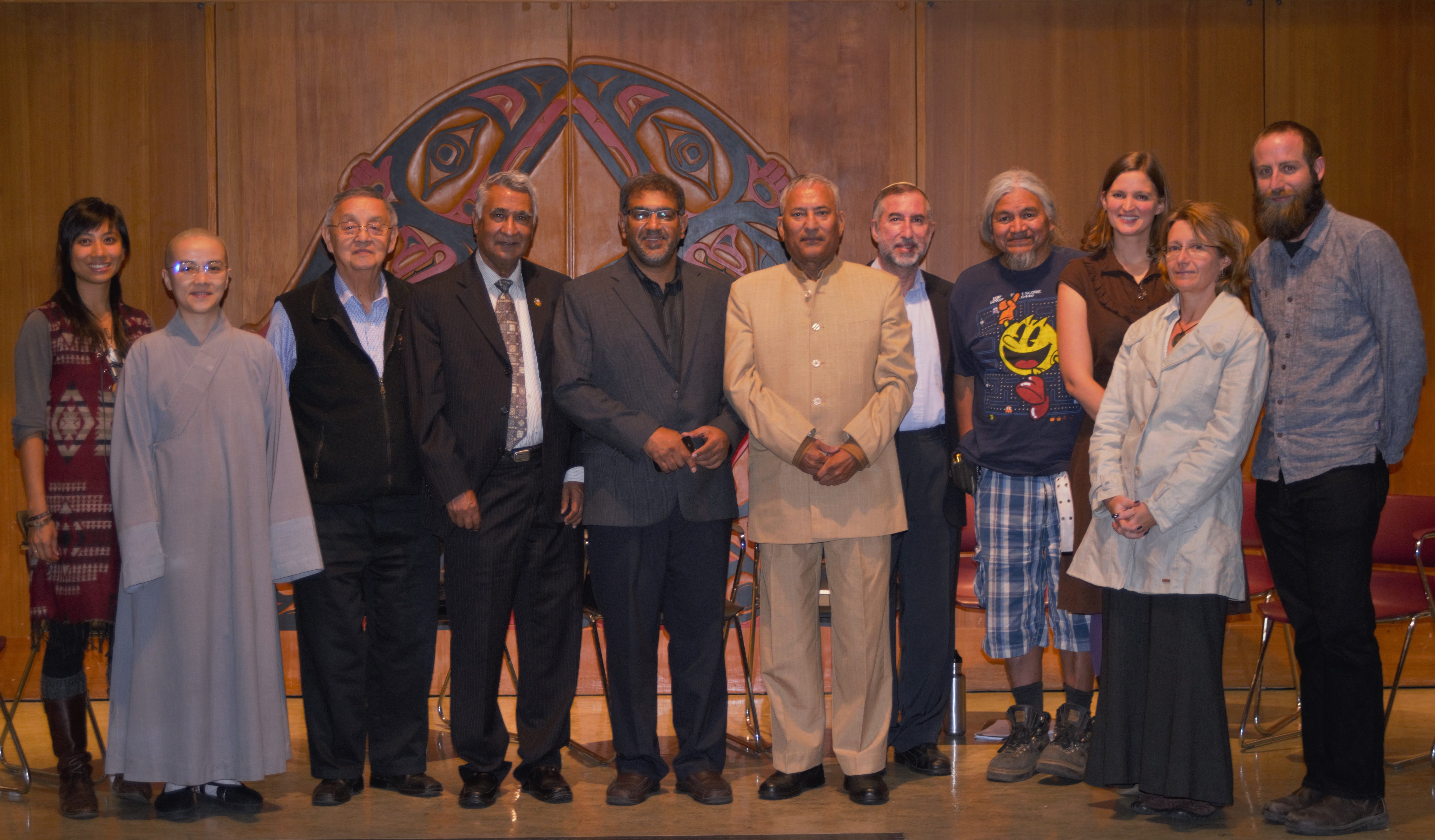
The picture of Monday’s speakers brings me great joy. For all the strife and religious violence in the world it was amazing to have people speaking from 10 different traditions, and sharing those perspectives with an audience of 80 other perspectives. We had some technical difficulties and the speakers went a little long, but to be in the First Nations Long House among the amazing totems and pillars was a wonderful place to tell stories of origin and beginnings. We were welcomed to the Musqueam territory by Elder Larry Grant, who told us about the origin of the name Musqueam, and the problematic nature of colonial English words like ‘creation’ and ‘Creator’ and the Musqueam concept of all things possessing a life force. As we learned, not all of our spiritual traditions tell stories of beginnings –our Buddhist and Hindu storytellers spoke of unimaginably long cosmic cycles within which human beings strive for liberation from suffering. While the Judeo-Christian creation stories (Gen. 1 and 2) offer poetic details about the emergence of the universe and a cast of characters, our Sikh storyteller declared that only God knows how the universe was brought into being. For us it will always be a mystery. In Islam, everything in creation points back to Allah, from beginning to end, and our Mormon storyteller spoke of our eternal co-existence with God and the universe. If we had had more time, I would have asked 10 more scientists to speak from their traditions. But our cosmology story teller, Ben Pfeiffer a Langara College science professor, did an amazing job, by telling of the Big Bang and the origin of the earth in a story that included a mythical spider who challenged the dominant telling of the scientific story of the universe by mostly white men. After the welcome dinner, we heard from those in the audience who brought up many interesting points and spoke from experience. They all had stories to tell, and I wish we would have had time to hear them all.
Day 2: Cosmologies
Cosmic Meditation Walk
On our second day, via skype, we heard from the producers of ‘Journey of the Universe’, a film about reconnecting the human purpose to cosmic evolution. During the response to the film by Bruce Sanguine, a local self-professed evolutionary Christian, a young woman entered the room and began speaking loudly, asking if she could speak, asking what we thought we were doing. I tried to ignore her and move on with the evening, but she persisted despite efforts by some of the participants to calm her down and invite her outside. At one point she insulted our speaker by saying what he was saying made no sense. As Bruce continued, I lost my temper and stormed up to her demanding that she leave the premises. She refused and my anger only escalated her outbursts. The room was tense and we tried to move forward, while someone called UBC security. While I stormed around, one of the participants quietly gained her trust, and took her outside, calming the woman down, and teaching her how to reconnect to herself through the ground and the trees that surround the Liu Institute. The woman admitted that perhaps she should not have made such a scene and apologized. The evening proceeded with some very insightful reflections, but as I reflected, my boldness melted into shame. Yes, I had worked so hard to build something, and she had tried to ruin it…How dare she insult my speaker! But I realized what a perfect metaphor it all was. All of our preconceived notions of comfort, order, harmony, normality, and mental health can be shattered in an instant. How could I change my relationship to the earth if I could not even love one person suffering from a momentary lapse in mental health? If that woman, who refused to tell us her name, is reading this, I want to say I am sorry. Please forgive my lack of compassion for you. I will do better.
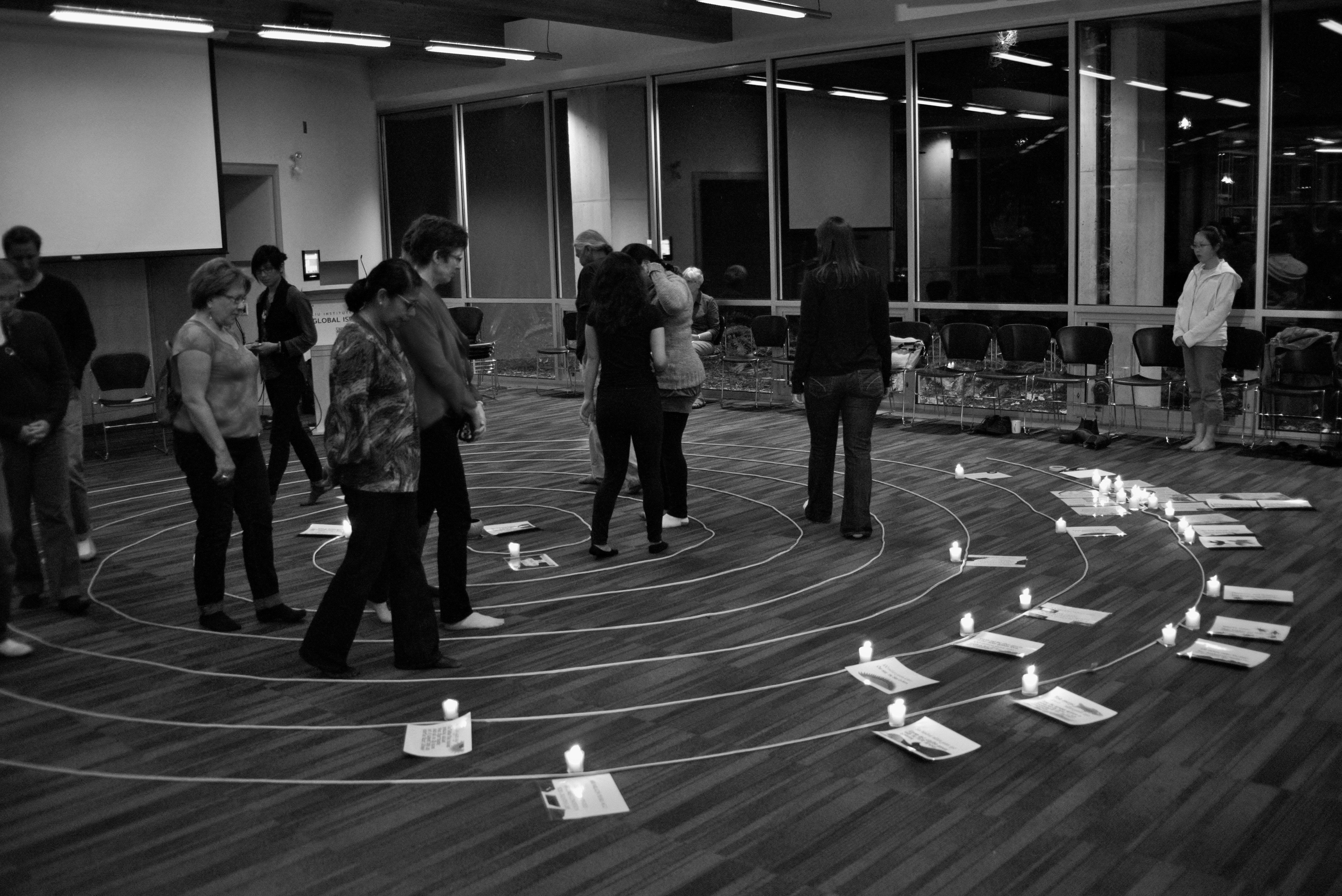
After our discussion we turned to the Sisters at Earth Literacies Program for a walking meditation that spanned the entire history of the universe as told by contemporary Cosmology, each milestone marked with a candle. I was impressed by the amount of silence between the beginning of the universe and the emergence of galaxies, and the tiny spaces between the creation of earth and the evolution of consciousness. After the Sisters outlined the journey, we all walked the spiral from the center to the outer edge in silence. It was profound to see the milestones that led to Jason M. Brown walking in a small room of peers in British Columbia under my feet; to grasp that I was but star stuff reflecting back on the process of becoming Mind stuff.
Day 3: Ecologies
Speakers and Participant from the afternoon session
On the third day we had an amazing and full lineup of speakers. We had some great discussion as well. I felt so privileged to be around people who care so deeply about the earth and making our civilization more sustainable. We also had the perspectives of Hindus, Buddhists, Christians, Jews, Pagans, Unitarians, Survivalists, Atheists and more! I was struck by Meg Robert’s and Mike Bell’s points about the importance of spiritual practice for keeping our activism vital. I was struck by the need to ground our consciousness raising in the landscape, in a context, or as Matthew Humphrey argued, in a bioregion, or life-place. As Franciscan Priest Richard Rohr has put it in his writing “We don’t think ourselves into new ways of living, we live ourselves into new ways of thinking.” This is exactly what Suresh Fernando is attempting to do with his spiritual community at Ruby Lake on the Sunshine Coast. Yes we can seek personal spirituality, but it must be grounded in place, in tradition, in community.
With respect to system change we had a few different minds. For example, Winnie Chu is starting an air pollution monitoring company guided by Buddhist principles. Others were adamant that what is needed is to create semi-autonomous zones that can push back the system which is hopelessly corrupt, to birth a new way of living on earth. These autonomous zones would not just be political, but could demand freedom from noise pollution, light pollution, techno-addiction, and the alienation from life itself. In the end it seems that authentic Transition will require an all hands on deck strategy: system change from within and pressure from without.
Spiritual practice is what will keep us grounded and keep us from burning out. We must be connected to the wild and to each other. And yet, it is essential that in seeking the wild, we do not romanticize it as some far off wilderness park. As Nikki Van Schyndel reminded us, our hearts are wild, and there are wild things all around us. And yes, sometimes it is scary, but fear can be the birth pang of joy. Yes, we must push back industrial civilization to some measure of sustainable limits, and yes we must protect and restore intact ecosystems; but we must also remember to dwell in the wilderness of the present moment, with what and who are all around us while we work toward these goals.
We were blessed to have several First Nation’s folks among us for our discussions, and they reminded us of the dangers of appropriating Indigenous lifeways. We must stand in solidarity with First Nations peoples and against continued racism; but we must also decolonize our own traditions and retrieve and reclaim the good and beautiful in them. As a Christian practicing Zen Buddhism, this was a particularly potent lesson for me. The Celtic and Franciscan traditions of Christianity have been neglected for the colonial, guilt ridden, and capitalist Christianity of the West.
Nikki teaching us how to make fire with a bow drill.
Day 4: Convergence
On Monday September 29, we decided to continue the community that was forged during these few days. The Spiritual Ecologies and New Cosmologies Community, a tentative title, has been born. Starting with online networking and resource sharing we want to continue to build bridges and understanding between faiths, to offer resources to communities of faith in the Pacific Northwest that want to do more to connect their faith with the earth. The community wants to plan more events, a 2015 Convergence perhaps, but definitely smaller workshops on Sacred Activism. Ari Lazer, one of artists is also hosting a workshop on Sacred Geometry, so check that out. If you did not get the email I sent out and would like to stay connected please let me know.
Thank you to all who attended this convergence! To my co-coordinator Elaine Hsiao, to Andrea Reynolds at the Liu Inistitue, to Blake Smith and Miriam Matejova from the Liu Lobby Gallery and to Maya Graves-Bacchus for her help and to many others for your love and support.
Please share your responses and reflections with me at
Jason [dot] minton [dot] brown [at] gmail [dot] com


 holyscapes