Imminence

img_6306

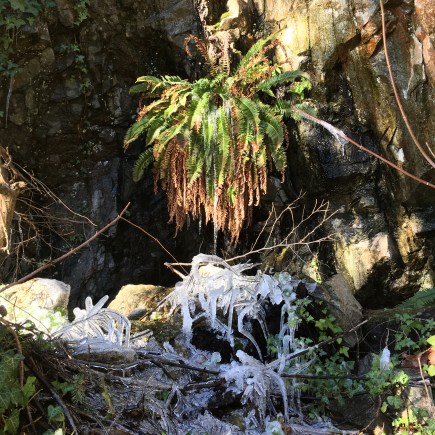
I remember the first time I realized that God not only created the world, but was immanent to it as well.

It was like staring at one of those paintings where an image of a tree or something is hiding, and it suddenly coming into view.

I was searching for God my whole life, but had been staring her in the face all along.

img_6302

Deep Roots, Entwined Branches: Reflections on the Parliament of the World’s Religions

Laying on cured grass just outside of a closed Forest Service campground in the foothills of the Idaho panhandle, cool air condenses into dew on my sleeping bag. I shiver between sleep and wakefulness. The stars keep me company. I watch Cassiopeia slowly swing around the North Star, and around 4:00 am, Orion becomes visible. It is strange that only when we sit still do we realize just how constant is our motion. There are dozens of other constellations whose faces I do not recognize, and whose stories I do not recall. Then, in the east, an almost imperceptible glow begins to put the trees and hilled horizon into dim relief. Venus, Mercury and Jupiter line up to greet the day. Morning is approaching.

I, along with five other members of the Salish Sea Spiritual Ecology Alliance are on our way to the 2015 Parliament of the World’s Religions supported by a small grant from the Sisters of Charity Halifax and we have stopped to camp for the night after a long day of driving.

The Parliament of the World’s Religions was first convened in 1893 in Chicago to coincide with the World’s Fair. This year it is being held in Salt Lake City, Utah the Axis Mundi of my first religious tradition, Mormonism, and the place I lived and taught World Religions for two years before I moved to Vancouver. In 2014, I attended the Society of American Foresters annual conference in the very same venue, and when I heard that the Parliament was coming in 2015, I felt a pang of synchronicity. I studied both forestry and theology in graduate school, and though it was a small coincidence, it felt like Life reassuring me that I was on the right path.

Arriving in Salt Lake City, we found the Salt Palace Convention Center packed with about 10,000 people, representing at least 50 faiths, from 80 countries. The first Parliament excluded Native peoples, Mormons and Atheists, but this year just about every possible belief and practice was present. We began by going through a ‘smudge’ purification ritual officiated by a kindly Paiute elder, and then making an offering of tobacco to the sacred fire. It was good to start the Parliament by acknowledging the Spiritual Ecology of the First Peoples of this land.

The Parliament was a veritable smorgasbord of spiritual and religious diversity: mandalas, labyrinths, spontaneous dance parties, flash mobs, meditation gurus, chanting, even a procession of people dressed like angels. Exhibitors hawked every kind of spiritual ware from prayer beads and Native American jewelry, to sacred texts and icons. It was a cacophonous mosaic of the world’s spiritu-diversity. Overwhelming at first, I settled into the rhythm of the Parliament, and to try and drink from its convention-shaped wisdom.

The mission of the Parliament is “to cultivate harmony among the world’s religious and spiritual communities and foster their engagement with the world and its guiding institutions in order to achieve a just, peaceful and sustainable world.” This mission was on full display throughout the Parliament, as most sessions focused on issues of poverty, cooperation, women’s rights, violence, terrorism, climate change, ecology, and more. I attended dozens of the concurrent sessions –from Pagans respond to the Pope, to Vedic Cosmology. I was even lucky enough presented a few myself.

In ‘Religion and Ecology in the Anthropocene’, I looked to the future religion in an ecological context of human domination. I presented Spiritual Ecology as an emerging and increasingly popular orientation that transcends religious affiliations. Our Panel headed up by Suresh Fernando, Maya Graves-Bacchus and Alysha Jones then defined spiritual ecology and presented the vision and mission of our organization. It was a wonderful conversation! In my second presentation ‘Trees, Forests and the Sacred’, I started with a poem on Sacred Groves, and then rushed through a PowerPoint on the types of sacred trees and forests. Then I invited participants to leave the air-conditioned convention center and spend time with actual trees in Temple Square. We reconvened in front of the LDS Temple and discussed our experiences. It was a very powerful way to bring home the importance of trees in our spiritual lives. My third presentation was as a short guided meditation on cosmology. Wandering through the phases of cosmic evolution, we meditation on the 5 elements focused on each in our bodies and in the earth. But enough about that!

Along with the hundreds of concurrent sessions there were six plenaries sessions spaced throughout the week which addressed Women’s issues; Emerging Leaders; Income Inequality; War, Violence and Hate Speech; Climate Change and Indigenous issues. The speeches and energy in the massive plenary hall was electric, and I was deeply moved by most of the speeches and speakers. The diversity of voices were not there to convince us of their beliefs or doctrines, but to challenge us to live up to our best moral teachings. Not that their beliefs and doctrines did not come through in their talks, or that they needed to check them at the door, but that the Parliament was simply not the place to debate the metaphysical truths of religious belief. It was a place of convergence in common cause, and a space for sharing the unique perspectives each tradition brings to the works of justice, mercy, poverty and ecology.

I was particularly inspired by the number and diversity of women leaders. Eco-feminist Vandana Shiva, writer and Course in Miracles enthusiast Marianne Williamson, Ayurveda teacher Mother Maya Tiwari, theologian Dr. Serene Jones, Indigenous Grandmother Mary Lyons, Rabbi Amy Eilberg, indigenous youth activist Ta’Kaiya Blaney, Primatologist Jane Goodall, writer Karen Armstrong, evangelical climate activist Katherine Hayhoe, religion and ecology scholar Mary Evelyn Tucker and so many more. The Parliament was a welcome place for those who sought to advance the equality of women. There was also a surge of energy focused on the reemergence of the Divine Feminine.

On the role of women, it was stated plainly, the world’s religions have a mixed record with respect to treating women with dignity. Parliament Board member Phyllis Curott reiterated,

“The dignity, safety and equality of women is the global human rights struggle of our time. The world’s religions can no longer contribute to or allow the denigration of half of humanity…Women, and men, of faith and spirit are gathering in Salt Lake City to fix this broken moral compass and call upon the world’s religions to stop the deprivation and violence against women and girls; to stop harmful teachings and practices that justify discrimination and abuse; and to ensure that women are fully involved in decision-making within religions.”

It was humbling to once again realize how much privilege I carry in the world as a white, cis-gendered male, Christian; and to realize that my place of privilege has led to the suffering of bodies that do not look like mine. Speaking of the recent attack on a Gurdwara in Wisconsin where a white supremacist killed six people and wounded four others, Sikh woman Valerie Kaur lamented that:

“100 years after my family has called this country home, and 14 years after 9/11, our bodies are seen as perpetually foreign, and potentially terrorist. Just as black bodies are seen as criminal, brown bodies illegal, trans bodies immoral, indigenous bodies savage, and women’s bodies as property.”

It is always a hard reality to face; that my demographic has caused so much suffering to women, to immigrants, to blacks, to indigenous communities, and to the LGBTQ community. It reminded me of something Jim Wallis said in relation to the violence facing so many African Americans in the US: “If white Christians in America acted more Christian than white when it came to race, black parents would be less fearful for their children.” These are hard words. The Parliament was a call to repentance. I am trying not to internalize guilt, but to channel it into the energy we need to build a better world, and the energy I need to continue to strive to be a better man, a more conscious white person, and the kind of Christian that takes God’s love seriously, for myself and for the other.

There was no illusion that religion is often tangled up with this discrimination, violence, terror and hatred around the globe. Fundamentalism, extremism, patriarchy, terrorism and capitalism were all called out for their negative consequences, faults, flaws and mistakes, but there was very little bitterness, vitriol or blame. For all its faults, religion was overwhelmingly embraced as a force for good in the world, a force that is capable of acting out of a deep and Divine source of love toward those that we might otherwise fear. Each speaker drawing from their own traditions and experiences, in the face of insurmountable problems, was able to expose the center of love and compassion at the core of all our religious and spiritual traditions. They admonished us to access this core with the intention of serving our human siblings and the earth community. Each speaker was grounded in respect, love and hope for the possibilities present in this remarkable gathering.

While the problems we face were certainly front and center, the good we have accomplished was also with us. Discussion of the transition from the UN Millennium Development Goals to the Sustainable Development Goals cited that fact that globally, extreme poverty has been cut in half since 1990. Eboo Patel discussed his work with Interfaith Youth Corps, which works with campus groups around the USA to build interfaith relationships and to make it known just how much interfaith cooperation has succeeded in the past. New Thought Minister Michael Beckwith talked about the potential of moving the economy from a model of Success 1.0 and 2.0 with an emphasis on personal profit, or personal profit tempered by philanthropy; to what he called Success 3.0, which focuses on the impacts our enterprises have on other people and the planet before personal profit. Jane Goodall spoke to the evolutionary origins of violence, and how human beings, unlike chimpanzees face a choice. We can act on those evolutionary impulses or we can transcend them. The Parliament was a pep-rally for actively choosing goodness over evil, forgiveness rather than revenge, and hope rather than despair.

One thing I noticed at the Parliament was that young people were a minority. This really hit home when I sat around the table with old friends from Utah and we realized that though most of us had attended BYU (the LDS owned College in Provo, Utah), most of us had left the Mormon Church. Few had transitioned to other faiths as I had, and most were still carrying the wounds of lost belief, residual guilt, and bitterness. My friends have left for many reasons, but I wished that they could have heard the plenary speeches which called us to forgiveness and hope. Yet, for most young people, the damage has been done, and the thought of returning to the religions of their upbringing is near impossible. I do not blame young people for leaving organized religion, as I said, there is plenty to point fingers at, but it makes me sad none the less. Especially at a time when their voices and creativity are so desperately needed to address these mounting global issues and problems. If religion wants to survive, it must find a way to engage young people in ways that are authentic, meaningful, and hopeful.

Yes religion can be insular, exclusive, moralistic and violent, but at the Parliament of the World’s Religions I realized that we were part of something much greater than a collection of religious institutions in dialogue. We are part of a global Interfaith Movement that is predicated on the assumption that we have something to learn from other religious traditions, and that the problems of the world are a test of how well our traditions serve humanity and the earth. Some predict that religion will go away. I am not convinced of this. Yes, religion will have to change as it always has—as I realized in the wet grass of the Idaho Panhandle, it is only when we sit still do we realize just how constant is our motion. As we continue to dialogue, to seek understanding, to cooperate on global projects to combat climate change, poverty and discrimination, the roots of our faith may deepen, but our branches will become more entwined. This is the religion of the future.
My First Visit to Gethsemani Abbey

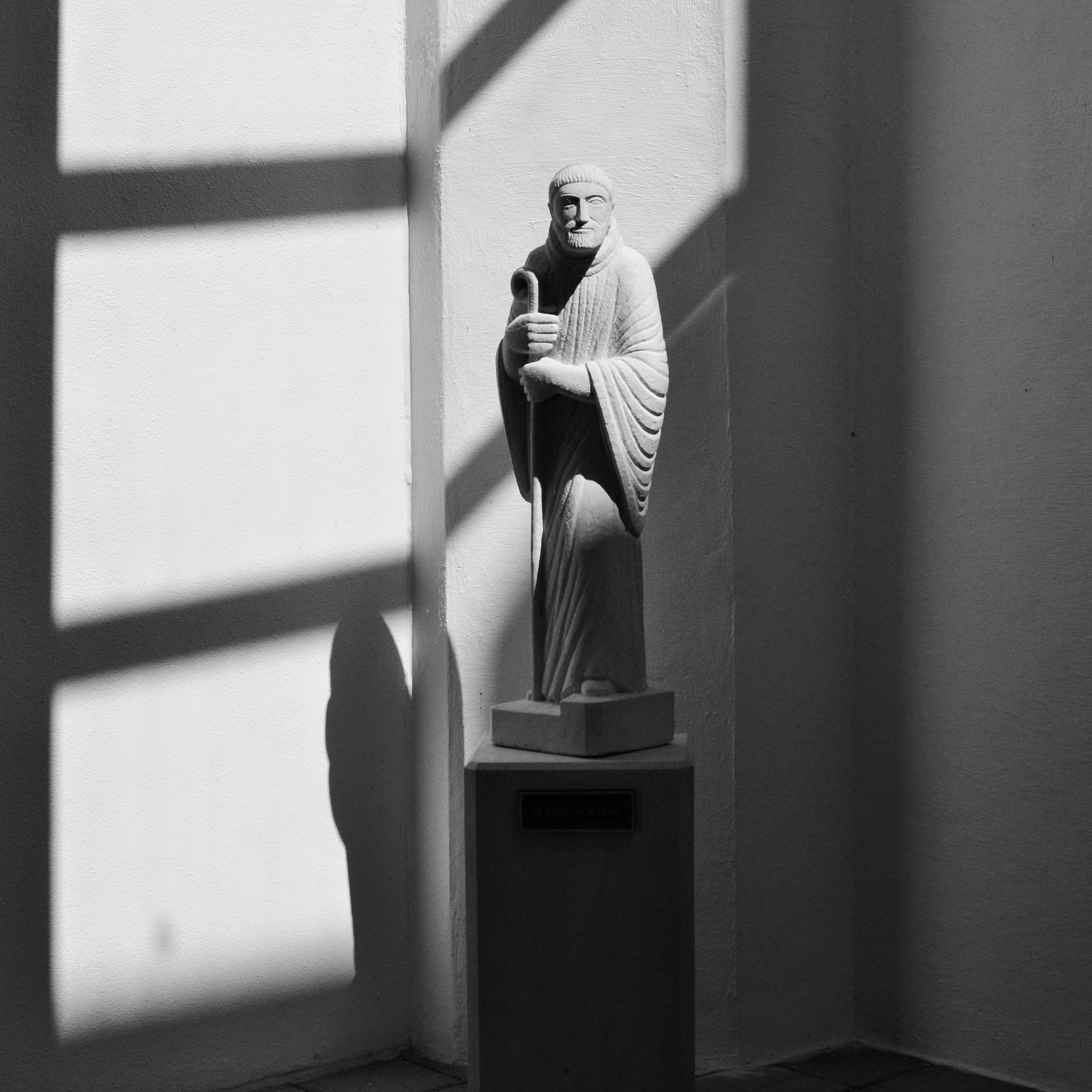
Statue greeting visitors to Gethsemani Abbey.

Statue greeting visitors to Gethsemani Abbey.

I arrived at Gethsemani in the first mega bus of three. The spire of the Abbey church rose suddenly behind a slight grassy hill. Several monks greeted us and led eager groups of about 20 through the cloister, Thomas Merton’s humble grave, and then up the short road to the hermitage where Merton started living full time in August of 1965. The pilgrim crowd, reverently snapping photos in silence, we converged in waves on the cinder block hermitage. It felt something like a flash mob-monastery—all of us interested to some degree in Merton’s spiritual writings, some of us scholars on Merton’s theology, but none willing to take the lead into the actual life of a monk or nun. We were a momentary cloister, a temporary community. Meanwhile the monastery’s average age climbs, and the monks announced this week that they would discontinue producing the cheese they have produced for many decades. Gethsemani Abbey remains a sacred site to many of us, but it is changing, and its long term future is uncertain.

I stood with the others outside the hermitage, drinking coke, listening to a monk tell us stories about Merton’s life here as fire ants, sent forth from their clay monasteries, silently tried to rip my toenails off my sandal-shod feet. We nodded, asked questions, paced through the small rooms, and then wandered outside toward the edges of the clearing to imagine what solitude would be like here. As we made our way back, another group eagerly approached.

At the end of our tour there was still about an hour before the monks were going to chant the mid-day hour, so I decided to head back out to the hermitage to see if I could steal a few moments alone. I passed chatting stragglers, and when I arrived, I went inside, snapped a few photos of the empty rooms, prayed in the small chapel, turned off the lights, picked up a few discarded refreshment cups from the floor, and then sat myself down on the now silent cement porch which had only a few minutes earlier been bustling with pacing pilgrims. A fat lizard scurried across the front of the cool cement porch into a small strip of sun near the edge. She stopped to eye me up and down, putting in a few push-ups before scurrying on. The breeze was cool and it lifted the green leaves of the tulip poplar, maple and oak trees that now surround the monastery. (At the time it was built, judging from some early photos, the area around the hermitage was much more open.)

Monks chanting the noon hour.

Monks chanting the noon hour.

I didn’t have any profound flashes of insight, or visions of Merton banging out drafts of his immortal prose, but I felt a glimmer of the wholeness of solitude, if only for a few precious minutes. I could hear my breath and the wind rising and falling together. I felt peace. I felt God. Then, a hunched figure appear on the meandering path up to the hermitage. My brief solitude at Merton’s hermitage was ended. As he approached I could see large cuffs in his pants, and a few patches. I could somehow tell he was a monk from Gethsemani, no doubt on his way to stay at the hermitage for a few days, as it is still in regular use. I greeted him, and in with a slightly annoyed but honest tone he said, “You must be a straggler?” I said, “Yes, I will get out of your hair” (he didn’t have very much of it). He introduced himself, and told me he had timed his annual week-long stay with the full moon, so as to be able to attend lauds and mass in the mornings without the use of a flash light. I wished him luck, hopped over a few anthills and was on my way down the road back to the cloister, the road that Merton and many other monks and retreatants have taken over the years. The bell rang, and I made it to the monastery chapel in time to hear the soft chant of the monks of Gethsemani. Later I gave a presentation at the Conference on Merton the hermit and the idea of wilderness. It was a beautiful day.

IMG_3027[1]

Merton’s hermitage from the path.

This year I have been lucky enough to visit a couple of sites with sacred significance to me: Dorothy Day’s Catholic Worker house in Manhattan and Aldo Leopold’s shack in Baraboo, Wisconsin. In past years I have also visited the site of the saw mill where John Muir worked in Yosemite Valley, the Sacred Grove where Mormon founder Joseph Smith had his visions, and Walden Pond. Each of these sites brings into full color the significance of place in our encounters with the Divine, with life. Each of us famous or not, inhabits a place. Our bodies know that place better than our minds. So, to inhabit the places where my mentors worked and wrote is like meeting them in person, or more awkwardly, meeting them in place. I think this desire is universal in humanity, based on the number of sacred sites, shrines, national historic sites, etc. that exist throughout the world. But just because we hold a particular cinder block hermitage in New Haven, Kentucky to be sacred, should not meant that everything outside that space is unsacred. As Wendell Berry has written, there are not sacred places and unsacred places in the world, there are only sacred places and desecrated places. May we continue to visit and protect the places that inspire us, and inspire the places we are at home in.

Learning to Hear the Music: Toward a Mormon Mystical Tradition

Raised as a devout Mormon, my religious life began taking new direction in about 2011, when I started teaching a World Religions class at Salt Lake Community College. The seeds of that new direction came while attending the Easter Vigil in Salt Lake’s beautiful Cathedral of the Madeleine, one of the few Cathedrals under the patronage of Mary Magdalen, the first person to see the resurrected Jesus. As I entered the dark Cathedral with hundreds of other candle lit faces, I realized that we were at a funeral; that we were not just talking about Christ’s death, we were mourning it in preparation to celebrate his resurrection; a gift freely given. Something clicked, I felt sincere sorrow and then joy. I began to finally understand that word so many other Christians were using: Grace. Since then, I have taken slow and cautious steps toward the Catholic faith, and during this year’s Easter Vigil, I was baptized, confirmed and received first communion.

Liturgy, participating in cycle of Christ life and death, helped me to realize that God’s love was always already there. And it was through this Grace, this freely given gift of the world, I was loved, unconditionally. But not loved as an object of a distant Father’s affection, actually loved into being. Creation is and continues to be an act of grace.

I am not completely checked out of Mormonism. Most of my family still practices, and I am plugged in to the Bloggernacle. So during my Easter retreat this year, I decided to tune into to a bit of General Conference. During Wilford W. Anderson recent General Conference address, he began with a story about a Native American man who asked a doctor if he could dance (dancing being a way of healing for this man). The Doctor said no, and asked if the man could teach him. The Native American said that he could teach him to dance, but that the doctor must first learn to hear the music. Applying this to contemporary Mormonism Anderson stated:

“Sometimes in our homes, we successfully teach the dance steps but are not as successful in helping our family members to hear the music. We learn the dance steps with our minds, but we hear the music with our hearts. The dance steps of the gospel are the things we do; the music of the gospel is the joyful spiritual feeling that comes from the Holy Ghost. It brings a change of heart and is the source of all righteous desires.”

This peeked my attention. My major problem with Mormon spiritual practice was that in my experience, morality and church participation were means of earning God’s love, of earning the presence of the Holy Spirit, who, I was taught, would flee at the slightest offence. In this mode of spirituality, guilt became the primary motivator for avoiding certain behaviors, believing certain doctrines, and even attending church. Christ’s atonement made my sins forgivable, but somehow, caught up in right action, I missed the whole point of Christ in the first place. Thus, learning to hear the music before we learn to dance seemed like a perfect metaphor for understanding Christ’s love: Hearing the music is primary, and learning the dance steps comes with practice, over a lifetime. Mystical encounter, the act of being present to God loving us into being, is at the core of Christian spirituality, and from which flow our desires to do good. But then Elder Anderson continued:

“The challenge for all of us who seek to teach the gospel is to expand the curriculum beyond just the dance steps. Our children’s happiness depends on their ability to hear and love the beautiful music of the gospel. How do we do it? First…”

Elder Anderson then attempts to teach us the steps to hearing the music. In order to hear the music you must learn the steps!? At this my heart sunk and I turned off Conference and began to pace my room. I began to wonder why a religion founded on a profound mystical encounter with the Father and the Son in a grove of trees, could have become so anti-mystical. I looked in the LDS Topical Guide to see what it had to say: “Mysticism: See False Doctrine Sorcery Superstitions Traditions of Men.”

The guide refuses even an attempt at defining the tradition which gave rise to its own religion! So I went to the always reliable (sometimes controversial) Richard Rohr, a Franciscan Friar: “All I mean by mysticism is experience-based religion whereby you come to really know something for yourself. It’s not just believing something; it’s knowing something.” It seemed so curious to me that Mormonism embraces this definition of mysticism as the means to understanding doctrine reject it as a spiritual practice for knowing God’s love. Somehow, instead of seeking personal experience of the truth and reality of God’s unearned, ever-present love, Mormonism uses ‘mystical’ encounter as a tool to confirm propositions of faith, identity and personal morality. Again, there is nothing wrong with morality, identity, or beliefs. But when we start with them as a means of getting to God, we will ALWAYS come up short. The person of Jesus came to reveal to us that this is backwards. We start with God’s love, and then live into beliefs, identity, and morals. As a Mormon I was living this process completely backwards, and as a fledgling Catholic, I still struggle with it.

Then, an article, like a cyber-revelation, came across my Facebook feed. It was Adam Miller’s General Theory of Grace. Miller agrees that Mormons have a “tendency to read the gospel as a kind of secular manual for can-do humanism and self-improvement.” For Miller “righteous works only become righteous when they are motivated by the pure love of Christ, when they are the product of God’s grace as that grace works its way out into the world through our hearts, minds, and hands.” And here’s the clincher: “Grace is this massive, ongoing act of divinely organized creation that involves an uncountable host of agents (human and nonhuman) embedded in irreducible webs of stewardship, consecration, sacrifice, and interdependence.” [i] Beautiful words, felt deeply. Mysticism, in this light, is learning to be quiet and experience the grace of God creating us from moment to moment in what has been called by Jean-Pierre De Caussade the sacrament of the present moment. I encourage my dear Mormon friends and family to pick up Adam Miller’s books. His prophetic writing could help us put the horse back in front of the cart so to speak and as Elder Anderson hopes, to hear the beautiful music of the gospel, to which our lives become a dance.

[i] http://bycommonconsent.com/2015/04/07/a-general-theory-of-grace-ldsconf/

Eulogy for my Grandmother Nancy Lee Holmsen

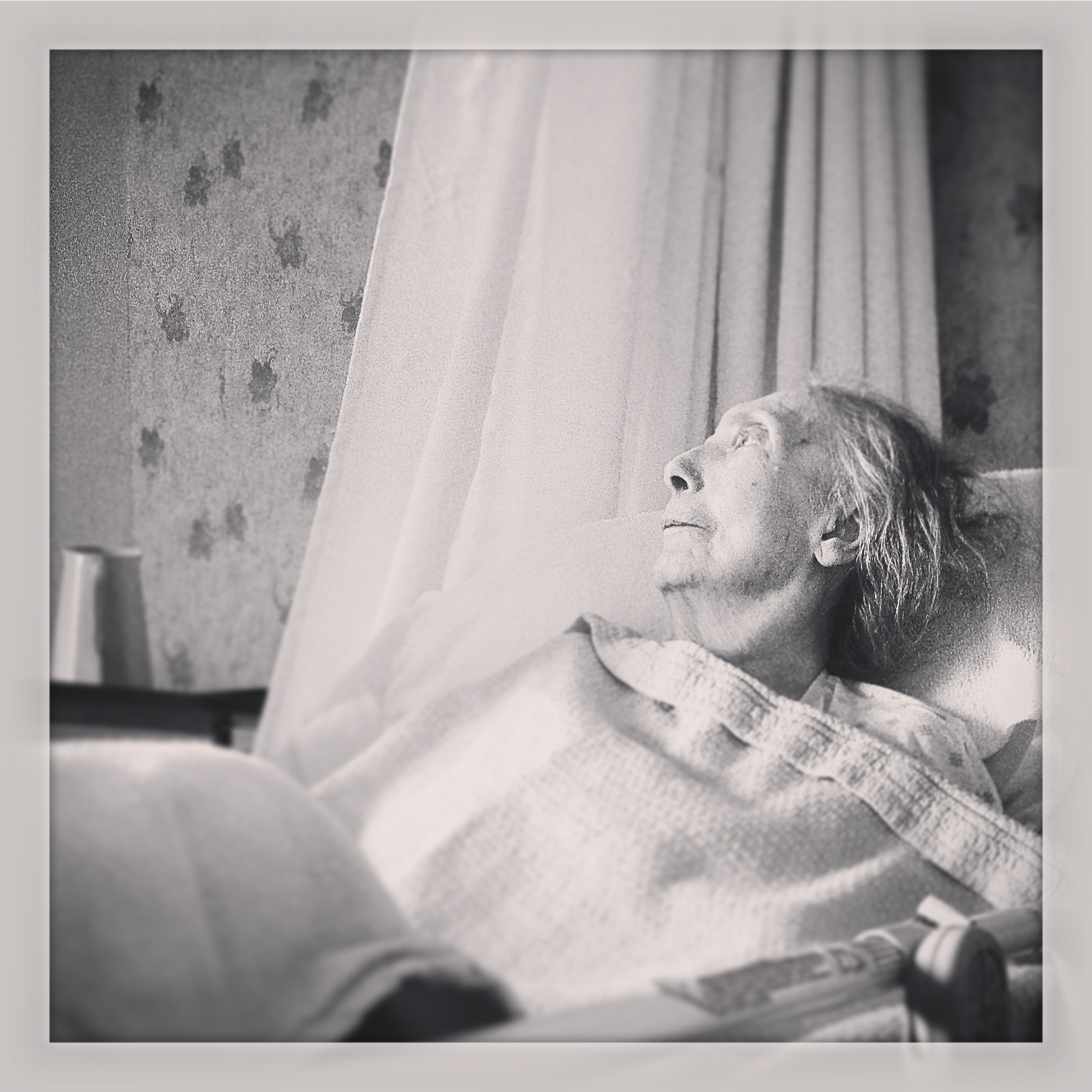
Nancy a few weeks before her death on Jan. 7, 2015.

Nancy a few weeks before her death on Jan. 7, 2015.

When I came to know Grandma Nancy, she had already been deeply wounded by life. My earliest memories of her are filled with explanations for why she could not walk as fast, see as well, or drive. Why part of her forehead was missing. Nancy had faced death several times in her life: Polio, cancer, a brutal car accident, meningitis; and she wanted none of it. She wanted to live!

In a Christian view of the afterlife, we might try to imagine Nancy as a perfect young woman dressed in white. But this would not be the Nancy that I knew. For me perfection is the wholeness brought about by our wounds. More than anyone I know, Nancy bore her woundedness with love, grace and humor. Her love and laughter have been present throughout my life and I will miss her.

Grandma Nancy was a towering figure of my childhood. Grandma’s house was always a place I loved to go. Sometimes, I would stay overnight at grandma’s small apartment and she would cook lamb chops (and after reading some of her journals, it appears that my siblings got a lot more dessert than I did). She would tell me stories about the Salt Lake of the 1940s and 50s. We have a few of her journals, from 1947, 1951, 1953 and 1954. Reading through them was a treat. She was a precocious young woman, taking note of the weather each day and starting each entry with: “Dear Diary.” She had an early crush on a boy named Dick and many, many friends. She called cigarettes “doogies”, saw movies, ate a lot of French fries, did chores, and played canasta. A few excerpts:

  • January 4, 1951: Had oodles of cars following us all night! Ma smelled smoke on me!
  • January 4, 1953: Don and I went to show. Saw ‘Lure of the Wilderness’ at Richey. Baby really was kicking in show. Don’s ma called earlier and we were scared she’d come and catch Don still here.
  • Friday July 30, 1954: Started throwing up terrible. All morning. Guess I’m pregnant again.
  • Tuesday September 28 1954: Went to the hospital with Polio.

She rarely writes about religion or church (except when she writes about not going), but writes passionately about lovers, friends, family and her home on 2nd North. She was a kind friend, a good sister, and a young mother.

Other times spent with Nancy we would just watch TV, or she would teach me how to haggle with Tijuana merchants if the chance ever arrived, (not sure why, but this is a very vivid memory of her). All of us grandkids remember her long natural finger nails which she would turn into eggs that needed cracking on our ticklish scalps. She never missed a birthday or Christmas and her gifts were generous despite her humble income. She loved to celebrate with us and her later journals are a litany of grandchildren milestones, birthdays and time spent with family. She was there for every major milestone in my life, like many of you.

To hear her stories was one thing, but to tell her our own was quite another. Whenever I told her a story, or showed her something I had made, or gave her an update from college, she lent almost comical attention to every detail. “Grandma look what I made!” YOU MADE THIS! NO!?

I love her and she will be sorely missed. However, I want to admit that I could have spent more time with her, cared about her suffering more, listened to her stories again. Nancy’s death has recommitted me to valuing our elders. With their death comes the reminder that we too will one day die. This is scary and sad, but let us also remember that death is part of the precious gift of life. Like leaves on a tree, our bodies flourish for a time and then return to the soil. This is one of our oldest metaphors; earth-lings, shaped from dust, we must all return to our Mother the Earth. We return to the soil, but the Tree of Life lives on. The air we breathe was breathed by Nancy, and now returning to the earth from which she came, the air we breathe is Nancy. It is hard to fully grasp. We want our loved ones to stay forever, we want to live forever ourselves. Why should the living pass back into the non-living?

These are questions humans have asked for thousands of years. And many of our spiritual traditions provide confident answers about what comes next. I am not here promote or to discourage any one of these beautiful beliefs that give us hope of seeing each other again. But I want to say that for me, a mature spirituality is less concerned with explanations for death and suffering, than with how we respond in the face of death and suffering. What will we do with the losses and the wounds that life metes out without respect of race, class or creed? This is for us to work through together, as family and as friends.

For me, though she was not religious, Nancy embodied fully a religious response to suffering and death; one that I hope to emulate to some small degree. She responded with awe, grace, love, hope, joy, humor and peace to life and in death she teaches us to do the same. Despite our wounds, let us follow the example of Nancy’s holy wonder for life, as we do the work of a thousand generations before us of burying our cherished dead. Thank you.

I would now invite us to celebrate Nancy with our stories and memories…

Convergence Reflections

A year ago, I decided I wanted to put on a conference. I had just started my PhD program at UBC and finished a course on the history of environmental thought. It became clear that there was so much to learn about our religious and spiritual relationship to the world. Being new in the Pacific Northwest I wanted to bring people together, to see what was out there, what was being done, and how we might form a stronger community of ‘spiritual ecologists’ in the region. I wanted to discuss religion, spirituality, ecology and cosmology in the same space, and I wanted to gather strength for the fight for our future that our generation is in the midst of. What started as an idea became a reality from September 22-24 and the 29th. With fifteen artists and at least twenty four presenters, speakers or narrators this truly was a Convergence of talent, ideas, passion and beauty. I chose the title Spiritual Ecologies and New Cosmologies, because I wanted to span the diverse terrain of scholarship, activism and advocacy for a new way of seeing ourselves in relationship to the earth and the Universe herself. I chose the plural because I knew there would not be just one vision of a sacred earth or a sacred cosmos, but many. I chose Convergence, because I wanted it to be about more than just presenting papers. As the core organizer I made plenty of mistakes: perhaps too many speakers, too few breaks, too much time in our heads. But overall we had an amazing spectrum of lectures, presentations, storytelling, performance, walking meditation, art and most importantly discussion and sharing. While the Convergence is over, the art will be exhibited at the Liu Institute until November 6, so if you missed the Convergence stop by!

Day 1: Beginnings

Storytellers

Storytellers

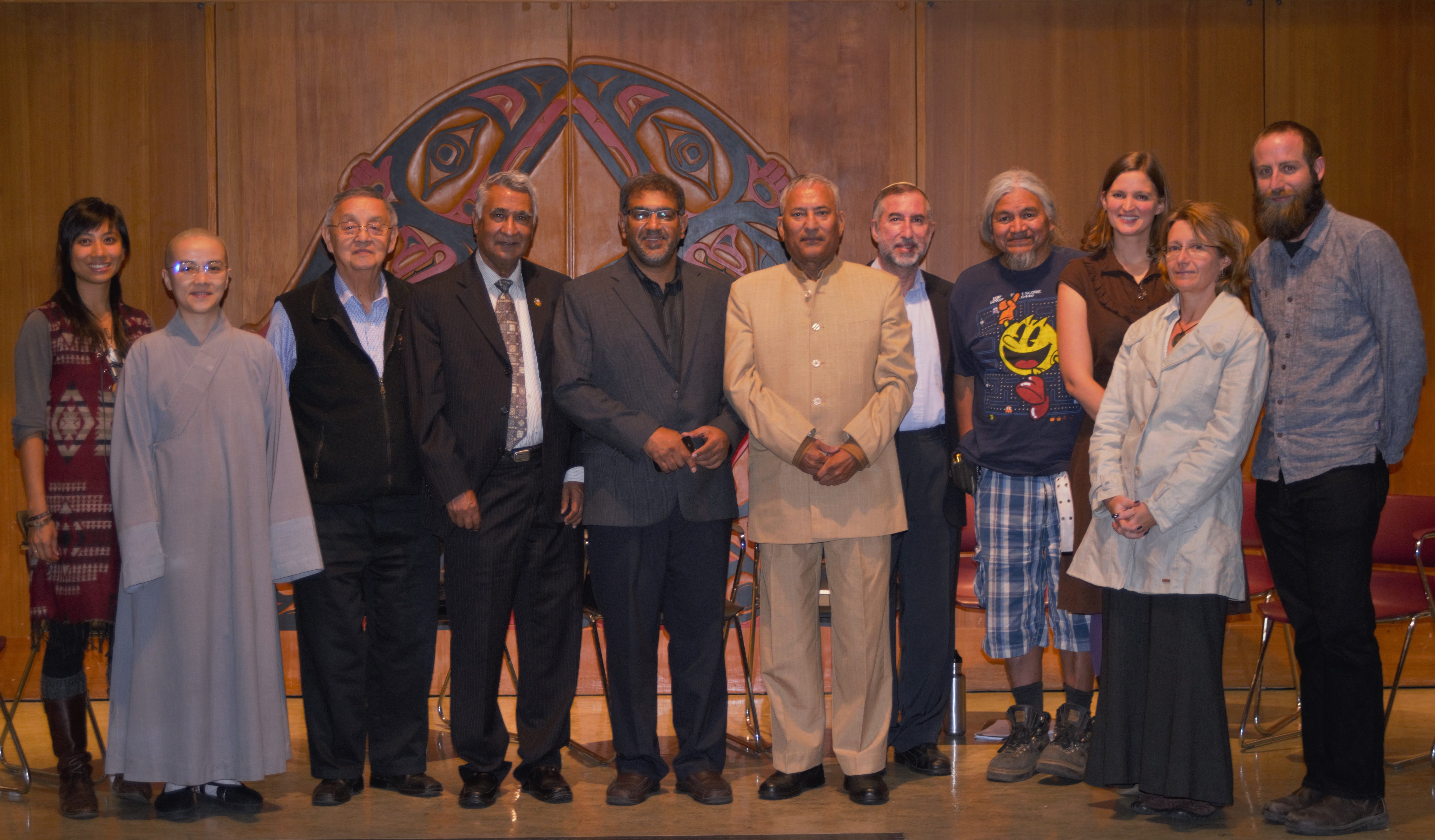
The picture of Monday’s speakers brings me great joy. For all the strife and religious violence in the world it was amazing to have people speaking from 10 different traditions, and sharing those perspectives with an audience of 80 other perspectives. We had some technical difficulties and the speakers went a little long, but to be in the First Nations Long House among the amazing totems and pillars was a wonderful place to tell stories of origin and beginnings. We were welcomed to the Musqueam territory by Elder Larry Grant, who told us about the origin of the name Musqueam, and the problematic nature of colonial English words like ‘creation’ and ‘Creator’ and the Musqueam concept of all things possessing a life force. As we learned, not all of our spiritual traditions tell stories of beginnings –our Buddhist and Hindu storytellers spoke of unimaginably long cosmic cycles within which human beings strive for liberation from suffering. While the Judeo-Christian creation stories (Gen. 1 and 2) offer poetic details about the emergence of the universe and a cast of characters, our Sikh storyteller declared that only God knows how the universe was brought into being. For us it will always be a mystery. In Islam, everything in creation points back to Allah, from beginning to end, and our Mormon storyteller spoke of our eternal co-existence with God and the universe. If we had had more time, I would have asked 10 more scientists to speak from their traditions. But our cosmology story teller, Ben Pfeiffer a Langara College science professor, did an amazing job, by telling of the Big Bang and the origin of the earth in a story that included a mythical spider who challenged the dominant telling of the scientific story of the universe by mostly white men. After the welcome dinner, we heard from those in the audience who brought up many interesting points and spoke from experience. They all had stories to tell, and I wish we would have had time to hear them all.

Day 2: Cosmologies

DSC_7468

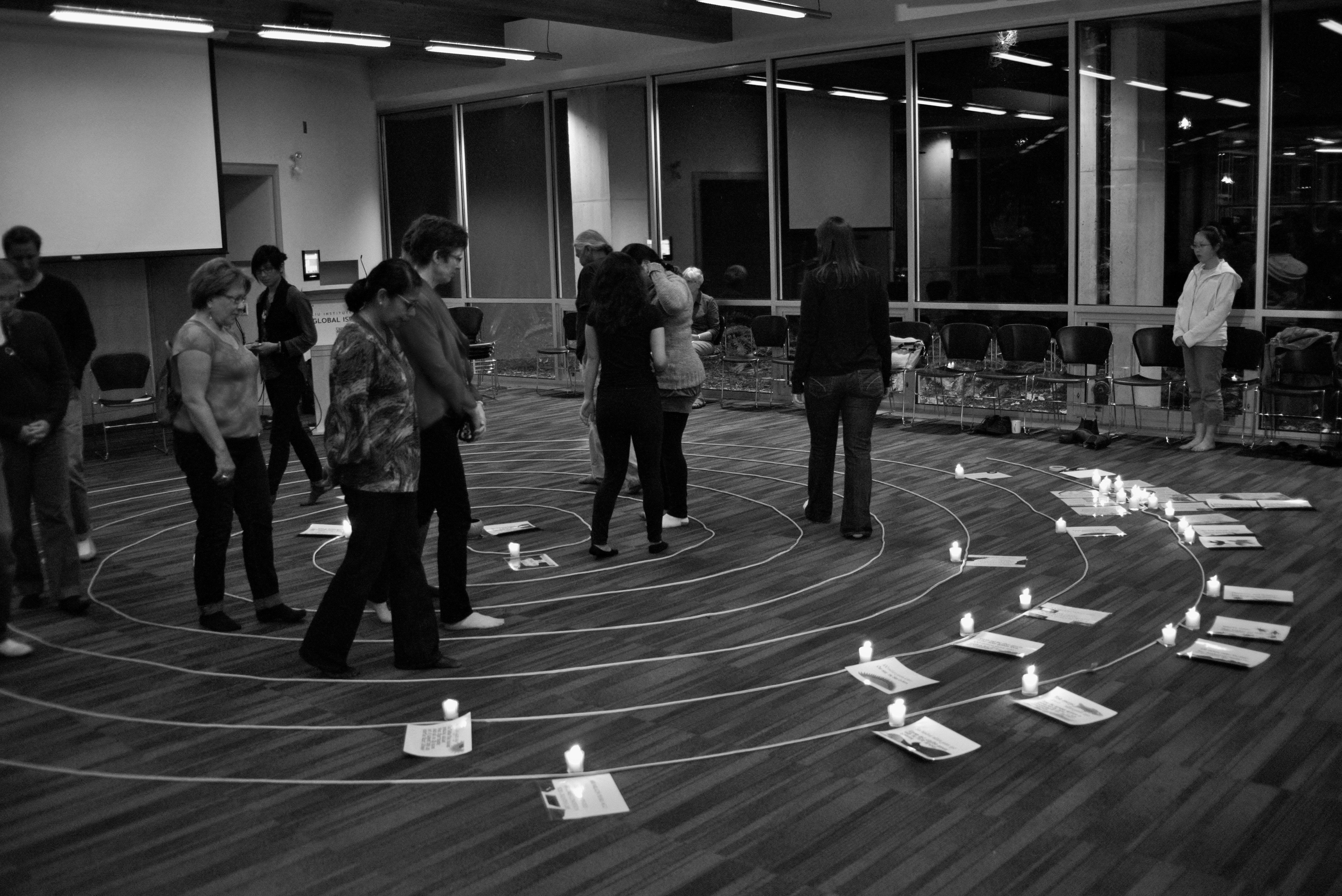
Cosmic Meditation Walk

On our second day, via skype, we heard from the producers of ‘Journey of the Universe’, a film about reconnecting the human purpose to cosmic evolution. During the response to the film by Bruce Sanguine, a local self-professed evolutionary Christian, a young woman entered the room and began speaking loudly, asking if she could speak, asking what we thought we were doing. I tried to ignore her and move on with the evening, but she persisted despite efforts by some of the participants to calm her down and invite her outside. At one point she insulted our speaker by saying what he was saying made no sense. As Bruce continued, I lost my temper and stormed up to her demanding that she leave the premises. She refused and my anger only escalated her outbursts. The room was tense and we tried to move forward, while someone called UBC security. While I stormed around, one of the participants quietly gained her trust, and took her outside, calming the woman down, and teaching her how to reconnect to herself through the ground and the trees that surround the Liu Institute. The woman admitted that perhaps she should not have made such a scene and apologized. The evening proceeded with some very insightful reflections, but as I reflected, my boldness melted into shame. Yes, I had worked so hard to build something, and she had tried to ruin it…How dare she insult my speaker! But I realized what a perfect metaphor it all was. All of our preconceived notions of comfort, order, harmony, normality, and mental health can be shattered in an instant. How could I change my relationship to the earth if I could not even love one person suffering from a momentary lapse in mental health? If that woman, who refused to tell us her name, is reading this, I want to say I am sorry. Please forgive my lack of compassion for you. I will do better.

After our discussion we turned to the Sisters at Earth Literacies Program for a walking meditation that spanned the entire history of the universe as told by contemporary Cosmology, each milestone marked with a candle. I was impressed by the amount of silence between the beginning of the universe and the emergence of galaxies, and the tiny spaces between the creation of earth and the evolution of consciousness. After the Sisters outlined the journey, we all walked the spiral from the center to the outer edge in silence. It was profound to see the milestones that led to Jason M. Brown walking in a small room of peers in British Columbia under my feet; to grasp that I was but star stuff reflecting back on the process of becoming Mind stuff.

Day 3: Ecologies

Speakers and Participant from the afternoon session

Speakers and Participant from the afternoon session

On the third day we had an amazing and full lineup of speakers. We had some great discussion as well. I felt so privileged to be around people who care so deeply about the earth and making our civilization more sustainable. We also had the perspectives of Hindus, Buddhists, Christians, Jews, Pagans, Unitarians, Survivalists, Atheists and more! I was struck by Meg Robert’s and Mike Bell’s points about the importance of spiritual practice for keeping our activism vital. I was struck by the need to ground our consciousness raising in the landscape, in a context, or as Matthew Humphrey argued, in a bioregion, or life-place. As Franciscan Priest Richard Rohr has put it in his writing “We don’t think ourselves into new ways of living, we live ourselves into new ways of thinking.” This is exactly what Suresh Fernando is attempting to do with his spiritual community at Ruby Lake on the Sunshine Coast. Yes we can seek personal spirituality, but it must be grounded in place, in tradition, in community.

With respect to system change we had a few different minds. For example, Winnie Chu is starting an air pollution monitoring company guided by Buddhist principles. Others were adamant that what is needed is to create semi-autonomous zones that can push back the system which is hopelessly corrupt, to birth a new way of living on earth. These autonomous zones would not just be political, but could demand freedom from noise pollution, light pollution, techno-addiction, and the alienation from life itself. In the end it seems that authentic Transition will require an all hands on deck strategy: system change from within and pressure from without.

Spiritual practice is what will keep us grounded and keep us from burning out. We must be connected to the wild and to each other. And yet, it is essential that in seeking the wild, we do not romanticize it as some far off wilderness park. As Nikki Van Schyndel reminded us, our hearts are wild, and there are wild things all around us. And yes, sometimes it is scary, but fear can be the birth pang of joy. Yes, we must push back industrial civilization to some measure of sustainable limits, and yes we must protect and restore intact ecosystems; but we must also remember to dwell in the wilderness of the present moment, with what and who are all around us while we work toward these goals.

We were blessed to have several First Nation’s folks among us for our discussions, and they reminded us of the dangers of appropriating Indigenous lifeways. We must stand in solidarity with First Nations peoples and against continued racism; but we must also decolonize our own traditions and retrieve and reclaim the good and beautiful in them. As a Christian practicing Zen Buddhism, this was a particularly potent lesson for me. The Celtic and Franciscan traditions of Christianity have been neglected for the colonial, guilt ridden, and capitalist Christianity of the West.

Nikki teaching us how to make fire with a bow drill.

Nikki teaching us how to make fire with a bow drill.

Day 4: Convergence

On Monday September 29, we decided to continue the community that was forged during these few days. The Spiritual Ecologies and New Cosmologies Community, a tentative title, has been born. Starting with online networking and resource sharing we want to continue to build bridges and understanding between faiths, to offer resources to communities of faith in the Pacific Northwest that want to do more to connect their faith with the earth. The community wants to plan more events, a 2015 Convergence perhaps, but definitely smaller workshops on Sacred Activism. Ari Lazer, one of artists is also hosting a workshop on Sacred Geometry, so check that out. If you did not get the email I sent out and would like to stay connected please let me know.


Thank you to all who attended this convergence! To my co-coordinator Elaine Hsiao, to Andrea Reynolds at the Liu Inistitue, to Blake Smith and Miriam Matejova from the Liu Lobby Gallery and to Maya Graves-Bacchus for her help and to many others for your love and support.

Please share your responses and reflections with me at

Jason [dot] minton [dot] brown [at] gmail [dot] com