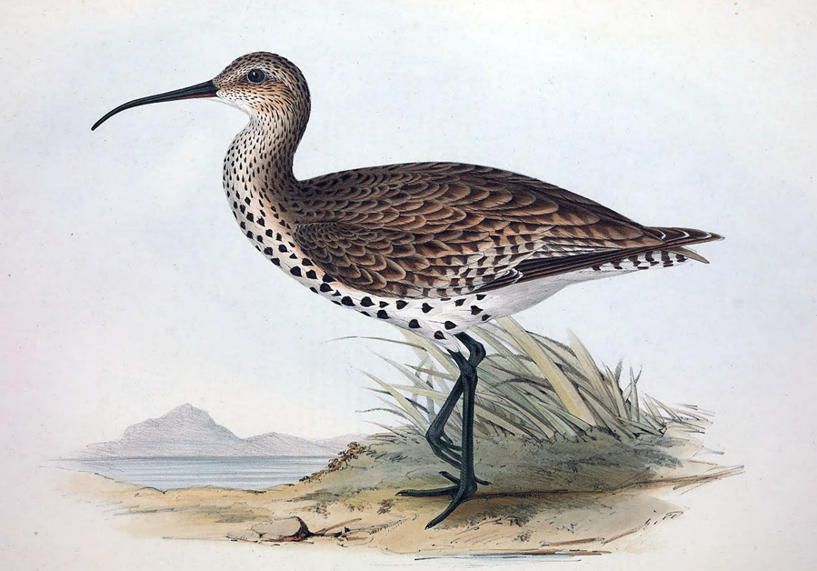
Slender Billed Curlew (Numenius tenuirostris)
In November of 2024 scientists declared that they were now confident another species had gone extinct. The Slender Billed Curlew (Numenius tenuirostris) is in the sand piper family and was last photographed in Morocco in 1995. Dr. Alex Bond, Senior Curator at the Natural History Museum in the UK reviewed all the available recent sightings and data and made this grim conclusion.
Europeans have caused extinctions in the past. The Dodo, the Great Auk or the Canary Island Oystercatcher. But these birds were endemic to islands. The Slender Billed Curlew was a shore bird that inhabited mainland habitat from Europe to North Africa. It was known to have bred in Siberia, but migration wintering grounds were observed in the Mediterranean and the Middle East.
It is a notable extinction because it is the first continental bird species to be declared extinct in recent history. The decline was long, but scientists are confident that the species is now globally extinct. What do we make of an extinction? How do we mourn a body of bodies that no longer flies, an avian language that is now silent?
We know that animals grieve for their dead kin in their own ways. Tahlequah, the Salish Sea resident orca mother carried her dead baby for 17 days. Primates, dogs, even crows show distinct behaviors around their dead. Elephants have been observed fondling the bones of their dead matriarchs tenderly, standing in quiet circles over the remembered dead.
On September 1, 1914, Martha the last Passenger Pigeon (Ectopistes migratorius) died in the Cincinnati Zoo. Once numbering in the billions, passenger pigeons formed sun-darkening flocks over much of eastern North America. They were hunted into oblivion by people with guns. Martha may not have understood that she was the last of her species, but I am sure there was a dove-shaped loneliness to her final days.
Death is part of life, not an exception. Extinction is part of evolution and not a failure of it. All that is true in this world is also all that is change, flux and transformation. From death comes new life. From extinction comes openings in the ongoing ecologies of our home. Just as death must be grieved, even in the hope of new life, so too must extinction be grieved. But the difference is that extinction in these times is one of many outward symptoms of a global illness that is threatening us with planetary death. And this death would not hold the promise of new life for a very long time. It is this death, not death in general, that we must resist; the death of a vibrant and living earth who should not yet die. And just as in ancient alchemy and Chinese variolation the cure was to be found in the illness itself, resistance is our only medicine, our lives lived well the best anti-bodies.
Nov. 30th has begun to be honored as a Remembrance Day for Lost Species. To face our grief and to acknowledge this planetary illness is to commit ourselves to healing, to building strength to fight. The documented events suggest that in the past there have been gatherings that encourage art making, speaker series, poetry readings. They encourage lighting candles, holding vigils and procession. I did not know the Slender Billed Curlew; can I still grieve authentically for her absence from the world? How might you sit with the strangeness of extinction in these heartbreaking times? Perhaps we could sit together. I am open to ideas.
Resources
Buchanan, G.M., Chapple, B., Berryman, A.J., Crockford, N., Jansen, J.J.F.J. and Bond, A.L. (2024), Global extinction of Slender-billed Curlew (Numenius tenuirostris). Ibis. https://doi-org.proxy.lib.sfu.ca/10.1111/ibi.13368
 holyscapes