Imminence

img_6306

I remember the first time I realized that God not only created the world, but was immanent to it as well.

It was like staring at one of those paintings where an image of a tree or something is hiding, and it suddenly coming into view.

I was searching for God my whole life, but had been staring her in the face all along.

img_6302

What it Means to be a Spiritual Ecologist

My current residence, Vancouver, BC is only the latest layer in a deep cultural geology that emerged after the glaciers melted from what is now being called the Salish Sea—the watersheds that drain into the Puget Sound, Strait of Juan de Fuca and the Georgia Strait. Coast Salish peoples number over 60,000 souls today making up over 50 tribes, bands and kin groups. By many of their own accounts, they have dwelt in this place from the beginning of time. I cannot speak for them, but I know that for many, place is not an inert geometric space that has over the years produced fond feelings of attachment; it is not an object outside themselves that they have learned to appreciate through meaning-making. Place is the ground of their being; it is an oikos—a dwelling-place, a habitation. The sea, mountains, forests, salmon, deer, plants, air and sky are woven into their being. The stories, myths, rituals, ceremonies and dangers spoken of by First Peoples are not metaphors projected onto otherwise meaningless physical terrain, they are the grammar of dwelling, they do not make up a worldview, they make up the world (See Eduardo Kohn (2013) How Forests Think).

For my people, the new-comers, the settlers, the children of colonials seeking a better life under the watchful eye of God and Progress, the Salish Sea too nourished our bodies, but also our love of money. Only later did we get around to nourishing our souls. Having laid our hands to ax and plow, we were proud of our work and our sweat. We dedicated it to God and built places of worship in His name. We brought ‘savage’ peoples a saving ‘religion’.

We too were immersed in not only a worldview, but a world; one that we believed would bring peace to earth and eternal life to souls. Only within the last few years have we begun to wake up to the savagery of our world; to the violence of what we thought was love, to the folly of what we thought was progress. We the learned, have much to learn, some achievements to celebrate, much to undo, and much to apologize for.

One way we sought to right our wrongs was by offering up large swaths of the land to healing, contemplation, beauty and solitude. Today, the Salish Sea has become our Spiritual Ecology too. In the 1800s we fell in love with Nature and sought to protect it from our advancing cult of Progress. But our Spiritual Ecology had a flaw, a difference to that of the First Peoples: it was dualistic. By dualistic I mean that the West dwells in a world of distinct domains: culture and nature, subject and object, traditional and modern, spirit and matter. This orientation to the world separates our dwelling places from our soul places: work and worship, city and country. Nature became a place that we went to after a long day; a refuge from civilization, a recreation. Non-humans became objects for our perception and manipulation (whether that be for food, money or beauty). Being ejected from the Garden, we tried to bring the Garden back to us through protected areas, National Parks and National Forests. Ecology meant Nature, and Spirit meant the non-material aspect of our all too materialistic world. This ontology is killing the world. It is killing our religions. It is killing our souls. Things are changing, slowly. Can you feel it?

For many of the rising generation, spirit is not so much a shimmery version of ourselves that lives inside us like the driver of a car. Spirit is anima, breath. Spirit is Life. Being spiritual is nothing more or less than being fully alive; being present to life and it’s flourishing. The religions most of us grew up with felt like rules and beliefs, and in-group out-group posturing. But within all religions there is always a spirituality of life.  Religion, religare—to bind together—can be about our connection to God and each other, but also about our connection to Life. Religion practiced in this guise is a response to life. It is not an answer to the question ‘what is the meaning of life?’, for as Philosopher John Caputo would say, life is the meaning of life. Or as poet Rainer Marie Rilke famously wrote, religious peoples everywhere might benefit from “living the questions” more than seeking for answers to them.

Ecology is not nature as a separate domain of reality. Ecology is the scientific study of organisms in their environment; but it is so much more than this, for there is no such thing as an environment. There is only a great web be-ing, an intricate web of life, life-ing. All life, even the life that is not yet life in the air, rocks food and water; even the life no longer living. Being present to life is being present to both the beauty and the pain of life. Yes there is tremendous suffering in the web of life and death, but even in the predator, disease and parasite there is life and the continuation of life, the evolution of life, the creativity of life.

A Spiritual Ecology then is a deep reverence for life a celebration of life in all aspects, and a participation in life’s beauty and pain. A Spiritual Ecologist mindfully witnesses to this beauty and pain and acts accordingly. Spiritual Ecology as I see it is one part perception, one part practice and one part ethic.

Perception: For a long time in the West, Spiritual Ecology was about appreciating the beauty of Nature, or protecting Nature from culture. In light of Climate Change, we are realizing there is no such thing as Nature. This is not to say that the world is an illusion, or even that it is an ephemeral social construction. Rather if we are looking for hard facts about the world, a place, a thing called Nature outside and apart from culture we will not find it. Nature is a disembodied spirit, a ghost that has haunted us for 200 years. But our perception is changing, through both the wisdom of religion and the propositions of science we are waking up to a different world. Theologian John Caputo gives us a glance of that world:

“The cosmos opened up by Copernicus collapse the distinction between ‘heaven’ and ‘earth’…The earth is itself a heavenly body, one more heavenly body made up of stardust, as are our own bodies. We are already heavenly bodies, which means that ‘heaven’ and ‘hell’ must report back at once to headquarters for reassignment, where they turn out to be ways of describing our terrestrial lives here ‘below’. Every body—everybody, everything—is a heavenly body. Heaven is overtaken by the heavens. Dust to dust, indeed, but it is all stellar dust. Our bodily flesh is woven of the flesh of the earth, even as the earth itself is the debris of stars, the outcome of innumerable cyclings and recyclings of stellar stuff, all so many rolls of the cosmic dice. We are not ‘subjects’ over and against ‘objects’, but bits and pieces of the universe itself, ways the world is wound up into little intensities producing special effects of a particular sort in our bodies in our little corner of the universe” (Caputo, 2011, The Insistence of God, 175).

Caputo expresses a deep call calling from beyond our Western world. Science and Religion, who have been temporarily separated due to irreconcilable differences, are starting to warm up to one another again. We need them both, but not as complementary institutions concerned with facts on one hand and values on the other; not as two coins that add up to 1.00, but two eyes in the same face, two lungs in the same chest.

It is very likely that there is no objective knowledge outside of human experience, but neither is human experience the unreliable black box of mere subjectivity. Our bodies, minds, souls and science emerged from this planet (even if we assert a Divine source). As Caputo again states, “our power of vision, as well as the particular structure of the color spectrum available to sight, is a direct and precise effect of the astronomical composition of our sun, which has set the parameters of vision which we and other animal forms have evolved. To ask whether what we see, as if it were inside our head, ‘corresponds’ to what is out there, ‘outside our head’, is to ask a question not only without an answer but without meaning” (Caputo 2006, The Insistence of God, 176).

Spiritual Ecology then does not involve going to Nature to find spiritual meaning or connection. This keeps nature separate from culture and spirit. Spiritual Ecology is cherishing life, and witnessing to the beauty and pain of the world wherever we are. Yes it is about interconnection, but also the connections that hurt, that threaten us with harm; and the connections that threaten others. The virtue of Christian hospitality is not only welcoming the known, the familiar; but also the wholly (Holy) other. Being open to life is to see it, really see it, in all its complexity and to let our lifeways emerge accordingly. This can happen in the ocean, the forest, the savannah, a farm, a city, or a slum. Spiritual Ecology is our communities, our places of worship, our prisons, our hospitals, our schools, the blackberry patches on the side of the road. It is wherever we are present to the unfolding of life.

This presence is not the appreciation of an aesthetic object. Anthropologist David Abrams helps us shift our gaze in this respect: “To touch the course skin of a tree is thus, at the same time to experience one’s own tactility, to feel oneself touched by the tree. And to see the world is also, at the same time to experience oneself as visible, to feel oneself seen” (Abrams 1996, The Spell of the Sensuous, 68). This is not a relationship between knowing subject and known object, it is the relationship between two waves in an ocean.

Practice: Once we realize with theologian (geologian) Thomas Berry that “The natural world is the maternal source of our being…the larger sacred community to which we belong.” (Berry 2006, Dream of the Earth, 81), our spiritual practices will reflect that fact. I was raised in the Mormon Church (LDS). I greatly admire the Mormon faith and its people; however, my own religious path has called me to a more contemplative and earthy practice. In catholic Christianities the Eucharist, prayer, churches and the saints all enhance and give particular form to the celebration of life, but they can also obscure it just as easily if they are taken as a club for the saved.

To say that Christ is in the bread and wine of the Eucharist is to ritualize the presence of Christ in the cosmos from the moment it flared forth at the Big Bang. To shout Christ is Risen, Alleluia! at Easter is to ritualize the emergence of tiny beautiful buds from the limbs of every tree at spring (in the northern hemisphere at least). To bring the body of Christ into one’s body prepares us to see God in everything we eat, in everyone we come into contact with.

Ethic: Once we realize in body and mind that we are the world we seek to experience, our actions should not take the form of a rigid dogma, a puritanical obsession with recycling or turning off the lights. I do not mean that these are wrong, I only mean that they are not ethics, they are dogmas. Green purchasing has become another marketing scheme to Western individuals that want to consume an identity. We do it all the time. I do it all the time. An ethic is a practice that carries moral weight, it is more complicated than a rule. Anthropologist Richard Nelson, writing of his connection to an island off the coast of British Columbia, captures the spirit of how an ethic might emerge for a Spiritual Ecologist:

“There is nothing in me that is not of earth, no split instant of separateness, no particle that disunites me from the surroundings. I am no less than the earth itself. The rivers run through my veins, the winds blow in and out with my breath, the soil makes my flesh, the sun’s heat smolders inside me. A sickness or injury that befalls the earth befalls me. A fouled molecule that runs through the earth runs through me. Where the earth is cleansed and nourished, its purity infuses me. The life of the earth is my life. My eyes are the earth gazing at itself…I am the island and the island is me” (My emphasis, Nelson 1989, The Island Within, 249-250).

All of our decisions have consequences that eventually return to us. How and whether we are able to turn this culture around is an ongoing debate, but it will require more than carbon markets, stricter regulations, expanded protected areas, or planting more trees. It will require a deep shift in our perception and practice of the world from which emerges an ethic that refuses to see one more species go extinct, one more child starve, one more woman abused, one more First Nations’ sacred site destroyed, one more mine tailings pond burst, one more clear cut, or one more oil spill in the ocean. How we get there, if we ever can at this point, is part of a long and difficult conversation. Spiritual Ecology is only one aspect of that conversation, but let’s let our lives start speaking.
Making the Invisible Visible

One way to conquer a people is to erase their places. As I attempt to come to an understanding of my own connection to place, it is important to remember the invisible layers that already exist. This project is mapping Indigenous Place-names in the Vancouver area. These simple place-names marked prominent features or seasonal uses and were embedded in a Spiritual Ecology of food, kin, myth, trade, and war.

Deep Roots, Entwined Branches: Reflections on the Parliament of the World’s Religions

Laying on cured grass just outside of a closed Forest Service campground in the foothills of the Idaho panhandle, cool air condenses into dew on my sleeping bag. I shiver between sleep and wakefulness. The stars keep me company. I watch Cassiopeia slowly swing around the North Star, and around 4:00 am, Orion becomes visible. It is strange that only when we sit still do we realize just how constant is our motion. There are dozens of other constellations whose faces I do not recognize, and whose stories I do not recall. Then, in the east, an almost imperceptible glow begins to put the trees and hilled horizon into dim relief. Venus, Mercury and Jupiter line up to greet the day. Morning is approaching.

I, along with five other members of the Salish Sea Spiritual Ecology Alliance are on our way to the 2015 Parliament of the World’s Religions supported by a small grant from the Sisters of Charity Halifax and we have stopped to camp for the night after a long day of driving.

The Parliament of the World’s Religions was first convened in 1893 in Chicago to coincide with the World’s Fair. This year it is being held in Salt Lake City, Utah the Axis Mundi of my first religious tradition, Mormonism, and the place I lived and taught World Religions for two years before I moved to Vancouver. In 2014, I attended the Society of American Foresters annual conference in the very same venue, and when I heard that the Parliament was coming in 2015, I felt a pang of synchronicity. I studied both forestry and theology in graduate school, and though it was a small coincidence, it felt like Life reassuring me that I was on the right path.

Arriving in Salt Lake City, we found the Salt Palace Convention Center packed with about 10,000 people, representing at least 50 faiths, from 80 countries. The first Parliament excluded Native peoples, Mormons and Atheists, but this year just about every possible belief and practice was present. We began by going through a ‘smudge’ purification ritual officiated by a kindly Paiute elder, and then making an offering of tobacco to the sacred fire. It was good to start the Parliament by acknowledging the Spiritual Ecology of the First Peoples of this land.

The Parliament was a veritable smorgasbord of spiritual and religious diversity: mandalas, labyrinths, spontaneous dance parties, flash mobs, meditation gurus, chanting, even a procession of people dressed like angels. Exhibitors hawked every kind of spiritual ware from prayer beads and Native American jewelry, to sacred texts and icons. It was a cacophonous mosaic of the world’s spiritu-diversity. Overwhelming at first, I settled into the rhythm of the Parliament, and to try and drink from its convention-shaped wisdom.

The mission of the Parliament is “to cultivate harmony among the world’s religious and spiritual communities and foster their engagement with the world and its guiding institutions in order to achieve a just, peaceful and sustainable world.” This mission was on full display throughout the Parliament, as most sessions focused on issues of poverty, cooperation, women’s rights, violence, terrorism, climate change, ecology, and more. I attended dozens of the concurrent sessions –from Pagans respond to the Pope, to Vedic Cosmology. I was even lucky enough presented a few myself.

In ‘Religion and Ecology in the Anthropocene’, I looked to the future religion in an ecological context of human domination. I presented Spiritual Ecology as an emerging and increasingly popular orientation that transcends religious affiliations. Our Panel headed up by Suresh Fernando, Maya Graves-Bacchus and Alysha Jones then defined spiritual ecology and presented the vision and mission of our organization. It was a wonderful conversation! In my second presentation ‘Trees, Forests and the Sacred’, I started with a poem on Sacred Groves, and then rushed through a PowerPoint on the types of sacred trees and forests. Then I invited participants to leave the air-conditioned convention center and spend time with actual trees in Temple Square. We reconvened in front of the LDS Temple and discussed our experiences. It was a very powerful way to bring home the importance of trees in our spiritual lives. My third presentation was as a short guided meditation on cosmology. Wandering through the phases of cosmic evolution, we meditation on the 5 elements focused on each in our bodies and in the earth. But enough about that!

Along with the hundreds of concurrent sessions there were six plenaries sessions spaced throughout the week which addressed Women’s issues; Emerging Leaders; Income Inequality; War, Violence and Hate Speech; Climate Change and Indigenous issues. The speeches and energy in the massive plenary hall was electric, and I was deeply moved by most of the speeches and speakers. The diversity of voices were not there to convince us of their beliefs or doctrines, but to challenge us to live up to our best moral teachings. Not that their beliefs and doctrines did not come through in their talks, or that they needed to check them at the door, but that the Parliament was simply not the place to debate the metaphysical truths of religious belief. It was a place of convergence in common cause, and a space for sharing the unique perspectives each tradition brings to the works of justice, mercy, poverty and ecology.

I was particularly inspired by the number and diversity of women leaders. Eco-feminist Vandana Shiva, writer and Course in Miracles enthusiast Marianne Williamson, Ayurveda teacher Mother Maya Tiwari, theologian Dr. Serene Jones, Indigenous Grandmother Mary Lyons, Rabbi Amy Eilberg, indigenous youth activist Ta’Kaiya Blaney, Primatologist Jane Goodall, writer Karen Armstrong, evangelical climate activist Katherine Hayhoe, religion and ecology scholar Mary Evelyn Tucker and so many more. The Parliament was a welcome place for those who sought to advance the equality of women. There was also a surge of energy focused on the reemergence of the Divine Feminine.

On the role of women, it was stated plainly, the world’s religions have a mixed record with respect to treating women with dignity. Parliament Board member Phyllis Curott reiterated,

“The dignity, safety and equality of women is the global human rights struggle of our time. The world’s religions can no longer contribute to or allow the denigration of half of humanity…Women, and men, of faith and spirit are gathering in Salt Lake City to fix this broken moral compass and call upon the world’s religions to stop the deprivation and violence against women and girls; to stop harmful teachings and practices that justify discrimination and abuse; and to ensure that women are fully involved in decision-making within religions.”

It was humbling to once again realize how much privilege I carry in the world as a white, cis-gendered male, Christian; and to realize that my place of privilege has led to the suffering of bodies that do not look like mine. Speaking of the recent attack on a Gurdwara in Wisconsin where a white supremacist killed six people and wounded four others, Sikh woman Valerie Kaur lamented that:

“100 years after my family has called this country home, and 14 years after 9/11, our bodies are seen as perpetually foreign, and potentially terrorist. Just as black bodies are seen as criminal, brown bodies illegal, trans bodies immoral, indigenous bodies savage, and women’s bodies as property.”

It is always a hard reality to face; that my demographic has caused so much suffering to women, to immigrants, to blacks, to indigenous communities, and to the LGBTQ community. It reminded me of something Jim Wallis said in relation to the violence facing so many African Americans in the US: “If white Christians in America acted more Christian than white when it came to race, black parents would be less fearful for their children.” These are hard words. The Parliament was a call to repentance. I am trying not to internalize guilt, but to channel it into the energy we need to build a better world, and the energy I need to continue to strive to be a better man, a more conscious white person, and the kind of Christian that takes God’s love seriously, for myself and for the other.

There was no illusion that religion is often tangled up with this discrimination, violence, terror and hatred around the globe. Fundamentalism, extremism, patriarchy, terrorism and capitalism were all called out for their negative consequences, faults, flaws and mistakes, but there was very little bitterness, vitriol or blame. For all its faults, religion was overwhelmingly embraced as a force for good in the world, a force that is capable of acting out of a deep and Divine source of love toward those that we might otherwise fear. Each speaker drawing from their own traditions and experiences, in the face of insurmountable problems, was able to expose the center of love and compassion at the core of all our religious and spiritual traditions. They admonished us to access this core with the intention of serving our human siblings and the earth community. Each speaker was grounded in respect, love and hope for the possibilities present in this remarkable gathering.

While the problems we face were certainly front and center, the good we have accomplished was also with us. Discussion of the transition from the UN Millennium Development Goals to the Sustainable Development Goals cited that fact that globally, extreme poverty has been cut in half since 1990. Eboo Patel discussed his work with Interfaith Youth Corps, which works with campus groups around the USA to build interfaith relationships and to make it known just how much interfaith cooperation has succeeded in the past. New Thought Minister Michael Beckwith talked about the potential of moving the economy from a model of Success 1.0 and 2.0 with an emphasis on personal profit, or personal profit tempered by philanthropy; to what he called Success 3.0, which focuses on the impacts our enterprises have on other people and the planet before personal profit. Jane Goodall spoke to the evolutionary origins of violence, and how human beings, unlike chimpanzees face a choice. We can act on those evolutionary impulses or we can transcend them. The Parliament was a pep-rally for actively choosing goodness over evil, forgiveness rather than revenge, and hope rather than despair.

One thing I noticed at the Parliament was that young people were a minority. This really hit home when I sat around the table with old friends from Utah and we realized that though most of us had attended BYU (the LDS owned College in Provo, Utah), most of us had left the Mormon Church. Few had transitioned to other faiths as I had, and most were still carrying the wounds of lost belief, residual guilt, and bitterness. My friends have left for many reasons, but I wished that they could have heard the plenary speeches which called us to forgiveness and hope. Yet, for most young people, the damage has been done, and the thought of returning to the religions of their upbringing is near impossible. I do not blame young people for leaving organized religion, as I said, there is plenty to point fingers at, but it makes me sad none the less. Especially at a time when their voices and creativity are so desperately needed to address these mounting global issues and problems. If religion wants to survive, it must find a way to engage young people in ways that are authentic, meaningful, and hopeful.

Yes religion can be insular, exclusive, moralistic and violent, but at the Parliament of the World’s Religions I realized that we were part of something much greater than a collection of religious institutions in dialogue. We are part of a global Interfaith Movement that is predicated on the assumption that we have something to learn from other religious traditions, and that the problems of the world are a test of how well our traditions serve humanity and the earth. Some predict that religion will go away. I am not convinced of this. Yes, religion will have to change as it always has—as I realized in the wet grass of the Idaho Panhandle, it is only when we sit still do we realize just how constant is our motion. As we continue to dialogue, to seek understanding, to cooperate on global projects to combat climate change, poverty and discrimination, the roots of our faith may deepen, but our branches will become more entwined. This is the religion of the future.

A night at the Park Butte Fire Lookout

4th of July.

I stumbled my way up and up the 3.5 mile trail to Park Butte historic Fire Lookout.

I arrive near dusk, not sure the time because I don’t have a watch or cell phone with me.

I find the place empty, how lucky to have it to myself for the night.

Up close, Mount Baker’s glaciers accordion down the southern slopes.

The sun is dipping toward the Salish Sea as I explore the nooks and crannies of the Lookout—pots, pans, water jugs, saws, axes, maps, log books from the 80s and 90s.

A few crumpled Gary Snyder poems in a tattered booklet: Patron saint of Washington Fire Lookouts.

I walk the creaky deck surrounding the Lookout.

The wind talks with long pauses between wordy gusts.

The thrushes sing, a bat flutters by eating bugs, the sky darkens.

Venus and Jupiter twinkle as a million tiny fireworks pop in the valley below.

A golden waning moon rises from the Cascade Mountains.

Sleep comes slowly, interrupted frequently by the wind rumbling and clattering through the leaky Lookout.

Smokey dawn, July 5.

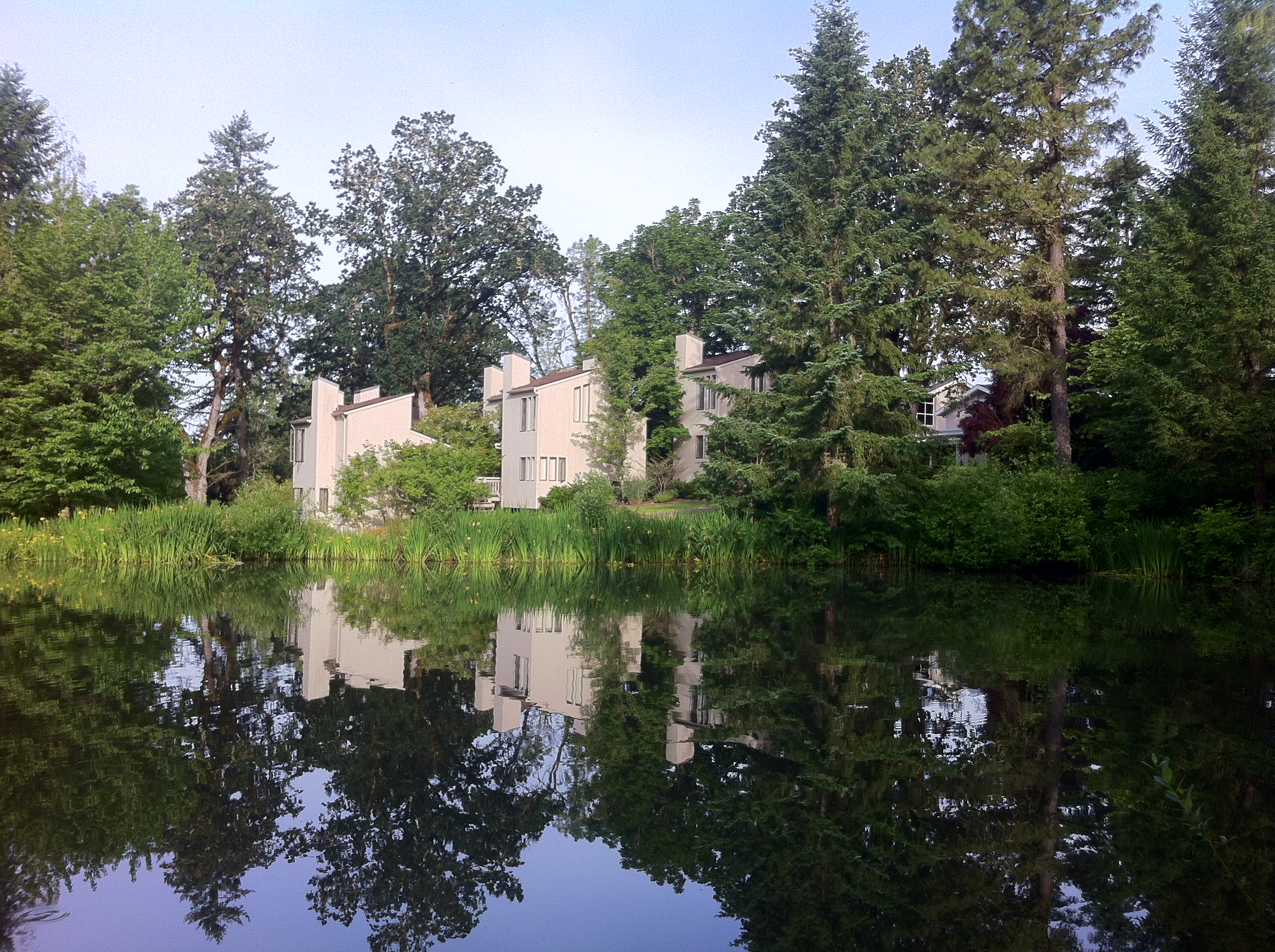
Guadalupe Abbey Pond, Oregon

IMG_2943

Massive carp break the surface of the large retreatant pond from below, barn swallows nip at it from above.

Constellations of ripples expand like impermanent tree rings

Braid through each other like ghosts and then settle into stillness.

The tall trees and clouds quiver and waver upside down

and then settle into stillness.

Bullfrogs roar at the morning chill, cacophonous birds blare with gossip, and the Abbey bells ring with joy.

(written May 30, 2015)

My First Visit to Gethsemani Abbey

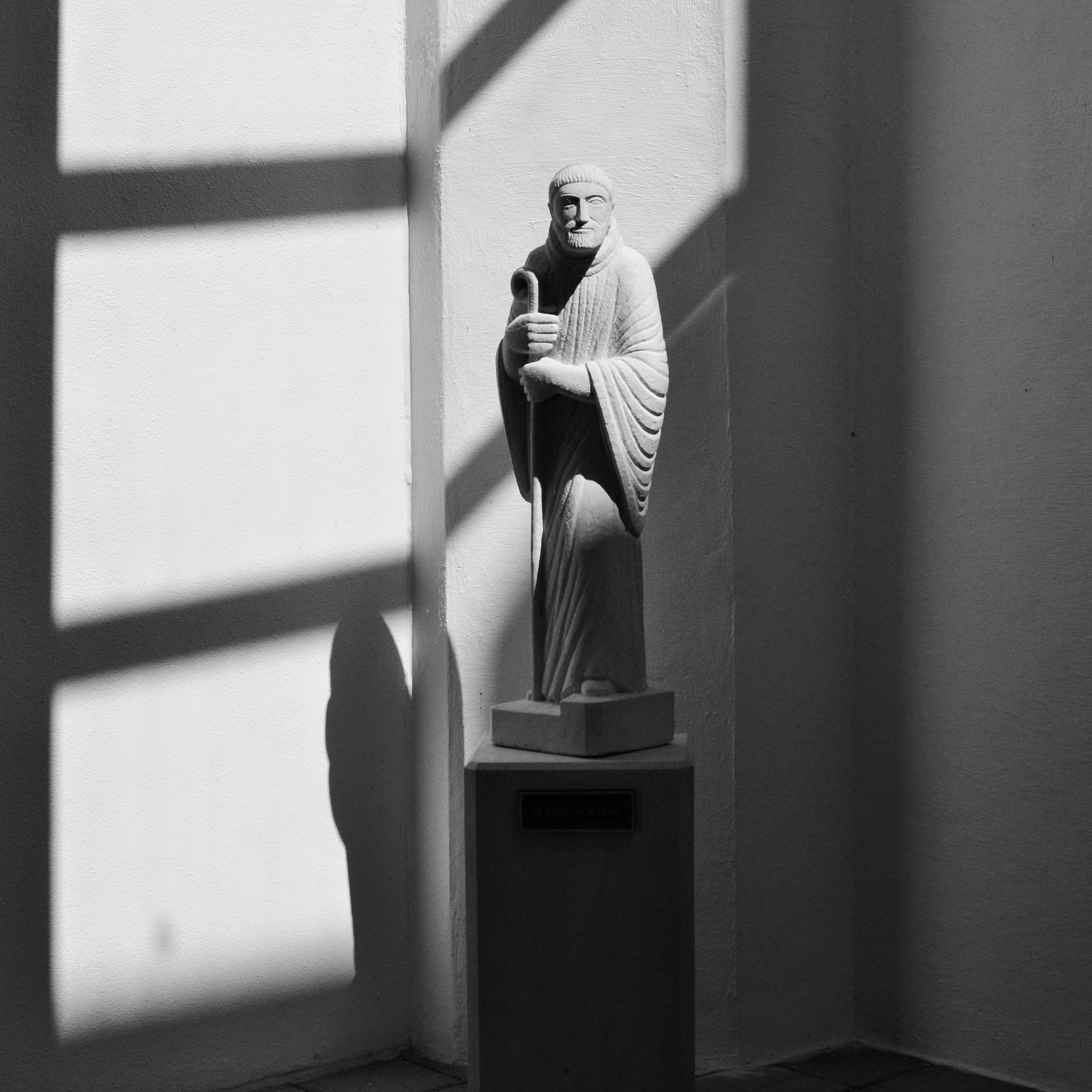
Statue greeting visitors to Gethsemani Abbey.

Statue greeting visitors to Gethsemani Abbey.

I arrived at Gethsemani in the first mega bus of three. The spire of the Abbey church rose suddenly behind a slight grassy hill. Several monks greeted us and led eager groups of about 20 through the cloister, Thomas Merton’s humble grave, and then up the short road to the hermitage where Merton started living full time in August of 1965. The pilgrim crowd, reverently snapping photos in silence, we converged in waves on the cinder block hermitage. It felt something like a flash mob-monastery—all of us interested to some degree in Merton’s spiritual writings, some of us scholars on Merton’s theology, but none willing to take the lead into the actual life of a monk or nun. We were a momentary cloister, a temporary community. Meanwhile the monastery’s average age climbs, and the monks announced this week that they would discontinue producing the cheese they have produced for many decades. Gethsemani Abbey remains a sacred site to many of us, but it is changing, and its long term future is uncertain.

I stood with the others outside the hermitage, drinking coke, listening to a monk tell us stories about Merton’s life here as fire ants, sent forth from their clay monasteries, silently tried to rip my toenails off my sandal-shod feet. We nodded, asked questions, paced through the small rooms, and then wandered outside toward the edges of the clearing to imagine what solitude would be like here. As we made our way back, another group eagerly approached.

At the end of our tour there was still about an hour before the monks were going to chant the mid-day hour, so I decided to head back out to the hermitage to see if I could steal a few moments alone. I passed chatting stragglers, and when I arrived, I went inside, snapped a few photos of the empty rooms, prayed in the small chapel, turned off the lights, picked up a few discarded refreshment cups from the floor, and then sat myself down on the now silent cement porch which had only a few minutes earlier been bustling with pacing pilgrims. A fat lizard scurried across the front of the cool cement porch into a small strip of sun near the edge. She stopped to eye me up and down, putting in a few push-ups before scurrying on. The breeze was cool and it lifted the green leaves of the tulip poplar, maple and oak trees that now surround the monastery. (At the time it was built, judging from some early photos, the area around the hermitage was much more open.)

Monks chanting the noon hour.

Monks chanting the noon hour.

I didn’t have any profound flashes of insight, or visions of Merton banging out drafts of his immortal prose, but I felt a glimmer of the wholeness of solitude, if only for a few precious minutes. I could hear my breath and the wind rising and falling together. I felt peace. I felt God. Then, a hunched figure appear on the meandering path up to the hermitage. My brief solitude at Merton’s hermitage was ended. As he approached I could see large cuffs in his pants, and a few patches. I could somehow tell he was a monk from Gethsemani, no doubt on his way to stay at the hermitage for a few days, as it is still in regular use. I greeted him, and in with a slightly annoyed but honest tone he said, “You must be a straggler?” I said, “Yes, I will get out of your hair” (he didn’t have very much of it). He introduced himself, and told me he had timed his annual week-long stay with the full moon, so as to be able to attend lauds and mass in the mornings without the use of a flash light. I wished him luck, hopped over a few anthills and was on my way down the road back to the cloister, the road that Merton and many other monks and retreatants have taken over the years. The bell rang, and I made it to the monastery chapel in time to hear the soft chant of the monks of Gethsemani. Later I gave a presentation at the Conference on Merton the hermit and the idea of wilderness. It was a beautiful day.

IMG_3027[1]

Merton’s hermitage from the path.

This year I have been lucky enough to visit a couple of sites with sacred significance to me: Dorothy Day’s Catholic Worker house in Manhattan and Aldo Leopold’s shack in Baraboo, Wisconsin. In past years I have also visited the site of the saw mill where John Muir worked in Yosemite Valley, the Sacred Grove where Mormon founder Joseph Smith had his visions, and Walden Pond. Each of these sites brings into full color the significance of place in our encounters with the Divine, with life. Each of us famous or not, inhabits a place. Our bodies know that place better than our minds. So, to inhabit the places where my mentors worked and wrote is like meeting them in person, or more awkwardly, meeting them in place. I think this desire is universal in humanity, based on the number of sacred sites, shrines, national historic sites, etc. that exist throughout the world. But just because we hold a particular cinder block hermitage in New Haven, Kentucky to be sacred, should not meant that everything outside that space is unsacred. As Wendell Berry has written, there are not sacred places and unsacred places in the world, there are only sacred places and desecrated places. May we continue to visit and protect the places that inspire us, and inspire the places we are at home in.

Holy Waiting in a Holy Universe

IMG_0787

Come Lord come,

Alpha: A Holy Flaring Forth! A Big Bang! A Cosmic Christ!

Omega: A Holy alphabet chanting itself into being!

A Universe singing to itself.

Halleluiah! Christ has come!

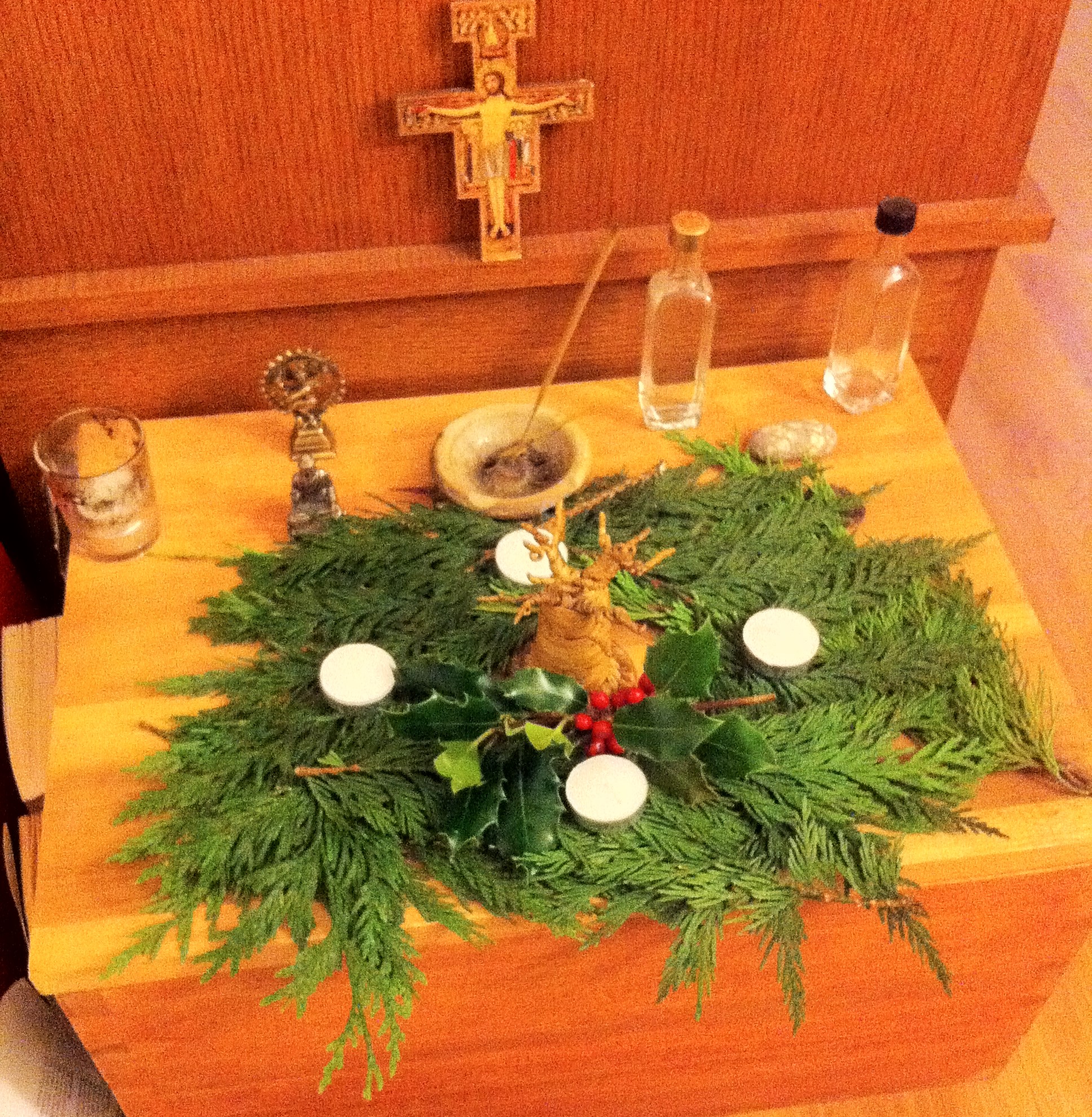
Adventus means coming. This year, on November 30, we end Ordinary Time in the Liturgical cycle and begin a four Sunday celebration leading up to Christmas. This year I am trying to deepen my experience of Christmas by making a small Advent Wreath on my personal altar and having daily contemplative devotionals leading up to Christmas day. Growing up, the secular rituals of gift giving, and the sentimental retelling of the nativity scene were fun, but this year I am trying to take more seriously what a story about a child born in a barn has to do with my fledgling contemplative spirituality within the Anglican Church.

The exact date of Christ’s birth may be unknown, but the choosing of December 25th as a fit day for celebration comes to us thanks to the Winter Solstice. It is on this day that we celebrate the sun ending its six month droop in the sky, and hence beginning his slow march back toward spring and summer. We celebrate the coming end of long darkness.

Advent then is a time of Holy Waiting for the end of spiritual darkness; of anticipation for Christ’s birth, but also hope for his return. In Trinitarian Christianity the event of Christ’s birth is referred to as the Incarnation. God became flesh in the person of Jesus of Nazareth (Mormons might call this a Condescension; see 1 Nephi 11).

What has humbled me most about this idea is that it means that Christ did not just descend to the earth and then leave when he died 33 years later like some Holy Alien. According to the familiar words of John “In the beginning was the Word, and the word was with God, and the Word was God” (1:1). If Christ is the Word of God then Creation is the alphabet. Another analogy from Paul’s letter to the Colossians: “He [Jesus] is the image of the invisible God, the firstborn of all creation; for in him all things in heaven and on earth were created, things visible and invisible, whether thrones or dominions or rulers or powers—all things have been through him and for him. He himself is before all things, and in him all things hold together” (1:15-17). Jesus as Christ is an Icon (image) of God in Creation. Christ is both the expression of God and the Image of God. Thus, we might say, as many have that the Incarnation began not just with the blessed birth of Jesus, but also with the Great Flaring Forth of the universe 13.8 billion years ago from a single point trillions of degrees hot. This is a tremendously powerful notion for me. At the center of a sometimes silly pastel plastic Nativity scene, is not only our God and our Savior, but a reassurance that we live in a Holy Universe.

This year I have created an Advent Retreat called Holy Waiting in a Holy Universe. I have divided the four weeks of Advent into the traditional four elements (Fire, Air, Water, and Earth), juxtaposing scriptures about each element with scriptures about the Coming of Christ. I hope that each day I will deepen my understanding of what it means to live in an Incarnational Universe. The gifts I give to family and friends will be offerings that remind us that we live in such a universe. Blessings to you and yours during this time of Holy Waiting and please feel free to follow along with me on my Advent retreat!

Download a Pdf of it here: Holy Waiting in a Holy Universe: An Advent Retreat

My first advent Wreath!

My first Advent Wreath!

Holy Ground

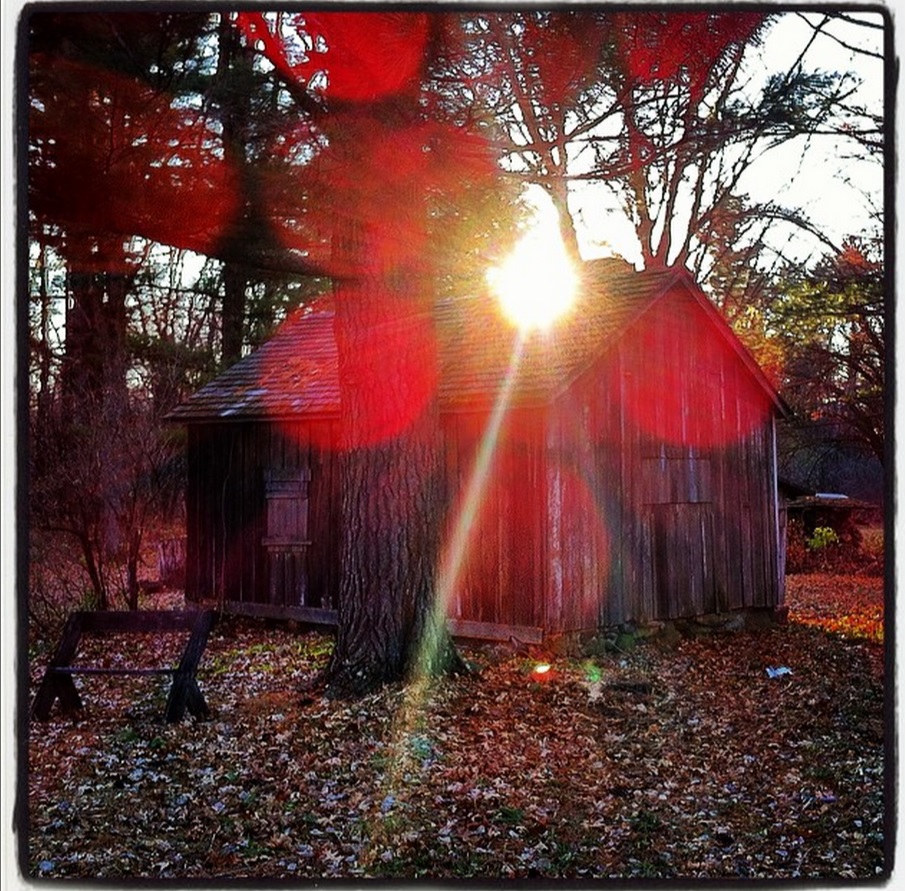
ShackThere is something about being in a place that our spiritual, historical or literary ancestors have once tread. Ones that walked, worked, wrote or traveled through a place or landscape. The practice of retracing their steps is an ancient human practice, we call pilgrimage. I didn’t go on foot, but between a lovely wedding in Chicago among family and an amazing Religion and Ecology conference in New Haven among friends, I was lucky enough through the grace of some old friends to visit several of these places over the last week. While in Madison, Wisconsin we travelled by car just north of Baraboo to a small shack on the western shore of the Wisconsin River. It was here that Aldo Leopold, Yale Alumnus and ecology saint wrote his famous A Sand County Almanac. The locale is no pristine wilderness, a sandy soiled pine forest that gives way to riparian grasses and shrubs at the river’s edge. But walking the numbered stations of the Leopold Foundation’s pamphlet, like an ecological stations of the cross, those typical trees took on the spirit of the Leopold family, who planted the trees in an act of ecological restoration. The shack as temple in a sacred grove. A temple, not of worship or divinity, but a tangible shrine to one of the early voices to suggest that humanity was not conqueror of Nature, but citizen. As we stood on the sandy river shore in silence, water lapping against the sandy ground, a flock of 15 sand hill cranes passed overhead on their way to their nightly roost. The water was deep blue and the air was chilly when the sun passed behind clouds. There was nothing otherworldly about the experience, but it certainly enriched my love for Leopold and his contribution to the ecology movement.

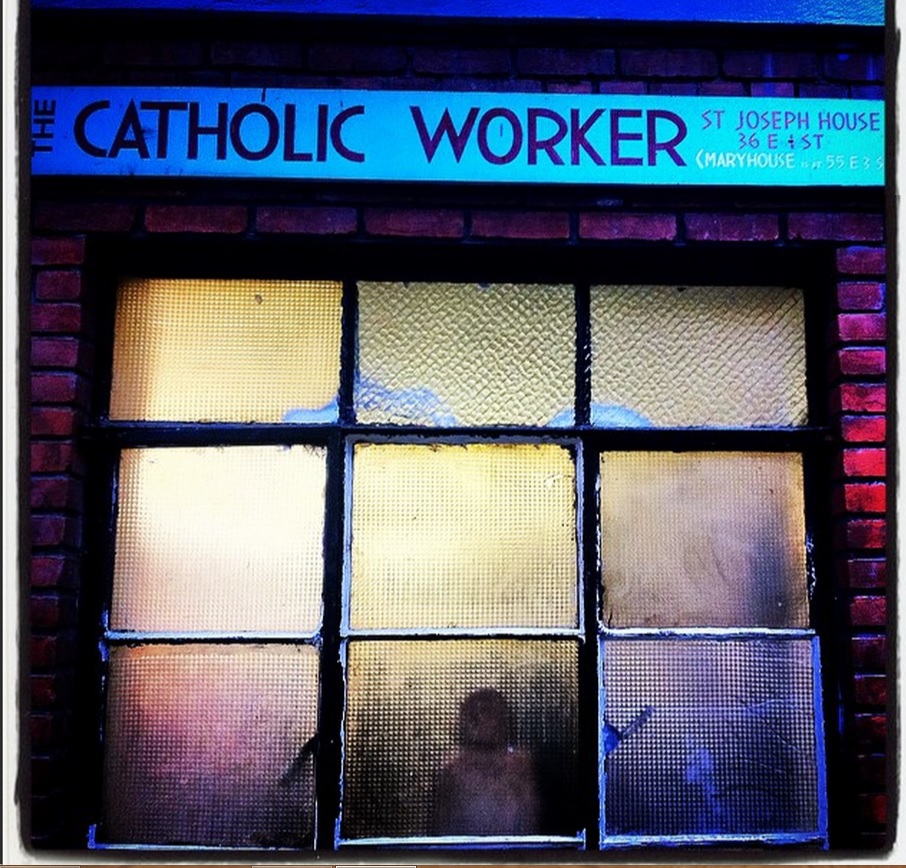
CWOn foot, I seek an inconspicuous corner of 1st Street in East Village, Manhattan. The St. Joseph Catholic Worker House of Hospitality has been in continuous operation since Peter Maurin and Dorothy Day founded them in 1936. When I arrived, a small crew of volunteers that included two Mormon missionaries, were serving a simple soup, and a smiling woman made the rounds topping off coffee mugs. The guests sat mostly in silence, some in quiet conversation. I struck up a short conversation with a volunteer and he immediately offered to let me serve some coffee. We chatted about the project, the place, and Dorothy Day, the movement’s founder, who is currently being reviewed by the Vatican for Canonization. The Catholic Worker Movement is a lot like other homeless shelters, but more than that it was an early socialist attempt to live the Gospel by fulfilling Jesus’s command to feed the hungry, clothe the naked, and visit the sick. They espouse a simple philosophy of Christian pacifism, agrarianism and personalism. They serve daily meals and give free clothing away and house several dozen people on a temporary basis. A drop in the bucket in a city of 8 million, but just looking around I could feel of Dorothy’s spirit, silently fulfilling the most basic of Christian practices.

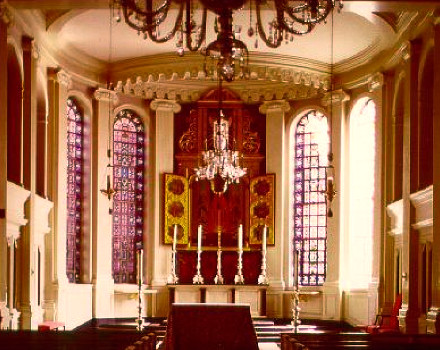
A young parish priest opened the Rectory door of Corpus Christi Church in Morningside Heights and asked “How can I help you?” I told him I was a reader of Thomas Merton, and asked if I could see the chapel. Without hesitation, he slipped into tour guide mode, opened the door and showed me to the room where Merton first met with Father George Barry Ford. A small hand painted portrait of Merton hung on the north wall. The Priest showed me into the church and guided me toward the back of the chapel to a small baptistery where Merton was baptized. The church was beautiful, built in 1936 in a Baroque Revival style. A little too ornate for my taste, and nothing like the Cathedrals I had visited throughout the day in Manhattan. But the place help a special presence as the place where Thomas Merton worked out his conversation and eventual decision to join the Trappists in Gethsemani Abbey, Kentucky. Merton went on to become one of the most influential Catholics of the 20th century, and his writing is widely read.

I am no expert on these writers, but they have all, Leopold, Day and Merton influenced by thinking, the way I live my life and the subject of my research. Being in the places where these wonderful human beings worked out their own questions, ideas and lives gave me a kind of strength and assurance that I was at least moving in the right direction.