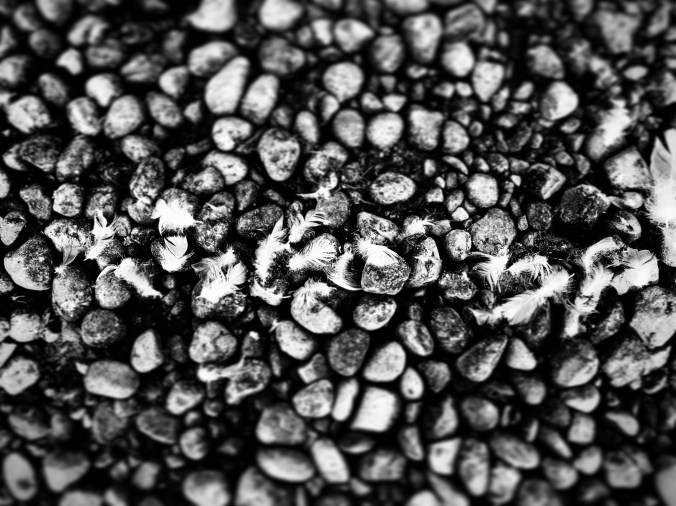
The high tide pushed the gull feathers into a straight line along several hundred feet of beach.
There was no sign of the body.
Only the inscribed threshold of those delicate feathers on the rocky shore.
The high tide pushed the gull feathers into a straight line along several hundred feet of beach.
There was no sign of the body.
Only the inscribed threshold of those delicate feathers on the rocky shore.
 Today in my morning prayers I read Psalms 58. If you are not familiar, Psalms 58 is one of the more vicious “Cursing” Psalms, wherein the poet-author begs God for vengeance on his enemies. Some exceptionally gruesome lines read:
O God, break the teeth in their mouths;
tear out the fangs of these lions, O Lord!
Let them vanish like water that runs away;
Let them wither like grass that is trodden underfoot.
Let them be like the snail that dissolves into slime,
like a woman’s miscarriage that never sees the sun.
This visceral desire for vengeance reminded me of the other infamous Psalm 137, which reads:
O daughter of Bablylon, destroyer,
blessed whoever repays you
the payment you paid us!
Blessed whoever grasps and shatters
your children on the rock!
Listening to mild mannered monks chant these lines is an interesting experience, but there is of course a theology behind it. The Psalms express and give voice to the entire range of human emotion, good and bad, and to chant the Psalms is to enter into those emotions on behalf of those who might be feeling them.
When I heard that a man known for past political activism killed two men on a train in Portland for confronting him over his harassment of two women, I felt angry. When I heard that Islamists had ambushed and killed over 20 Christians as they travelled to a monastery in Egypt, I was furious. When I heard about Manchester, Paris, Orlando, Charleston, the list goes on, I wanted justice. The cowardly acts of terrorists by these white supremacists and Islamist Extremists are cut from the same cloth.
In Psalm 137, the Psalmist is reeling from the recent leveling of Jerusalem by Babylonian forces. The carnage left the Jews feeling completely abandoned by God. And at times like this, with more and more senseless violence we can feel the same.
As a human being, my initial reaction is a desire for vengeance, justice and annihilation. But as someone who believes in the reality of the Christian story, I am also committed to reading the Psalms through the lens of Christ, who asks me to dash my vice, sin and hatred on the rock of his paschal mystery. The Psalms name the justifiable reaction, but Christ calls us to purify them, and to move toward a place of forgiveness, love and nonviolence.
In the spring,
The pale yellow-green leaves of the maples
Bleed into the rich yellow plumage of the just-arrived warblers.
By the time the maple leaves are deep green with summer,
The warblers will have gone.
–May 17, 2017
About a week before Lent began, I took a retreat to a Benedictine monastery in central Washington. Unlike several of the other monasteries I have visited, this particular monastery was located in a more suburban setting, and, founded as a small college, the monastery is now a bustling university.
I went hoping for some silence, writing time and immersion in the familiar rhythms of the monastic liturgy. When I arrived, however, the first thing I noticed when I got out of the car, was how loud it was. I could hear I-5 rushing and hushing in the background. In addition, the liturgy was not chanted but spoken, which made it feel less vibrant, and the space of the chapel was one of those ill conceived modernist boxes. Nonetheless, the monks were kind, and I enjoyed talking with them, and learning about the monastery’s history.
The monastery started with close to 600 acres, but now retained only about 350, most of which was devoted to the campus and student housing. They had a small farm operation in the 1930s-1950s but it ended by the 1960s. Even with a smaller footprint, the monastery had taken good care of the remaining second or third growth forests, which had a number of walking trails. And even with the white noise of the freeway in the background, I enjoyed walking them.
Despite the loveliness of the forest, I ended up having a difficult time writing, felt restless during the spoken Divine Office, and everywhere I went, the freeway was audible. I ended up leaving early, so I could get home and regroup.
On the way, feeling the weight of dissertation anxiety and something of the distance that opens between us and the Divine at times, I decided to go for a hike at my favorite protected area in Bellingham, Washington, Stimpson Family Nature Preserve. It was late in the afternoon, and a friend and I headed around the wet, still snowy in places, trail.
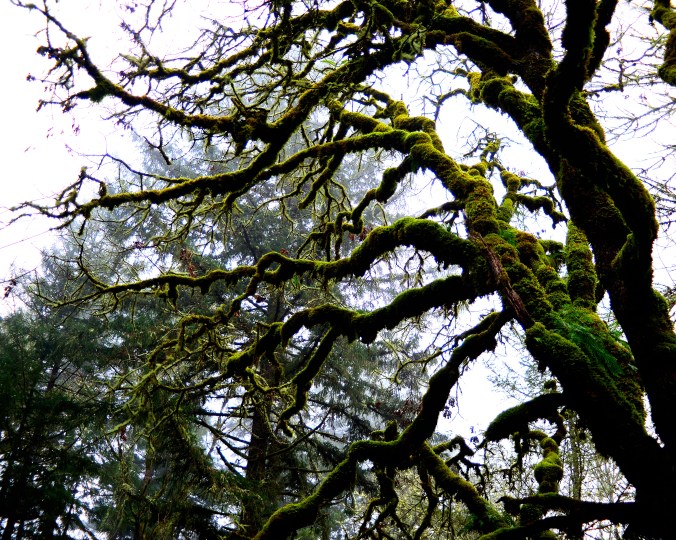
It is one of the few older growth forests in the area, and I often feel God’s presence there as I breathe the clean cool air, and marvel at the riot of colors. But this time, riding the wave of restlessness from my retreat, I felt a very strong sense of God’s absence. It hit me like a wave, a sudden pang of nihilistic agnosticism, and the darkening forest, still silent and deadened to winter, felt cold, indifferent and lifeless.
For several days after this, I pondered the dark mood that had descended. I stopped praying, and considered skipping Church for a few weeks. My usual excitement for Lent turned into a smoldering dread.
I recently decided to join an Anglo-Catholic Parish in Vancouver because of its wonderful liturgy, and I had signed up to be part of the altar party as a torch bearer on Ash Wednesday. So, despite the darkness that had descended onto my spiritual life, I decided to go.
At first I felt sad, and distant, but as the liturgy proceeded, my attention sharpened, and I began to feel lighter. During the consecration of the Eucharist, which like Traditionalist Catholic Mass is said with the Priest facing the altar, as torch bearer, I knelt with the candle behind the priest. As the bells rang and the priest lifted the bread and then the wine, a subtle shift occurred in my chest. The utter strangeness and beauty of the liturgy penetrated my dark mood, and lifted me back into a place of openness and receptivity. It was nothing profound, or revelatory, but a perceptible change. I was again, ready to enter into simplicity and silence of Lent, in anticipation of Easter.
Reflecting on this ‘Dark Night of the Soul’, I began to understand the gift that God’s absence can sometimes be. I remembered the scene in 1 Kings 19, where Elijah is called out of his hiding place in a cave by God:
“Then a great and powerful wind tore the mountains apart and shattered the rocks before the Lord, but the Lord was not in the wind. After the wind there was an earthquake, but the Lord was not in the earthquake. After the earthquake came a fire, but the Lord was not in the fire. And after the fire came a gentle whisper. When Elijah heard it, he pulled his cloak over his face and went out and stood at the mouth of the cave.” (NIV)
Of course God is present to all things, but She cannot be confined to any one of the elements. Having experienced God’s presence so deeply in forests over the years, it was alarming to feel such a sense of despair, and emptiness. But it is true, just as the forest is a place of beauty and life; it is also a place of suffering and death. If God were wholly present to the forest, there would be no distance to cross between us.
As Pope Francis writes in Laudato Si:
“Our relationship with the environment can never be isolated from our relationship with others and with God. Otherwise, it would be nothing more than romantic individualism dressed up in ecological garb, locking us into a stifling immanence” (Laudato Si, 119).
I am most certainly guilty of romanticism, but this phrase, “stifling immanence” keeps coming back to me. God is everywhere present, and hold all things in existence at each moment. But there remains an infinite gap between us.
As I deepen my Lenten journey with prayer, fasting and silence, I am grateful for this lesson, and it has served as rich food in the Desert of Lent this year.
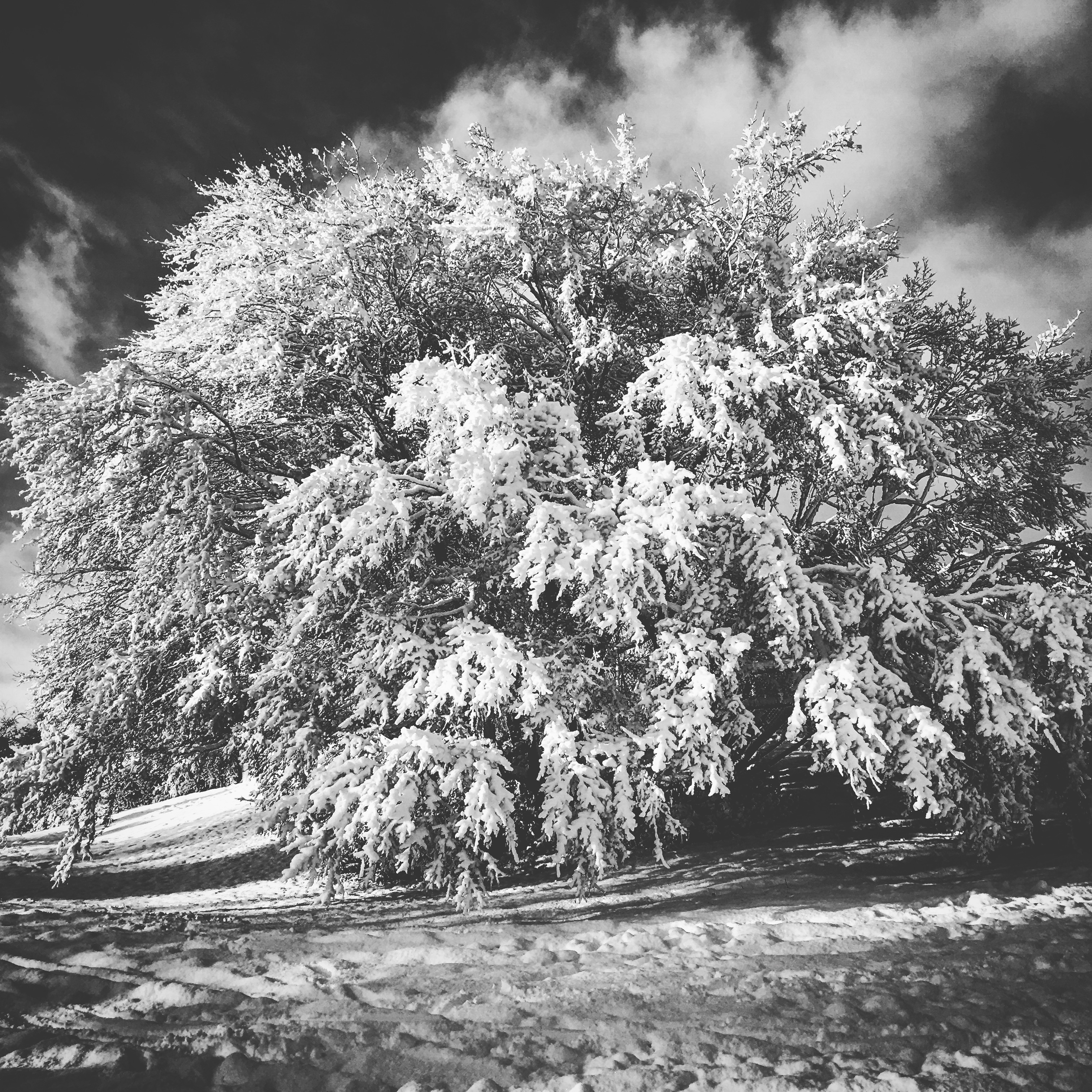
Imagine the most common of trees, the Christmas (or Solstice) tree, decorated with globes, lights and a star on top. Allow that tree to grow in your mind so that it fills the sky.
The bright star at the very top of the tree merges with the North Star, Polaris.
Now imagine that the gold and silver globes become the sun, the phases of the moon, and the other planets moving through the sky, appearing to pivot around the North Star.
Imagine that the twinkling lights are billions and billions of stars.
The Christmas tree is a microcosm of the macrocosm.
The Norse pagans placed the ash tree at the center of their cosmology.
Its sprawling roots descended into the underworld; its trunk and branches passed through the mortal realm, ascending to heavenly.
The Maya imaged the cosmos as a great Ceiba tree, which also descended to the underworld and ascended through thirteen levels of heaven, each level with its own god.
The sun and moon made their way along the Ceiba’s trunk, and the spirits of the dead moved along its rough bark.
The naturalist and pantheist John Muir used to climb to the top of large pine trees during rain storms. About trees and the universe he mused:
We all travel the Milky Way together, trees and [humans]; but it never occurred to me until th[at] stormy day, while swinging in the wind, that trees are travelers, in the ordinary sense. They make many journeys, not extensive ones, it is true; but our own little journeys, away and back again, are only little more than tree-wavings—many of them not so much.
In the beginning, the tree of life emerged as a tiny seedling.
Soon, it branched out into everything we call living: microbes, fungi, plants, trees, animals.
The seeds of humans germinated in the trees.
Our mammalian and primate ancestors made their homes in their bows.
Eventually, our curiosity compelled us down from the safety of their branches and out onto the savanna.
Yet, the trees never left us;
They continued to provision us with gifts on our long walks.
They gave food, fodder, shelter, tools, medicine and stories.
They appeared in our dreams.
It was here, in a forest, that Zoroaster in Persia saw the Saena Tree in a vision emerging from the primeval sea, a tree from whose seeds all other plants would grow.
It was here that Yahweh, Semitic sky god, came to earth and planted a garden of trees, pleasing to the eye and good for food.
It was here that Inanna, Babylonian goddess of beauty and love, nourished the Huluppu tree on the banks of the Euphrates River.
It was here that Kaang, creator god of the Batswana Bushmen, created the first mighty tree and led the first animals and people out from the underworld through its roots and branches.
It was here that the sacred tree gave light to the Iroquois’s island in the sky—before the sun was made, before Sky Woman fell through a hole in the island in the sky, and before the earth was formed on the back of a great turtle.
It was here that the Mayan Tree of Life lifted the sky out from the primordial sea, surrounded by four more trees that hold the sky in place and mark the cardinal directions.
It was here, in a forest, that the first whispers of the divine spoke to human consciousness.
It was here that Jacob wrestled with angels and beheld visions.
It was here that Hindu seekers learned the wisdom of gurus.
It was here, seated beneath the Bodhi tree, that Siddhartha Gautama became the Buddha.
It was here that Moses fasted, prayed, and received God’s Law.
It was here that Muhammad sought refuge in mountain caves and spoke the words of the holy Koran.
It was here that Guru Nanak experienced the Oneness of God.
It was here that Nephi of the Book of Mormon communed with angels and beheld the glorious fruit of the Tree of Life.
It was here, in a forest, that we built our first temples and worshipped God without priesthoods.
It was here that Asherah, Canaanite goddess of all living things, was worshipped.
It was here, as Sycamore fig, that Isis of Egypt was lavished praise.
It was here, in grove of sacred oak, that the Druids passed on their knowledge, and sacrificed human flesh to the gods.
It was also here, in the forest, that, after civilization blossomed, we looked for inspiration—
Temples of stone with their pillars, columns, and cathedral arches were all made to resemble the trunks of trees, carrying the eye upward to God.
And yet, it would seem that these temples of stone confined God to one place, one people, one faith.
It was here that we fell from grace.
It was here that Adam and Eve ate the fruit of a misunderstood tree.
It was here that civilization bloomed.
It was here that we logged, burned, mined, clear-cut, developed.
It was here that the old stories were forgotten and new ones were written;
Stories in which creation was no longer sacred, enchanted, animate, subjective.
Return
In an age of climate chaos and heart breaking extinction, it is here, to the forest, that we must return.
Not only as skiers, hikers, campers, birders, hunters, and foresters, but as devotees.
Because it is here that we see the universe in microcosm, where we get our bearings.
It is here that creation awes.
It is here that we experience the divine.
It is here that we can bring our questions.
It is here that we can dwell in mystical solitude.
It is here that we are now—The global forest.
To return to the forest, we must become familiar with it.
I invite you to go to a mountain grove or a city park and take off your shoes.
When you are comfortable and alone, close your eyes.
Begin by focusing on feeling—as a tree might—the sun, the wind, the earth beneath your toes and on your skin.
If you wish, stretch your arms up and out like branches seeking the light.
Imagine drinking in the caramel rays of the sun as nourishment.
Focus on your breath by letting the air pass through your nostrils and fill the arboreal-patterned branches in your lungs.
Feel your lungs slowly fill with oxygen.
Feel them slowly empty as your body expels carbon dioxide.
Focus on the entire process of breathing and how each moment changes.
In and out.
As you breathe in, imagine that the oxygen, conceived in the leaves of trees, is gently birthed from the leaf’s stomata, wafting through space, and entering your lungs.
As you breathe out, imagine that the CO2, re-born in your lungs, is gently wafting through the air and entering the receptive stomata of the leaves.
In and out.
The air becomes us, becomes them.
It is a sacrament; we take it upon us, into us, and they upon themselves.
As we breathe in, the trees breathe out.
As the trees breathe out, we breathe in.
We are their lungs and they are ours.
In and out.
This is not a supernatural idea; it is an ecological reality.
May we dwell in this reality!
The mystic monk and (one time monastery forester) Thomas Merton said:
We are already one. But we imagine that we are not. And what we have to recover is our original unity. What we have to be is what we are.
What we are is not all that different from trees.
And so I offer you this prayer for your walks and sits among the trees.
Forest, Trees. May we sustain you as you sustain us.
Clumsy reach for truck keys.
Alarm triggered, rhythmic honking startles me.
It also startles a crow above the truck.
We lock eyes,
silence.
Sunset.
Waiting to catch the last ferry from Nanaimo to Horseshoe Bay.
On tailgate of my truck, eating Raman and boiled eggs out of a tin bowl—
I watch yellow jackets munch at the dead bugs splattered to the bumper of a Volkswagen.
4th of July.
I stumbled my way up and up the 3.5 mile trail to Park Butte historic Fire Lookout.
I arrive near dusk, not sure the time because I don’t have a watch or cell phone with me.
I find the place empty, how lucky to have it to myself for the night.
Up close, Mount Baker’s glaciers accordion down the southern slopes.
The sun is dipping toward the Salish Sea as I explore the nooks and crannies of the Lookout—pots, pans, water jugs, saws, axes, maps, log books from the 80s and 90s.
A few crumpled Gary Snyder poems in a tattered booklet: Patron saint of Washington Fire Lookouts.
I walk the creaky deck surrounding the Lookout.
The wind talks with long pauses between wordy gusts.
The thrushes sing, a bat flutters by eating bugs, the sky darkens.
Venus and Jupiter twinkle as a million tiny fireworks pop in the valley below.
A golden waning moon rises from the Cascade Mountains.
Sleep comes slowly, interrupted frequently by the wind rumbling and clattering through the leaky Lookout.
Smokey dawn, July 5.
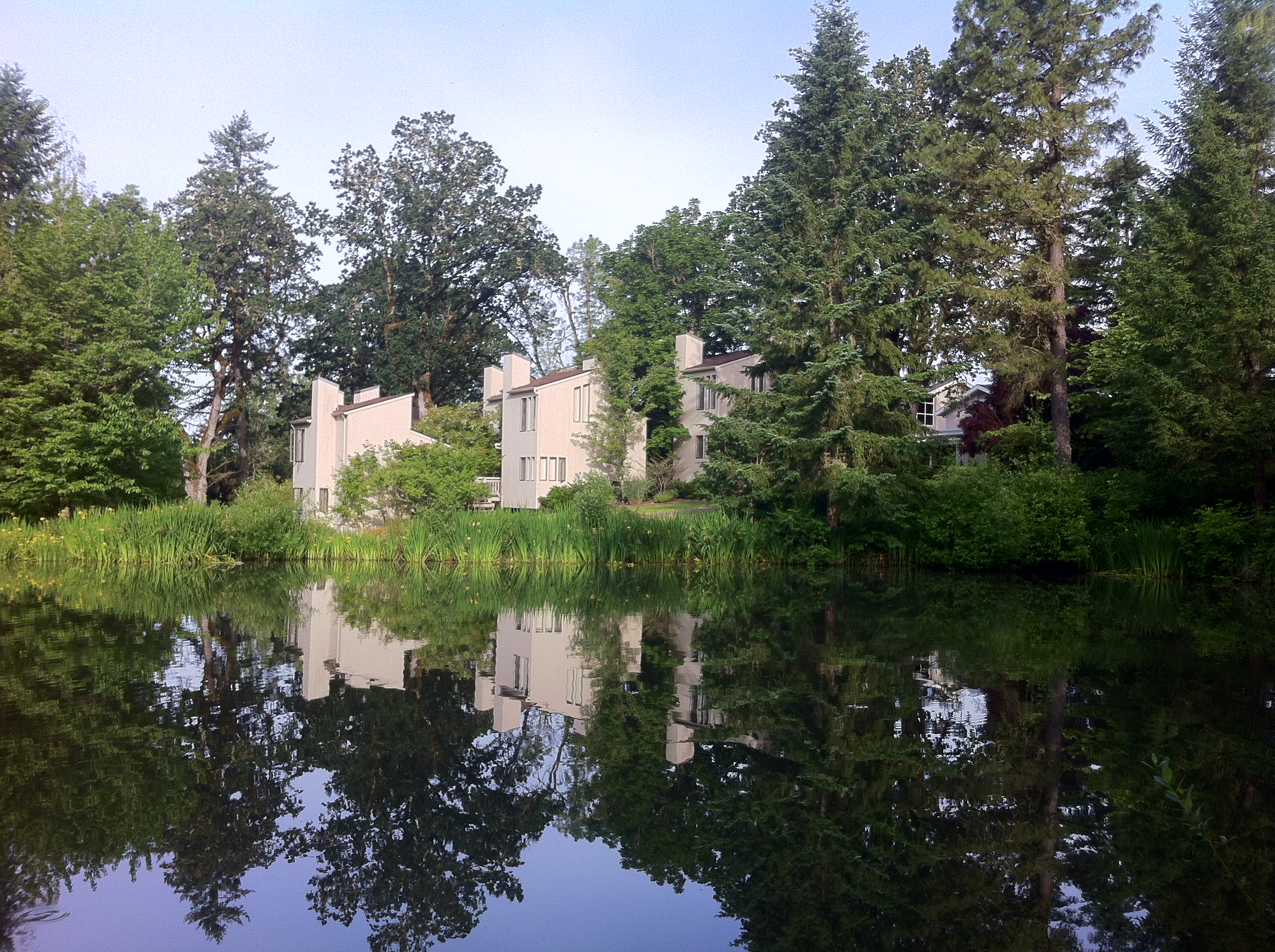
Massive carp break the surface of the large retreatant pond from below, barn swallows nip at it from above.
Constellations of ripples expand like impermanent tree rings
Braid through each other like ghosts and then settle into stillness.
The tall trees and clouds quiver and waver upside down
and then settle into stillness.
Bullfrogs roar at the morning chill, cacophonous birds blare with gossip, and the Abbey bells ring with joy.
(written May 30, 2015)
Standing on an old bridge over the muddy North Fork of Bear Grass Creek.
Blue jays eat ripe mulberries above.
Carp and snapping turtles gobble up the leftovers from below.
 holyscapes