My First Visit to Gethsemani Abbey

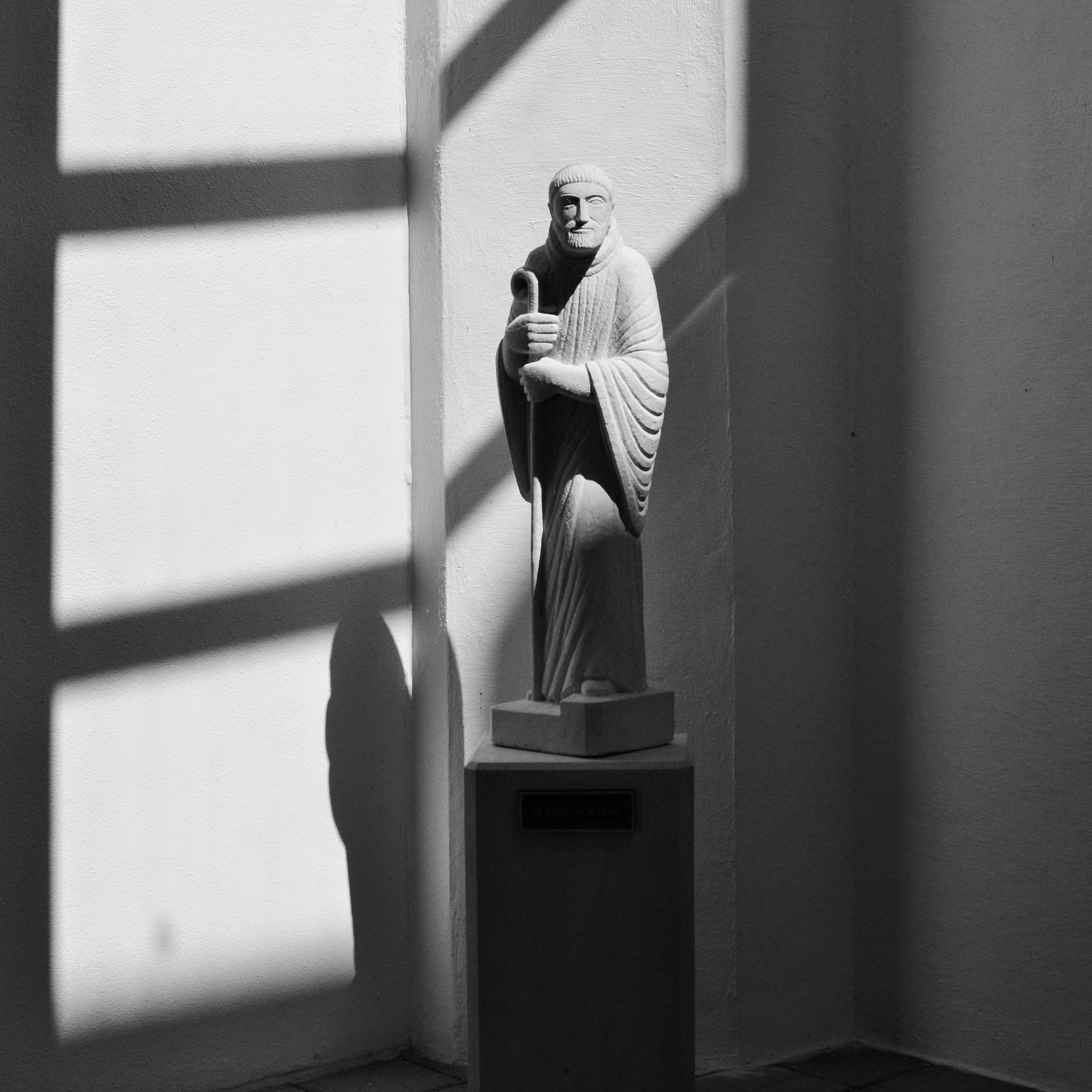
Statue greeting visitors to Gethsemani Abbey.

Statue greeting visitors to Gethsemani Abbey.

I arrived at Gethsemani in the first mega bus of three. The spire of the Abbey church rose suddenly behind a slight grassy hill. Several monks greeted us and led eager groups of about 20 through the cloister, Thomas Merton’s humble grave, and then up the short road to the hermitage where Merton started living full time in August of 1965. The pilgrim crowd, reverently snapping photos in silence, we converged in waves on the cinder block hermitage. It felt something like a flash mob-monastery—all of us interested to some degree in Merton’s spiritual writings, some of us scholars on Merton’s theology, but none willing to take the lead into the actual life of a monk or nun. We were a momentary cloister, a temporary community. Meanwhile the monastery’s average age climbs, and the monks announced this week that they would discontinue producing the cheese they have produced for many decades. Gethsemani Abbey remains a sacred site to many of us, but it is changing, and its long term future is uncertain.

I stood with the others outside the hermitage, drinking coke, listening to a monk tell us stories about Merton’s life here as fire ants, sent forth from their clay monasteries, silently tried to rip my toenails off my sandal-shod feet. We nodded, asked questions, paced through the small rooms, and then wandered outside toward the edges of the clearing to imagine what solitude would be like here. As we made our way back, another group eagerly approached.

At the end of our tour there was still about an hour before the monks were going to chant the mid-day hour, so I decided to head back out to the hermitage to see if I could steal a few moments alone. I passed chatting stragglers, and when I arrived, I went inside, snapped a few photos of the empty rooms, prayed in the small chapel, turned off the lights, picked up a few discarded refreshment cups from the floor, and then sat myself down on the now silent cement porch which had only a few minutes earlier been bustling with pacing pilgrims. A fat lizard scurried across the front of the cool cement porch into a small strip of sun near the edge. She stopped to eye me up and down, putting in a few push-ups before scurrying on. The breeze was cool and it lifted the green leaves of the tulip poplar, maple and oak trees that now surround the monastery. (At the time it was built, judging from some early photos, the area around the hermitage was much more open.)

Monks chanting the noon hour.

Monks chanting the noon hour.

I didn’t have any profound flashes of insight, or visions of Merton banging out drafts of his immortal prose, but I felt a glimmer of the wholeness of solitude, if only for a few precious minutes. I could hear my breath and the wind rising and falling together. I felt peace. I felt God. Then, a hunched figure appear on the meandering path up to the hermitage. My brief solitude at Merton’s hermitage was ended. As he approached I could see large cuffs in his pants, and a few patches. I could somehow tell he was a monk from Gethsemani, no doubt on his way to stay at the hermitage for a few days, as it is still in regular use. I greeted him, and in with a slightly annoyed but honest tone he said, “You must be a straggler?” I said, “Yes, I will get out of your hair” (he didn’t have very much of it). He introduced himself, and told me he had timed his annual week-long stay with the full moon, so as to be able to attend lauds and mass in the mornings without the use of a flash light. I wished him luck, hopped over a few anthills and was on my way down the road back to the cloister, the road that Merton and many other monks and retreatants have taken over the years. The bell rang, and I made it to the monastery chapel in time to hear the soft chant of the monks of Gethsemani. Later I gave a presentation at the Conference on Merton the hermit and the idea of wilderness. It was a beautiful day.

IMG_3027[1]

Merton’s hermitage from the path.

This year I have been lucky enough to visit a couple of sites with sacred significance to me: Dorothy Day’s Catholic Worker house in Manhattan and Aldo Leopold’s shack in Baraboo, Wisconsin. In past years I have also visited the site of the saw mill where John Muir worked in Yosemite Valley, the Sacred Grove where Mormon founder Joseph Smith had his visions, and Walden Pond. Each of these sites brings into full color the significance of place in our encounters with the Divine, with life. Each of us famous or not, inhabits a place. Our bodies know that place better than our minds. So, to inhabit the places where my mentors worked and wrote is like meeting them in person, or more awkwardly, meeting them in place. I think this desire is universal in humanity, based on the number of sacred sites, shrines, national historic sites, etc. that exist throughout the world. But just because we hold a particular cinder block hermitage in New Haven, Kentucky to be sacred, should not meant that everything outside that space is unsacred. As Wendell Berry has written, there are not sacred places and unsacred places in the world, there are only sacred places and desecrated places. May we continue to visit and protect the places that inspire us, and inspire the places we are at home in.

Learning to Hear the Music: Toward a Mormon Mystical Tradition

Raised as a devout Mormon, my religious life began taking new direction in about 2011, when I started teaching a World Religions class at Salt Lake Community College. The seeds of that new direction came while attending the Easter Vigil in Salt Lake’s beautiful Cathedral of the Madeleine, one of the few Cathedrals under the patronage of Mary Magdalen, the first person to see the resurrected Jesus. As I entered the dark Cathedral with hundreds of other candle lit faces, I realized that we were at a funeral; that we were not just talking about Christ’s death, we were mourning it in preparation to celebrate his resurrection; a gift freely given. Something clicked, I felt sincere sorrow and then joy. I began to finally understand that word so many other Christians were using: Grace. Since then, I have taken slow and cautious steps toward the Catholic faith, and during this year’s Easter Vigil, I was baptized, confirmed and received first communion.

Liturgy, participating in cycle of Christ life and death, helped me to realize that God’s love was always already there. And it was through this Grace, this freely given gift of the world, I was loved, unconditionally. But not loved as an object of a distant Father’s affection, actually loved into being. Creation is and continues to be an act of grace.

I am not completely checked out of Mormonism. Most of my family still practices, and I am plugged in to the Bloggernacle. So during my Easter retreat this year, I decided to tune into to a bit of General Conference. During Wilford W. Anderson recent General Conference address, he began with a story about a Native American man who asked a doctor if he could dance (dancing being a way of healing for this man). The Doctor said no, and asked if the man could teach him. The Native American said that he could teach him to dance, but that the doctor must first learn to hear the music. Applying this to contemporary Mormonism Anderson stated:

“Sometimes in our homes, we successfully teach the dance steps but are not as successful in helping our family members to hear the music. We learn the dance steps with our minds, but we hear the music with our hearts. The dance steps of the gospel are the things we do; the music of the gospel is the joyful spiritual feeling that comes from the Holy Ghost. It brings a change of heart and is the source of all righteous desires.”

This peeked my attention. My major problem with Mormon spiritual practice was that in my experience, morality and church participation were means of earning God’s love, of earning the presence of the Holy Spirit, who, I was taught, would flee at the slightest offence. In this mode of spirituality, guilt became the primary motivator for avoiding certain behaviors, believing certain doctrines, and even attending church. Christ’s atonement made my sins forgivable, but somehow, caught up in right action, I missed the whole point of Christ in the first place. Thus, learning to hear the music before we learn to dance seemed like a perfect metaphor for understanding Christ’s love: Hearing the music is primary, and learning the dance steps comes with practice, over a lifetime. Mystical encounter, the act of being present to God loving us into being, is at the core of Christian spirituality, and from which flow our desires to do good. But then Elder Anderson continued:

“The challenge for all of us who seek to teach the gospel is to expand the curriculum beyond just the dance steps. Our children’s happiness depends on their ability to hear and love the beautiful music of the gospel. How do we do it? First…”

Elder Anderson then attempts to teach us the steps to hearing the music. In order to hear the music you must learn the steps!? At this my heart sunk and I turned off Conference and began to pace my room. I began to wonder why a religion founded on a profound mystical encounter with the Father and the Son in a grove of trees, could have become so anti-mystical. I looked in the LDS Topical Guide to see what it had to say: “Mysticism: See False Doctrine Sorcery Superstitions Traditions of Men.”

The guide refuses even an attempt at defining the tradition which gave rise to its own religion! So I went to the always reliable (sometimes controversial) Richard Rohr, a Franciscan Friar: “All I mean by mysticism is experience-based religion whereby you come to really know something for yourself. It’s not just believing something; it’s knowing something.” It seemed so curious to me that Mormonism embraces this definition of mysticism as the means to understanding doctrine reject it as a spiritual practice for knowing God’s love. Somehow, instead of seeking personal experience of the truth and reality of God’s unearned, ever-present love, Mormonism uses ‘mystical’ encounter as a tool to confirm propositions of faith, identity and personal morality. Again, there is nothing wrong with morality, identity, or beliefs. But when we start with them as a means of getting to God, we will ALWAYS come up short. The person of Jesus came to reveal to us that this is backwards. We start with God’s love, and then live into beliefs, identity, and morals. As a Mormon I was living this process completely backwards, and as a fledgling Catholic, I still struggle with it.

Then, an article, like a cyber-revelation, came across my Facebook feed. It was Adam Miller’s General Theory of Grace. Miller agrees that Mormons have a “tendency to read the gospel as a kind of secular manual for can-do humanism and self-improvement.” For Miller “righteous works only become righteous when they are motivated by the pure love of Christ, when they are the product of God’s grace as that grace works its way out into the world through our hearts, minds, and hands.” And here’s the clincher: “Grace is this massive, ongoing act of divinely organized creation that involves an uncountable host of agents (human and nonhuman) embedded in irreducible webs of stewardship, consecration, sacrifice, and interdependence.” [i] Beautiful words, felt deeply. Mysticism, in this light, is learning to be quiet and experience the grace of God creating us from moment to moment in what has been called by Jean-Pierre De Caussade the sacrament of the present moment. I encourage my dear Mormon friends and family to pick up Adam Miller’s books. His prophetic writing could help us put the horse back in front of the cart so to speak and as Elder Anderson hopes, to hear the beautiful music of the gospel, to which our lives become a dance.

[i] http://bycommonconsent.com/2015/04/07/a-general-theory-of-grace-ldsconf/

Holy Waiting in a Holy Universe

IMG_0787

Come Lord come,

Alpha: A Holy Flaring Forth! A Big Bang! A Cosmic Christ!

Omega: A Holy alphabet chanting itself into being!

A Universe singing to itself.

Halleluiah! Christ has come!

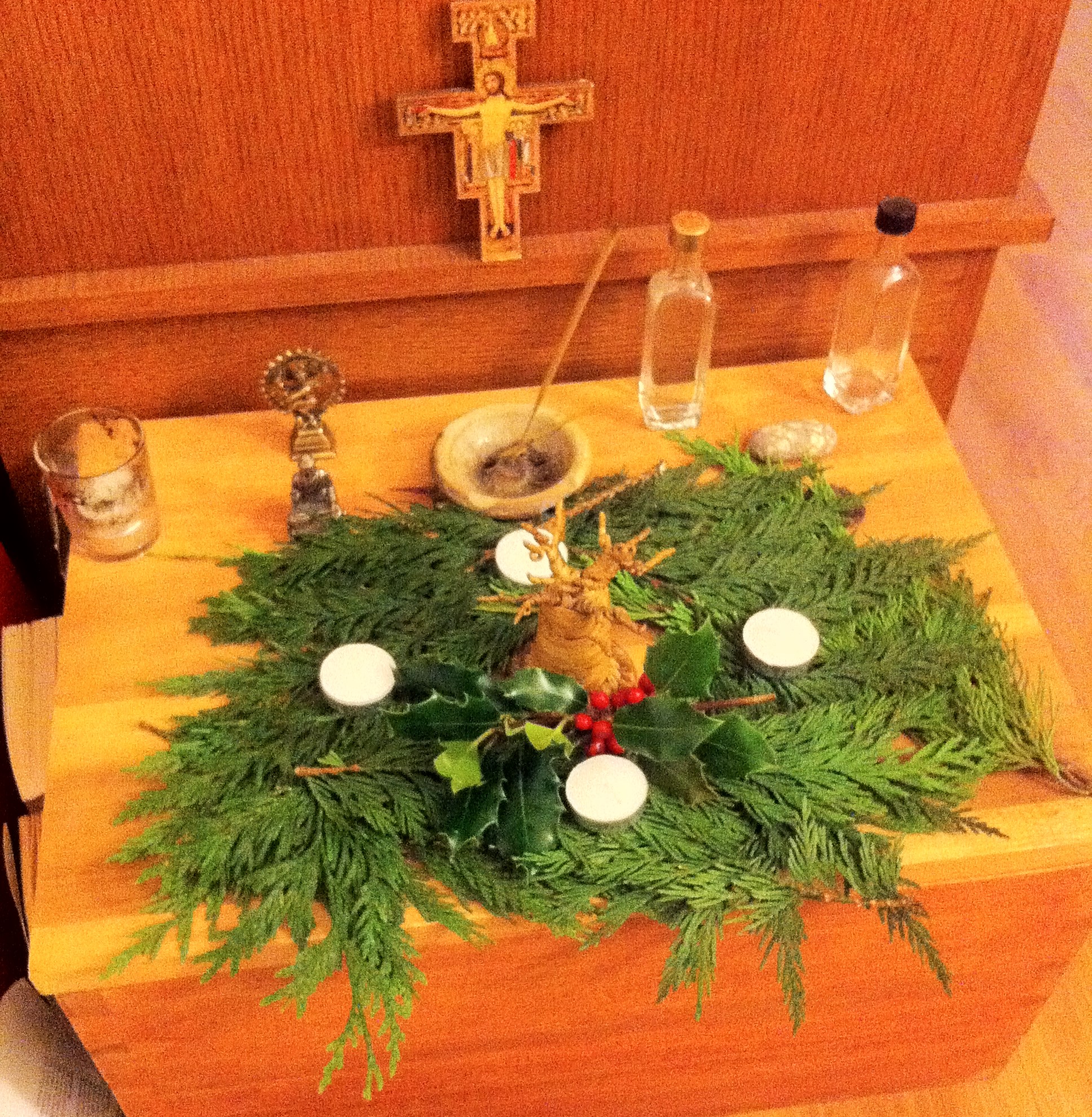
Adventus means coming. This year, on November 30, we end Ordinary Time in the Liturgical cycle and begin a four Sunday celebration leading up to Christmas. This year I am trying to deepen my experience of Christmas by making a small Advent Wreath on my personal altar and having daily contemplative devotionals leading up to Christmas day. Growing up, the secular rituals of gift giving, and the sentimental retelling of the nativity scene were fun, but this year I am trying to take more seriously what a story about a child born in a barn has to do with my fledgling contemplative spirituality within the Anglican Church.

The exact date of Christ’s birth may be unknown, but the choosing of December 25th as a fit day for celebration comes to us thanks to the Winter Solstice. It is on this day that we celebrate the sun ending its six month droop in the sky, and hence beginning his slow march back toward spring and summer. We celebrate the coming end of long darkness.

Advent then is a time of Holy Waiting for the end of spiritual darkness; of anticipation for Christ’s birth, but also hope for his return. In Trinitarian Christianity the event of Christ’s birth is referred to as the Incarnation. God became flesh in the person of Jesus of Nazareth (Mormons might call this a Condescension; see 1 Nephi 11).

What has humbled me most about this idea is that it means that Christ did not just descend to the earth and then leave when he died 33 years later like some Holy Alien. According to the familiar words of John “In the beginning was the Word, and the word was with God, and the Word was God” (1:1). If Christ is the Word of God then Creation is the alphabet. Another analogy from Paul’s letter to the Colossians: “He [Jesus] is the image of the invisible God, the firstborn of all creation; for in him all things in heaven and on earth were created, things visible and invisible, whether thrones or dominions or rulers or powers—all things have been through him and for him. He himself is before all things, and in him all things hold together” (1:15-17). Jesus as Christ is an Icon (image) of God in Creation. Christ is both the expression of God and the Image of God. Thus, we might say, as many have that the Incarnation began not just with the blessed birth of Jesus, but also with the Great Flaring Forth of the universe 13.8 billion years ago from a single point trillions of degrees hot. This is a tremendously powerful notion for me. At the center of a sometimes silly pastel plastic Nativity scene, is not only our God and our Savior, but a reassurance that we live in a Holy Universe.

This year I have created an Advent Retreat called Holy Waiting in a Holy Universe. I have divided the four weeks of Advent into the traditional four elements (Fire, Air, Water, and Earth), juxtaposing scriptures about each element with scriptures about the Coming of Christ. I hope that each day I will deepen my understanding of what it means to live in an Incarnational Universe. The gifts I give to family and friends will be offerings that remind us that we live in such a universe. Blessings to you and yours during this time of Holy Waiting and please feel free to follow along with me on my Advent retreat!

Download a Pdf of it here: Holy Waiting in a Holy Universe: An Advent Retreat

My first advent Wreath!

My first Advent Wreath!