Two Walks

IMG_7592

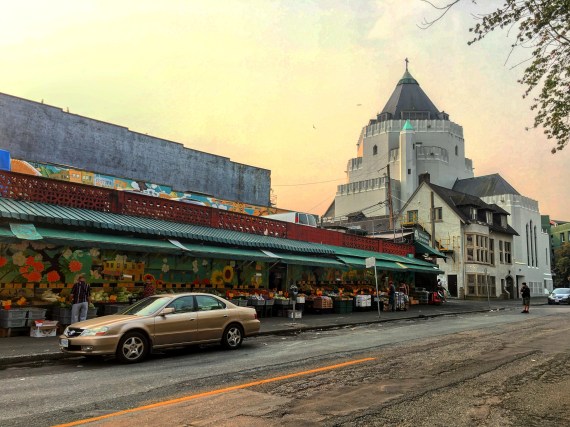
On Sunday I took two walks. One before church and one after. The first took me through the Downtown Eastside of Vancouver’s urban core. I set up the vestments and chalices for the morning Mass. Then, I left the church and headed west along the boundary between Gastown and Chinatown. Gentrification has created a kind of checker board of social housing interspersed with hip up and coming vintage stores, pizza by the slice and dive bars. Buildings tower over head. The streets are still sparse in the early cool of Sunday morning. A man lies sleeping in a doorway. A woman j-walks slowly eyes fixed to the ground. Crows and pigeons forage and peck at the street.

As I round a corner, turning north and then east, the streets are even more sparse. Trinket and tourist shops are still closed. There are a few early risers with cameras. The uneven pavement rests, waiting for the city to wake. I try to make unthreatening eye contact. I try to pray for each person. I forget. My mind wanders and then I start up again.

I return to the church and attend Mass. It is solemn and beautiful. The familiar words, chants and choreography nourish me. I relish in the tiny morsel of bread and sour wine that dissolves into my mouth, dissolving me with it.

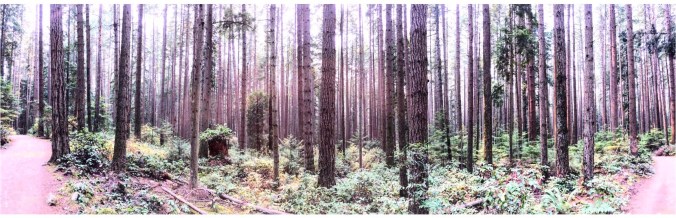
The second through a second growth douglas fir forest in North Vancouver. Its tall trees and clean air have become something of a sacred grove for me as I work through a dark period in my life. A period in my life that is rich with the productive pain of spiritual growth.  After coffee and a few greetings I drive to the Northshore and take a familiar trail down toward Lynn Creek. The trees tower over me. The sun peeks through in speckles and flecks from high above. The forest is still cool and still even though it is after noon. I ask the trees and salal to pray for me like they are saints. I pass couples and tourists, dog walkers and families. I try to make unthreatening eye contact. I try to pray for each person. I forget. My mind wanders and then I start up again. Crows and robins forage and peck at the ground. I approach the gurgle of Lynn Creek. I sit on a flat rock caressed on all sides by water. My mind drifts off into the soft sound and continuously flowing water. My two walks were really just one long walk.

img_7587.jpg

Should Non-Yogis Practice Athleticized Yoga?

In a popular online video, entitled something like Yoga for Complete Beginners, the instructor begins by inviting participants into a Sanskrit-named pose. We, the viewers, are going to relax, to ‘watch’ the breath, ‘create space’ in the body, and ‘connect’ with ourselves. We are encouraged to remember that there are no right or wrong poses. The movements are about “self-expression” and “awareness” of the body. When I finished my awkward attempts at the poses and lay on my back listening to the soft exit music of the video, I felt good. But I was soon distracted with some light self-criticism. A lifelong curmudgeon and cynic about all things trendy, I am skeptical about the surge in popularity of yoga in North America. But if yoga feels good, and contributes to a general sense of wellbeing and fitness, then what’s the problem with someone like me dabbling with it?

I have been thinking and walking with some questions about my own relationship to athleticized forms of yoga. I really do support people of any background committing to any spiritual or religious practices. I have no problem with conversion. Religions should earn their adherents, and if one’s ancestral tradition is not filling us spiritually we should look elsewhere. What I am concerned with is a twofold problem with the adoption of so-called Eastern spiritual practices by us Westerners (generally speaking Northern Europeans and European-descended diaspora communities): Appropriation of these traditions for profit, and, a shallow buffet-style mentality that actually ends up reinforcing the primary Western “religion” of consumerism and self-centered ego worship.

As a bit of background, Yoga came to the West in the 19th century, but since the 1990s has taken the Western world by storm. A 2016 survey suggests that over 36 million Americans practice some form of yoga, and the United Nations has even declared an International Day of Yoga. There is a growing yoga industry in North America, especially the Pacific Northwest, and practicing yoga classes are promoted as promising immediate physical and emotional benefits to practitioners. Characteristically, we even have North American-adapted versions of yoga that serve specific demographics: Acro, Power, Flow, Hot, Bikram, Yin, Restorative, Gentle, etc. each with a different emphasis, benefit or purpose. As journalist Hanna Rosin points out in her Atlantic article, ‘Striking a Pose’, “Where older religions promised heaven, the church of yoga promises quicker, more practical, earthly gratification, in the form of better heart rates and well-toned arms.”

In Roots of Yoga James Mallinson and Mark Singleton (2017) describe the deep historical and ecumenical roots of yoga as a spiritual path. Yoga has a diverse cast of practitioners from the beginning. It can be broadly defined as a psycho-physical technique that was designed to facilitate the achievement of overall well being and in the case of most serious yogis throughout history, spiritual enlightenment. The Vedas, the oldest religious texts in Hinduism, and arguably the world, make mention of visionary meditation, posture, mantra repetition, and breathe control as part of their central practice of venerating and petitioning various Deities.

Key passages from the Upanishads and the Mahabharata, also Hindu scriptures, mention yoga, but there are also sources going back to ancient Tantric, Buddhist and Jain traditions. This is because in around 500 BCE, Buddhists, Jains, and Ajivikas, began to split off from the Brahmanic sects to form their own ascetical cohorts and lineages motivated by finding an end to suffering and the cycle of birth and death (Samsara). The goal was liberation (moksha, nirvana), which included the annihilation of the individual ego, not its enhancement, into the Divine Source.

According to Mallinson and Singleton, yoga was initially practiced through meditation techniques. The earliest definition of Yoga comes from the Katha Upanishad, wherein the senses are held still, like a chariot driver controlling his horses. However, these Yogins also developed a suit of austerities to win favors from the gods, or to intensify their meditation practice and bring the body into alignment with the soul. Patanjali’s Yogasutras (2CE) is the most prominent text in the history of contemporary Yoga, wherein the author lays out metaphysical and practical concerns with yoga as a path to enlightenment. However, two centuries before this text, the Yogacara school of Buddhism was also teaching a form of Yoga as well, suggesting that yoga does not have a single founder or institutional origin, though it did emerge from the Indian constellation of spiritual and religious practices that have today solidified into various religious traditions.

In around 1,000 CE what is now called Hatha Yoga developed out of several lineages in India, which were designed to be more accessible to householders, rather than purely for ascetics, hermits or monks. Yoga soon became a practice that anyone could engage in regardless of caste, class or metaphysical persuasion. In essence, this was a kind of secularization of a religious practice. Hatha drew broadly from Patanjali and the Tantra tradition, but focused on a more intensive use of postures called Asanas, to lead the body and mind into greater unity. Proper diet, regulated breathing, and a focus on practice apart from caste and metaphysical school, made Hatha a diverse and widely adaptable lineage. Especially within the Hatha lineage, yoga had no centralized interpreter or missionary order, and it diffused through various Hindu-Buddhist lineages as one of many techniques which aided the seeker on the path to enlightenment.

On his tour of Europe and North America, particularly his speech at the 1893 Parliament of World Religions, Swami Vivekananda was one of the many streams of Indian spirituality that introduced yoga and Hinduism to the West. Hindu philosophy also took root within the Transcendentalist spirituality of Ralph Waldo Emerson, and the Theosophical mysticism of Helena Blavatsky. During the 1960s, like other eastern traditions, it became a foil to the establishment religions, especially Christianity, with its rigid dogmas and cerebral worship. Yoga became another badge of hippie counter-culture along with LSD, Transcendental Meditation and flower power. And of course, some were absolutely authentically drawn to yoga’s ecumenical appeal, its emphasis on practice, and its myriad benefits for wellbeing. This isn’t all that different from Yoga’s role 2,500 years earlier within counter-Brahmanic traditions such as Jain, Buddhist and forest dwelling ascetics.

Today Yoga is big business, with millions of Europeans, Diaspora Europeans and North Americans practicing some form of Yoga. In Vancouver where I live, there might not be as many yoga studios as sushi joints and coffee shops, but there are certainly as many as traditional churches or temples. Yoga as a form of exercise really took off in the 1990s with Entrepreneurial gurus such as Bikram Choudhury and a thousand others. President Barack Obama endorsed yoga as a “universal language of spiritual exercise,” and even the American College of Sports Medicine recommends integrating yoga into one’s exercise regime.

If yoga is such an adaptable and beneficial practice, what might be the problem with its athleticization in North America? Well, despite its flexibility, in its Western setting, many expressions that call themselves Yoga have been bent out of shape, to use an appropriate analogy, and has taken on a very different set of values and objectives. To be clear I do not deny the transferability and diffusion of religious and spiritual traditions. All religion is hybrid, mixture, conversation, especially the Yogic disciplines. But I can’t help but worry that the yoga boom has appropriated the mystique of yoga from its original purpose in the service of the religion of self promoted by capitalism.

Yoga, like MindfulnessTM has been co-opted into the capitalist project of desire and identity fulfillment rather than as extensions of the paths that lead to liberation and transformation. I am not against conversion, or against North American yogi’s who have found an identifiable lineage. But hip yoga fitness hubs that cater to Western standards of beauty, body type and a vaguely spiritual identity, do violence to the traditions they have borrowed from. Yoga is not a marketing slogan, a clever T-shirt punch line, or décor. It seems that yoga and mindfulness are increasingly been employed to satiate proximate desires for relaxation, productivity, bodily health and fitness, rather than as tools in the human quest for ultimate desire and fulfillment through union with the Divine, if the Divine is invoked at all. As Hanna Rosin writes, “yoga is no longer a spiritual antidote to the upscale Western lifestyle; it’s just the latest manifestation.”

Yogis should practice yoga, wherever they come from, but to appropriate yoga into the Western cult of the Self, is wrong. Practicing yoga casually, or from within another tradition may supplement our spirituality, but all too often it seems to simply foster a spiritual buffet mentality. So where should non-Yogis go for practices that promote spiritual and physical wellbeing? Does the west not have a comparable tradition? Yes, in fact we do. As journalist Linda Johnsen points out ancient Greeks and Romans practiced something like Yoga which in Greek was called Henosis or, which cultivated a single-pointed awareness of the unitary consciousness that pervades existence. The 3rd century BCE Greek philosopher Plotinus’s last words were “Try to unite the divinity in yourself, with the divinity in all things.” In the Gymnasium, where Greeks competed naked, fitness and enlightenment were stops along the same path. Only in the modern West has bodily wellness and spiritual wellness been so divided. But not without an effort to keep the two together. For example, in the 1850s there was a movement called the ‘New Gymnastics’ (with a more modest dress code) for the purpose of renewing the body and the soul in the service of ensuring healthy and balanced communities.

We in the West seem to always be looking for a remedy for the busy, sedentary modern life, even while we refuse to abandon it for something more wholesome and spirituality satisfying. So, of course one obvious response is that we need to change the structures of society so that our lives are more balanced, whole and fulfilling in the first place! But my question remains, why didn’t we just revive the gymnastics movements, or create something similar? What is it about eastern spiritualities and practices that is so irresistible to some in the secular West?

There is of course no single answer to this question, which is admittedly reductive from the start. By and large, I see a connection between the rise of the spiritual but not religious and the failure of western spiritual traditions to fully engage with practices that unify body and the soul, before engaging with metaphysical or theological questions. Many Christian denominations lead with belief, creed or scriptural interpretation, rather than teaching first and foremost ways of sinking into a deep and sustaining relationship with the Divine. Christian and yoga instructor Karen Hefford in her article “Why are People Going to Yoga Instead of Church?” sheds light on the attraction of yoga for some Christians. She writes:

“I find more comfort in the silence of my yoga practice than I do when I am in church. I feel a deeper connection while practicing yoga because it is about surrendering and finding peace… Prayer is often about asking for something or thanking God. Yoga is more about clearing the mind… and surrendering it all.”

If Christian churches are not teaching the deep tradition of silence, surrender, and peace that is at the heart of Christianity, then they have done the Christian tradition a great disservice. I’m not sure Yoga should not be a spiritual supplement, a revenue generator, or a youth magnet for churches. It is its own path to God and people who practice it should focus on walking that path. Christians should begin with their own tradition, before we dialogue and learn from others. Most find themselves in a sort of in between space, not quite Christian but not a committed Yogi. Again, I sympathize with the disappointment of the church as a whole, and the appeal to a simple embodied practice. But I think all of our traditions can do better.

For example, within the Christian Contemplative tradition there is a practice called Centering Prayer, a tradition derived from the anonymous 14th century writer of the Cloud of the Unknowing. This practice is promoted by many contemporary Christian lineages. It teaches a form of meditation that strives to go beyond words and petitions for the mysterious silence of God, the Cloud of Unknowing. It is prayer, but a form of prayer that does not treat God as a own personal vending machine. Rather Centering Prayer is a way of letting go of ideas, concepts and notions about God in the first place, which can get in the way of an experience. Quieting the body and mind, we are free to encounter the Divine.

In the mystic spiritualty aimed at self-realization of George Gurdjieff (1867-1949) often called The Work or The Fourth Way, he not only employs music, individual and group work but also a form of sacred movement or dance. Gurdjieff saw this method as unique and more advanced from the paths of monks and yogis. Though I know very little about Gurdjieff’s ideas, his movement was a kind of embodied knowing rather than a form of calisthenics.

From more solidly Christian examples, Karen Hefford points out that the 13th century Saint Dominic taught nine different symbolic postures for prayer, each of which engaged the body in a unique way; from a profound bow, to a full prostration, to genuflecting, and standing in the shape of the cross. Of course Dominic also practiced a more intense asceticism, including self-flagellation, but this will seem tame compared to the austerities of the early Yogis.

In another case, the Eastern Orthodox, who typically do not have pews in their churches, services are participated in standing. When a worshiper enters a church, they often cross themselves several times, touch the ground, kneel or prostrate themselves.

The Roman Catholic monks of New Camaldoli Hermitage in Big Sur California, are affiliated with the teachings and legacy of Fr. Bede Griffiths (1906-1992). Griffiths (we share a birthday!) began as a Benedictine monk in England, but felt deeply drawn to the spirituality of India. He ended up founding an Ashram-monastery that is now affiliated with the Camaldoli Order. Griffiths practiced yoga and was steeped in the theology and stories of Hindu scriptures. While yoga does not form part of the public liturgy of the New Camaldoli monks who hold the liturgy of the hours, many of the monks practice yoga as part of their contemplative prayer practice.

There is a lot of different ways that Christians might engage the body in spirituality without becoming Yogis. Saying the Rosary or reciting the Jesus Prayer (‘Lord Jesus Christ Son of God have mercy on me’) while stretching, doing calisthenics, running or going on contemplative walks. These forms of somatic prayer could be a seed of the return of Christian prostration sessions which are oriented toward an icon, altar, or an easterly aspect, which has deep roots and history in Christian architecture, symbolizing the return of the Sun and the Son.

Lastly, I think pilgrimage is a powerful embodied practice that incorporates travel, hiking and intention. Christians, like Hindus and Muslims, have practiced pilgrimage for thousands of years. Sometimes oriented toward penance, sometimes as a way of thinking through a problem or choice. Sometimes as a way to express grief or gratitude. but pilgrimage is a powerful practice that pushes us to our physical and emotional limits. It engages the whole person and connects us to other people, land and the non-human world.

To summarize, I am all for a full-bodied embrace of a spiritual tradition that puts one on the path to self-realization in God through harmonizing body, soul and spirit. What I am opposed to is a capitalistic cult of the spiritual identity that promises to make a few enterprising entrepreneurs richer, while reinforcing rather than eliminating the ego, the cult of sexy bodies, and the buffet style self-indulgence of some spiritual but not religious seekers. In addition, I believe that Christianity has the resources to fulfill the intuition of yoga’s appeal if it were to more creatively engage its own history, theology of the incarnation and embodied spirituality.

Why we Need the Cursing Psalms

DSC_0925.jpgToday in my morning prayers I read Psalms 58. If you are not familiar, Psalms 58 is one of the more vicious “Cursing” Psalms, wherein the poet-author begs God for vengeance on his enemies. Some exceptionally gruesome lines read:
O God, break the teeth in their mouths;

tear out the fangs of these lions, O Lord!

Let them vanish like water that runs away;

Let them wither like grass that is trodden underfoot.

Let them be like the snail that dissolves into slime,

like a woman’s miscarriage that never sees the sun.

This visceral desire for vengeance reminded me of the other infamous Psalm 137, which reads:

O daughter of Bablylon, destroyer,

blessed whoever repays you

the payment you paid us!

Blessed whoever grasps and shatters

your children on the rock!

Listening to mild mannered monks chant these lines is an interesting experience, but there is of course a theology behind it. The Psalms express and give voice to the entire range of human emotion, good and bad, and to chant the Psalms is to enter into those emotions on behalf of those who might be feeling them.

When I heard that a man known for past political activism killed two men on a train in Portland for confronting him over his harassment of two women, I felt angry. When I heard that Islamists had ambushed and killed over 20 Christians as they travelled to a monastery in Egypt, I was furious. When I heard about Manchester, Paris, Orlando, Charleston, the list goes on, I wanted justice. The cowardly acts of terrorists by these white supremacists and Islamist Extremists are cut from the same cloth.

In Psalm 137, the Psalmist is reeling from the recent leveling of Jerusalem by Babylonian forces. The carnage left the Jews feeling completely abandoned by God. And at times like this, with more and more senseless violence we can feel the same.

As a human being, my initial reaction is a desire for vengeance, justice and annihilation. But as someone who believes in the reality of the Christian story, I am also committed to reading the Psalms through the lens of Christ, who asks me to dash my vice, sin and hatred on the rock of his paschal mystery. The Psalms name the justifiable reaction, but Christ calls us to purify them, and to move toward a place of forgiveness, love and nonviolence.

Liturgy as Ecology

FullSizeRender

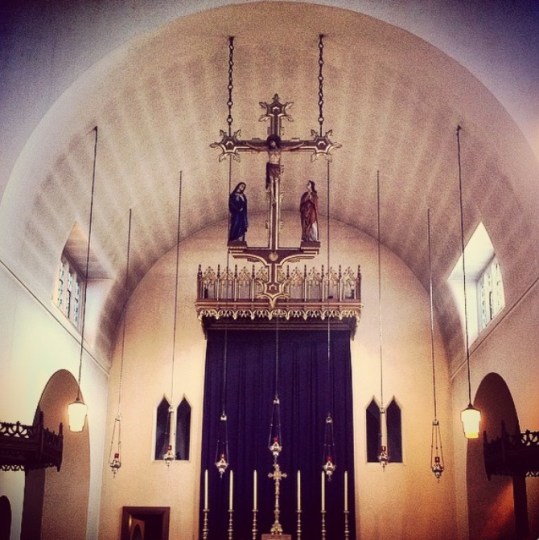
Saint James Anglican Church

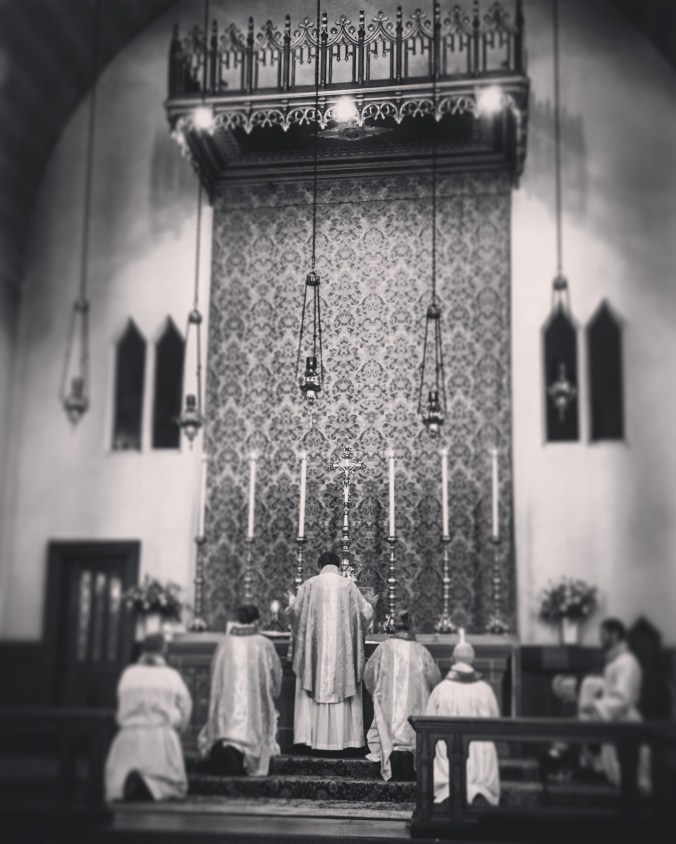
I attend a High Mass Anglo-Catholic Parish in Vancouver called Saint James. There are sometimes 12 people in the Chancel at a time, attending to the consecration of the Eucharist, swarming in dervish like semi-circles around the eastward facing priest. Priests, deacons, sub-deacons, acolytes, thurifer, torch bearers and crucifer. No single one of us, even the priest makes the dance complete. We are each an integral part of the liturgical ecology.

This is of course not a food chain, but food is involved. Our oikos is the altar,  the place where we bring the fruits of the land, the work of human hands, and  ourselves, and to turn it, ever so slowly, into God. As an ecosystem transfers energy from up the trophic hierarchy from simple to complex organisms, so we during the liturgy, move the desires of our hearts into God’s desires; a little more each day.

It is true, that if we stay on the surface, the liturgy can be boring and repetitive. But just under the surface, the intricate dance that turns bread and wine into the body and blood of Christ on the altar, is an icon for the everyday intricacy that turns our food into our bodies; bodies that make up the mystical body of Christ.

Lost in Lent

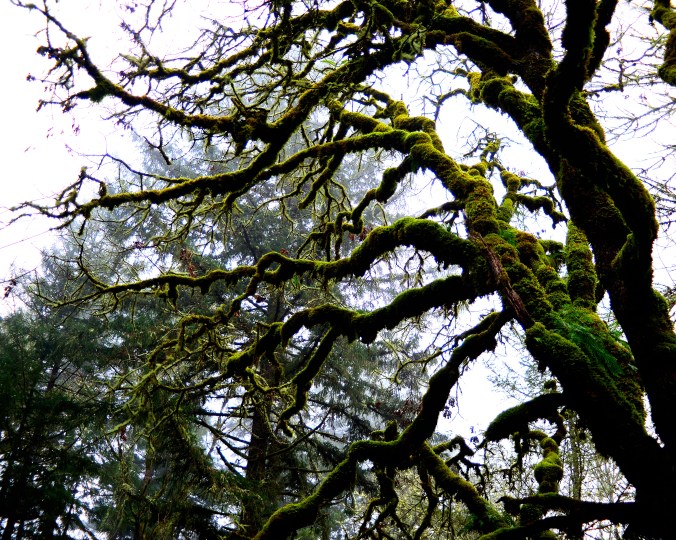
5-Moss on sleeping oak
About a week before Lent began, I took a retreat to a Benedictine monastery in central Washington. Unlike several of the other monasteries I have visited, this particular monastery was located in a more suburban setting, and, founded as a small college, the monastery is now a bustling university.

I went hoping for some silence, writing time and immersion in the familiar rhythms of the monastic liturgy. When I arrived, however, the first thing I noticed when I got out of the car, was how loud it was. I could hear I-5 rushing and hushing in the background. In addition, the liturgy was not chanted but spoken, which made it feel less vibrant, and the space of the chapel was one of those ill conceived modernist boxes. Nonetheless, the monks were kind, and I enjoyed talking with them, and learning about the monastery’s history.

The monastery started with close to 600 acres, but now retained only about 350, most of which was devoted to the campus and student housing. They had a small farm operation in the 1930s-1950s but it ended by the 1960s. Even with a smaller footprint, the monastery had taken good care of the remaining second or third growth forests, which had a number of walking trails. And even with the white noise of the freeway in the background, I enjoyed walking them.

Despite the loveliness of the forest, I ended up having a difficult time writing, felt restless during the spoken Divine Office, and everywhere I went, the freeway was audible. I ended up leaving early, so I could get home and regroup.

On the way, feeling the weight of dissertation anxiety and something of the distance that opens between us and the Divine at times, I decided to go for a hike at my favorite protected area in Bellingham, Washington, Stimpson Family Nature Preserve. It was late in the afternoon, and a friend and I headed around the wet, still snowy in places, trail.

It is one of the few older growth forests in the area, and I often feel God’s presence there as I breathe the clean cool air, and marvel at the riot of colors. But this time, riding the wave of restlessness from my retreat, I felt a very strong sense of God’s absence. It hit me like a wave, a sudden pang of nihilistic agnosticism, and the darkening forest, still silent and deadened to winter, felt cold, indifferent and lifeless.

For several days after this, I pondered the dark mood that had descended. I stopped praying, and considered skipping Church for a few weeks. My usual excitement for Lent turned into a smoldering dread.

I recently decided to join an Anglo-Catholic Parish in Vancouver because of its wonderful liturgy, and I had signed up to be part of the altar party as a torch bearer on Ash Wednesday. So, despite the darkness that had descended onto my spiritual life, I decided to go.

At first I felt sad, and distant, but as the liturgy proceeded, my attention sharpened, and I began to feel lighter. During the consecration of the Eucharist, which like Traditionalist Catholic Mass is said with the Priest facing the altar, as torch bearer, I knelt with the candle behind the priest. As the bells rang and the priest lifted the bread and then the wine, a subtle shift occurred in my chest. The utter strangeness and beauty of the liturgy penetrated my dark mood, and lifted me back into a place of openness and receptivity. It was nothing profound, or revelatory, but a perceptible change. I was again, ready to enter into simplicity and silence of Lent, in anticipation of Easter.

Reflecting on this ‘Dark Night of the Soul’, I began to understand the gift that God’s absence can sometimes be. I remembered the scene in 1 Kings 19, where Elijah is called out of his hiding place in a cave by God:

Then a great and powerful wind tore the mountains apart and shattered the rocks before the Lord, but the Lord was not in the wind. After the wind there was an earthquake, but the Lord was not in the earthquake. After the earthquake came a fire, but the Lord was not in the fire. And after the fire came a gentle whisper. When Elijah heard it, he pulled his cloak over his face and went out and stood at the mouth of the cave.” (NIV) 

Of course God is present to all things, but She cannot be confined to any one of the elements. Having experienced God’s presence so deeply in forests over the years, it was alarming to feel such a sense of despair, and emptiness. But it is true, just as the forest is a place of beauty and life; it is also a place of suffering and death. If God were wholly present to the forest, there would be no distance to cross between us.

As Pope Francis writes in Laudato Si:

“Our relationship with the environment can never be isolated from our relationship with others and with God. Otherwise, it would be nothing more than romantic individualism dressed up in ecological garb, locking us into a stifling immanence” (Laudato Si, 119).

I am most certainly guilty of romanticism, but this phrase, “stifling immanence” keeps coming back to me. God is everywhere present, and hold all things in existence at each moment. But there remains an infinite gap between us.

As I deepen my Lenten journey with prayer, fasting and silence, I am grateful for this lesson, and it has served as rich food in the Desert of Lent this year.

DSC_0858

The Tower of Silence

The Prophet Zoroaster

The Prophet Zoroaster. Source: Wikipedia

I recently did an interview with three Zoroastrians who live here in Vancouver. As I was preparing for the interview, I learned the fascinating history of the death rituals practiced by ancient and some modern Zoroastrian communities.

Briefly, Zoroastrians are followers of the teachings of the prophet Zarathustra, or Zoroaster in Greek, who is thought to have lived some time between 1,500 and 650 BCE. They are probably the first monotheistic religions with a great reverence for the elements, especially fire, which is a kind of incarnation of wisdom.

However, because of a dualistic cosmology, with the forces of good and evil forever at odds, dead bodies are believed to be quickly tainted by evil spirits. Because the elements are holy, death must be dealt with in such a way that the elements are not tainted by the corpse. This means no burial, no cremation, or setting out to sea. Traditionally then, Zoroastrians have conducted what is often referred to as ‘sky burial.’ The corpse is taken to a place called a Tower of Silence, where carrion eaters such as vultures devour the corpse. The technical term for this is excarnation, and it is also practiced by certain sects of Tibetan Buddhism, and in Mongolia, Bhutan, and Nepal.

Mumbai Tower of Silence Entrance Source: Wikipedia

Mumbai Tower of Silence Entrance
Source: Wikipedia

One particular case that drew my attention, was the Zoroastrian community in Mumbai, whose Tower of Silence called the Doongerwadi, is surrounded by 54 acres of unmanaged forest, creating a small oasis. The Tower was built in the late 1600s, but is located in what is now an upper middle class neighborhood.

However, in the 1990s, the vulture population, which traditionally devoured the corpses in short order, collapsed due to the use of a drug administered to cattle, which was then ingested by the birds who had eaten the remains of treated cows. In some places, the vulture population was decreased by 99%.

This decrease in the vulture population, has meant that there are not enough birds to properly decompose the corpses of Mumbai’s Zoroastrian community, and there are worries about the public health implications of half decomposed corpses sitting around, even with the forest buffer.

In response, Zoroastrian activists have begun experimenting. There is a vulture breeding program in the works that is having some success, but others have began experimenting with solar concentrators which direct the suns heat onto the decomposing corpses which dries them out and speeds up decomposition time.

Sources

https://www.theguardian.com/cities/2015/jan/26/death-city-lack-vultures-threatens-mumbai-towers-of-silence

http://news.bbc.co.uk/2/hi/south_asia/1443789.stm

Homily: Living Symbols

[Homily delivered Feb. 26, 2017 to Saint Margaret Cedar-Cottage Anglican Church.]

img_6588

At 4:13 AM I stumbled in the pale darkness to my choir stall. When I finally looked up through the west facing window of the chapel at Our Lady of Guadalupe Abbey in northwestern Oregon, a glowing full moon was setting through a light haze. The monks began to chant the early morning Divine Office of Vigils, a ritual that unfolds day after day, month after month, and year after year in monasteries all over the world.

This month-long immersive retreat in 2014, inspired the questions that would become my PhD dissertation research, which I completed over a six month period in 2015 and 2016. I am now in writing the dissertation, and should be done in the next 2, 3, 4 or 5 months. I wanted to better understand the relationship between the 1,500 year old monastic tradition, contemporary environmental discourses and the land. And I wanted to better describe for the emerging Spiritual Ecology literature the ways that theological ideas and spiritual symbols populate monastic spirituality of place and creation.

Exodus 24:12-18

In the readings this morning, we are gifted several land-based symbols. God says to Moses in Exodus: “Come up to me on the mountain.” Liberated from Egypt, God is now eager to build a relationship with his people and Moses’s ascent of Mount Sinai to receive the Law mirrors our own spiritual journeys. A thick cloud covered the mountain for six days before Moses was finally called into God’s presence, like so much of my own spiritual life, lived in darkness, with small rays of light.

Matthew 17:1-19

In the Gospel reading, Jesus too ascends a “high mountain.” There, his disciples witness one of the most perplexing scenes in the New Testament: The Transfiguration. Jesus’s face and garments shone like the sun. And then, certainly conscious of the Hebrew text, the writer says that a bright cloud overshadowed them and they heard a voice say: “This is my Son, the Beloved; with him I am well pleased; listen to him!” Christ, who was fully human and fully God, was revealing in his very person to Peter, James and John his fulfillment of the Law and the Prophets. And presence of the symbols of mountain and cloud were bound up in the authenticity of Jesus’s claims to messianic authority.

2 Peter 1:16-21

Even though it’s not clear that the Apostle Peter is the author of our second reading, the message is clear: “For we did not follow cleverly devised myths when we made known to you the power and coming of our Lord Jesus Christ, but we had been eyewitnesses of his majesty.” Reading Exodus and Matthew, it might feel simple to slip into an easy allegorical hermeneutic, to see everything as a symbol; but the writer of 2 Peter is clear: Stop trying to turn everything into a myth! This reminds me of the quote from Catholic writer Flannery O’Conner who said of the Real Presence in the Eucharist, “If it’s just a symbol, to hell with it.”

img_6579With these texts in mind, especially questions of religious symbols and religious realities, I want to talk a little bit about my research with monastic communities, and then return to these texts at the end. Monasticism, like Christianity as a whole is steeped in symbols. For example, the Abbas and Ammas of the early monastic tradition experienced the desert as a symbol of purification and sanctification. Saint Anthony fled to the desert to live a life of solitude, spiritual warfare and strict asceticism. The silence and nakedness of the desert landscape was as it were a habitat for the silence and simplicity that led the Desert Fathers and Mothers through the wilderness of their own sin to the simplicity of God’s presence. As Saint Jerome wrote, “The desert loves to strip bare.”
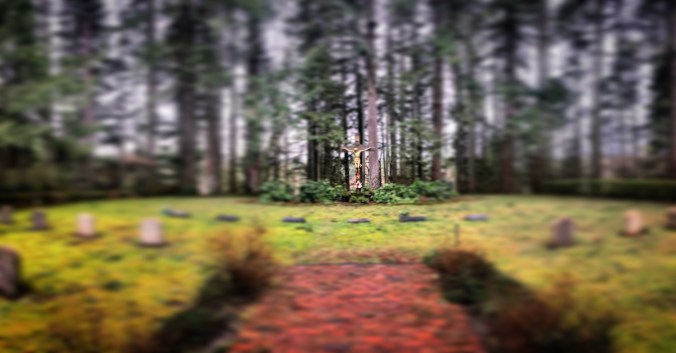
The motifs of the Desert-wilderness and the Paradise-garden are like two poles in Biblical land-based motifs. Pulling the people of Israel between them. Adam and Eve were created in a garden, but driven to the wilderness. The people of Israel were enslaved in the lush Nile Delta, but liberated into a harsh desert. The prophets promised the return of the garden if Israel would flee the wilderness of their idolatry. Christ suffered and resurrected in a garden after spending 40 days in the wilderness. The cloister garden at the center of the medieval monastery embodied also this eschatological liminality between earth and heaven, wilderness and garden.

Mountains too were and continue to be powerful symbols of the spiritual life. From Mount Sinai to Mount Tabor, John of the Cross and the writer of the Cloud of Unknowing, each drawing on the metaphors of ascent and obscurity.

But do you need a desert to practice desert spirituality?

Do you need the fecundity of a spring time garden to understand the resurrection?

I would argue that we do.

For my PhD research, I conducted 50 interviews, some seated and some walking, with monks at four monasteries in the American West. My first stop was to New Camaldoli Hermitage in Big Sur, California. The community was established in 1958 by monks from Italy. The Hermitage is located on 880 acres in the Ventana Wilderness of the Santa Lucia Mountains. Coastal Live Oak dominate the erosive, fire adapted chaparral ecology, and the narrow steep canyons shelter the southernmost reaches of Coastal Redwood. The monks make their living by hosting retreatants and run a small fruitcake and granola business.

The second monastery I visited was New Clairvaux Trappist Abbey, which is located on 600 acres of prime farmland in California’s Central Valley and was founded in 1955. It is located in orchard country, and they grow walnuts and prunes, and recently started a vineyard. They are flanked on one side by Deer Creek, and enjoy a lush tree covered cloister that is shared with flocks of turkey vultures and wild turkeys that are more abundant than the monks themselves. They recently restored a 12th century Cistercian Chapter house as part of an attempt to draw more pilgrims to the site.

Thirdly, I stayed at Our Lady of Guadalupe Trappist Abbey, which was also founded in 1955, in the foothills of the Coastal Range in Western Oregon. When they arrived, they found that the previous owner had clear cut the property and run. They replanted, and today the 1,300 acre property is covered by Douglas fir forests, mostly planted by the monks. Though they began as grain and sheep farmers, today the monastery makes its living through a wine storage warehouse, a bookbindery, a fruitcake business, and a sustainable forestry operation.

For my last stop, I headed to the high pinyon-juniper deserts of New Mexico. At the end of a 13 mile muddy dirt road, surrounded by the Chama River Wilderness, an adobe chapel stands in humble relief against steep painted cliffs. Founded in 1964, Christ in the Desert Abbey is the fastest growing in the Order, with over 40 monks in various stages of formation. The monks primarily live from their bookstore and hospitality, but also grow commercial hops which they sell to homebrewers.

In my interviews, the monastic values of Silence, Solitude and Beauty were consistently described as being upheld and populated by the land. The land was not just a setting for a way of life, but elements which participated in the spiritual practices of contemplative life. To use a monastic term, the land incarnates, gives flesh, to their prayer life.

Thus, the monks live in a world that is steeped in religious symbols through their daily practice of lectio divina, and the chanting of the Psalms. As one monk of Christ in the Desert put it:

“Any monk who has spent his life chanting the Divine Office cannot have any experience and not have it reflect, or give utterance in the Psalmody. The psalmody is a great template to place on the world for understanding it, and its language becomes your own.”

In this mode, the land becomes rich with symbol: a tree growing out of a rock teaches perseverance, a distant train whistle reminds one to pray, a little flower recalls Saint Therese of Lisieux, a swaying Douglas fir tree points to the wood of the cross, a gash in a tree symbolizes Christ’s wounds. In each case, the elements of the land act as symbol within a system of religious symbology. One monk of Christ in the Desert, who wore a cowboy hat most of the time related:

“When the moon rises over that mesa and you see this glowing light halo. It echoes what I read in the Psalms. In the Jewish tradition the Passover takes place at the full moon, their agricultural feasts are linked to the lunar calendar. When they sing their praises, ‘like the sunlight on the top of the temple,’ ‘like the moon at the Passover Feast.’ ‘Like the rising of incense at evening prayer.’ They’re all describing unbelievable beauty. I look up and I’m like that’s what they were talking about.”

The land populates familiar Psalms, scriptures and stories with its elements and thus enriches the monastic experience of both text and land.

Theologically speaking, God’s presence in the land is a kind of real presence that does not just point to, but participates in God. This gives an embodied or in their words, incarnational, quality to their experience of the land. As another example, one monk went for a long walk on a spring day, but a sudden snow storm picked up and he almost lost his way. He related that from then on Psalm 111 that states “Fear of the Lord is the beginning of wisdom” took on a whole new meaning.

In addition, the monks often spoke of their experiences on the land in terms of flashes of insight, or moments of clarity that transcended any specific location or symbolic meaning. One monk called these experiences “charged moments” where a tree or vista one sees frequently, suddenly awakens to God’s presence.

The monks at each community, in their own ways, have sunken deep roots into the lands they live on and care for. Each, in the Benedictine tradition, strive to be “Lovers of the place” as the Trappist adage goes. When I asked one monk if this meant that the landscape was sacred, he paused and said, “I would only say that it is loved.”

I am arguing in my dissertation that monastic perception of landscape can be characterized as what an embodied semiotics. By this I simply mean that symbols and embodied experience reinforce each other in the landscape, and without embodied experience symbols are in danger of losing their meaning.

The motifs of desert and wilderness, the symbols of water, cloud, mountain, doves, bread and wine, the agricultural allegories of Jesus, and the garden, are in this reading, reinforced by consistent contact with these elements and activities in real life.

On the last Sunday before Lent, as we move into the pinnacle of the Christian calendar, it is no coincidence that the resurrection of the body of Jesus is celebrated during the resurrection of the body of the earth. But does this mean that Jesus’s resurrection can be read as just a symbol, an archetype, a metaphor for the undefeated message of Jesus? Certainly Peter and the other Apostles would say no. They did not give up their own lives as martyrs for a metaphor.

For a long time I struggled with believing in the resurrection as a historical reality. But when I began to realize the connection between the land and the paschal mystery, it was the symbols in the land itself that drew me to the possibility of Christ’s resurrection. And that in turn reinforced my ability to see Christ in the entire cosmic reality of death and rebirth active and continual in every part of the universe.

As Peter warns his readers: “You will do well to be attentive to this as to a lamp shining in a dark place, until the day dawns and the morning star rises in your hearts.” For how can we truly believe in the return of the Beloved Son, if we have never been up early enough to see the return of the star we call sun?

img_6568

Sacred Groves

img_6302

Prelude

Imagine the most common of trees, the Christmas (or Solstice) tree, decorated with globes, lights and a star on top. Allow that tree to grow in your mind so that it fills the sky.

The bright star at the very top of the tree merges with the North Star, Polaris.

Now imagine that the gold and silver globes become the sun, the phases of the moon, and the other planets moving through the sky, appearing to pivot around the North Star.

Imagine that the twinkling lights are billions and billions of stars.

The Christmas tree is a microcosm of the macrocosm.

The Norse pagans placed the ash tree at the center of their cosmology.

Its sprawling roots descended into the underworld; its trunk and branches passed through the mortal realm, ascending to heavenly.

The Maya imaged the cosmos as a great Ceiba tree, which also descended to the underworld and ascended through thirteen levels of heaven, each level with its own god.

The sun and moon made their way along the Ceiba’s trunk, and the spirits of the dead moved along its rough bark.

The naturalist and pantheist John Muir used to climb to the top of large pine trees during rain storms. About trees and the universe he mused:

We all travel the Milky Way together, trees and [humans]; but it never occurred to me until th[at] stormy day, while swinging in the wind, that trees are travelers, in the ordinary sense. They make many journeys, not extensive ones, it is true; but our own little journeys, away and back again, are only little more than tree-wavings—many of them not so much.

The Tree of Life

In the beginning, the tree of life emerged as a tiny seedling.

Soon, it branched out into everything we call living: microbes, fungi, plants, trees, animals.

The seeds of humans germinated in the trees.

Our mammalian and primate ancestors made their homes in their bows.

Eventually, our curiosity compelled us down from the safety of their branches and out onto the savanna.

Yet, the trees never left us;

They continued to provision us with gifts on our long walks.

They gave food, fodder, shelter, tools, medicine and stories.

They appeared in our dreams.

It was here, in a forest, that Zoroaster in Persia saw the Saena Tree in a vision emerging from the primeval sea, a tree from whose seeds all other plants would grow.

It was here that Yahweh, Semitic sky god, came to earth and planted a garden of trees, pleasing to the eye and good for food.

It was here that Inanna, Babylonian goddess of beauty and love, nourished the Huluppu tree on the banks of the Euphrates River.

It was here that Kaang, creator god of the Batswana Bushmen, created the first mighty tree and led the first animals and people out from the underworld through its roots and branches.

It was here that the sacred tree gave light to the Iroquois’s island in the sky—before the sun was made, before Sky Woman fell through a hole in the island in the sky, and before the earth was formed on the back of a great turtle.

It was here that the Mayan Tree of Life lifted the sky out from the primordial sea, surrounded by four more trees that hold the sky in place and mark the cardinal directions.

First Visions

It was here, in a forest, that the first whispers of the divine spoke to human consciousness.

It was here that Jacob wrestled with angels and beheld visions.

It was here that Hindu seekers learned the wisdom of gurus.

It was here, seated beneath the Bodhi tree, that Siddhartha Gautama became the Buddha.

It was here that Moses fasted, prayed, and received God’s Law.

It was here that Muhammad sought refuge in mountain caves and spoke the words of the holy Koran.

It was here that Guru Nanak experienced the Oneness of God.

It was here that Nephi of the Book of Mormon communed with angels and beheld the glorious fruit of the Tree of Life.

First Temples

It was here, in a forest, that we built our first temples and worshipped God without priesthoods.

It was here that Asherah, Canaanite goddess of all living things, was worshipped.

It was here, as Sycamore fig, that Isis of Egypt was lavished praise.

It was here, in grove of sacred oak, that the Druids passed on their knowledge, and sacrificed human flesh to the gods.

It was also here, in the forest, that, after civilization blossomed, we looked for inspiration—

Temples of stone with their pillars, columns, and cathedral arches were all made to resemble the trunks of trees, carrying the eye upward to God.

And yet, it would seem that these temples of stone confined God to one place, one people, one faith.

Fall

It was here that we fell from grace.

It was here that Adam and Eve ate the fruit of a misunderstood tree.

It was here that civilization bloomed.

It was here that we logged, burned, mined, clear-cut, developed.

It was here that the old stories were forgotten and new ones were written;

Stories in which creation was no longer sacred, enchanted, animate, subjective.

Return

In an age of climate chaos and heart breaking extinction, it is here, to the forest, that we must return.

Not only as skiers, hikers, campers, birders, hunters, and foresters, but as devotees.

Because it is here that we see the universe in microcosm, where we get our bearings.

It is here that creation awes.

It is here that we experience the divine.

It is here that we can bring our questions.

It is here that we can dwell in mystical solitude.

It is here that we are now—The global forest.

Call

To return to the forest, we must become familiar with it.

I invite you to go to a mountain grove or a city park and take off your shoes.

When you are comfortable and alone, close your eyes.

Begin by focusing on feeling—as a tree might—the sun, the wind, the earth beneath your toes and on your skin.

If you wish, stretch your arms up and out like branches seeking the light.

Imagine drinking in the caramel rays of the sun as nourishment.

Focus on your breath by letting the air pass through your nostrils and fill the arboreal-patterned branches in your lungs.

Feel your lungs slowly fill with oxygen.

Feel them slowly empty as your body expels carbon dioxide.

Focus on the entire process of breathing and how each moment changes.

In and out.

As you breathe in, imagine that the oxygen, conceived in the leaves of trees, is gently birthed from the leaf’s stomata, wafting through space, and entering your lungs.

As you breathe out, imagine that the CO2, re-born in your lungs, is gently wafting through the air and entering the receptive stomata of the leaves.

In and out.

The air becomes us, becomes them.

It is a sacrament; we take it upon us, into us, and they upon themselves.

As we breathe in, the trees breathe out.

As the trees breathe out, we breathe in.

We are their lungs and they are ours.

In and out.

This is not a supernatural idea; it is an ecological reality.

May we dwell in this reality!

The mystic monk and (one time monastery forester) Thomas Merton said:

We are already one. But we imagine that we are not. And what we have to recover is our original unity. What we have to be is what we are.

What we are is not all that different from trees.

And so I offer you this prayer for your walks and sits among the trees.

Forest, Trees. May we sustain you as you sustain us.