Liturgy as Ecology

FullSizeRender

Saint James Anglican Church

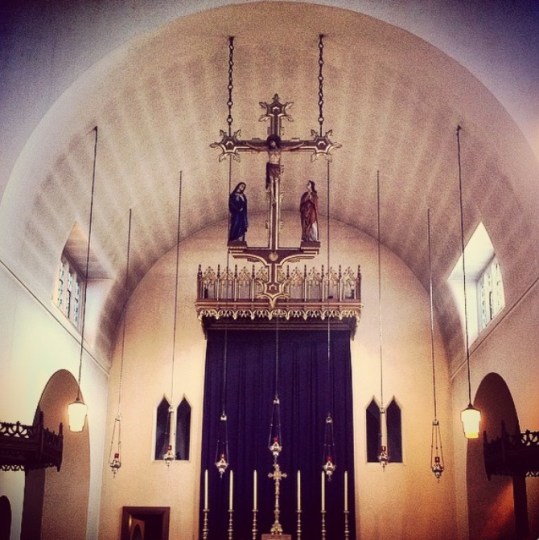
I attend a High Mass Anglo-Catholic Parish in Vancouver called Saint James. There are sometimes 12 people in the Chancel at a time, attending to the consecration of the Eucharist, swarming in dervish like semi-circles around the eastward facing priest. Priests, deacons, sub-deacons, acolytes, thurifer, torch bearers and crucifer. No single one of us, even the priest makes the dance complete. We are each an integral part of the liturgical ecology.

This is of course not a food chain, but food is involved. Our oikos is the altar,  the place where we bring the fruits of the land, the work of human hands, and  ourselves, and to turn it, ever so slowly, into God. As an ecosystem transfers energy from up the trophic hierarchy from simple to complex organisms, so we during the liturgy, move the desires of our hearts into God’s desires; a little more each day.

It is true, that if we stay on the surface, the liturgy can be boring and repetitive. But just under the surface, the intricate dance that turns bread and wine into the body and blood of Christ on the altar, is an icon for the everyday intricacy that turns our food into our bodies; bodies that make up the mystical body of Christ.

The Gardener

Slide1
In today’s Gospel reading from John 20:12-15 we read:

“But Mary stayed outside the tomb weeping. And as she wept, she bent over into the tomb and saw two angels in white sitting there, one at the head and one at the feet where the body of Jesus had been. And they said to her, “Woman, why are you weeping?” She said to them, “They have taken my Lord, and I don’t know where they laid him.” When she had said this, she turned around and saw Jesus there, but did not know it was Jesus. Jesus said to her, “Woman, why are you weeping? Whom are you looking for?” She thought it was the gardener and said to him, “Sir, if you carried him away, tell me where you laid him, and I will take him.”

We all know what happens next. This familiar Easter narrative has both delighted and puzzled Christians over the centuries. Mary Magdalene, a woman, was the first to see the resurrected Jesus. She was the Apostle to the Apostles, the first member of the Christian Church. We have often wondered, however, why it was that she did not immediately recognize Jesus.

One Jewish legend of the time, attempting to discredit the story of the resurrection, speaks of a man named Judas, who was worried that Jesus’s disciples would trample his cabbages when they came to visit his tomb. So, he relocated Jesus to another tomb, and the myth of the resurrection began. It is said by Biblical scholar Rudolf Schnackenberg, that perhaps this story is the reason John’s Gospel refers to Jesus as a gardener in the first place.

Other commentators have of course pointed to Mary’s grief, or even her focus on the worldly body of Jesus as reasons why she did not at first see her Teacher. Or, perhaps the author of the Gospel was playing with the familiar ancient trope of the disguised returning hero (See Homer’s Odyssey).

I would like to suggest a much simpler possibility. Perhaps Mary mistook Jesus for a gardener, because he was gardening. The scripture says that Mary turns around and sees Jesus there, it does not say that Jesus was facing her. Perhaps she noticed his presence, but his face was obscured because he was hunched over, hands in the dirt, taking in the smells of the earth on the early morning after he had suffered so much, and been miraculously returned to life.

The dialogue that ensues between Mary and Jesus could have taken place at a short distance, as Jesus playfully repeats the words of the angels, “why are you crying?” and Mary hopelessly asks if perhaps he knows where her Teacher has been laid. Perhaps he then got up from his task, and put his hand on Mary’s shuddering shoulder and spoke more directly: “Mary!” And when she looked up, only then did she recognize the face of the man she had come to love and respect so much.

Now, of course this is speculation, but I feel like this reading enriches many of the existing elements of symbolism in salvation history. As many commentators have pointed out from the earliest days of the church, including Paul, whereas Adam brings sin and death into the world through disobedience in the Garden of Eden, it is Christ, who in the Garden of Gethsemane and then the garden of the tomb points to the final Garden of the Resurrection. The Garden of Eden begins the salvation narrative, and the garden tomb finishes it. Jesus is the new Adam, as Mary is the new Eve. Christ suffered in a garden. He rises in a garden. As the second Adam, he is the “Greater Gardener.”

Sometimes we imagine the resurrected Jesus as a white-clad, angel like man. But the accounts of the resurrection, often portray him in day-to-day scenes. He appears to Apostles in a small room, and eats with them; He appears to two men walking along the road, and again eats with them; He sits by the Lake of Galilee and cooks breakfast over a fire. I am reminded of the familiar Zen Koan, “Before enlightenment, chop wood, carry water. After enlightenment, chop wood, carry water.” Before the resurrection, fully human and fully divine, after the resurrection, fully human and fully divine.

We will never know for certain of course, but there is nothing that convicts me of the both the reality and naturalness of the resurrection more than watching the cycles of birth, life, death, decay and rebirth that happen each year in the garden that we call earth.

References

Schnackenberg, Rudolf. The Gospel According to St. John: Volume III. Crossroad, 1990.

Lost in Lent

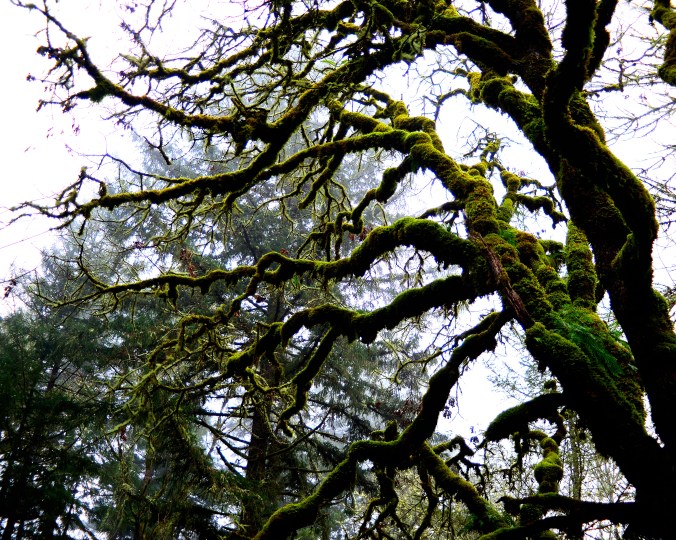
5-Moss on sleeping oak
About a week before Lent began, I took a retreat to a Benedictine monastery in central Washington. Unlike several of the other monasteries I have visited, this particular monastery was located in a more suburban setting, and, founded as a small college, the monastery is now a bustling university.

I went hoping for some silence, writing time and immersion in the familiar rhythms of the monastic liturgy. When I arrived, however, the first thing I noticed when I got out of the car, was how loud it was. I could hear I-5 rushing and hushing in the background. In addition, the liturgy was not chanted but spoken, which made it feel less vibrant, and the space of the chapel was one of those ill conceived modernist boxes. Nonetheless, the monks were kind, and I enjoyed talking with them, and learning about the monastery’s history.

The monastery started with close to 600 acres, but now retained only about 350, most of which was devoted to the campus and student housing. They had a small farm operation in the 1930s-1950s but it ended by the 1960s. Even with a smaller footprint, the monastery had taken good care of the remaining second or third growth forests, which had a number of walking trails. And even with the white noise of the freeway in the background, I enjoyed walking them.

Despite the loveliness of the forest, I ended up having a difficult time writing, felt restless during the spoken Divine Office, and everywhere I went, the freeway was audible. I ended up leaving early, so I could get home and regroup.

On the way, feeling the weight of dissertation anxiety and something of the distance that opens between us and the Divine at times, I decided to go for a hike at my favorite protected area in Bellingham, Washington, Stimpson Family Nature Preserve. It was late in the afternoon, and a friend and I headed around the wet, still snowy in places, trail.

It is one of the few older growth forests in the area, and I often feel God’s presence there as I breathe the clean cool air, and marvel at the riot of colors. But this time, riding the wave of restlessness from my retreat, I felt a very strong sense of God’s absence. It hit me like a wave, a sudden pang of nihilistic agnosticism, and the darkening forest, still silent and deadened to winter, felt cold, indifferent and lifeless.

For several days after this, I pondered the dark mood that had descended. I stopped praying, and considered skipping Church for a few weeks. My usual excitement for Lent turned into a smoldering dread.

I recently decided to join an Anglo-Catholic Parish in Vancouver because of its wonderful liturgy, and I had signed up to be part of the altar party as a torch bearer on Ash Wednesday. So, despite the darkness that had descended onto my spiritual life, I decided to go.

At first I felt sad, and distant, but as the liturgy proceeded, my attention sharpened, and I began to feel lighter. During the consecration of the Eucharist, which like Traditionalist Catholic Mass is said with the Priest facing the altar, as torch bearer, I knelt with the candle behind the priest. As the bells rang and the priest lifted the bread and then the wine, a subtle shift occurred in my chest. The utter strangeness and beauty of the liturgy penetrated my dark mood, and lifted me back into a place of openness and receptivity. It was nothing profound, or revelatory, but a perceptible change. I was again, ready to enter into simplicity and silence of Lent, in anticipation of Easter.

Reflecting on this ‘Dark Night of the Soul’, I began to understand the gift that God’s absence can sometimes be. I remembered the scene in 1 Kings 19, where Elijah is called out of his hiding place in a cave by God:

Then a great and powerful wind tore the mountains apart and shattered the rocks before the Lord, but the Lord was not in the wind. After the wind there was an earthquake, but the Lord was not in the earthquake. After the earthquake came a fire, but the Lord was not in the fire. And after the fire came a gentle whisper. When Elijah heard it, he pulled his cloak over his face and went out and stood at the mouth of the cave.” (NIV) 

Of course God is present to all things, but She cannot be confined to any one of the elements. Having experienced God’s presence so deeply in forests over the years, it was alarming to feel such a sense of despair, and emptiness. But it is true, just as the forest is a place of beauty and life; it is also a place of suffering and death. If God were wholly present to the forest, there would be no distance to cross between us.

As Pope Francis writes in Laudato Si:

“Our relationship with the environment can never be isolated from our relationship with others and with God. Otherwise, it would be nothing more than romantic individualism dressed up in ecological garb, locking us into a stifling immanence” (Laudato Si, 119).

I am most certainly guilty of romanticism, but this phrase, “stifling immanence” keeps coming back to me. God is everywhere present, and hold all things in existence at each moment. But there remains an infinite gap between us.

As I deepen my Lenten journey with prayer, fasting and silence, I am grateful for this lesson, and it has served as rich food in the Desert of Lent this year.

DSC_0858

Homily: Living Symbols

[Homily delivered Feb. 26, 2017 to Saint Margaret Cedar-Cottage Anglican Church.]

img_6588

At 4:13 AM I stumbled in the pale darkness to my choir stall. When I finally looked up through the west facing window of the chapel at Our Lady of Guadalupe Abbey in northwestern Oregon, a glowing full moon was setting through a light haze. The monks began to chant the early morning Divine Office of Vigils, a ritual that unfolds day after day, month after month, and year after year in monasteries all over the world.

This month-long immersive retreat in 2014, inspired the questions that would become my PhD dissertation research, which I completed over a six month period in 2015 and 2016. I am now in writing the dissertation, and should be done in the next 2, 3, 4 or 5 months. I wanted to better understand the relationship between the 1,500 year old monastic tradition, contemporary environmental discourses and the land. And I wanted to better describe for the emerging Spiritual Ecology literature the ways that theological ideas and spiritual symbols populate monastic spirituality of place and creation.

Exodus 24:12-18

In the readings this morning, we are gifted several land-based symbols. God says to Moses in Exodus: “Come up to me on the mountain.” Liberated from Egypt, God is now eager to build a relationship with his people and Moses’s ascent of Mount Sinai to receive the Law mirrors our own spiritual journeys. A thick cloud covered the mountain for six days before Moses was finally called into God’s presence, like so much of my own spiritual life, lived in darkness, with small rays of light.

Matthew 17:1-19

In the Gospel reading, Jesus too ascends a “high mountain.” There, his disciples witness one of the most perplexing scenes in the New Testament: The Transfiguration. Jesus’s face and garments shone like the sun. And then, certainly conscious of the Hebrew text, the writer says that a bright cloud overshadowed them and they heard a voice say: “This is my Son, the Beloved; with him I am well pleased; listen to him!” Christ, who was fully human and fully God, was revealing in his very person to Peter, James and John his fulfillment of the Law and the Prophets. And presence of the symbols of mountain and cloud were bound up in the authenticity of Jesus’s claims to messianic authority.

2 Peter 1:16-21

Even though it’s not clear that the Apostle Peter is the author of our second reading, the message is clear: “For we did not follow cleverly devised myths when we made known to you the power and coming of our Lord Jesus Christ, but we had been eyewitnesses of his majesty.” Reading Exodus and Matthew, it might feel simple to slip into an easy allegorical hermeneutic, to see everything as a symbol; but the writer of 2 Peter is clear: Stop trying to turn everything into a myth! This reminds me of the quote from Catholic writer Flannery O’Conner who said of the Real Presence in the Eucharist, “If it’s just a symbol, to hell with it.”
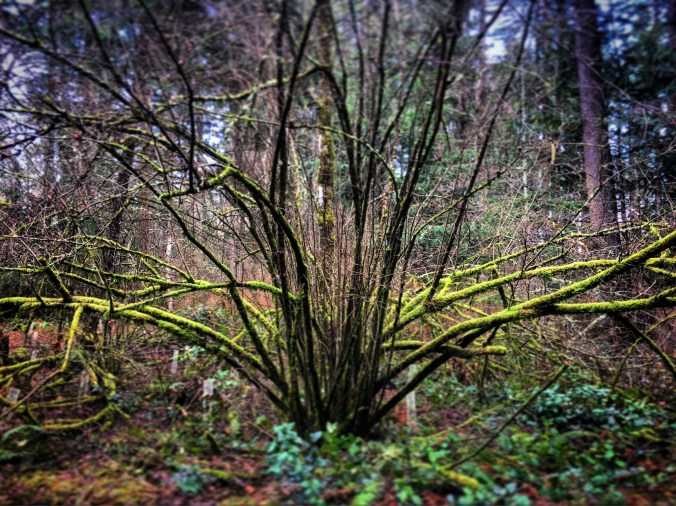
img_6579With these texts in mind, especially questions of religious symbols and religious realities, I want to talk a little bit about my research with monastic communities, and then return to these texts at the end. Monasticism, like Christianity as a whole is steeped in symbols. For example, the Abbas and Ammas of the early monastic tradition experienced the desert as a symbol of purification and sanctification. Saint Anthony fled to the desert to live a life of solitude, spiritual warfare and strict asceticism. The silence and nakedness of the desert landscape was as it were a habitat for the silence and simplicity that led the Desert Fathers and Mothers through the wilderness of their own sin to the simplicity of God’s presence. As Saint Jerome wrote, “The desert loves to strip bare.”

The motifs of the Desert-wilderness and the Paradise-garden are like two poles in Biblical land-based motifs. Pulling the people of Israel between them. Adam and Eve were created in a garden, but driven to the wilderness. The people of Israel were enslaved in the lush Nile Delta, but liberated into a harsh desert. The prophets promised the return of the garden if Israel would flee the wilderness of their idolatry. Christ suffered and resurrected in a garden after spending 40 days in the wilderness. The cloister garden at the center of the medieval monastery embodied also this eschatological liminality between earth and heaven, wilderness and garden.

Mountains too were and continue to be powerful symbols of the spiritual life. From Mount Sinai to Mount Tabor, John of the Cross and the writer of the Cloud of Unknowing, each drawing on the metaphors of ascent and obscurity.

But do you need a desert to practice desert spirituality?

Do you need the fecundity of a spring time garden to understand the resurrection?

I would argue that we do.

For my PhD research, I conducted 50 interviews, some seated and some walking, with monks at four monasteries in the American West. My first stop was to New Camaldoli Hermitage in Big Sur, California. The community was established in 1958 by monks from Italy. The Hermitage is located on 880 acres in the Ventana Wilderness of the Santa Lucia Mountains. Coastal Live Oak dominate the erosive, fire adapted chaparral ecology, and the narrow steep canyons shelter the southernmost reaches of Coastal Redwood. The monks make their living by hosting retreatants and run a small fruitcake and granola business.

The second monastery I visited was New Clairvaux Trappist Abbey, which is located on 600 acres of prime farmland in California’s Central Valley and was founded in 1955. It is located in orchard country, and they grow walnuts and prunes, and recently started a vineyard. They are flanked on one side by Deer Creek, and enjoy a lush tree covered cloister that is shared with flocks of turkey vultures and wild turkeys that are more abundant than the monks themselves. They recently restored a 12th century Cistercian Chapter house as part of an attempt to draw more pilgrims to the site.

Thirdly, I stayed at Our Lady of Guadalupe Trappist Abbey, which was also founded in 1955, in the foothills of the Coastal Range in Western Oregon. When they arrived, they found that the previous owner had clear cut the property and run. They replanted, and today the 1,300 acre property is covered by Douglas fir forests, mostly planted by the monks. Though they began as grain and sheep farmers, today the monastery makes its living through a wine storage warehouse, a bookbindery, a fruitcake business, and a sustainable forestry operation.

For my last stop, I headed to the high pinyon-juniper deserts of New Mexico. At the end of a 13 mile muddy dirt road, surrounded by the Chama River Wilderness, an adobe chapel stands in humble relief against steep painted cliffs. Founded in 1964, Christ in the Desert Abbey is the fastest growing in the Order, with over 40 monks in various stages of formation. The monks primarily live from their bookstore and hospitality, but also grow commercial hops which they sell to homebrewers.

In my interviews, the monastic values of Silence, Solitude and Beauty were consistently described as being upheld and populated by the land. The land was not just a setting for a way of life, but elements which participated in the spiritual practices of contemplative life. To use a monastic term, the land incarnates, gives flesh, to their prayer life.

Thus, the monks live in a world that is steeped in religious symbols through their daily practice of lectio divina, and the chanting of the Psalms. As one monk of Christ in the Desert put it:

“Any monk who has spent his life chanting the Divine Office cannot have any experience and not have it reflect, or give utterance in the Psalmody. The psalmody is a great template to place on the world for understanding it, and its language becomes your own.”

In this mode, the land becomes rich with symbol: a tree growing out of a rock teaches perseverance, a distant train whistle reminds one to pray, a little flower recalls Saint Therese of Lisieux, a swaying Douglas fir tree points to the wood of the cross, a gash in a tree symbolizes Christ’s wounds. In each case, the elements of the land act as symbol within a system of religious symbology. One monk of Christ in the Desert, who wore a cowboy hat most of the time related:

“When the moon rises over that mesa and you see this glowing light halo. It echoes what I read in the Psalms. In the Jewish tradition the Passover takes place at the full moon, their agricultural feasts are linked to the lunar calendar. When they sing their praises, ‘like the sunlight on the top of the temple,’ ‘like the moon at the Passover Feast.’ ‘Like the rising of incense at evening prayer.’ They’re all describing unbelievable beauty. I look up and I’m like that’s what they were talking about.”

The land populates familiar Psalms, scriptures and stories with its elements and thus enriches the monastic experience of both text and land.

Theologically speaking, God’s presence in the land is a kind of real presence that does not just point to, but participates in God. This gives an embodied or in their words, incarnational, quality to their experience of the land. As another example, one monk went for a long walk on a spring day, but a sudden snow storm picked up and he almost lost his way. He related that from then on Psalm 111 that states “Fear of the Lord is the beginning of wisdom” took on a whole new meaning.

In addition, the monks often spoke of their experiences on the land in terms of flashes of insight, or moments of clarity that transcended any specific location or symbolic meaning. One monk called these experiences “charged moments” where a tree or vista one sees frequently, suddenly awakens to God’s presence.

The monks at each community, in their own ways, have sunken deep roots into the lands they live on and care for. Each, in the Benedictine tradition, strive to be “Lovers of the place” as the Trappist adage goes. When I asked one monk if this meant that the landscape was sacred, he paused and said, “I would only say that it is loved.”

I am arguing in my dissertation that monastic perception of landscape can be characterized as what an embodied semiotics. By this I simply mean that symbols and embodied experience reinforce each other in the landscape, and without embodied experience symbols are in danger of losing their meaning.

The motifs of desert and wilderness, the symbols of water, cloud, mountain, doves, bread and wine, the agricultural allegories of Jesus, and the garden, are in this reading, reinforced by consistent contact with these elements and activities in real life.

On the last Sunday before Lent, as we move into the pinnacle of the Christian calendar, it is no coincidence that the resurrection of the body of Jesus is celebrated during the resurrection of the body of the earth. But does this mean that Jesus’s resurrection can be read as just a symbol, an archetype, a metaphor for the undefeated message of Jesus? Certainly Peter and the other Apostles would say no. They did not give up their own lives as martyrs for a metaphor.

For a long time I struggled with believing in the resurrection as a historical reality. But when I began to realize the connection between the land and the paschal mystery, it was the symbols in the land itself that drew me to the possibility of Christ’s resurrection. And that in turn reinforced my ability to see Christ in the entire cosmic reality of death and rebirth active and continual in every part of the universe.

As Peter warns his readers: “You will do well to be attentive to this as to a lamp shining in a dark place, until the day dawns and the morning star rises in your hearts.” For how can we truly believe in the return of the Beloved Son, if we have never been up early enough to see the return of the star we call sun?
img_6568

Two Takes on the Decline of Christianity

Krista Tippet, the gifted radio journalist who hosts the popular On Being radio show and blog, recently published an article in the Jesuit America Magazine. The article is an optimistic assessment of the future of religion in the hands of an increasingly irreligious generation we all know as “Millennials.”

While many are wringing their hands at the decline of religious identity and church attendance among nearly 1/3 of those under 30, Tippet boldly proclaims: “The new nonreligious may be the greatest hope for the revitalization of religion.” Tippet identifies these ‘spiritual but not religious’ with an emerging ‘21st century reformation,’ wherein the traditional markers of Christian or religious identity are shifting, not disappearing. Her comments resonate with writers like Episcopal Priest Matthew Wright or Camaldolese monk Cyprian Consiglio who are calling this shift the ‘Second Axial Age,’ comparing it to first Axial Age, which was responsible for birthing the world’s major religious traditions between 900-300 BCE.

Tippet doesn’t blame many of the young for feeling repulsed by religion. The political debates of the 1980s and 90s were filled with toxic moralizing, culture warriors that hardly seemed to embody the love we were taught was the essence of the God we were supposed to be worshiping. The new forms of religiosity she sees defy many of modernism’s supposed conflicts: New Monastics like Adam Bucko and Rory McEntee are reinventing community and liturgy; curiosity and wonder are transcending the crusty debates between religious and scientific certainty; and a passion for social justice is melting the supposed divide between secular and sacred. She writes:

“I see seekers in this realm pointing Christianity back to its own untamable, countercultural, service-oriented heart. I have spoken with a young man who started a digital enterprise that joins strangers for conversation and community around life traumas, from the economic to the familial; young Californians with a passion for social justice working to gain a theological grounding and spiritual resilience for their work and others; African-American meditators helping community initiatives cast a wider and more diverse net of neighbors. The line between sacred and secular does not quite make sense to any of them, even though none of them are religious in any traditional form. But they are animated by Martin Luther King Jr.’s vision of creating “the beloved community.” They are giving themselves over to this, with great intention and humility, as a calling that is spiritual and not merely social and political.”

The decline in traditional religious observance is a sign of the shape of religion to come, not the death knells of religion as we know it.

Conservative writer Rod Dreher on the other hand, has a different approach. Convinced by Alasdair MacIntyre’s critique of modernity in After Virtue who writes: “What matters at this stage is the construction of local forms of community within which civility and the intellectual and moral life can be sustained through the new dark ages which are already upon us” (my emphasis), Dreher sees Christian culture becoming dangerously thin in the wake of modernity. He thus calls on Christians to adopt the ‘Benedict Option’ or, a communitarian vision rooted in the wisdom of the 1,500 year old Rule of Saint Benedict. He defines it this way:

“The “Benedict Option” refers to Christians in the contemporary West who cease to identify the continuation of civility and moral community with the maintenance of American empire, and who therefore are keen to construct local forms of community as loci of Christian resistance against what the empire represents.”

American Christianity has become to individualistic, too patriotic, and too cozy with the norms and assumptions of modernity. The Enlightenment project created a world of science and democracy, but also of “moral chaos and fragmentation.”

Dreher is not a utopian, or an escapist, but his view of contemporary religious scene differs greatly from that of Tippet. While Tippet is optimistic about the energy and possibility in the rising generation, Dreher seeks to circle the wagons so that Christianity can revitalize itself from within. “Voting Republican, and expecting judges to save us, is over. It’s all about culture now.”

Dreher thus looks to Saint Benedict (480-553), the Italian monk who in the 6th century fled the corruption of a defeated Rome for the solitude of the forest. He eventually gathered a community around him, and wrote his famous Rule. For Dreher, Benedictine monasticism can teach the whole of Christianity many lessons about authentic Christianity, without necessarily requiring that we all become celibate monastics.

He writes, “The monasteries were incubators of Christian and classical culture, and outposts of evangelization in the barbarian kingdoms.” For Dreher and many others, Christianity is not a worldview or system of beliefs, but a way of life. Thus community must begin not just with beliefs and morality but praxis. How shall we live? This means creating community boundaries and norm that form Christians in a way of life. It means balancing work and prayer, but also making our work a prayer. It means not just going to church on Sunday, and then returning to 9-5 job during the week. Dreher also admonishes Christianity to learn the monastic virtue of Stability: or, learning how to stay put, and seeing what places and people have to teach us. We need, Dreher suggests, to learn how to live in community again, because community living informs who we are and what we are called to be.

Dreher and Tippet stake out seemingly opposite assessments of the state and future of religion, particularly Christianity. However, I think that both hit on important tasks for religious culture in the coming years.

  • We do need to bust open the polemical opposition between religion and science which has only served to entrench fundamentalisms on both sides.
  • We do need a deeper commitment to place and community that is not rooted in pleasure and ego fulfillment. A community is not a group of people who agree on everything, that is a clique.
  • As with the recent conversations regarding refugees, we need a consistent moral compass that does not obsess over ‘pelvic’ issues, or abortion, but the broad principles of a moral society. For example a consistent ethic of life would care about the number of abortions, and the destruction of ecosystems.
  • We need to integrate our work and our spiritual lives. Many of us do not want to live a compartmentalized life between work and religion. We feel a call to vocation, a mission in the world that is both fulfilling and provides for our needs. This has as much to do with democratizing the workplace as it does with renewing skills and crafts from which we can make a living.

In the end, I agree with both Tippet and Dreher, the future of religion is bright, but we can’t all hold the same candle.


Imminence

img_6306

I remember the first time I realized that God not only created the world, but was immanent to it as well.

It was like staring at one of those paintings where an image of a tree or something is hiding, and it suddenly coming into view.

I was searching for God my whole life, but had been staring her in the face all along.

img_6302

My First Visit to Gethsemani Abbey

Statue greeting visitors to Gethsemani Abbey.

Statue greeting visitors to Gethsemani Abbey.

I arrived at Gethsemani in the first mega bus of three. The spire of the Abbey church rose suddenly behind a slight grassy hill. Several monks greeted us and led eager groups of about 20 through the cloister, Thomas Merton’s humble grave, and then up the short road to the hermitage where Merton started living full time in August of 1965. The pilgrim crowd, reverently snapping photos in silence, we converged in waves on the cinder block hermitage. It felt something like a flash mob-monastery—all of us interested to some degree in Merton’s spiritual writings, some of us scholars on Merton’s theology, but none willing to take the lead into the actual life of a monk or nun. We were a momentary cloister, a temporary community. Meanwhile the monastery’s average age climbs, and the monks announced this week that they would discontinue producing the cheese they have produced for many decades. Gethsemani Abbey remains a sacred site to many of us, but it is changing, and its long term future is uncertain.

I stood with the others outside the hermitage, drinking coke, listening to a monk tell us stories about Merton’s life here as fire ants, sent forth from their clay monasteries, silently tried to rip my toenails off my sandal-shod feet. We nodded, asked questions, paced through the small rooms, and then wandered outside toward the edges of the clearing to imagine what solitude would be like here. As we made our way back, another group eagerly approached.

At the end of our tour there was still about an hour before the monks were going to chant the mid-day hour, so I decided to head back out to the hermitage to see if I could steal a few moments alone. I passed chatting stragglers, and when I arrived, I went inside, snapped a few photos of the empty rooms, prayed in the small chapel, turned off the lights, picked up a few discarded refreshment cups from the floor, and then sat myself down on the now silent cement porch which had only a few minutes earlier been bustling with pacing pilgrims. A fat lizard scurried across the front of the cool cement porch into a small strip of sun near the edge. She stopped to eye me up and down, putting in a few push-ups before scurrying on. The breeze was cool and it lifted the green leaves of the tulip poplar, maple and oak trees that now surround the monastery. (At the time it was built, judging from some early photos, the area around the hermitage was much more open.)

Monks chanting the noon hour.

Monks chanting the noon hour.

I didn’t have any profound flashes of insight, or visions of Merton banging out drafts of his immortal prose, but I felt a glimmer of the wholeness of solitude, if only for a few precious minutes. I could hear my breath and the wind rising and falling together. I felt peace. I felt God. Then, a hunched figure appear on the meandering path up to the hermitage. My brief solitude at Merton’s hermitage was ended. As he approached I could see large cuffs in his pants, and a few patches. I could somehow tell he was a monk from Gethsemani, no doubt on his way to stay at the hermitage for a few days, as it is still in regular use. I greeted him, and in with a slightly annoyed but honest tone he said, “You must be a straggler?” I said, “Yes, I will get out of your hair” (he didn’t have very much of it). He introduced himself, and told me he had timed his annual week-long stay with the full moon, so as to be able to attend lauds and mass in the mornings without the use of a flash light. I wished him luck, hopped over a few anthills and was on my way down the road back to the cloister, the road that Merton and many other monks and retreatants have taken over the years. The bell rang, and I made it to the monastery chapel in time to hear the soft chant of the monks of Gethsemani. Later I gave a presentation at the Conference on Merton the hermit and the idea of wilderness. It was a beautiful day.

IMG_3027[1]

Merton’s hermitage from the path.

This year I have been lucky enough to visit a couple of sites with sacred significance to me: Dorothy Day’s Catholic Worker house in Manhattan and Aldo Leopold’s shack in Baraboo, Wisconsin. In past years I have also visited the site of the saw mill where John Muir worked in Yosemite Valley, the Sacred Grove where Mormon founder Joseph Smith had his visions, and Walden Pond. Each of these sites brings into full color the significance of place in our encounters with the Divine, with life. Each of us famous or not, inhabits a place. Our bodies know that place better than our minds. So, to inhabit the places where my mentors worked and wrote is like meeting them in person, or more awkwardly, meeting them in place. I think this desire is universal in humanity, based on the number of sacred sites, shrines, national historic sites, etc. that exist throughout the world. But just because we hold a particular cinder block hermitage in New Haven, Kentucky to be sacred, should not meant that everything outside that space is unsacred. As Wendell Berry has written, there are not sacred places and unsacred places in the world, there are only sacred places and desecrated places. May we continue to visit and protect the places that inspire us, and inspire the places we are at home in.

Learning to Hear the Music: Toward a Mormon Mystical Tradition

Raised as a devout Mormon, my religious life began taking new direction in about 2011, when I started teaching a World Religions class at Salt Lake Community College. The seeds of that new direction came while attending the Easter Vigil in Salt Lake’s beautiful Cathedral of the Madeleine, one of the few Cathedrals under the patronage of Mary Magdalen, the first person to see the resurrected Jesus. As I entered the dark Cathedral with hundreds of other candle lit faces, I realized that we were at a funeral; that we were not just talking about Christ’s death, we were mourning it in preparation to celebrate his resurrection; a gift freely given. Something clicked, I felt sincere sorrow and then joy. I began to finally understand that word so many other Christians were using: Grace. Since then, I have taken slow and cautious steps toward the Catholic faith, and during this year’s Easter Vigil, I was baptized, confirmed and received first communion.

Liturgy, participating in cycle of Christ life and death, helped me to realize that God’s love was always already there. And it was through this Grace, this freely given gift of the world, I was loved, unconditionally. But not loved as an object of a distant Father’s affection, actually loved into being. Creation is and continues to be an act of grace.

I am not completely checked out of Mormonism. Most of my family still practices, and I am plugged in to the Bloggernacle. So during my Easter retreat this year, I decided to tune into to a bit of General Conference. During Wilford W. Anderson recent General Conference address, he began with a story about a Native American man who asked a doctor if he could dance (dancing being a way of healing for this man). The Doctor said no, and asked if the man could teach him. The Native American said that he could teach him to dance, but that the doctor must first learn to hear the music. Applying this to contemporary Mormonism Anderson stated:

“Sometimes in our homes, we successfully teach the dance steps but are not as successful in helping our family members to hear the music. We learn the dance steps with our minds, but we hear the music with our hearts. The dance steps of the gospel are the things we do; the music of the gospel is the joyful spiritual feeling that comes from the Holy Ghost. It brings a change of heart and is the source of all righteous desires.”

This peeked my attention. My major problem with Mormon spiritual practice was that in my experience, morality and church participation were means of earning God’s love, of earning the presence of the Holy Spirit, who, I was taught, would flee at the slightest offence. In this mode of spirituality, guilt became the primary motivator for avoiding certain behaviors, believing certain doctrines, and even attending church. Christ’s atonement made my sins forgivable, but somehow, caught up in right action, I missed the whole point of Christ in the first place. Thus, learning to hear the music before we learn to dance seemed like a perfect metaphor for understanding Christ’s love: Hearing the music is primary, and learning the dance steps comes with practice, over a lifetime. Mystical encounter, the act of being present to God loving us into being, is at the core of Christian spirituality, and from which flow our desires to do good. But then Elder Anderson continued:

“The challenge for all of us who seek to teach the gospel is to expand the curriculum beyond just the dance steps. Our children’s happiness depends on their ability to hear and love the beautiful music of the gospel. How do we do it? First…”

Elder Anderson then attempts to teach us the steps to hearing the music. In order to hear the music you must learn the steps!? At this my heart sunk and I turned off Conference and began to pace my room. I began to wonder why a religion founded on a profound mystical encounter with the Father and the Son in a grove of trees, could have become so anti-mystical. I looked in the LDS Topical Guide to see what it had to say: “Mysticism: See False Doctrine Sorcery Superstitions Traditions of Men.”

The guide refuses even an attempt at defining the tradition which gave rise to its own religion! So I went to the always reliable (sometimes controversial) Richard Rohr, a Franciscan Friar: “All I mean by mysticism is experience-based religion whereby you come to really know something for yourself. It’s not just believing something; it’s knowing something.” It seemed so curious to me that Mormonism embraces this definition of mysticism as the means to understanding doctrine reject it as a spiritual practice for knowing God’s love. Somehow, instead of seeking personal experience of the truth and reality of God’s unearned, ever-present love, Mormonism uses ‘mystical’ encounter as a tool to confirm propositions of faith, identity and personal morality. Again, there is nothing wrong with morality, identity, or beliefs. But when we start with them as a means of getting to God, we will ALWAYS come up short. The person of Jesus came to reveal to us that this is backwards. We start with God’s love, and then live into beliefs, identity, and morals. As a Mormon I was living this process completely backwards, and as a fledgling Catholic, I still struggle with it.

Then, an article, like a cyber-revelation, came across my Facebook feed. It was Adam Miller’s General Theory of Grace. Miller agrees that Mormons have a “tendency to read the gospel as a kind of secular manual for can-do humanism and self-improvement.” For Miller “righteous works only become righteous when they are motivated by the pure love of Christ, when they are the product of God’s grace as that grace works its way out into the world through our hearts, minds, and hands.” And here’s the clincher: “Grace is this massive, ongoing act of divinely organized creation that involves an uncountable host of agents (human and nonhuman) embedded in irreducible webs of stewardship, consecration, sacrifice, and interdependence.” [i] Beautiful words, felt deeply. Mysticism, in this light, is learning to be quiet and experience the grace of God creating us from moment to moment in what has been called by Jean-Pierre De Caussade the sacrament of the present moment. I encourage my dear Mormon friends and family to pick up Adam Miller’s books. His prophetic writing could help us put the horse back in front of the cart so to speak and as Elder Anderson hopes, to hear the beautiful music of the gospel, to which our lives become a dance.

[i] http://bycommonconsent.com/2015/04/07/a-general-theory-of-grace-ldsconf/

Holy Waiting in a Holy Universe

IMG_0787

Come Lord come,

Alpha: A Holy Flaring Forth! A Big Bang! A Cosmic Christ!

Omega: A Holy alphabet chanting itself into being!

A Universe singing to itself.

Halleluiah! Christ has come!

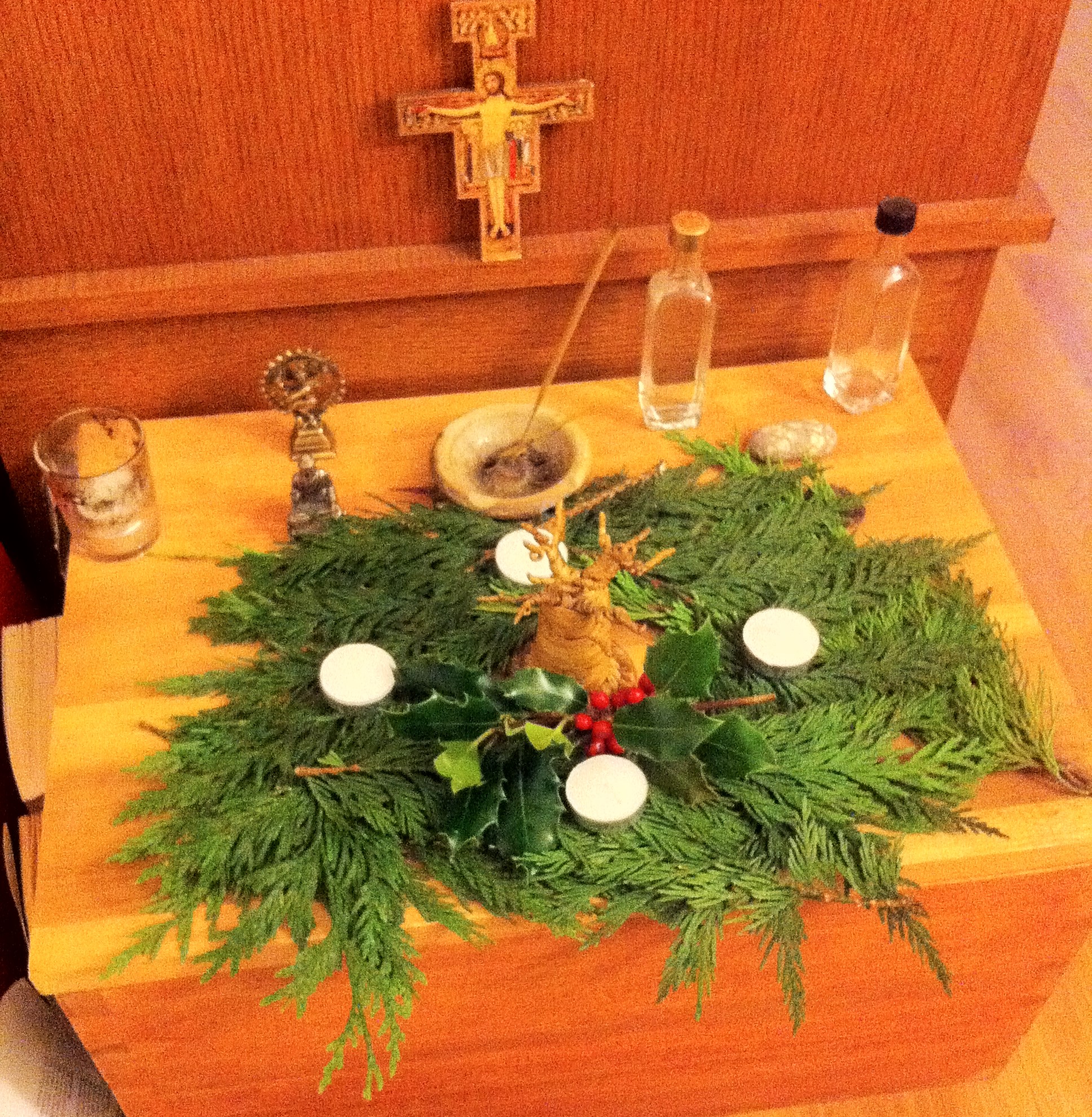
Adventus means coming. This year, on November 30, we end Ordinary Time in the Liturgical cycle and begin a four Sunday celebration leading up to Christmas. This year I am trying to deepen my experience of Christmas by making a small Advent Wreath on my personal altar and having daily contemplative devotionals leading up to Christmas day. Growing up, the secular rituals of gift giving, and the sentimental retelling of the nativity scene were fun, but this year I am trying to take more seriously what a story about a child born in a barn has to do with my fledgling contemplative spirituality within the Anglican Church.

The exact date of Christ’s birth may be unknown, but the choosing of December 25th as a fit day for celebration comes to us thanks to the Winter Solstice. It is on this day that we celebrate the sun ending its six month droop in the sky, and hence beginning his slow march back toward spring and summer. We celebrate the coming end of long darkness.

Advent then is a time of Holy Waiting for the end of spiritual darkness; of anticipation for Christ’s birth, but also hope for his return. In Trinitarian Christianity the event of Christ’s birth is referred to as the Incarnation. God became flesh in the person of Jesus of Nazareth (Mormons might call this a Condescension; see 1 Nephi 11).

What has humbled me most about this idea is that it means that Christ did not just descend to the earth and then leave when he died 33 years later like some Holy Alien. According to the familiar words of John “In the beginning was the Word, and the word was with God, and the Word was God” (1:1). If Christ is the Word of God then Creation is the alphabet. Another analogy from Paul’s letter to the Colossians: “He [Jesus] is the image of the invisible God, the firstborn of all creation; for in him all things in heaven and on earth were created, things visible and invisible, whether thrones or dominions or rulers or powers—all things have been through him and for him. He himself is before all things, and in him all things hold together” (1:15-17). Jesus as Christ is an Icon (image) of God in Creation. Christ is both the expression of God and the Image of God. Thus, we might say, as many have that the Incarnation began not just with the blessed birth of Jesus, but also with the Great Flaring Forth of the universe 13.8 billion years ago from a single point trillions of degrees hot. This is a tremendously powerful notion for me. At the center of a sometimes silly pastel plastic Nativity scene, is not only our God and our Savior, but a reassurance that we live in a Holy Universe.

This year I have created an Advent Retreat called Holy Waiting in a Holy Universe. I have divided the four weeks of Advent into the traditional four elements (Fire, Air, Water, and Earth), juxtaposing scriptures about each element with scriptures about the Coming of Christ. I hope that each day I will deepen my understanding of what it means to live in an Incarnational Universe. The gifts I give to family and friends will be offerings that remind us that we live in such a universe. Blessings to you and yours during this time of Holy Waiting and please feel free to follow along with me on my Advent retreat!

Download a Pdf of it here: Holy Waiting in a Holy Universe: An Advent Retreat

My first advent Wreath!

My first Advent Wreath!